


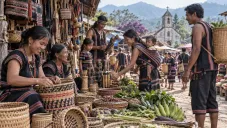
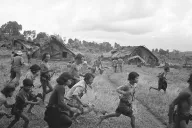

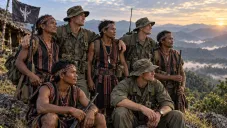
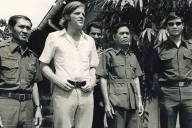

















Beyond the large peoples — Rhade, Jarai, Bahnar, Sedang, Mnong, Koho — the highlands are home to many smaller peoples, some of only a few tens of thousands, whose names rarely appear in the record. This page gathers what the sources say about ten of them, so that each at least has a place in our library.

Where these facts come from
Almost everything below is from a single source: Minority Groups in the Republic of Vietnam, a handbook compiled for the US Army in 1966 from the ethnography then available. Its population figures are estimates of the 1960s, often with very wide ranges, and its descriptions are of a way of life before the war’s worst years. We give them as the handbook does. Language codes are from Glottolog. Vietnam today groups several of these peoples under larger official names; the names used here are the ones the peoples themselves and the older literature use.
Hre
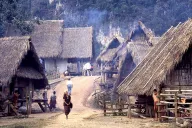
Many Hre farmed irrigated wet-rice fields, as the Sre did further south; the rest farmed hill fields. Their highland houses stood on piles about seven feet high and could be forty-five feet long. The village was the highest political unit, but the handbook notes that in the past Hre villages had combined against Vietnamese expansion. In 1949 the Hre rose against the Viet Minh; the handbook records that some 5,000 Vietnamese settlers, including women and children, were killed. We record it as the source does; the killing of civilians is not something we defend.
Cua (Kor)
The Cua country was known for the best cinnamon bark in South Vietnam, traded constantly with ethnic Vietnamese merchants. Cua houses were entered by a notched pole and divided into small rooms, each with an open mud fire-box for cooking, heating and smoking meat. The handbook describes Cua society as patrilineal, with inheritance in the male line. Cua men were known as skilled hunters with crossbows and traps (see Hunting and the crossbow).
Jeh
Jeh villages had one to ten longhouses, each 150 to 600 feet long and divided into a compartment for every family. The Jeh worked iron, made pottery and wove baskets. The French reached them around 1927, and some villages held out until about 1935. Jeh households kept the skulls of sacrificed buffaloes, painted with blood and chalk.
Halang
Halang houses stood about four and a half feet off the ground; the communal house was home to widowers and unmarried men. The handbook records a Siamese advance along the Sesan into the heart of Halang country early in the eighteenth century.
Rengao
The name, the handbook says, means “frontier” in Bahnar. The Rengao were among the peoples Mayréna gathered into his “confederation” of 1888 (see The kingdom of the Sedang). Their sorcerers, bojau, decided which sacrifices would cure a sickness.
Katu
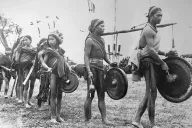
Katu villages were fenced, with five to fifty houses set in a circle around a sacrificial post. At funerals and reburials gongs and drums were played through the night, and Katu songs were accompanied by a bamboo flute of three or four notes. Katu hunters used traps, crossbows sometimes with poisoned arrows, bird calls and dogs.
Bru
Bru houses stood in an oval or circle around a central common house. Boys learned at five or six to shoot the crossbow and to know the sounds and plants of the forest; game was shared with the whole village. The French pacified the Bru in 1897. In 1969 a Marine photographer recorded a Bru shop at Đông Hà selling handwork from Bru villages in the Cua valley of Quảng Trị (see Hunting and the crossbow).
Brao, Chrau and Monom
- Brao (also Lave) live in Cambodia, Laos and Vietnam; their language is West Bahnaric, Brao (ISO brb). Brao villages were among those affected by the Lower Sesan 2 dam (see Lower Sesan 2).
- Chrau (also Jro) live toward the south, near the old Bình Tuy province. The handbook treated them as a Koho group; linguists list Chrau as a separate South Bahnaric language, Chrau (ISO crw).
- Monom (also Bonom) live between the Sedang and the Hre; their language is North Bahnaric, Monom (ISO moo). Vietnam’s official list counts them, like the Halang, as Xơ Đăng (Glottolog, citing Ethnologue).
See also The Sedang, The Koho, Maa, Churu and Raglai and Language resources.
Sources
- Department of the Army, Minority Groups in the Republic of Vietnam, Pamphlet 550-105 (1966) — the Hre, Cua, Jeh, Halang, Rengao, Katu, Bru and Koho chapters
- Gerald C. Hickey, The Major Ethnic Groups of the South Vietnamese Highlands, RAND RM-4041 (1964) — text copy — on whether the Rengao, Hre and Halang are distinct from the Sedang and Bahnar
- Glottolog, language pages linked above
Compiled September 2026. These are short entries because the independent record is short. If you belong to one of these peoples, we would be glad to write a fuller page with you.