























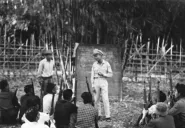
Seven thousand years ago people were living in the lava caves at Krong No, burying their dead in a flexed position, cooking at hearths and wearing ornaments made from sea-snail shells carried a hundred kilometers from the coast. That is the best-dated thing we have. Out at the edges the claims get bigger and the ground gets softer: stone tools at An Khê that may be 788,000 years old or may be younger, eleven tuned stones from Dak Nong that have never been dated at all, and a Hindu temple complex on the Lam Dong plateau whose builders nobody has been able to name.

The caves at Krong No
Two volcanic caves in Dak Nong, dug between 2017 and 2019, hold a stratigraphy 1.85 meters thick with continuous habitation from about 7,000 to 4,000 years ago. Out of them came fourteen hearths and seven graves with the bodies laid flexed; nearly four thousand stone tools, sixty-six bone artifacts, ten ornaments of sea-snail shell, one bronze arrowhead, more than twelve hundred potsherds, over seventy-six thousand animal bones and more than a hundred thousand fragments of mollusc shell. The radiocarbon dates run from about 6,090 to about 4,680 years before the present, and they were produced in Russian and American laboratories.
The sea-snail shell is the detail to hold on to. It is direct, dated, physical evidence that people living on this plateau were exchanging goods with the coast in the Neolithic. Whoever they were, they were not isolated.
The plateau in the late Neolithic
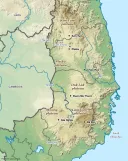
Sixty archaeological sites of the late Neolithic and early metal age have been found across the Central Highlands: five burial sites, fifty-two habitation sites, and three stone-tool workshops. Forty-five of the sixty are in the uplands. The people here were not only using tools; they were manufacturing them at dedicated places.
Two cultures have been named. The Bien Ho culture is radiocarbon-dated from twenty-one samples at the Lung Leng site to between about 3,500 and 2,000 years ago; the Buon Triet or Ho Lak culture lies in the southern highlands near Lak lake. The finds include shouldered adzes and an adze shaped like a buffalo’s tooth, coarse red pottery tempered with sand and plant fiber, grinding stones, nephrite beads — and molds for casting bronze.
Lung Leng itself was found in 1999 during the building of a hydroelectric scheme and dug in 1999 and 2001 over some 11,500 square meters, yielding more than fourteen thousand objects. It is one of the largest excavations ever carried out in Vietnam, and it happened because the site was about to go under water. What was recovered was recovered against a deadline. What was not is beneath a reservoir.
The survey that sets out these sites says nothing at all about who the makers were, or whether they have anything to do with the peoples living here now. That silence is honest, and it is worth printing.
An Khê, and how old the oldest tools are
At Gò Đá and Roc Tung in Gia Lai a joint Russian and Vietnamese team excavated between 2014 and 2019 and recovered about 1,200 stone artifacts, 872 of them from stratified layers: bifaces, picks, scrapers, choppers. They proposed the name “An Khê culture” and argued the industry arose on its own rather than arriving from Africa.
The dating is the argument. Tektites — glass thrown out by a meteorite impact — found with the tools were dated in 2024 by a largely French team, with the excavators as co-authors, to 788,000 years, plus or minus 2,600. That is a very precise number, and it is a number about the glass, not about the tools.
Two things have to be said next. First, the same 2024 paper records that at Gò Đá the tektites came from a layer lying above the deposit that held the bifacial tools. That makes 788,000 years a minimum age there, not an age; the tools could be older. At Roc Tung the tektite was in the same sediment as the tools. The two sites are not in the same evidential position. Second, the whole method — dating stone tools by tektites lying near them — was attacked in a leading journal of human evolution over the parallel sites in southern China, on the grounds that the glass may not be where it originally fell, and that the tools need not be as old as 800,000 years and could be much younger. The critic proposed no alternative date. He asked for the deposits to be dated by a method independent of the tektites. As far as we can find, that has not been published for An Khê.
No hominin bone of any kind has been found at An Khê. The tools are attributed to Homo erectus by inference from the age alone. The honest position is that there are two published positions, both peer-reviewed, and that the precision in the date of the glass is not matched by any precision about the tools.
The stone instruments
On February 2, 1949, laborers cutting a new stretch of track in Mnong Gar country turned up a set of eleven large flaked stone blades of micaceous cordierite hornfels. Georges Condominas heard of it three days later and went to the place on the fifth. The Mnong Gar called the stones mâu prum, stone chains, and did not take them for instruments; the elder Baap Can said that what had once been iron had now become stone. It was in Paris, after they reached the Musée de l’Homme, that André Schaeffner recognized ten of them as the bars of a lithophone.
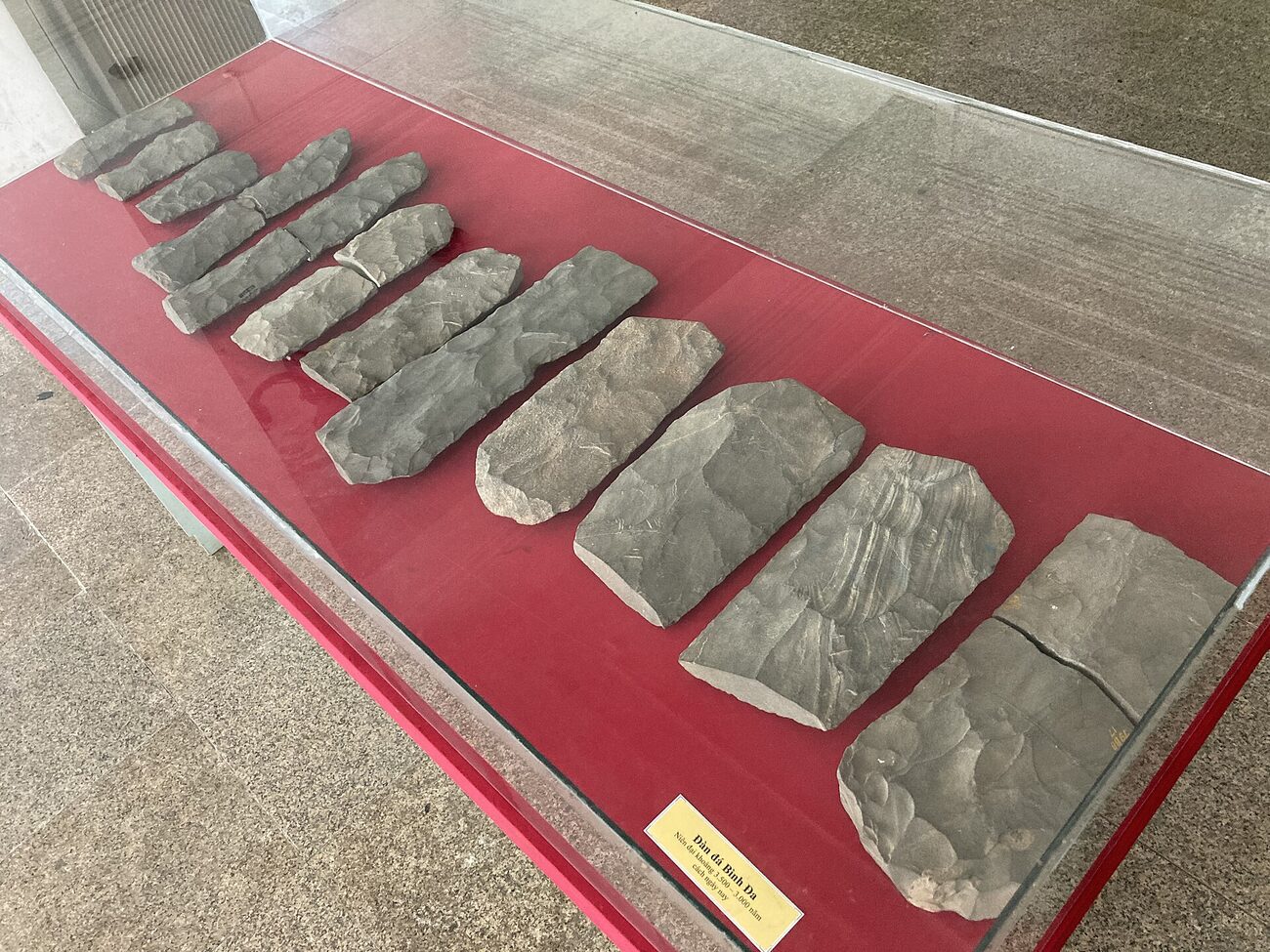

Condominas thought the workmanship belonged to the Bacsonian, then immediately qualified it — Bacsonian pieces are coarse and these blades are a remarkable technical achievement — and then refused the conclusion outright, because the lack of precise stratigraphic data did not permit it. The Ndut Lieng Krak stones have never been directly dated, and are not dated today.
What can be said about the age of highland lithophones comes from elsewhere. A lithophone from an excavated context at Khánh Sơn had associated wood carbon-dated to about 3,180 years before the present. The current peer-reviewed statement is that lithophones, found across the south-central provinces and in Dak Lak, Dak Nong and Lam Dong, may have been in use around 3,000 years ago, on relative dating. So the defensible figure is roughly three thousand years, on one radiocarbon date from associated wood — not the five thousand that is often quoted, and never from a date on the Ndut Lieng Krak stones themselves.
A third set turned up in Ma’ country in May 1958, found by a Ma’ man named K’Siöng while clearing land on a basalt ridge. Six stones rang originally; three had shattered in a village fire, and three, called goong lu’, remained. The local account of them is that six men were caught by an eclipse of the sun and turned to stone. What our stones sound like is on Gongs and epics.
The temple nobody can name
On the Lam Dong plateau stands the Cát Tiên complex, built between roughly the end of the sixth century and the ninth. In the largest temple, in the hollow brick shaft at its center, excavators found 166 gold objects, four gold lingas, a silver egg-shaped vase holding a bronze linga plated with silver, and pieces of colored stone; twenty-five of the gold plaques carry images of Hindu gods and thirty-seven carry inscriptions, mostly prayers and the name of a donor.
The peer-reviewed treatment of it makes no ethnic or political attribution at all. Not Cham, not Khmer, not Funan, not local. So the honest sentence is this: a large Hindu temple complex was built on our plateau between the sixth and ninth centuries, endowed by people rich enough to bury 166 gold objects under one shrine, and nobody has established who they were.
The one Cham tower in the highlands is Yang Prong in Ea Sup, Dak Lak, late thirteenth century. Its name means “great gods” in Jarai.
What the languages say
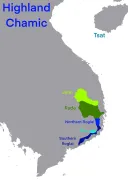
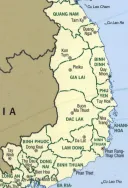
Two families live on this plateau. The Bahnar, Sedang, Mnong, Koho, Stieng and their relatives speak Austroasiatic languages; the Rhade, Jarai, Chru and Raglai speak Chamic languages, which are Austronesian.
The strongest linguistic statement about who has been here longest is that Bahnaric and Katuic, resident in the region for the longest period, show the highest level of mutual borrowing. The linguists who wrote it attach their own warning: lexical dating methods have been consistently savaged by critics, and they offer their figures as a way of diagnosing borrowing rather than as a family tree.
On the Chamic side the standard account has Chamic speakers arriving from the coast. Against it stands the finding that Chamic borrowed heavily from Mon-Khmer languages rather than the other way around, which means Chamic speakers came into a region that already had a Mon-Khmer population — and that features once taken for native Chamic developments are influence from Bahnaric and Katuic.
And there is a harder version still, and we print it because it cuts our way and because it is not proven. On this reading, speakers of Old Cham moved into a highlands entirely occupied by Mon-Khmer speakers, established political control, and eventually made them switch language, so that Jarai and Rhade developed out of Cham and were probably not distinct languages during the period of classical Champa. If that is right, the Jarai and the Rhade are not arrivals at all: they are the long-resident people of this plateau, and what changed was the language in their mouths. It is one scholar’s hypothesis, reported by another, and both readings belong on this page with the names attached.
Jarai itself has drifted furthest. Studied in both its western dialect in Cambodia and its eastern dialect in Dak Lak, it turns out to carry register where its coastal relatives carry a voicing contrast — enough, the linguists say, to force a reconsideration of how the ancestor of the whole family is reconstructed. Our languages are on Our peoples and our languages.
The rivers, and the edge of history
Before any border there were rivers, and the trade ran along them: a port at a river mouth, collecting points upstream, and goods moving both ways. Eaglewood, ivory and rhinoceros horn went down; salt came up, and salt was the most important thing traded between lowlanders and uplanders, along what was called the road of salt. The exchange network between upland and lowland was already working by the seventh century.
A Vietnamese official writing in 1776 set down what was actually carried. Traders came with salt, fish sauce, dried fish, ironware, copper pots, silver hairpins and bracelets, and took away millet, chickens, oxen, hemp, wax, rattan, mulberry bark for paper, highland cloth and curtains. One elephant could carry sixty buckets of rice. An ox fetched at most ten quan; an elephant was worth two thoi of silver. And the officials collected, as tax, four pairs of rhinoceros horns and one male elephant at least two meters tall.
Champa was not only the coast: parts of our highlands were inside it, and the Cham kept a presence here well into the eighteenth century. The Jarai Patao Apui and Patao Ia, the Kings of Fire and Water, sent tribute every three years to the courts at Phnom Penh and at Huế — see The Kings of Fire and Water. The big men of our villages owed their influence to their place in those trade networks. And the sharp ethnic lines that are now drawn around us were not there: separations of that kind, one historian argues, were products of the modern colonial and postcolonial states.
What is missing
There is not one published ancient genome from the Central Highlands. The seven flexed burials in the Krong No cave are the obvious candidates and nothing has been published from them. Across the whole of Vietnam only about four thousand years of genetic history has been recovered, against sixty-five thousand years of modern human occupation, because the heat and the humidity destroy the bone.
We have found no peer-reviewed source outside Vietnam documenting a bronze drum found in any highland province; the local bronze evidence we do have is the casting molds. No jar-burial site of the Sa Huỳnh tradition has been named on the plateau proper, though its trade beads reached far inland. Sedang ironworking is famous in the ethnography and has no archaeology behind it that we could find. And nothing has ever been dated at Ndut Lieng Krak.
The argument about who was here first is made in public in Vietnam and it matters to us. We would rather set out what the evidence can bear than win the argument with a number we cannot stand behind.
Sources
- Le X. H., Nguyen K. S., La T. P. and Nguyen V. B., “Archeology of the Volcanic Caves in Krong No,” The Russian Journal of Vietnamese Studies 7 (2023) — the stratigraphy, the hearths and burials, the sea-snail ornaments and the radiocarbon dates. The excavation is Vietnamese; the dating laboratories are Russian and American and the journal is Russian
- Tran Qui Thinh, “Late Neolithic/Early Metal Age Sites in the Central Highlands (Tay Nguyen) of Vietnam,” Indo-Pacific Prehistory Association Bulletin 25 (2005) — the sixty sites, the workshops, the Biển Hồ and Buôn Triết cultures and the Lung Leng dates
- A. P. Derevianko and others, “The Discovery of a Bifacial Industry in Vietnam,” Archaeology, Ethnology & Anthropology of Eurasia 46/3 (2018), and Kandyba and others, “The Early Paleolithic Go Da Site,” same journal 49/4 (2021) — the excavations and the toolkit
- Véronique Michel, Fred Jourdan, Marie-Hélène Moncel and others, “High-precision ⁴⁰Ar/³⁹Ar dating of Australasian tektites associated with bifacial tools,” Quaternary Science Reviews 346 (2024) — the date of 788,000 years, and the statement that at Gò Đá the tektites lay in a layer above the tools
- Marco Langbroek, “Do tektites really date the bifaces from the Bose (Baise) basin?” Journal of Human Evolution 80 (2015) — the case against dating the tools by the glass
- Georges Condominas, “Le lithophone préhistorique de Ndut Lieng Krak,” Bulletin de l’École française d’Extrême-Orient 45 (1952) — the discovery of February 2, 1949, the stone, the Mnong Gar name and Baap Can’s remark, the identification in Paris, and his refusal to date them. Translations ours
- Roger Blench, “From Vietnamese Lithophones to Balinese Gamelans,” Indo-Pacific Prehistory Association Bulletin 26 (2006) — the claimed age of 5,000 years and the Khánh Sơn radiocarbon date of 3,180 years
- Fredeliza Z. Campos, Jennifer R. Hull and Vương Thu Hồng, “In search of a musical past,” Antiquity 97 (2023) — the distribution of lithophones and the relative date of about 3,000 years
- Jean Boulbet, “Découverte d’un troisième lithophone préhistorique en pays mnong-maa’,” L’Anthropologie 62 (1958) — the Ma’ stones, K’Siöng, and the account of the eclipse
- Le Thi Lien, “Hindu Beliefs and the Maritime Network in Southern Vietnam During the Early Common Era,” Journal of Indo-Pacific Archaeology 39 (2015) — Cát Tiên, its dates, its gold, and the absence of any attribution
- Paul Sidwell and Roger Blench, “The Austroasiatic Urheimat: the Southeastern Riverine Hypothesis” (2011) — Bahnaric and Katuic as the longest resident, and the authors’ own warning about the method
- Paul Sidwell, “The Mon-Khmer substrate in Chamic” (2007) — Chamic borrowing from Bahnaric and Katuic, and what that implies about who was here first
- Michael Vickery, Champa Revised (Asia Research Institute, 2005) — reporting Gérard Diffloth’s argument that the highlanders were made to switch language, and that the Cham inscriptions say nothing about the highland peoples
- Marc Brunelle, Ke Leb, Thành Tấn Tạ and Lư Giang Đinh, “Voicing or register in Jarai dialects?” Journal of the International Phonetic Association 54 (2024)
- H. L. Tran and others, “The first maternal genetic study of hunter-gatherers from Vietnam,” Molecular Genetics and Genomics 298 (2023) — four thousand years of genetic record against sixty-five thousand years of occupation, and no Central Highlands samples
- Trần Kỳ Phương, “Interactions Between Uplands and Lowlands Through the ‘Riverine Exchange Network’,” BiblioAsia 4 (2008) — the river model, eaglewood downstream and the road of salt upstream
- Lê Quý Đôn, Phủ biên tạp lục (1776), in Li Tana and Anthony Reid (eds), Southern Vietnam under the Nguyễn; excerpt at Asia for Educators, Columbia University — what was carried in each direction, and the taxes in rhinoceros horn and elephants
- Oscar Salemink, “A View from the Mountains” (2011) — Champa including parts of the highlands, the triennial tribute of the Kings of Fire and Water, the big men and the trade networks, and ethnic separations as products of the modern state
Compiled September 2026. Where archaeologists disagree about a date — An Khê above all — both positions are given with their proponents, and we have not adopted the figure that would suit us best.