
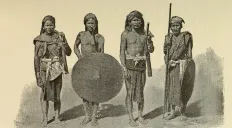
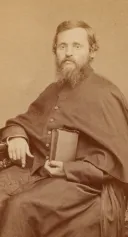

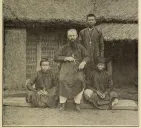











The legend said they lived alone in seven towers on seven mountains, moved from one to the next each year, never saw a human face, and reigned seven years. A French officer went to find out, and in February 1891 he found the Master of Fire lying on a bamboo couch smoking a long copper pipe, among people who paid him no great deference. He carried no talisman and looked like anyone else except that he was tall. Both things are true at once, and the distance between them is what this page is about.
What they were, and were not
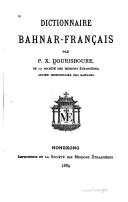
The first full French description, published in 1883 by a man who had governed a Cambodian province, is careful about it. They are, he writes, “deux majestés nominales, spirituelles ou mystérieuses plutôt qu’effectives” — two nominal majesties, spiritual or mysterious rather than effective — of whom every people in the southern half of the peninsula had heard. And then, flatly:
“ces deux princes sauvages n’exercent aucune autorité politique ou administrative; ce sont de bons paysans qui vivent de leur labeur”
These two savage princes exercise no political or administrative authority; they are good farmers who live by their own work. No army, no taxes, no court. And yet at a feast or a marriage or a sacrifice to the yang the people would send for the Master of Fire, prepare a place for him, and lay white cotton cloth along the ground and down the whole path he was to walk on.
The ethnologist who spent longest among the Jarai put the positive case in one word: the Pơtao of fire, of wind and of water harmonized the relations between people, and between people and the country — and did it well beyond Jarai territory, into Cambodia. That is not a weak form of kingship. It is a different office. The reason they had no soldiers is not that they were too poor to raise any.
The sword
Three talismans belonged to the office, and they had to stay in the family or lose their power: the fruit of a creeper gathered at the time of the last deluge, still green; a rattan, very old, bearing flowers that never fade; and a sword with a spirit living in it.
The spirit was said to be a slave’s. His blood had fallen on the blade while it was being forged, and he died by his own choice to expiate an offense he had not meant to commit. The Master of Water could raise a flood with the first two talismans. If the Master of Fire drew the sword a few inches from its sheath the sun would hide and men and animals would fall into a deep sleep; if he drew it right out, the world would end. Buffalo, pigs, fowls and ducks were offered to the blade for rain.
The sword is often said to have come down from heaven. The good sources do not say that. They say it was made, and that a man died over it, which is a better story and a harder one.
And it was kept wrapped. In cotton and silk — and among the presents the king of Cambodia sent every year were rich stuffs to wrap the sacred sword. The tribute was partly a supply of cloth for an object the sender had never seen.
Where the sword is now we cannot tell you. No photograph of it is in any archive we could search. The one man from outside who is recorded sitting with a Master of Fire for an afternoon, in 1891, reports that he had no talisman about him at all. Every claim we found that states where the sword is today comes through Vietnamese state channels, and we do not use those. That the only people who say they know are the people whose state refused to let the office continue is worth noticing on its own.
The thumb in the wax
The exchange with Cambodia is the best-documented thing about the Pơtao, and the detail in it is extraordinary. What came back from the Master of Fire, invariably, was an enormous loaf of wax and two great calabashes, one of rice and one of sesame, sometimes with a little ivory and some rhinoceros horn. And:
“Au centre du pain de cire, on remarquait l’empreinte du gros doigt de la main du roi du feu.”
In the middle of the loaf of wax you could see the print of the Master of Fire’s thumb. The Frenchman recording it understood what it was for: it was the custom in India, and still in Cambodia, to keep carefully the print of the hands and feet of the people one esteemed most, and to send the print of a finger of his sacred person was an unmistakable mark of regard.
What happened to it at the other end completes the picture. As soon as the gifts reached the Cambodian capital they were handed to the brahmins — gardiens de l’épée sacrée des anciens rois khmers, the keepers of the sacred sword of the old Khmer kings — who put them beside the regalia of their own sovereigns. The wax was made into tapers and burned on the altars on ceremony days. In bad times, in epidemics, in floods, in war, a little of the rice and sesame was thrown on the ground to quiet the angry spirits.
So a Jarai thumbprint went, once a year, into the room where Cambodia kept its own sacred sword, and the wax it was pressed into was burned in front of the Khmer regalia. Whatever the court in Phnom Penh thought it was receiving, it was not treating it as a tribute from nobody.
Nine elephants, and the bones
This page had the elephants going the wrong way. They went from us.
In a war King Ang Duong of Cambodia had to fight against the Vietnamese — he reigned from 1841 to 1860 — the Master of Fire sent him nine elephants, with his wishes for the success of Cambodian arms and his regret that he could not do more. Jarai mahouts and envoys brought them down and handed them over at Oudong itself. There was a great feast for the savage ambassadors, as the record calls them; they were clothed properly from head to foot, treated as well as could be managed for a month, and went home with a good memory of their reception and gifts for their mystic king.
Then:
“Mais malheureusement quelques-uns d’entre eux moururent en route de la petite vérole. A la belle saison suivante, le roi sauvage fit réclamer à Ang-duong les ossements de ses sujets restés sur le territoire cambodgien.”
Some of them died of smallpox on the road home. In the next dry season the Master of Fire sent to Ang Duong to demand the bones of his subjects left on Cambodian ground. Nothing could be found of them, and the matter was settled with some fresh presents, which — the Frenchman observes — gave more pleasure than the remains that had been expected.
That is a highland office sending an army’s worth of elephants to a foreign war it had no stake in, and then, a season later, sending back to ask for its dead men’s bones. Our people do not leave their dead in other people’s country. See The tomb house.
On how often the gifts moved, the sources split, and we can now say which way they split. The French accounts nearest the thing say every year — the gifts passed from tribe to tribe until they reached their destination, because no Cambodian would attempt the journey. The three-year figure comes from a later American compilation and looks as though it belongs to the Vietnamese tribute cycle rather than the Cambodian one. The exchange ended when Norodom came to the throne: his predecessors had made a point of the courtesy, and Norodom, in the phrase of the record, answered nothing and gave nothing.

Nobody wanted the job
The office was hereditary in one family, or two by other accounts, and the holders had revenues and were excused from farming. And still, when a vacancy came, the eligible men — they had to be strong and to have children — ran and hid. While the dead man’s body burned, his kinsmen went into the forest and hid there for fear of being raised to the dignity he had just left. The people went out to look for them, and the first one whose hiding place was found became the Master of Fire or of Water.
Two Jarai versions of the choosing were recorded in the 1960s. In one, the Sadet before he dies throws his copper bracelet into the pool where the people of Plei M’tao bathe, and whichever man comes up with it on his arm is the next. In the other, after his death the young men of the Siu clan gather to sleep in one house; an elder calls out in the night, “Who will be Bok Redau?”; and the one who answers in his sleep — it is I — has a cotton bracelet put on his wrist.
A bracelet again, as at a betrothal and as at the palabre of 1926. In our country the thing that binds you is put on your arm. See The bracelet.
And there was a reason to run. Like other sacred kings, the Masters of Fire and Water were not allowed to die a natural death; it was held traditional for the kinsmen of the Master of Fire to kill him when he had grown old. Against the custom of the whole country, which is burial, their bodies were burned — and their nails and some of their teeth and bones were kept as amulets.
1904
On April 7, 1904, Prosper Odend’hal was killed at a Jarai village. He was a French official attached to the school of the Far East at Hanoi, and he had gone into Jarai country without a military escort to get the Master of Fire — the Sadet Oi At — to submit to French rule.
The American account, which reached the Anglophone world and this page, says he was warmly received; that after a great deal of ceremonial wine he became ill and refused more wine and chicken, which annoyed the Sadet, as did his asking to see the sacred sword; that a letter he wrote to another French official was read as a call for reinforcements; and that they attacked and killed him. More French troops came into Jarai country and the Jarai were soon subdued.
The French archival account, worked through a century later, gives a different set of reasons and does not include the sword at all. Before Odend’hal arrived, a colonist had sent gifts to the Master of Fire to get a horse, been dissatisfied with the animal, and asked for military help; the French post commander had attacked and burned the village and killed people in it. Odend’hal knew this and wrote that he would have difficulty entering into relations with them, since Frenchmen had previously only shot at them. He had also moved inscribed Cham stones — stone-spirits to the people there — and had to explain returning them. And the ethnologist who knew the Jarai best held that he was killed because he was a threat to Jarai independence, which is a political reading rather than a superstitious one. We have not been able to read the French original ourselves and set this out as what that scholarship reports.
What the reprisal did is the part nobody tells. A French inspector brought columns in from May 8. At Plei Lut they met twelve to fifteen hundred Jarai; fifty were killed and the village was burned. The reason the villagers gave for refusing to submit was not the sword and not the French: a priest had earlier fined them twenty buffalo over the thatching of a church, and they did not want to submit or to see Europeans any more. The columns stayed until November. Villages were made to submit, to supply labor, or to pay. The Master of Fire and the Master of Water fled and were never caught; the Master of Wind was not pursued. In 1906 the surviving notables were tried and imprisoned. And the Governor-General declined to prosecute the Master of Fire himself, on the ground that he was a precious auxiliary for French penetration of a difficult region.
Fifty people killed at Plei Lut, men executed on the spot, notables imprisoned two years later — and the man at the center of it deliberately spared, because he was useful.
The last one
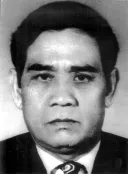
The office survived the French. An American anthropologist attended the Master of Fire’s rituals in 1966, and one photograph of a Jarai Master of Fire from those years is in the Smithsonian’s archive of his work.
The last Master of Fire died in 1987. We are not able to give you his name: every source that names him rests on Vietnamese official publication. His chosen successor, recorded as Siu Aluân, was never installed — the authorities objected — and died in 1999. Who those authorities were and what grounds they stated, we could not establish from any source we can use.
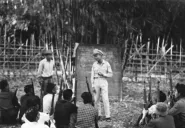
What we can put beside it is this. In 1988, the year after the last Master of Fire died, a film crew from the Hanoi documentary studio shot seventy minutes of color film across three highland provinces. The reels are in the Smithsonian’s film archive in Washington, and the catalog describes what is on them: among the footage from Gia Lai–Kon Tum is “a reenactment of the Jarai king of fire celebration in Cheo Reo.”
A reenactment. One year after the man died and while his successor was being refused, a state film unit was staging the ceremony for the camera. The fullest scholarly account of what happened to the office reads the refusal as part of a policy of dismantling highland institutions that could hold people’s loyalty; and it reports something more uncomfortable than a simple ban — that the man who expected to hold the office accepted the plan to film the succession, preferred to be photographed in official dress, kept the business cards of distinguished visitors, and expected medals from the state. He was not refusing the state. He was asking it to confirm him.
The same 1988 reels also hold a buffalo sacrifice at Lac Duong and an Êđê celebration at Cư Pông, which are cited elsewhere in this library as evidence that the old rites were still being held. They are. And on the same three reels the one office the state would not allow to continue is being performed by actors.
What the Pơtao show
People who say the highlanders had no institutions before the French, the Americans or the Party arrived are wrong in a specific and documented way. For centuries the court of Cambodia sent gifts every year to two Jarai offices and received wax with a thumbprint in it; the Vietnamese court knew them well enough to put them on its maps. When Western anthropology first tried to work out what a sacred king was, it put the Masters of Fire and Water at the head of the chapter — they were the opening case, in 1911, in the most widely read book of its kind ever written. The offices did not end because we stopped believing in them. They ended because a state decided they would.
Whose voices these are
Almost none of this page is ours. It is a Cambodian provincial governor writing in French in 1883, a French officer in 1891, a Scottish anthropologist compiling in 1911, an American in 1964, and French colonial police files. The nearest thing to a Jarai voice in it is the people of Plei Lut in May 1904 telling the column why they would not submit — twenty buffalo taken over a church roof — recorded in a document the French kept themselves, on a day fifty of them were killed.
And there is a second absence worth stating. Our own diaspora organizations’ histories do not mention the Pơtao at all. Our institutional memory begins with colonization, runs through BAJARAKA and FULRO and the persecution, and is organized around the church. The Masters of Fire and Water are not in it. Meanwhile the living ritual is narrated almost entirely by the state that stopped it. If your family is from the Ayun valley and remembers, that is the gap you can close and nobody else can. See How to record an elder.
See also: Before history, The Jarai, Yang, the spirits.
Sources
- Jean Moura, Le royaume du Cambodge, vol. I (Leroux, Paris, 1883), pp. 413–419 — at the Internet Archive, read against its own page images. The two nominal majesties exercising no political or administrative authority; the white cotton laid on the path; the loaf of wax with the thumbprint at its center and the calabashes of rice and sesame; the gifts handed to the brahmins who keep the sacred sword of the old Khmer kings, and the wax burned as tapers; the nine elephants sent to Ang Duong, the envoys who died of smallpox and the demand for their bones; and Norodom answering nothing and giving nothing
- J. G. Frazer, The Golden Bough, 3rd ed., part I, The Magic Art and the Evolution of Kings, vol. II (1911), pp. 3–20 — at the Internet Archive, read against its own page images. The seven towers and Frazer’s own judgment that these are mere fables; the French officer of February 1891 and the bamboo couch and the copper pipe; the three talismans and the sword with the slave’s spirit in it; the cotton and silk and the annual Cambodian cloth to wrap it; the eligible men fleeing and hiding; the prohibition on dying a natural death; the cremation against the custom of the country and the nails, teeth and bones kept as amulets. Frazer’s own source for the talismans and the succession is Étienne Aymonier, Excursions et reconnaissances no. 16 (Saigon, 1883), pp. 175 ff., which we have not read
- Gerald C. Hickey, The Major Ethnic Groups of the South Vietnamese Highlands, RM-4041-ARPA (RAND, April 1964), pp. 13, 32–35 — the blade to the Jarai and the scabbard to the Khmer, the title Master of the Sabre, the Siu clan, the bracelet thrown into the bathing pool, the sleeping warriors and “Bok Redau”, the killing of the Master when he grows old, and the three-year figure for the Cambodian gifts. Note that this memorandum of 1964 is Hickey compiling French ethnology, two years before he attended the rituals himself; his eyewitness account is in Free in the Forest (Yale, 1982), which we have not read
- Minority Groups in the Republic of Vietnam, Department of the Army Pamphlet 550-105, 1966, pp. 280–281 — at the Internet Archive. The standard account of Odend’hal’s death, including the request to see the sacred sword, and the name of the office-holder, the Sadet Oi At
- Mathieu Guérin with Jonathan Padwe, “Pénétration coloniale et résistance chez les Jarai,” Outre-Mers, revue d’histoire (2011) — the archival reconstruction: the itinerary, the burned village and the horse, the moved Cham stones, the reprisal columns, Plei Lut and the fifty killed, the twenty buffalo fined over a church roof, the trials of 1906, and the decision not to prosecute the Master of Fire. We read this in summary and not in the French; every detail from it should be checked against the original before it is relied on
- Jacques Dournes, Pötao: une théorie du pouvoir chez les Indochinois Jörai (Flammarion, 1977) — on Gallica, which was closed to us. Its argument, as reported by Andrew Hardy in The Barefoot Anthropologist and in the review of that book, is that Jarai political organization cannot be separated from the cultural, social and religious, and that the Pơtao of fire, wind and water harmonized the relations between people and between people and nature, well beyond Jarai country
- Oscar Salemink, “The King of Fire and Vietnamese Ethnic Policy in the Central Highlands,” in McCaskill and Kampe (eds), Development or Domestication? Indigenous Peoples of Southeast Asia (Silkworm, 1997), and the chapter “The Dying God Revisited” in The Ethnography of Vietnam’s Central Highlanders (University of Hawai‘i Press, 2003) — the fullest study of what the state did, and the account of the successor seeking the state’s recognition. We know it at one remove and have not read it directly
- Smithsonian Institution, Human Studies Film Archives, HSFA.1988.15, Montagnard-Dega Ethnic Minority People of the Highlands of South Vietnam, filmed by Lương Đức, 1988, three reels, 70 minutes, color, silent — “a reenactment of the Jarai king of fire celebration in Cheo Reo,” together with the buffalo sacrifice at Lac Duong and the Êđê celebration at Cư Pông
- Smithsonian National Anthropological Archives, Photo Lot 73-34, Gerald Cannon Hickey photographs of Montagnard peoples in South Vietnam, circa 1960–1969, 16 prints — including one image of the King of Fire. The man is not named in the collection record
Compiled September 2026, from the nineteenth-century sources themselves. Where the French archival account of 1904 and the American account disagree, both are given.