







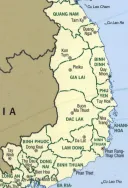


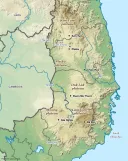
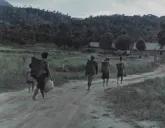
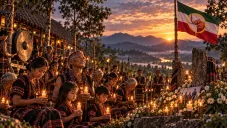
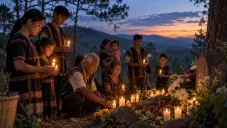
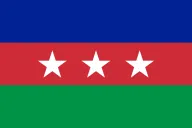

The border between Vietnam and Cambodia runs through the middle of one people. The Mnong of Dak Nong are the Bunong of Mondulkiri; the Jarai of Gia Lai are one of the largest peoples of Ratanakiri. When the crackdown came after February 2001, our people walked east to west across a line that meant nothing to them, into villages where the language was theirs. Between 2001 and 2005 about two and a half thousand of them made that crossing. Some were flown to America within weeks. Some were handed back across the border in handcuffs within days, one group for three hundred American dollars a head. Most waited, in forest camps, in tin sheds in Phnom Penh, in pits under a tarpaulin, for a decision made in three capitals none of them had ever seen.

The crossing
The people who went first did not want to go. Nearly every account of the crossing begins with a man explaining why he did not want to make it.
A Jarai man who crossed in February 2001, who had been in the forest with FULRO in 1990 and knew what the forest was:
“In my heart I didn’t want to run to Cambodia and abandon my family. I was in the forest before with FULRO in 1990 and know how difficult it is. All I want is a place that’s safe. If the Vietnamese catch me, they will chop me up like chopped fish. Our group needs to stay together; live together and die together. If the U.N. wants to meet me to ask about our problem I will meet them. But I will not abandon my group.”
A Jarai man who had led the land rights movement in his district gave the whole shape of it in one paragraph — why he left, what the forest was like, and the exact moment he understood that there was now nowhere to be:
“I fled from my village after I saw forty police ransack my neighbor’s house and take him away to jail. I escaped to Cambodia but in my heart I didn’t want to come here. I felt I was abandoning the people in Vietnam — not only my wife and children, but also the movement. I didn’t come here in order to resettle elsewhere but to get information to our leader so that he could find a way to solve the problem. Once I got here I realized that I couldn’t return to Vietnam or I’d be arrested. The situation hiding in the forest was also very difficult. Police were hunting for us on both sides of the border. We ran out of food, we had no shelter from the rain, and some of us fell ill from malaria. Soon we realized we couldn’t stay in Cambodia and we couldn’t go back to Vietnam. We asked the U.N. to help us; otherwise we would have been arrested. Now all I wonder is, what about my wife and children in Vietnam — I’ve had no news about what happened to them after I left.”
Read the last sentence again. That is the cost of the crossing, stated by the man paying it, and it was paid by everyone on this page.
Not everyone who crossed had demonstrated. From June 2001, people began arriving who had not attended the demonstrations and in some cases had not heard about them until afterward; of the more than a hundred who came in July of that year, most had never been near one. A Jarai church leader from Gia Lai, interviewed on June 26, 2001, who had been to nothing:
“After the demonstrations there was no peace or freedom in my village. When I woke up one morning, the place was full of soldiers, who’d come at night. There were many police and more than twenty soldiers, who entered each house.”
And a Rhade man from Dak Lak, held and tortured at Buon Ma Thuot prison, interviewed July 17, 2001, who explained precisely what he had come for:
“I fled to Cambodia to meet the upper levels — the international community and the U.N. — to solve the problem of land. I don’t ever want to see Vietnamese [people] again, until this problem is solved. I abandoned my wife, my house, my children. I fled to Cambodia to show the U.N. about our struggle for the land of Dega. I want the U.N. to [delineate] clearly the map: which is the area of the ethnic minorities, and which is the area of the Vietnamese. I want the international community to understand clearly that I didn’t come here to get rich or to resettle abroad. We just want our land. When we have our land, we can support our families and live freely. We want the world to know that we want justice. We want our own country.”
Keep that paragraph in mind. Three and a half years later, UNHCR would tell the press that many of the people crossing had come under the illusion that the UN could help with their land problems and were not necessarily fleeing persecution. The man above had already answered that, in July 2001, before it was said. He was not confused about why he had come. He was telling the agency what it was.
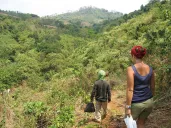
On the Cambodian side, people helped. A Cambodian villager who carried food to people hiding in the Mondulkiri forest:
“I told them they should not come [out of hiding], as they will be arrested. I talked with them for one hour and I gave them twenty kilos of rice…They cried and I cried. They blamed me, saying that they came here and I can’t help them. They said that if they go back they will be killed, and they can’t stay in the forest.”
Later, in 2002, villagers suspected of helping people were themselves arrested on trafficking and illegal-immigration charges, and armed Cambodian militia were stationed in the border villages to threaten anyone who assisted. See Kin across the border.
The first thirty-eight
In March 2001, provincial officials in Mondulkiri arrested twenty-four Rhade from Dak Lak. On March 24 they were flown in military helicopters to Phnom Penh and held at the national Gendarmerie headquarters. Prime Minister Hun Sen initially threatened to deport them, saying he did not want Cambodia to become a haven for other countries’ political opponents. On March 31 the government agreed to let UNHCR interview them. They were recognized as refugees and in early April they were resettled in the United States, together with fourteen Jarai who had reached UNHCR separately. Thirty-eight people.
While they were in the Gendarmerie compound, Vietnamese officials came to see them.
“We were questioned several times by Vietnamese people when we were in Phnom Penh. Vietnamese people also took videotapes of us there. The Vietnamese Red Cross person tried to force us to take letters and watch a videotape. He argued in English with an American man about this. We all stuck our fingers in our ears and lowered our heads when they put on the video. We refused to take the letters.”
One of them recognized a face in the room:
“I had seen him before — at the demonstration in Buon Ma Thuot. He was watching us and talking to the police, but dressed in civilian clothes. He was staring at me during the demonstration and asked me to stop demonstrating. When he met me in Phnom Penh, he asked me if I would go back to Vietnam. I said not until we get land for our people. He asked where I lived. I told him it wasn’t his business. He told me my family was waiting for me. I said fine, but we need land. He tried to scare me. There were three Vietnamese there and one Cambodian guard. I’m pretty sure two were from Hanoi. They had a camera and took photographs of us. I asked them where they were from and they said Phnom Penh. I said I guess that you’re from Hanoi. They got angry and said how did I know. They looked like strangers, talked very angrily with me, blamed me for causing others to leave Vietnam. They said these people look to you. If those people go back, they will go with you. I said I don’t want to see your face. The next day the Vietnamese called me again for questioning. They asked us to return to Vietnam. I said not until we have land for our people. They asked if we’d done the paperwork. I said we tried hundreds of times; your heart is hard. They said if I returned to Vietnam, there will be no problem but if you go far away there will be big problems.”
Thirty-eight people in a foreign police compound, with their fingers in their ears, refusing to watch a film that had been made for them. The resettlement infuriated the Vietnamese government.
The United States has an account of its own part in that month, in its annual human rights report on Cambodia for 2001: in March the Cambodian government began to facilitate access for Montagnard asylum seekers to UNHCR, helped UNHCR establish temporary refuge locations in two provinces, and cooperated with UNHCR and a foreign government in resettling thirty-eight refugees in the foreign country. The foreign government is the United States, describing itself in the third person in its own report. It is a small thing and it is worth noticing: the document that records a year of forced returns will not name the country that took the thirty-eight.
The camps, and what nobody wrote down
On May 11, 2001, UNHCR staff brought about a hundred and fifty people — thirty families — out of hiding places in the Mondulkiri forest to an encampment at the provincial capital, Sen Monorom. On May 17 UNHCR finally got Cambodian approval for two camps, one in Mondulkiri and one in Ratanakiri. By the end of that month they held close to four hundred people.
Then the numbers move strangely. By July it was more than three hundred — fewer than in May, while people were still arriving. The curve dips because people were being put back across the border faster than they were coming in. By October it was more than seven hundred; by the end of 2001, nine hundred and fifty-seven; by January 2002, about a thousand. Across the whole life of the two sites, about nine hundred people passed through them. Over the year following February 2001, more than fifteen hundred of our people reached Cambodia in all.
Here is what nobody wrote down. There is no published description of daily life in those two camps. Not the rations, not the water, not what the shelters were made of, not whether there was any schooling for the children, not what medical care there was, not how long a family with small children waited. Human Rights Watch does not describe it. The report written for UNHCR does not describe it. The US Committee for Refugees does not describe it. The State Department does not describe it. The only account of camp conditions ever published came from Vietnamese state media, which said the people in them had dropsy and malaria and were kept under surveillance — produced by the government they had run away from, and worth nothing.
Nine hundred people lived in those two sites for the better part of a year. Most of them are in North Carolina. Six recorded conversations would settle every one of these questions permanently, and nothing else ever will. See How to record an elder.
Sent back
The deportations ran alongside the camps from the first month.
| Date | What happened |
|---|---|
| March 26–27, 2001 | At 11 a.m. on March 26 the First Deputy Police Commissioner of Mondulkiri, with the provincial gendarmerie commander, drove nineteen Jarai men from Koh Nhek district to the Bou Praing crossing. They were sent back into Vietnam at 5 p.m. on March 27. See below. |
| April 30, 2001 | Thirty-two Rhade and Jarai from Chu Se district, Gia Lai, forcibly returned. |
| May 8, 2001 | Y Lim, also called Dien Y Lien, his wife Maria Nam Linh and their five children — Mnong, who had been issued official UNHCR protection documents on April 25 — were loaded onto a truck in Mondulkiri by Cambodian police and sent back to Vietnam. |
| May 10, 2001 | Thirty-two more forced back from Koh Nhek district. |
| May 14, 2001 | Hok Lundy, Director General of the Cambodian National Police, met the US ambassador, Kent Wiedemann, and assured him that no deportations would take place. |
| May 15, 2001 | Cambodian district police in Ratanakiri escorted two vehicles carrying fourteen people — including five women and three children — to the border and returned them as undocumented illegal immigrants. That night, at about 11:30, the Ratanakiri provincial police commissioner accompanied three vehicles carrying forty-nine Jarai, forty-eight men and one woman, to the same border. Sixty-three people in twenty-four hours, the day after the assurance. |
| August 2001 | Up to forty-three people whose claims UNHCR had rejected were deported. |
| September 24, 2001 | Eight Jarai were arrested, beaten, and handed to Vietnamese police in exchange for three hundred US dollars. |
| December 27, 2001 | A group of a hundred and sixty-seven people who had crossed in December were forcibly returned from Mondulkiri by Cambodian and Vietnamese police. |
Two figures from that year should be set beside each other. The US State Department’s report on Cambodia for 2001 records that between March and the end of the year, as many as two hundred and fifty-six possible asylum seekers were repatriated against their will, in violation of Cambodia’s own standing policy, and that no local official was punished for it. Human Rights Watch’s own summation of the same period is higher: more than five hundred refugees who fled to Cambodia in the year after February 2001 were forcibly returned.
And the mechanism. A district official in Mondulkiri stated that Cambodian police were escorting Vietnamese police through the province to look for refugees, and there were reports that bounties were being offered for each Montagnard deported. On September 24 the figure was three hundred dollars for eight people. That is a price on a person’s body, paid across an international border, for a man who had walked out of his village because the police had a list with his name on it.
Bou Praing: what happened to the nineteen
Nineteen Jarai men from Buon Ea Sup in Dak Lak had been at the demonstration in Buon Ma Thuot on February 3. In early March they heard that arrests in their village were set for March 18, and they went out into the fields and the forest over several days. By the middle of the month they had gathered near the border, and on March 21 they crossed into Koh Nhek district in northern Mondulkiri.
Cambodian police found them within days. They were taken to the commune headquarters, then escorted by thirteen police and soldiers to the district town, where their belongings were taken and they were handcuffed in the back of a pickup. On March 25 the First Deputy Police Commissioner of Mondulkiri and the provincial gendarmerie commander drove them to the Bou Praing crossing. In the early hours of March 26 they were handed over. On the Vietnamese side of that handover stood the provincial governor of Dak Lak, the provincial military commander and the provincial police chief. On March 29 the Mondulkiri Police Commissioner filed his report of the transfer to the Director General of the National Police.
The paper trail for that deportation exists, in Khmer, and has been published: a numbered report from the Mondulkiri Provincial Police Commissariat and a signed minutes of transfer from the border post. Officials on both sides wrote it all down.
What happened next is in the men’s own words, given in October 2001. At Post 10, the Vietnamese border checkpoint, they were photographed, questioned and beaten: “They asked us why we were so hard headed and stubborn.” Then a windowless police van:
“There wasn’t any water at all in the van. We couldn’t tell if it was day or night.”
At Buon Ma Thuot they were beaten for three to four hours. “They used a rubber truncheon to beat us over our whole body, including our heads.” They beat their fingers, hands, arms and necks; they pried their eyes open and pinched and twisted their eyelids and ears. Then they were taken to a security facility in Ho Chi Minh City, seven days, questioned four or five times:
“They stuck us in dark cells; two people each in tiny cement rooms. There were no windows, only a small slot for air.”
They were pressed to sign a statement. “They forced us to read it. The report said… Ethnic minorities should be one together with the Vietnamese.”
After two more nights in the Dak Lak provincial prison, fifteen of them were released on their families’ written guarantees. They could not work their own fields without permission. They could not gather in groups of more than three. Their Bibles and hymnals were confiscated, and so were the guitars and the electric organs. In August they were served with compulsory letters of invitation to a goat’s blood ceremony on August 18 — the mass renunciation described at February 2001.
On August 24, seventy-eight men from Ea Sup and Ea H’leo gathered near the border. They hid in the forest for more than a week without food. On September 1 they crossed and reached UNHCR in Mondulkiri. More than a hundred people arrived in that single last week of August, most of them running from the ceremonies.
What happened to the ones who went back
Four days after Cambodia, Vietnam and UNHCR signed their first repatriation agreement, Vietnam put four of the men Cambodia had already handed over on trial. On January 25, 2002 they were convicted of organizing illegal migrations. The UN Secretary-General’s Special Representative for human rights in Cambodia recorded it in a press release six weeks later. The four were Siu Beng of Plei Betel and Siu Be of Plei Luh Ngo, both Chu Se, three and a half years each; Y Hnoch, Bahnar, of Brong Mang, Dak Doa, and Kpa Hling of Plei Ho Bi, Chu Se, five and a half years each. All four had been forcibly returned from Cambodia in April and May 2001. The individual sentences add to a maximum of five and a half years; the UN release says up to six and a half. We give the individual figures and note that they do not match the summary.
On October 22, 2002, four more men deported on December 27, 2001 were sentenced in Dak Lak: Rahlan Loa of Buon Toat, Krong Pac, nine years for illegally migrating abroad to act against the people’s authorities; and Y Tim E Ban, Y Coi B Krong and Y Tho Mas E Ya, eight years each.
On Christmas Day 2002, eight more men from the same December group were sentenced in Dak Lak for inciting local people to migrate illegally and opposing the policy of state and party unity: Y Thuon Nie, ten years and four years’ probation, and Y Pum Bya, Y Tien Nie Kdam, Y Boh Nie, Y Are Nie, Y Lem Bkrong, Y Ju Nie and Y Nai Mlo, eight years each.
Others, named in the record without full trial detail: Y Tim Bya, a Rhade pastor deported in December 2001 with the group of a hundred and sixty-seven — ten years. Y Rit Nie, a Rhade church leader of Buon Poc, arrested in December 2001, arrested again in 2004 trying to leave, at least five years. A Brih, Bahnar, of Kon Tum, returned from Cambodia in 2002 and arrested in 2004 for helping others to flee — a guide. Rahlan Tuan, twenty-six, of Chu Se, arrested by Cambodian security officials on November 19, 2003 while crossing to seek asylum, tried on September 20, 2004 with four others whose names have never been published, seven years for undermining national unity. Y Lia Nie, Rhade, arrested in 2002 while reportedly trying to register his child for school — seven years.
Underneath all of these sits one article of the penal code. Article 91: fleeing abroad, or staying abroad, to oppose the people’s administration. At least sixty-five of our people imprisoned since 2001 were arrested while trying to reach asylum in Cambodia. Article 91 is the fact that makes the phrase voluntary return incoherent. A state that imprisons people for having left cannot receive them back on neutral terms, and every agreement described below was negotiated as though it could. See The laws used against us.
The first agreement, and its collapse
On January 21, 2002, after a second round of talks in Phnom Penh, Cambodia, Vietnam and UNHCR signed a tripartite agreement on repatriation. It covered about a thousand people. In UNHCR’s announcement the same day, its officials would be able to visit the Central Highlands before the returns and to monitor the process, and Vietnam had given assurances that everyone returning would be well received and would not be subjected to any punitive or discriminatory treatment.
Human Rights Watch said at once what was missing: the agreement carried no protections for evangelical Christians, and in particular none for leaders of Dega Protestantism or of the land rights movement. On February 19 it called for the repatriation to be halted.
That same day the first returns began. Seven UNHCR staff accompanied fifteen people from Ratanakiri toward Kon Tum; the convoy left at seven in the morning, crossed about three hours later and was expected at Kon Tum around half past two. UNHCR acknowledged concerns raised by US officials and by NGOs and said it was following the terms of the agreement in full compliance with its mandate, that only people from villages it had already visited were being returned, and — in a sentence that says a good deal about the position it was in — that in 2000 it had facilitated the repatriation of seven hundred and eighty-six thousand people worldwide.
Then it came apart, in five weeks.
On February 21 and 22, Vietnam and Cambodia agreed between themselves on an April 30 deadline for the whole caseload. UNHCR said publicly that a deadline would totally undermine the idea of voluntariness and that the agreement was under threat. On February 22, a visit by Vietnamese and Cambodian officials to the UNHCR site in Mondulkiri ended with five asylum seekers being struck with an electric baton after they spoke against repatriation.
On March 2, sixty-three people were deported from Andong Meas district in Ratanakiri over the objections of UNHCR staff, who had been denied access to them on the grounds that they were illegal immigrants. On March 15 and 16, thirty-five more went back from Mondulkiri.
On March 21, more than four hundred people arrived at the Mondulkiri site in twelve tour buses from Vietnam — a delegation that included, by one account, as many as a hundred Vietnamese government agents. They were allowed to walk through the camp, seek out individual refugees and search their huts. Cambodian police brought out guns and electric batons. Members of the delegation threatened and manhandled UNHCR staff and refugees.
The next day, March 22, UNHCR withdrew:
“Mindful that UNHCR cannot be part of a process that no longer conforms to its mandate or principles governing voluntary repatriation, I regret to inform you that UNHCR is left with no choice but to disassociate itself from the repatriation agreement.”
Fifteen people had gone home with UNHCR. About two hundred more had gone what was called spontaneously.
Three parties, three interests, and it is worth naming all of them. Vietnam wanted the camps emptied and the witnesses back inside a region it controlled; it signed an agreement that gave UNHCR access on paper and then did not give the access. Cambodia wanted the problem gone and its relationship with Hanoi undisturbed, and it was willing to hand people over at province level while giving ambassadorial assurances in the capital. UNHCR wanted a repatriation it could describe as voluntary. It stayed in the arrangement through the April 30 deadline and through the electric baton on February 22, and it left on March 22 — the day after its own staff were manhandled. That is what the withdrawal was: late, and triggered by an attack on the agency rather than by a year of what had been happening to the people it was there to protect. We say that plainly and we also record that UNHCR withdrew at all, which Cambodia and Vietnam did not.
The camps close
On March 31, 2002, Hun Sen announced that both UNHCR camps would shut within a month and that newcomers would be barred. From the end of March, any new Montagnard asylum seeker was to be treated as an illegal migrant and summarily deported without a chance to claim asylum. Human Rights Watch’s refugee policy director, Rachael Reilly: “Cambodia has an obligation under international law to keep its borders open to those fleeing persecution.”
In mid-April the two camps closed and their nine hundred and thirty-two residents were moved to Phnom Penh for resettlement processing to the United States. The Mondulkiri site was looted and destroyed; UNHCR issued a briefing note about it under the heading Cambodia: camp looted and destroyed.
From March 2002, UNHCR screened only people who reached its Phnom Penh office under their own power. That single administrative rule is what turned the border into a wall: a person in the forest in Ratanakiri was now four hundred kilometers of Cambodian road from being able to ask for protection at all. More than four hundred people were deported during April and May 2002 alone.
The first group of resettled refugees left for the United States in June. About eight hundred went that year; by the end of 2002, seven hundred and ninety-one of nine hundred and fifteen had been admitted, with a hundred and twenty-four more expected in 2003. That story is at The 2002 resettlement.
The closed years
For two years almost nothing was visible. In 2003, thirty-eight people approached UNHCR in Phnom Penh in the whole year. About twenty remained under its protection at the end of it. In November, eleven people who had been hiding in the forest since July were forcibly deported, and at least a hundred more were returned over the year. Cambodia doubled its border patrols from three hundred guards to six hundred. Over a hundred and sixty of our people were resettled to the United States from the earlier caseload.
One person from those years has a name in the public record, and her story is the whole system in one line.
Ma Utt reached a clinic in Phnom Penh in October 2003 with cerebral malaria. Her brother had been helping people who were in hiding. “The authorities found out and we feared arrest.” She had left on July 20 with about eighteen others and joined a larger group of sixty-one. She crossed the river at night: “The water was very high and I was very afraid.” Another of her brothers had been arrested for having a cellphone. In the six months before she arrived, twenty-three people in total had made it to Phnom Penh. People caught crossing the border were getting three to ten years for illegal migration; the week before she was interviewed, four people had been given ten to thirteen years for taking part in a demonstration in 2001. She said:
“I do not know when I will see my parents again… And I am very worried for the others left behind in the forest.”
We can tell her what happened to them. In November, the sixty people who had crossed on July 20 were found between Ratanakiri and Mondulkiri. Thirty-four went home — the word used was voluntarily. Seven surrendered to the Cambodian authorities. Eight who were trying to reach UNHCR were helped by local villagers. The last eleven were found when police leaned on local fishermen to say where they were.
A river crossing at night in July, and a police interrogation of fishermen in November. That is the machinery, end to end, and it took five months.
The Cambodian government’s public line in that year, from a Ministry of Interior spokesman, was that UNHCR had been illegally recruiting and trafficking people, and a question about whether the arrivals were true refugees or economic refugees.
After Easter 2004
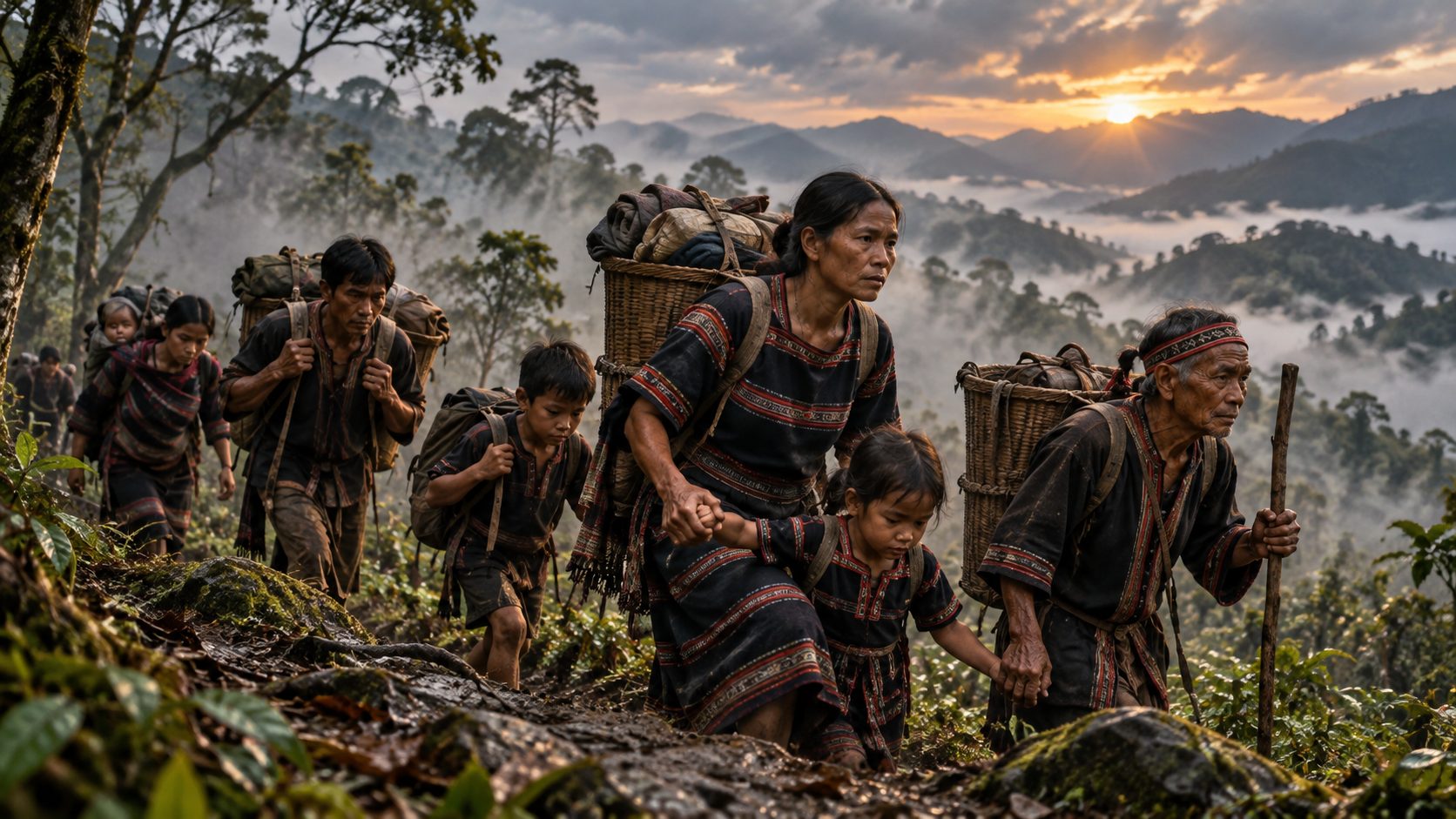
After the Easter demonstrations of April 10 and 11, 2004, hundreds of people went for the border again. See Easter Week 2004. This time the door was closed from both sides in the same week: Cambodian security forces had been instructed to deport any Montagnard who tried to cross, and on April 10 Cambodia demanded that UNHCR close even its standby office in Ratanakiri, accusing it of having operated there without authorization and secretly, to lure people out of Vietnam.
UNHCR’s reply of April 13 is worth reading as the agency talking about being pushed:
“We closed our premises at the insistence of the Cambodian government but expect we will still have access to the region in the event of further arrivals.”
“UNHCR is dismayed by published comments allegedly made by Cambodian authorities in which our office in Ratanakiri was characterised as unauthorised and which stated we were operating ‘secretly’ in border areas to ‘lure’ Montagnards from Viet Nam.”
So for three months there was nowhere to go and nobody to find. What the camps meant in the summer of 2004 was not a camp at all. Two sets of reporters got into the Ratanakiri forest and described what they found.
The first, at the end of May, found three sites. Five people in a tiny clearing under deep canopy that could only be reached by crawling along animal tracks, with stomach illness and not enough food or drinking water. Five people under a flimsy roof of blue and red striped tarpaulin about one and a half meters by two, with five hammocks, including two young women described as pale and sickly who had been in the forest nineteen days, making a watery soup of forest mushrooms and rice. And six men on a hillside that a night of torrential rain had turned into a river, with one small sheet of waterproof material between them, their clothes and slippers hung up to dry, a little rice, and no mosquito nets.
The people there said this. A forty-year-old Jarai man who had left his village on April 13:
“During the demonstration the soldiers hit us and they used sticks of wood with nails to beat us…. The police, soldiers and Vietnamese people came to our village and kicked in our doors and attacked us in our homes.”
“I saw with my own eyes one person killed in my village.”
“We want the international community and the UN to help and protect us.”
A nineteen-year-old from Gia Lai, under the tarpaulin:
“We think a lot, but we don’t know where we will go. We can’t go back because we are afraid the Vietnamese government will kill us or we will be put in the prison. We want the UN to help us. If we stay in the jungle, we have no medicine.”
A forty-four-year-old at the third camp:
“We fled our village one month and 15 days already. We fled from Vietnam because they suppress our religion. We cannot stay in Vietnam because there is no freedom and they make arrests everyday.”
And a man of thirty-one in the same group, who handed the reporters film of the protests he had carried out with him:
“It is better to die here than in Vietnam.”
In July a second reporter found about two hundred and fifty people being fed by Cambodia Ksor, a twenty-five-year-old Jarai villager from the Cambodian side, who said: “I am frightened. But I dare to come here even at night to help them.” Among the people he was feeding was Rahlan Bang, aged eleven, one month into hiding, living under plastic sheeting with her family on rice and plant leaves: “In my village I never had a problem. But since I have been here, I have been sick.”
A third reporter, in the same forest, met an eight-year-old girl who had built a miniature house out of twigs under the sheeting where her family was living. “I am happier here because there are no soldiers.” Her father: “I don’t know how long we can live like this.”
Prime Minister Hun Sen’s word for these people was illegal immigrants. King Norodom Sihanouk, in the same year, supported the asylum seekers publicly and wrote that Montagnards are deprived of their ancestral lands. He is the one senior Cambodian voice on our side in 2004 and it should be recorded.
In June 2004, after considerable pressure, Cambodia agreed that UNHCR could reopen offices in the northeast, so long as they did not become camps. In July it authorized UNHCR to go and retrieve people. From July 19, more than a hundred came out of the forest to ask for protection, and Cambodia gave UNHCR thirty days to find a resettlement country or they would be sent back. Five joint operations with the Cambodian authorities between July and November located four hundred and forty-one people. By November, five hundred and fifty-three were under UNHCR protection; by late December, more than seven hundred.
There is one allegation from that summer that must be reported exactly as it stands and no further. In a written statement submitted to the United Nations Commission on Human Rights, it is recorded that on May 13, 2004 a member of the Cambodian National Assembly, Son Chhay, reported that police officers had raped and robbed a group of eighty Montagnard refugees before deporting them, that deportations had occurred at least three times since the previous April, and that he called these acts a crime against humanity. That is a named parliamentarian’s report, carried in a UN document. We have not found any investigation of it, before or since.
Misled
On November 5, 2004, UNHCR published two documents about the caseload it was now holding. One was a briefing note. The other was a feature headed Misled Montagnards in Cambodia say no to resettlement. Its spokesman was quoted:
“Many asylum seekers had crossed following rumours that ‘UN’ could help recover confiscated lands, and not all were fleeing persecution.”
“This situation has placed UNHCR in a quandary.”
And the note: Montagnards, under the illusion that we can help with their land problems, may have put themselves at unnecessary risk. Of a hundred and forty-eight cases submitted for US resettlement, thirty-eight were accepted and a hundred and ten refused; UNHCR’s protection staff suspected external pressure had influenced the refusals.
Name the position the agency was in. It was holding several hundred people in a host state that had declared them illegal migrants and had given it thirty days to export them, while negotiating with a state of origin that controlled all access to the region they would otherwise go back to. In that position it publicly reclassified a large part of its caseload as people who had come for the wrong reason. That sentence — not all were fleeing persecution — was doing work for two governments, whatever UNHCR intended by it.
We are not going to sneer at an agency that was also, in the same years, the only body that got anybody out. We are going to put its sentence and our people’s sentences on the same page. The Rhade man in July 2001: “I want the international community to understand clearly that I didn’t come here to get rich or to resettle abroad. We just want our land.” The man in the Ratanakiri forest in May 2004: “It is better to die here than in Vietnam.” Those are not the words of people who had been lured. They are the words of people who had understood the situation precisely and were telling anyone who would listen.
On January 1, 2005, Cambodia’s national police chief was quoted on the method now to be used at the border: “The authorities have to convince the local people to be our spies in order to report how many Montagnards [enter Cambodia] to arrest them and send them back to Vietnam.”
The memorandum of January 25, 2005
The second attempt at the same arrangement, by the same three parties, three years after the first one collapsed.
It was signed in Hanoi on January 25, 2005 by Le Cong Phung, Vietnam’s First Deputy Minister of Foreign Affairs; Long Visalo, Cambodia’s Secretary of State; and Erika Feller, UNHCR’s Director of International Protection. It covered about seven hundred and fifty people, all of them by then in Phnom Penh.
It institutionalized temporary protection in Cambodia and offered two options, return or resettlement. Vietnam undertook not to prosecute or discriminate against returnees on the basis of their illegal departure. People who wanted neither option had one month to decide, after which Cambodia and UNHCR would work with the Vietnamese government to bring them back in an orderly and safe fashion.
Read the undertaking again, and then read Article 91 again. Vietnam promised not to punish people for leaving. The exact and only thing it promised. Human Rights Watch stated the defect in one sentence:
“By specifying that the Vietnamese government agrees not to punish or prosecute returnees for their ‘illegal departure,’ the MoU remains conspicuously silent regarding the range of other grounds for which the Vietnamese authorities may punish returnees.”
A returnee could not be punished for having crossed the border. He could be punished for Dega Protestantism, for the land rights movement, for a cellphone, for a prayer meeting, for helping someone else cross, and for every one of those things people were being punished throughout the period the memorandum was in force. The monitoring provision said only that at an appropriate time the Vietnamese government and UNHCR would consult and cooperate on visits.
In the same month it was signed, provincial authorities took four people out of a UNHCR shelter in Phnom Penh and sent them back.
July 20, 2005
Site 1 was a facility in Phnom Penh that mainly held people whose refugee claims UNHCR had rejected.
The operation began at half past five in the morning. Police set up roadblocks to keep journalists and Cambodian and United Nations human rights monitors away from the building. At six, dozens of riot police, some with AK-47s over their shoulders, went in.
The Montagnards sat down on the floor and linked arms. Police were seen to slap and hit them and to beat them with batons, to use electric prods, and to drag people out by their arms, by their legs, and in several cases by their hair, and push them onto buses. The convoy was away by ten to seven.
From one of the seven eyewitness accounts published four days later:
“The Montagnards were completely non-violent. Some were gathered in a group and began to pray and then they let out a terrible sound of lamentation and wailing…Police pulled one man out in front and beat him as he was lying on the cement. He writhed when he was stuck with a baton. More people were beaten and dragged or carried out the gate. I saw a policeman kick one woman in the stomach.”
Other accounts in the same set describe people sitting clinging together on the floor, wailing, when the police came in; batons used on seated people at random; a woman dragged by her hair; people shocked with electric batons while carrying children.
Brad Adams, Asia director at Human Rights Watch: “There was no excuse for using electric batons or beating unarmed individuals engaged in peaceful civil disobedience.”
How many were deported that morning is not settled, and we print both figures. Human Rights Watch said a hundred and one, in both of its releases that week. UNHCR, the report written for UNHCR, and the US State Department all say ninety-four. The likeliest explanation is that a hundred and one people were put on the buses and ninety-four rejected asylum seekers were the ones actually deported under the memorandum, but we have not been able to establish that and will not print it as though we had.
UNHCR personnel were present in the building. The human rights monitors were the ones kept outside by the roadblocks. Both of those things are in the record and both belong in it.
Monitoring
After the returns began in March 2005, UNHCR made twelve monitoring visits to the Central Highlands by June 2006 and met sixty-four percent of all returnees. That is a high coverage rate for a returnee caseload, higher than most, and the agency was right to say so. What its statements after each visit said was this:
- After the mission of March 18–21, 2005: “No one I met amongst the returnees claimed they were beaten or harassed during their stay in Pleiku or upon their return home.”
- After June 22–24, 2005: “They were neither beaten nor mistreated upon returning to their native villages.”
- After August 2–4, 2005, under a press release headed UNHCR mission finds Montagnard returnees and deportees well: “This was a very encouraging and enlightening visit…seemed well, in good physical condition and under no particular threat or duress.”
- After August 22–24, 2005: “There were no signs of fear.”
- On April 28, 2006, after two days in the highlands meeting a hundred and ninety returnees, the Assistant High Commissioner for Protection: “I feel quite confident…that protection concerns are being addressed.”
Here is how those visits were conducted. Police and government officials, including provincial and district People’s Committee chairmen, accompanied UNHCR on every one of the twelve missions and sat in on most of the meetings. Private meetings were not permitted until the ninth mission, in February 2006, and then only in Dak Lak and not in Gia Lai. The report written for UNHCR’s own protection division records the same thing without answering it: government officials came with the UNHCR team for all interviews, and critics questioned whether the agency had sufficient independence and strength for objective monitoring.
Now the other side of the same visits, from two men who were visited.
P., a Jarai man, a recognized refugee who went home voluntarily in May 2005. On arrival he was held three nights in a dark cell with his hands tied, punched in the face four times, beaten on the chest, back, groin and face, kicked with army boots, and had writing pens forced between his fingers with rope pulled tight. He was arrested again in July, held five nights, kept in stress positions for hours, hung upside down by the feet for thirty minutes at a time, and pressed to renounce Dega Christianity.
“I told them I fled because I was afraid the police would beat me. As a response, they punched me in the face with their fists four times.”
“When I was finally allowed to return to my village and see my wife, she was shocked by how swollen and bruised my face was.”
He said that before the UN came to his village the police visited and threatened violence; that the secret police hid their weapons when the UN staff arrived and got them out again afterward; and that when he was asked about mistreatment, he was too frightened to say anything.
C., a Jarai man whose claim had been rejected, who went home in March 2005. Seven days in detention at Pleiku on arrival, with interrogation and beating. Summoned to the commune office about three times a month afterward. Two days’ detention in September 2005, two more in October, slapped and boxed on the ears until blood came out of them.
“They told me if we catch you again you will spend nine or ten years in prison. I was afraid and I ran.”
“This is the second time I’ve fled to Cambodia. Whether I live or die depends on the international [organizations]. If they send me back to Vietnam, I’m dead.”
He described what a monitoring visit looked like from inside it: ten returnees called to the commune office rather than visited at home; the one returnee who spoke English isolated upstairs so that he could not talk to the UN staff; about twenty officials in the room, including the district chief and plainclothes police; and a police warning beforehand not to speak.
“None of us spoke about problems — we were all too afraid.”
Both men said the same thing about why they had gone home in the first place: the UN told me there were no more problems in Vietnam. Two different men, in separate interviews, one sentence.
UNHCR answered on June 16, 2006:
“Frankly, we find the report unbalanced and reject its accusations.”
“The HRW report draws very generalised conclusions from essentially the accounts of five people whose stories cannot be verified by any objective means.”
“We have had contact with these people and found discrepancies between accounts they related to us and to HRW.”
“Our public statements have reflected the reality we found on the ground.”
We are not going to adjudicate between two institutions, and we do not need to. Look at the central objection: five men’s accounts cannot be verified by any objective means.
That sentence is true, and it is a statement about the Central Highlands, not about P. and C. The region was sealed. Every road in was controlled by the government the accounts were about. The only objective means anyone had was a visit with the district People’s Committee chairman sitting in the room and the plainclothes police along the wall. Under those conditions the people who lived through a thing are not a poor substitute for the record. They are the record, and what they say cannot be checked because checking has been made impossible by the party that would be checked.
There is one more thing to set down. In late August 2005, UNHCR’s regional representative in Bangkok, asked about the people who had crossed expecting help with their land, said: “This is very sad. There is something ethically wrong in starting these kind of unfounded rumours which place people at risk.” Within a year, two men who had gone home would say that what they had been told, by the UN, was that there were no more problems in Vietnam.
The arithmetic
The closing account of the memorandum, as published in June 2006 in the report written for UNHCR’s protection division:
“Since the agreement was signed in 2005, 190 people have returned to Vietnam – 102 voluntary returnees and 94 rejected asylum seekers – while 605 have been resettled.”
“Another 249 refugees remain under UNHCR’s care in Phnom Penh as of June 2006.”
A hundred and two plus ninety-four is a hundred and ninety-six.
The error is small and it is traceable, and we show the working because how a number is built is part of what the number is. On April 28, 2006, UNHCR gave the figures as ninety-six voluntary returns and ninety-four deportations, total a hundred and ninety. That was right at that date, and Human Rights Watch used the same ninety-six in the same weeks. On June 16, 2006, UNHCR gave a revised breakdown: eighty-two voluntary returns in 2005 and twenty more in 2006, which is a hundred and two, plus the ninety-four deported. Six more people had gone home between late April and mid-June. The report published that same month took the updated voluntary figure and kept the old total.
The true figure at June 2006 is a hundred and ninety-six people returned, six hundred and five resettled, two hundred and forty-nine still waiting in Phnom Penh.
Where people went
The United States took almost everyone: about eight hundred in 2002, more than a hundred and sixty in 2003, sixty-seven in 2004, and the bulk of the six hundred and five resettled under the memorandum. Approximately thirteen hundred people were resettled abroad in all between 2001 and 2006. Most went to North Carolina. See The 2002 resettlement, North Carolina and The wider diaspora.
Finland took seventy-two. The first group of twenty-seven flew from Phnom Penh to Oulu on May 11, 2005. A UNHCR protection officer described the orientation briefing beforehand: “There were a lot of smiles and some laughter during our orientation briefing. Overall, they seemed a bit nervous but excited.” A second group followed in early June. Sweden took seven in 2004 and more later. Canada began accepting people in 2005.
Two hundred and forty-nine people were still in Phnom Penh in June 2006, and this page cannot tell you what became of all of them, because the record of the years after that is thin and much of what exists is the agency’s own summary of itself. What is certain is that the sequence did not end. On July 18, 2008, after twenty-eight asylum seekers were sent back, between sixty and a hundred Montagnards came out into the street outside the UNHCR center in Phnom Penh and chanted for freedom. One of them, who had got out of the compound the day before, was arrested, beaten, and deported the next day. A human rights worker who was there: “Some were angry, some were weeping.” One of the people in the street said, in Khmer, to Cambodian police:
“Cambodians, Montagnards, we are the same people. We are brothers and sisters. Vietnam takes the lands of the ethnic people.”
That is where this page began, said aloud in the street, seven years later.
The families who stayed
One more part of the record belongs here, because it is the part that explains why so many people would not go home.
The wife of a Jarai refugee had his remittances confiscated, was interrogated for two days, and was told the police would take half of any future transfer: “They told my wife that next time I send money, she must tell them — they will take half.”
A Bahnar woman whose husband fled in 2001 and was resettled in the United States:
“When my husband fled to Cambodia, the authorities followed me a lot. They thought I would also try to flee. After my husband went to the U.S. the police asked me many questions: does he send money, how often, how much, and so on. I wanted to buy a hand phone because I live far from the district town but they did not allow me. They were afraid I would help the political movement.”
A Rhade woman from Dak Lak who reached the United States in 2005 under family reunification had been summoned twelve times between 2003 and 2006 and held eleven days in a district police station in 2003 on an accusation of taking food to an uncle in hiding.
“They would ask me about my husband: What does he do in the U.S.? Does he send you money? Do you talk with him on the phone? What do you talk about?”
“They were angry, and slapped me on the face and choked me. They asked me if I wanted to die.”
“The police made me kneel for three hours on my knees, with my hands up in the air. They placed a Bible in front of me and told me, ‘Pray to your Bible to help you now.’ Then they put me in a cell.”
Before she flew, a district policeman said this to her:
“Now you are going to the United States. Tell everyone over there — your husband, your aunts and uncles, all your people: don’t do any political work over there.”
Within two months of her arrival, her brother was arrested, beaten and jailed.
That policeman understood exactly what the camps had produced. Not a refugee population. Witnesses.
What we do not have
What the two camps were like. Nobody wrote it down. The people who lived in them are alive and most of them are in North Carolina, and this is the single most valuable thing anyone reading this page could give us.
The Phnom Penh sites. Site 1 and the shelters that held hundreds of people through 2004 and 2005 appear in the record only as addresses. Who ran them, what they were like, what people did all day for a year — unrecorded.
What happened to the four taken from the UNHCR shelter in January 2005, and to the hundred and sixty-seven returned on December 27, 2001, and to most of the people in the deportation table above. Some were tried and are named on this page. Most were not.
The people who went back. A hundred and ninety-six by June 2006, of whom UNHCR met sixty-four percent in a room with the district chairman present. Nobody has ever asked them, in private, in their own language, what the years since were like.
If you crossed, if you waited, if you were sent back, or if you went home and stayed — we would like the account. See How to record an elder.
Terms
- Refoulement
- The return of a person to a country where they face persecution. It is prohibited by Article 33 of the 1951 Refugee Convention, to which Cambodia is a party. Almost everything described on this page under the heading of deportation is refoulement.
- Tripartite agreement
- An arrangement between a country of asylum, a country of origin and UNHCR governing the return of refugees. Two were made here: January 21, 2002, which collapsed in eight weeks, and January 25, 2005.
- Rejected asylum seeker
- A person UNHCR has screened and not recognized as a refugee. Under the 2005 memorandum, rejected asylum seekers could be deported; the ninety-four returned on July 20, 2005 were in this category.
- Article 91
- The provision of Vietnam’s penal code covering flight abroad, or remaining abroad, to oppose the people’s administration. At least sixty-five of our people imprisoned since 2001 were arrested while trying to reach Cambodia.
See also: February 2001: the highlands stand up, Easter Week 2004, The 2002 resettlement, Asylum today, Kin across the border.
Sources
- Human Rights Watch, Repression of Montagnards, April 2002, chapters XIII and XVII — the 2001 flight, the deportation chronology, the Bou Praing case study, and the refugees’ own accounts of the crossing. Its appendices reproduce the Cambodian transfer documents of March 2001
- Human Rights Watch, New Assault on Rights in Vietnam’s Central Highlands, January 2003 — the trials of the returned, with village, district and sentence
- Human Rights Watch, Vietnam: Torture, Arrests of Montagnard Christians; Cambodia Slams the Door on New Asylum Seekers, January 2005
- Human Rights Watch, No Sanctuary, June 2006 — the 2005 memorandum, the accounts of P., C. and S., the families left behind, and the twelve monitoring missions
- Human Rights Watch, eyewitness accounts of the forced return of July 20, 2005, and the accompanying release of July 25, 2005
- Vietnam: Situation of Indigenous Minority Groups in the Central Highlands, a Writenet report commissioned by UNHCR’s Status Determination and Protection Information Section, June 2006 — the whole arc, and the closing arithmetic at pages 13 and 14. The published PDF carries no author’s name, so we cite it by title
- UNHCR briefing notes and features: the agreement of January 21, 2002; the first return of February 19, 2002; the closure of the Ratanakiri office, April 13, 2004; Misled Montagnards in Cambodia say no to resettlement and the briefing note of November 5, 2004; the monitoring feature of September 5, 2005; and the reply to Human Rights Watch of June 16, 2006
- Office of the High Commissioner for Human Rights, press release of the Special Representative of the Secretary-General for human rights in Cambodia, March 4, 2002 — the deportation of sixty-three from Andong Meas, the trial of January 25, 2002, and the electric baton at Mondulkiri
- Written statement of the Transnational Radical Party to the Commission on Human Rights, E/CN.4/2005/NGO/270, March 10, 2005 — the report by Son Chhay of May 13, 2004, and the destruction of the Mondulkiri camp
- United States Department of State, Country Reports on Human Rights Practices for Cambodia, 2001 and after; and the US Committee for Refugees, World Refugee Survey for 2003 and 2004 — the counts of forced returns, and the admissions to the United States
- UN News, “Two dozen Vietnamese Montagnards go to Finland as refugees,” May 11, 2005, and the reports of September 23, 2005 and April 28, 2006
- Contemporaneous reporting from the Ratanakiri forest in 2004 by The Cambodia Daily, by Kevin Doyle for the International Herald Tribune, and by Phil Zabriskie for TIME; and Phnom Penh Post reporting of October 2003, January 2004 and July 2008
Compiled September 2026. No Vietnamese government or state media source is used as a source on this page. Several things here are unsettled and are printed unsettled: whether ninety-four or a hundred and one people were deported on July 20, 2005; whether the sentences at the trial of January 25, 2002 topped out at five and a half years or six and a half; and the total returned under the 2005 memorandum, which the published account gives as a hundred and ninety and which its own components make a hundred and ninety-six. Village and personal name spellings follow the records in which they were written down. The largest gap on this page is not a disputed number. It is that nobody ever wrote down what living in those camps was like, and the people who can say are alive.