



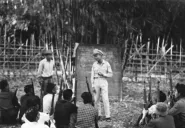
From 1964 the Americans stopped asking our men to guard their own villages and started asking them to go wherever the war was worst. They went: in the Mobile Strike Forces, the Mike Forces, that were flown in to camps under siege, and in the reconnaissance teams and raiding companies of MACV-SOG that crossed into Laos and Cambodia. The Americans who fought beside them wrote books, won medals and have graves with their names on them. Out of thousands of Dega who served with SOG, we have found fewer than a dozen named in anything published. This page is about them, and about the ones nobody named.

Sent where the Americans sent us
The Civilian Irregular Defense Group began at Buon Enao in 1961 as a way for Rhade villages to defend themselves; that story is told in The American years. By 1964 the program had moved our men out of their villages and into camps along the border. The next step moved them out of the camps too.
The Army’s official history of its own Special Forces, written by Colonel Francis J. Kelly and published by the Department of the Army in 1973, dates the beginning precisely. In October 1964,
“a mobile strike force, dubbed the ‘Eagle Flight,’ was formed in II Corps Tactical Zone.”
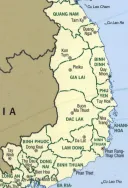
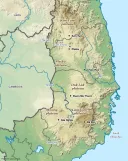
II Corps was our country: Kon Tum, Pleiku, Darlac, Quang Duc, Tuyen Duc, Lam Dong and Phu Bon, with the coast behind them. The Eagle Flight was a company of trained strikers kept ready to be flown to any camp that was attacked. Kelly says the strike forces were placed under American Special Forces command alone when they were formed, and only came under joint American and Vietnamese command in December 1966. That detail matters to us. For their first two years there were no Vietnamese officers in the chain of command of the men who carried the guns, and that is how a unit like the Pleiku Mike Force could become what it became.
In June 1965 General William Westmoreland approved a reserve for each of the four corps headquarters of the Special Forces. Kelly again:
“These multipurpose reaction forces, called mobile strike forces, were formed during the fourth quarter of 1965. … Each mobile strike force consisted of a headquarters and three companies with a total strength of 594.”
The first of them was not ours. The US Army’s special operations historian Kenneth Finlayson writes that the first Mike Force battalion was formed near Saigon in June 1965 from ethnic Chinese Nung soldiers, and that “There were no Vietnamese CIDG or Special Forces in the first MIKE Force.” The name came from its founder, Lieutenant Colonel Miguel de la Peña, whom his men called Mike. Finlayson also records what those Nung soldiers were paid:
“Each man received 6600 piastres ($55.00) per month as opposed to the 1500 p ($12.00) that was the CIDG monthly wage.”
We have not found the figure for our own Mike Force companies, and we will not borrow the Nung figure for them. If your father kept a Mike Force pay card, it would settle the question; see the note at the end of this page.
The force grew fast. Kelly writes that its strength doubled between June 1966 and June 1967. By 1968 there were five commands: one for each corps, and a fifth at Nha Trang, which Kelly says grew to a reinforced battalion and saw action in all four corps areas. The Mike Forces of the south were largely Nung and Cambodian. The Mike Force of II Corps, at Pleiku, was ours.
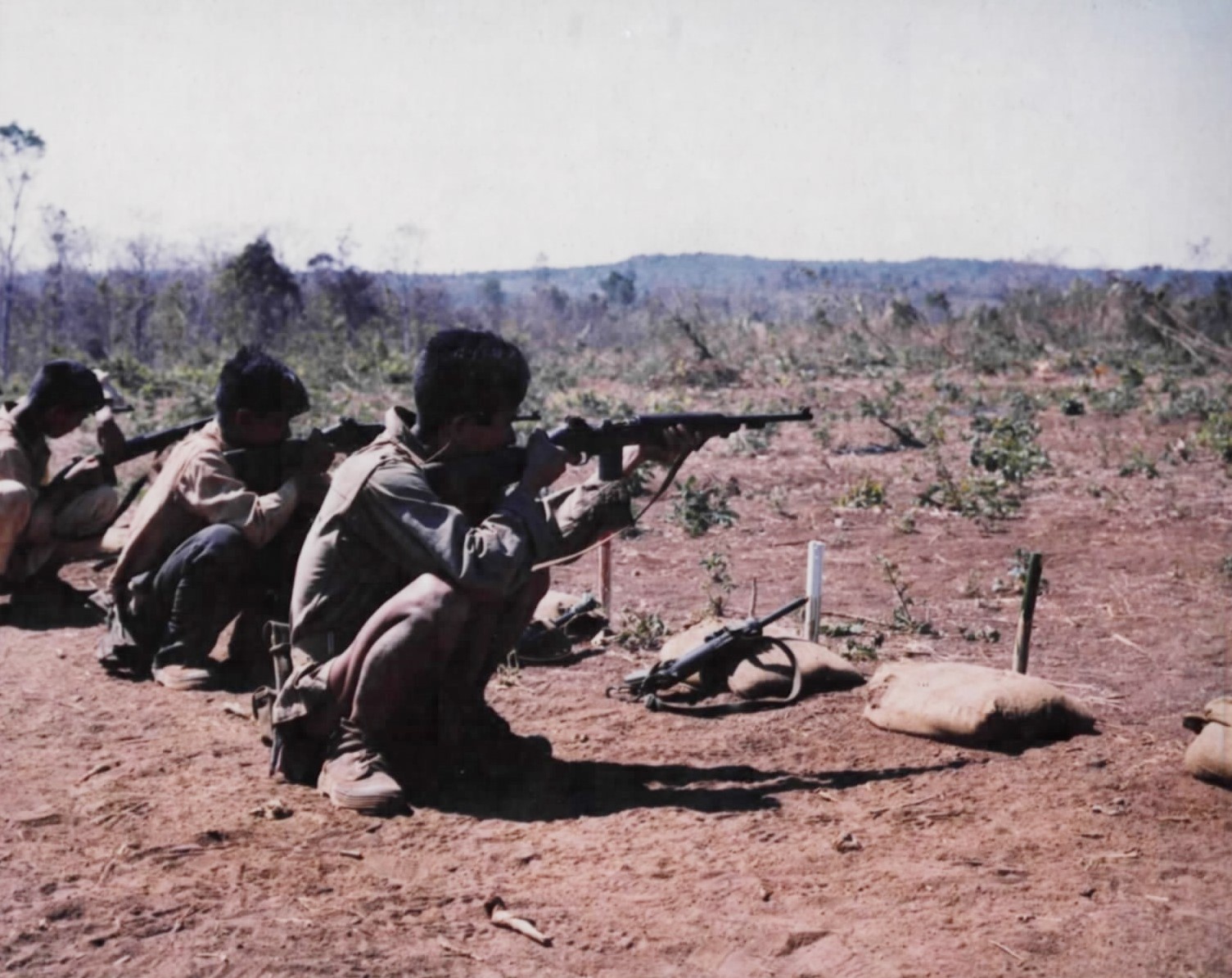

“We are Jarai”: the Mike Force at Pleiku
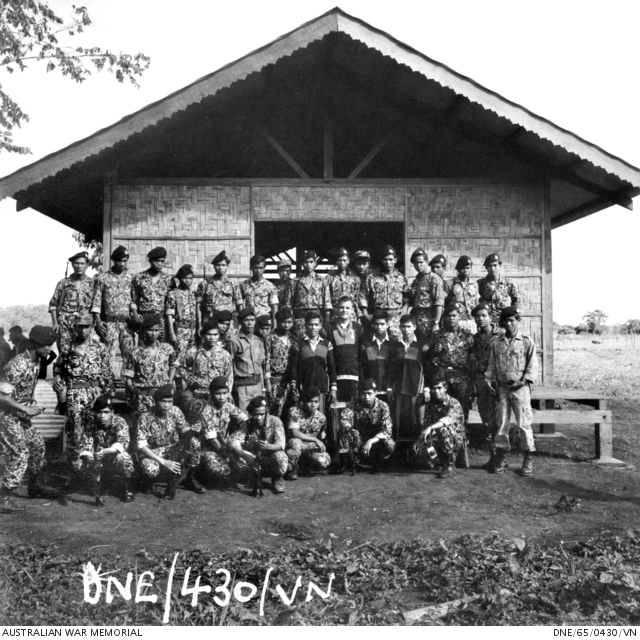
An Australian Army photograph caption of October 1968 describes the Pleiku Mike Force as ten companies of soldiers, “mainly Montagnard hill tribesmen,” with sixteen Australian advisers. Tom Burke, who commanded one of its companies in 1970, says of its men: “Most of these fighters came from the Rhade and Jarai tribes.”
The Americans paid them. The movement of our own people collected from them. William H. Chickering, who commanded a Mike Force battalion in 1967 and spent sixteen years on a history of FULRO, writes that
“the Mike Force was almost 100-percent FULRO. Every pay day, he would circulate, collecting everyone’s FULRO dues, one-tenth of their pay.”
The man who went round on pay day was Kpa Doh. An American officer, Frank Quinn, knew about the dues because he kept the piastres for him. Every month, a tenth of an American payroll went to a Dega national liberation movement that Saigon was trying to destroy. The American writer and Special Forces officer Jim Morris, who served in II Corps, remembered it the same way in 2025: “We ran something like a 10,000-man army and it was wall-to-wall FULRO.” That is a veteran’s memory, not a count, and we give it with his name.
Kpa Doh was Jarai. Morris met him in 1964 as the chief interpreter of his Special Forces team at Buon Beng, and writes that “Kpa Doh gave me my first Montagnard bracelet when A-424 arrived at Camp Buon Beng.” (On the bracelet, see The bracelet.) He became the chief interpreter and, in Morris’s words, the “de facto commander” of the II Corps Mike Force. The Americans called him an interpreter. The men followed him.
Plei Trap valley, the night of November 8, 1966
In the first week of November 1966 about 160 Jarai soldiers of the Pleiku Mike Force and six American Special Forces men were sent into the Plei Trap valley, west of Pleiku near the Cambodian border. Chickering, telling it from the account of one of the Americans, Bob Ramsey, who was twenty-six and in his first combat, is plain about what they were for. They were bait: their job was to find the North Vietnamese and hold them long enough for American aircraft and the American 4th Infantry Division to be brought down on them.
After midnight, in the dark, the Jarai suddenly shouted, all together, and stopped. Chickering explains what the Americans understood by it. One of the men had heard or smelled the enemy, and instead of firing blind into the forest the company answered with its voices. Chickering puts the meaning into words:
“We dare you to attack. We are Jarai.”
Those words are his rendering of what the shout meant, not a record of what anyone said, and we give them as his. But nobody who knows our people will doubt the sense of them.
The North Vietnamese came. In the fighting Kpa Doh was shot in the neck by a rifle round and kept going, walking the line and, in Chickering’s words, “tapping his men’s boots as he passed.” Ramsey said of him: “It didn’t even knock him down. It just looked like it pissed him off.” He carried a rasp in his voice from that wound for the rest of his life; Morris noticed it when he found him again in 1967. The aircraft came in the morning, and the American infantry after them.
“Fourteen Jarai were killed, 40 were wounded … Fifty-eight North Vietnamese were found dead.”
All six Americans lived. Not one of the fourteen Jarai who died that night is named in anything we have been able to read. Their families are in the villages around Pleiku and in North Carolina. If you know who they were, we want their names for the memorial register.
By 1967 Kpa Doh had been dismissed as chief interpreter; Morris does not say why. By 1973 he was a major in the Cambodian army in Phnom Penh. In April 1975, Morris writes, Kpa Doh and his family were among the people who took refuge in the French embassy when the Khmer Rouge took the city, and they were among those the French were made to hand over. Morris believes they were executed. Chickering could not rule out a different end, fighting the Vietnamese later. The embassy is told on Y Bham Enuol in Phnom Penh, and Kpa Doh’s life on The men of FULRO.

The Australians, and their photographs
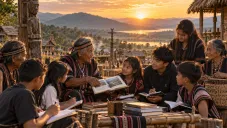
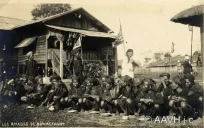
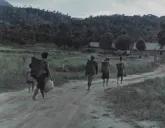
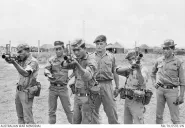
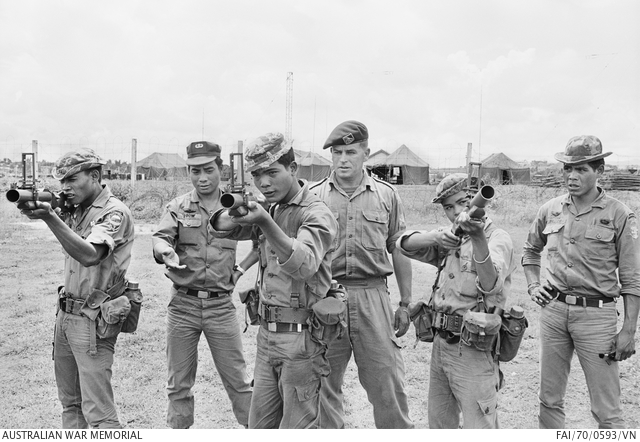
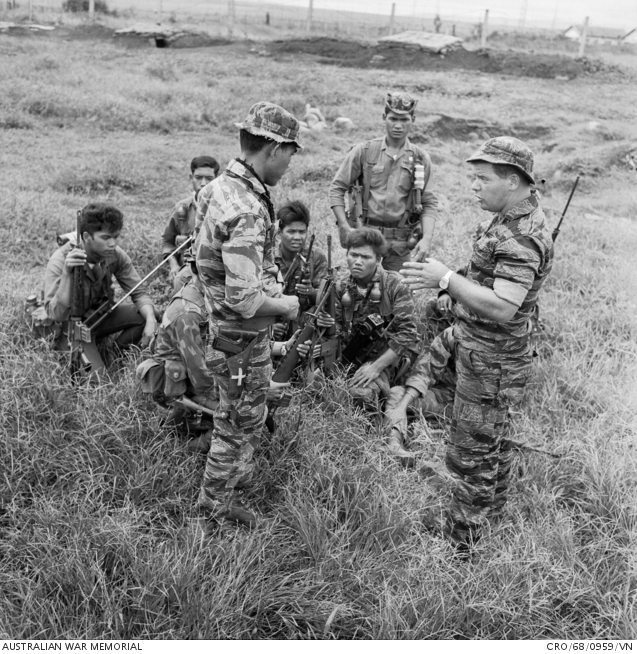
From 1967 to 1971 officers and warrant officers of the Australian Army Training Team Vietnam served with the II Corps Mike Force, and some of them commanded its companies and battalions. Their army wanted a combat role for them, and its photographers followed them for the Australian newspapers. Those photographs are now in the Australian War Memorial and in the public domain, and they are the best pictures of our Mike Force soldiers that exist anywhere.
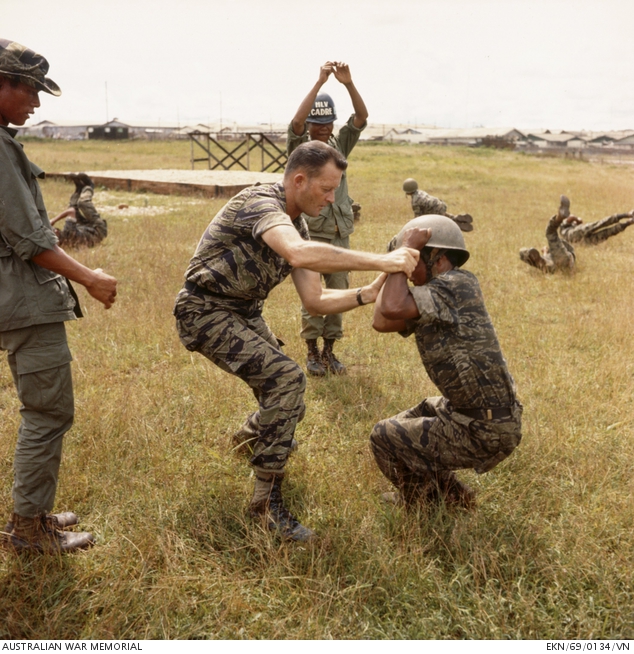
They have one habit. The captions name every Australian, with his rank, his home suburb and his state. They almost never name one of us. The men in the frame are “Montagnard soldiers,” “an aspiring parachutist,” “a Montagnard village chief.” The one exception we have found is the photograph at the top of this page, where a South Vietnamese Army captain named Siu Ddow stands beside the Australian instructor. His name is Jarai. If you know him, or know what became of him, we would like to hear from you.

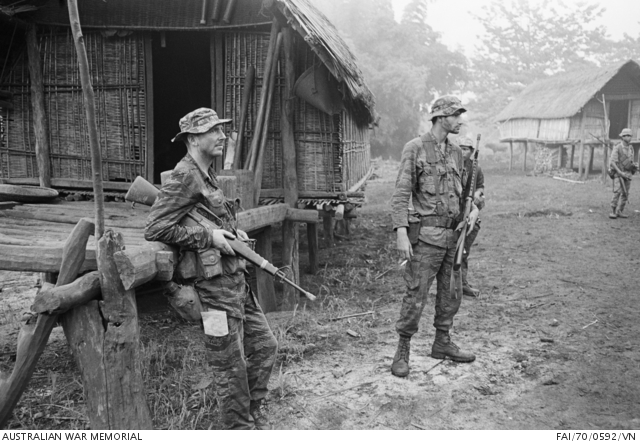

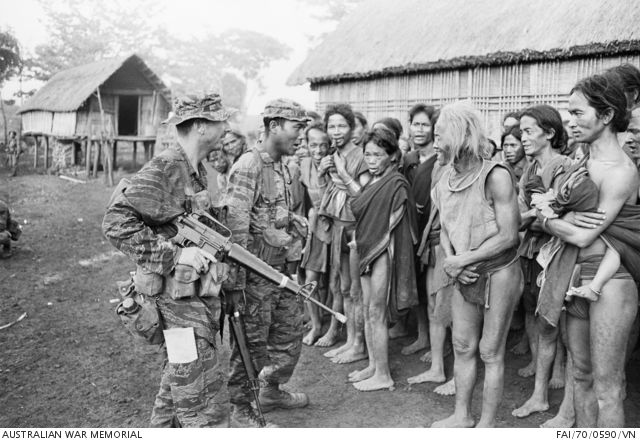

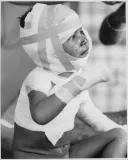
The last two pictures are from the same operation in July 1970, and they show something the Australian captions do not dwell on. Much of the Mike Force’s work in its last year was cordon and search: surrounding highland villages at first light, searching the houses and questioning the chief. The soldiers doing it were Dega, and so were the villages.

Kon Tum and the border, 1969–1970
Ben Het, May 24, 1969. Warrant Officer Keith Payne of the Australian Army was commanding the 212th Company of the 1st Mobile Strike Force Battalion near Ben Het, in Kon Tum province, when, in the citation’s words, “the battalion was attacked by a North Vietnamese force of superior strength.” The companies were driven back and broken up. His Victoria Cross citation says that in the night he went out alone “to find the wounded and other indigenous soldiers,” and that
“He finally collected forty lost soldiers, some of whom had been wounded and returned with this group to the temporary defensive position.”
The forty were men of his company, and his company was Dega. Payne received the highest award his country gives. The citation calls the men he saved “indigenous soldiers,” and none of the forty is named.
Dak Seang, April 1970. When the North Vietnamese besieged the camp at Dak Seang, north of Dak To, the 1st Battalion of the 2nd Mobile Strike Force, about four hundred strong, was sent to break through to it. The battle is told on The battles fought on our land. What belongs here is its cost to the battalion. The collector and writer Julian Tennant, working from the Australian records, writes:
“They had suffered over a hundred dead or wounded casualties, over a third of the battalion’s strength.”
Four of them were killed by an American napalm canister that burst in the middle of their own platoon, which also wounded seventeen more. One Australian warrant officer, John Pettit, was killed on April 4. The Australians who fought there are all named in Tennant’s account. The Dega are not.
A cave in Cambodia, March 1970
On March 1, 1970, the 221st Company of the Pleiku Mike Force was ordered across the border into Cambodia, to the area of the old French airstrip at Le Rolland in Mondulkiri, west of Bu Prang. Its American commander, Tom Burke, wrote the story down fifty years later. One day he was climbing down into a cavern and reached back to steady himself on a rock. Then he saw
“Y-Tote, my Jarai company commander, running at me with a raised machete.”
He thought he was about to die. Y-Tote grabbed him by the collar, threw him forward and then, Burke writes, “shoved an almost behead viper into my face.” The snake had been beside his hand.
At the ruined French villa by the airstrip there was a wooden banister. “My oldest Yard, Y-Bai, a platoon sergeant in his fifties, came and asked if he could have the banister.” He took it apart, cut it into short lengths and handed them round, and the men sat and carved them. “They were making pipes.”
We give Burke’s spellings. “Y” is how Rhade men’s names begin, and Burke calls Y-Tote Jarai; the company was both. A man who was a platoon sergeant in his fifties in 1970 was born before the First World War ended in Europe and had seen the French, the Japanese, the Viet Minh and the Americans come into our country. His family will know his full name.
Blackjack: sent into the forest for weeks
In the second half of 1966 the Special Forces began what Kelly calls “the mobile guerrilla forces—Blackjack Operations”: companies of strikers with a few Americans, sent deep into country the North Vietnamese held and kept there for a month or more, supplied from the air. Two of them were ours. The records of both are summarized in the operations database of the Vietnam Helicopter Pilots Association, which cites the military historian Shelby Stanton; we have not been able to read Stanton’s own pages.
- Blackjack 21, October 13 to November 9, 1966, in the Plei Trap valley of Kon Tum province: a Special Forces team of fifteen, a Mike Force company of 150, a reconnaissance platoon of 34 and 249 Montagnards of the CIDG. The Plei Trap fight told above happened while it was in the valley. Whether Kpa Doh’s 160 Jarai were its Mike Force company or a separate operation, we cannot yet say.
- Blackjack 22, December 10, 1966 to January 12, 1967, out of Buon Mi Ga: twelve Americans, six interpreters and 173 Montagnards of Detachment A-219. At 4:30 in the morning of January 9 the patrol base was attacked; the wounded were carried for an hour and a half to a landing zone and lifted out under fire. The American writer S. L. A. Marshall told the operation in his book Ambush (1969) as “the marathon patrol.” Marshall named individuals as a rule, and his book is the most likely place to find the names of the Rhade of Buon Mi Ga who walked it.
The other Blackjack operations, and the long-range reconnaissance projects called Delta, Omega and Sigma, were fought mainly in the south with Nung, Cambodian and Vietnamese troops. We do not claim them. Project Omega moved to Buon Ma Thuot when it became part of SOG’s southern command, and its successors there used Rhade teams, as the next part of this page shows.
Across the fence: SOG
The Military Assistance Command, Vietnam – Studies and Observations Group was the secret special operations command of the war. Its ground teams went “across the fence” into Laos and Cambodia to watch and raid the roads and trails the North Vietnamese used to move men and supplies south, through and beside our country. The US Army’s own history of SOG describes the teams:
“Reconnaissance teams (RT) consisted of two-to-three Americans and six-to-nine indigenous personnel, normally Vietnamese, Montagnards, Cambodians, or ethnic Chinese.”
SOG had three field commands. Command and Control North was at Đà Nẵng and worked into Laos; Command and Control Central was at Kon Tum and worked into southern Laos and northeastern Cambodia; Command and Control South was at Buon Ma Thuot and worked into Cambodia. A retired Army intelligence officer, Robert Turkoly-Joczik, wrote in 1999 that SOG’s ground branch was said to have had 2,000 to 2,500 Americans and 7,000 to 8,000 indigenous troops, and gave the reason our men were valued:
“The Montagnards of Vietnam’s Central Highlands were especially helpful in the cross-border operations since their tribal affiliations crossed international boundaries.”
He is right, and it is worth saying what it meant. The border the teams crossed was a line the French had drawn through our peoples. The Jarai, the Bahnar, the Sedang, the Mnong and the Brao live on both sides of it. A Dega scout in Laos or Cambodia was often walking in country his own relatives lived in. See Kin across the border.
Which of our peoples went with which base. Put together from the named cases below, the pattern is clear enough:
- Kon Tum (CCC): Jarai, Sedang and Bahnar. An American team leader, Michael Buckland, wrote of RT Maine in 1969 that “our team was nearly all Jarai.” RT Washington, in October 1971, had “three Sedang Montagnards, one Bnar and one Jarai.” The Hatchet Force company of Operation Tailwind was Dega.
- Buon Ma Thuot (CCS): Rhade. The sergeant Jerry Shriver, famous among the Americans, “spoke Radhe fluently.” RT Plane’s best men were Rhade.
- The north (CCN): most teams there were Vietnamese and Nung, but the Bru of the far north served there. A radio relay site near Khe Sanh was defended in 1971 by “some 20 Bru.” The Bru are told on The smaller peoples.
John Plaster, a SOG veteran and its best-known historian, is reported to write that our men usually walked point and rear security on a team, and that even the lowest-ranking of them was paid as much as a captain in the South Vietnamese army. We have not been able to check either claim in his book, and we give them as his. The Americans trusted our men at the front and the back of the team, where a mistake killed everyone.
Five men with Shriver, April 24, 1969
On April 24, 1969, an enlarged Hatchet Force from Buon Ma Thuot was landed in Kampong Cham province in Cambodia against what the Americans believed was the headquarters of the Communist command for the south. The landing zone was a trap. The account kept by Task Force Omega, an American group that works for the missing, puts it this way:
“Approximately 10 to 15 minutes into the raging battle, Capt. Cahill heard SFC Shriver transmit over his radio that he and five Montagnard soldiers were going to enter the tree line on the west edge of the LZ in an effort to flank an enemy position.”
The six men ran across thirty yards of open ground into the trees and were not seen again. “Jerry Shriver, along with his five Montagnards, were reported as Missing in Action.” Fourteen months later an American graves team went back to the site and recovered remains later identified as those of an American medic and “1 of the missing Montagnards.”
Shriver, the same account says, spoke Rhade fluently and spent most of his pay on food and clothes for the families of the Rhade soldiers in his platoon. The Americans remember him as “Mad Dog.” His five Rhade are remembered as a number. Four of them are still missing, and none of the five is named in any account we have found. Their families in Buon Ma Thuot have waited since 1969.
The first free-fall into Laos, November 28, 1970
In 1970 SOG decided to try inserting a team by high-altitude parachute jump, falling most of the way before opening, so that the enemy on the ground would not hear an aircraft land or see a parachute until the last moment. It had never been done in combat. A history of the operations compiled from the jumpers’ own accounts by Kenneth Conboy and Charles Wesley records how the team was chosen at Buon Ma Thuot:
“Appleton brought four, stripping RT PLANE of its best Rhade members, Tiak Bya-Ya, Noe Nie-Ya, Wak Nie-Ya, and Klu Bay-Ya.”
Training was hard. Klu Bay-Ya, the team’s grenadier, landed in the water off Ishima Island on his first jump. Wak Nie-Ya was hurt in training. By the night of the jump the team was six: three Americans, a Vietnamese warrant officer, and two Rhade, Tiak Bya-Ya and No Nie-Ya.
“At 0200 hours on 28 November 1970, the six RT FLORIDA members filed aboard a C-130E Combat Talon Black Bird.”
The aircraft climbed to 17,000 feet and crossed into Laos. The six jumped into the dark, and landed scattered, in bad weather, without maps of the area. One of the Americans, Cliff Newman, climbed a hill that lightning had burned bare and found Tiak Bya-Ya there, and together they tried to raise an American spotter plane on the radio. No Nie-Ya found the Vietnamese warrant officer. They were not lifted out until December 2.
Two Rhade men from Buon Ma Thuot were one third of the first combat free-fall insertion the United States ever made. Other accounts of the same jump call them only “two Montagnards.” Conboy and Wesley’s text adds, of Tiak Bya-Ya, “now living in Hope Mills, NC.” If he or his family read this, we would be honored to record his own account.
Operation Tailwind, September 11–14, 1970
In September 1970 a Hatchet Force company from Kon Tum was flown from Dak To seventy kilometers into Laos, south of the Bolovens Plateau, to draw North Vietnamese troops away from a CIA operation. Accounts differ on its size. The Marine Corps official history gives sixteen Americans and 110 Montagnards; John Stryker Meyer, a SOG veteran writing about it fifty years later, gives “15 Green Berets and 120 Montagnard mercenaries who were based in Kontum.” The company fought for four days.
Meyer writes that by the time the company was out of the helicopters, “four Montagnards had been wounded from enemy gunfire. One died while flying back to base.” The American medic, Gary Rose, worked on the wounded without stopping; in 2017 he received the Medal of Honor for it. His citation records that he went out under fire to a Montagnard soldier wounded forty or fifty meters outside the company’s position and shielded him with his own body. Meyer’s account adds one sentence about the man working beside him:
“Rose and his indigenous medic counterpart, Koch, worked tirelessly on the wounded all night, even as they moved through the dark jungle.”
That is all we know of Koch: one word, and that he was a medic who did the same work all night as the man who received the Medal of Honor. The Marine history counts three Montagnards killed and thirty-three wounded on Tailwind. In 1998 an American television network claimed the operation had used nerve gas, and retracted the story after a Pentagon review; that controversy was about Americans, and our three dead were not part of it.
Hickory, June 1971
On a hilltop northwest of Khe Sanh, SOG kept a radio relay site called Hickory. When the North Vietnamese attacked it on June 4, 1971, and the helicopters came to take the Americans out, two sergeants, Jon Cavaiani and Robert Jones, stayed to defend it “with some 20 Bru.” The next morning the site was overrun. Jones was killed; Cavaiani was captured and later received the Medal of Honor. Of the Bru, the only account we have says “many of the Bru managed to escape.” How many did not, and who they were, is not written anywhere we have found.
The dead nobody named
The American casualty records of SOG are among the most careful records of the war. They give each American’s full name, rank, team and date, and the volunteer chronicles kept by SOG veterans follow them day by day. Our men appear in the same entries as numbers and initials:
- March 24, 1970, Ratanakiri, Cambodia: the helicopter lifting out RT Pennsylvania was hit near the triborder, exploded and crashed. Aboard were four American crewmen, the team’s three Americans, “as well as five indigenous team members.” The Americans’ remains were recovered and identified between 1994 and 2001, and they are buried under their names. The five men of Kon Tum are not named in the record, and we do not know what became of their remains.
- April 15, 1970, near Dak Seang: two American team leaders “volunteered to form a compliment of Montagnard to serve as a Bright Light team” to rescue a downed crew. The Americans and the Montagnards with them were killed before the helicopter reached the landing zone.
- In the same chronicles, for 1969 alone: four “Special Commandos” killed with RT New Mexico on January 29; three with RT Plumb in Cambodia on March 2; six on Operation Spindown out of Kon Tum on March 5; four with an American in Cambodia on March 18.
Those entries are not a total. They are the ones a volunteer happened to write down beside an American loss. SOG did count its hired soldiers as a group. Its annex to the American command’s history for 1969, as Wikipedia reports it, gives for the Prairie Fire operations in Laos that year alone: 57 of its commandos killed, 270 wounded and 31 missing, against 20, 199 and 9 Americans. That count mixes our men with Vietnamese, Nung and Cambodians, and covers one year and one country. It is the only official count of SOG’s local dead we have found. There is no count of Dega killed in SOG, and none of Dega killed in the Mike Forces.
Numbers, and who gave them
| What | Figure | Who says so |
|---|---|---|
| Montagnards who fought beside US forces | about 61,000, of a people of about a million | S. Res. 395, US Senate, 2023 (Tillis and Budd of North Carolina) |
| In the mobile strike forces | “Another 18,000 … reportedly” | the same resolution, with its own “reportedly” |
| One mobile strike force, 1965 | 594 men in three companies | Kelly, the Army’s official history |
| II Corps strike forces | “something like a 10,000-man army” | Jim Morris, from memory, 2025 |
| SOG ground branch, 1964–72 | 2,000–2,500 Americans; 7,000–8,000 local troops | Turkoly-Joczik, 1999, “said to have had” |
| SOG’s commandos, end of 1969 | 3,068 | SOG’s annex to the MACV command history, as reported by Wikipedia |
| SOG commandos lost in Laos, 1969 | 57 killed, 270 wounded, 31 missing | the same |
| Plei Trap, November 8, 1966 | 14 Jarai killed, 40 wounded | Chickering |
| Dak Seang relief, April 1970 | over 100 killed or wounded, of about 400 | Tennant, from Australian records |
| Tailwind, September 1970 | 3 killed, 33 wounded | US Marine Corps official history |
| Shriver’s raid, April 1969 | 5 missing; 1 later identified | Task Force Omega |
| Our people killed in the wars to 1975 | more than a million | Rong Nay, before the US Senate, March 10, 1998 |
The last line is a Dega witness speaking for his people before the Senate of the United States, and we print it as his testimony. Other tellers give lower figures; they are set side by side on The American years.
Handed over, 1970–1972
At the end of 1970 the Americans ended the program. Kelly’s chronology records that in December 1970 the countrywide reserve at Nha Trang was disbanded and that the Civilian Irregular Defense Group program “was officially terminated.” The Mike Forces were converted into units of the South Vietnamese army. Kelly explains the word:
“civilian irregulars were converted into regular Vietnamese soldiers, Regional or Popular Forces or Vietnamese Army, and lost their CIDG status. Conversion was not very popular among the CIDG, although eventually most men did convert.”
For a Dega soldier, conversion meant serving under the same government that had disarmed Buon Enao in 1962 and fought FULRO since 1964. On May 1, 1972, SOG itself was reduced to a small advisory team and renamed. What became of its Dega commandos we have not found written down anywhere: whether they were taken into the South Vietnamese Strategic Technical Directorate, paid off, or simply sent home. Our veterans know.
In March 1975, when the highlands fell, some of the Americans who had served with our men tried to get them out. What happened on the beach at Nha Trang, and after, is told on 1975, and what came after.
Afterward, in their own words
The Americans’ war ended in 1973. Ours did not. For a Dega man, service with the Mike Force or SOG was a mark of trust to the Americans and a mark of guilt to the state that won; see Reeducation and the forest and The camps. In 2019 VFW Magazine talked to some of the men who reached North Carolina.
Y Monah was a reconnaissance man for the Green Berets, chosen, the magazine says, because he knew the border and spoke the right language; he called in coordinates and worked along the Cambodian frontier. In 1975 he was imprisoned for five years. He escaped, fearing that he would be taken again and killed, and in the end reached the United States. He told the magazine what the war had taught him:
“I saw then all the Vietnamese acted the same. None of them, north or south, liked us Montagnards. That was a war between north and south. We died for nothing because we are nothing to them.”
Ykhiem Ayun joined the Mike Force at Buon Ma Thuot at sixteen. In seven days of fighting in June 1969 he was shot in the chest; he was wounded four times in all and still carries the metal. He was captured at Pleiku, released in 1992, fled to Cambodia when the police began questioning him again, and reached America on June 24, 2002. Of his American captain he said, “He was a good man. He loved the Montagnards.” Of why he fought: “We wanted to stand for our own people.”
Y’Siu Hlong spent the years after 1975 in the forest with the resistance. “In the jungle, we keep looking for the Americans. There were no Americans.”
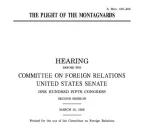
Rong Nay, who was second in command of that resistance, told the US Senate Foreign Relations Committee on March 10, 1998:
“Both the North and South Vietnamese Governments exterminated our people and occupied our land.”
At the same hearing Y Hin Nie, president of the Montagnard Dega Association, said simply: “During the Vietnam War, many of us were compatriots with U.S. Army groups.” See Our veterans in America.
The men whose names were written down
These are the Dega of the Mike Forces and SOG whom we have found named in anything published. We spell each name as the source spells it; a family may spell it otherwise.
| Name | Unit | What the record says |
|---|---|---|
| Kpa Doh (Jarai) | II Corps Mike Force, Pleiku | Chief interpreter and de facto commander; collected FULRO’s tenth on pay day; shot in the neck at Plei Trap, November 8, 1966, and fought on; a major in the Cambodian army by 1973; believed killed in 1975 |
| Siu Ddow | 2nd Mobile Strike Force, Pleiku | A captain, training Mike Force soldiers, July 1970 (Australian War Memorial photograph) |
| Y-Tote | 221st Company, Pleiku Mike Force | Company commander; saved his American captain from a viper in a Cambodian cave, March 1970 |
| Y-Bai | 221st Company, Pleiku Mike Force | Platoon sergeant “in his fifties” in 1970 |
| Ykhiem Ayun | Mike Force, Buon Ma Thuot | Joined at sixteen; wounded four times; shot in the chest, June 1969; prisoner until 1992 |
| Y Monah | Reconnaissance with the Green Berets | Border scout; five years in prison after 1975 |
| Tiak Bya-Ya (Rhade) | RT Plane and RT Florida, SOG, Buon Ma Thuot | One of two Rhade on the first combat free-fall jump, November 28, 1970 |
| No Nie-Ya (Rhade; also spelled Noe Nie-Ya) | the same | The other Rhade jumper |
| Wak Nie-Ya and Klu Bay-Ya (Rhade) | RT Plane | Trained for the same jump |
| Nhut and Andre | RT Maine, SOG, Kon Tum | Nhut wounded; both photographed on the extraction ropes beneath a helicopter, September 22, 1969 |
| Koch | Hatchet Force, SOG, Kon Tum | Medic; worked on the wounded all night on Tailwind, September 1970 |
| Five Rhade soldiers | Hatchet Force, SOG, Buon Ma Thuot | Went into the trees with Jerry Shriver, April 24, 1969; four still missing. Unnamed |
| Five men of RT Pennsylvania | SOG, Kon Tum | Killed when their helicopter was shot down, March 24, 1970. Unnamed |
| Fourteen Jarai | Pleiku Mike Force | Killed at Plei Trap, November 8, 1966. Unnamed |
| About twenty Bru | SOG, Hickory | Defended the relay site, June 4–5, 1971. Unnamed |
The American records name the Americans down to their middle initials, and the Dega beside them as “five indigenous,” “20 Bru,” “SCU.” That is a fact about the record, not about the war.
Keep the papers
If your father or grandfather served with a Mike Force company, a SOG team or a CIDG camp, his documents matter now: discharge papers, pay cards, unit photographs, letters from American officers. They are history, and they are also among the strongest evidence a Dega asylum applicant or a family seeking reunification can produce. Copy them, keep the copies apart from the originals, and read how to document before sending anything to anyone, including us.
What we do not know
The names of our dead. The fourteen of Plei Trap, the five with Shriver, the five of RT Pennsylvania, the Bru of Hickory, the dead of Dak Seang. The contract rolls of the Special Forces and SOG may survive in American archives. Our veterans in North Carolina who served at Kon Tum and Buon Ma Thuot can name many of them now.
What the Mike Force paid our men, and whether the Plaster figure for SOG is right.
What became of SOG’s Dega commandos in 1972.
Who Koch was, and Y-Tote and Y-Bai’s full names, and the Rhade of Buon Mi Ga on Blackjack 22.
SOG’s own yearly counts of its commandos killed, wounded and missing from 1967 to 1972. They are printed in the annexes to the American command histories, and adding them up is work someone can do.
If you can help with any of it, see How to record an elder.
See also: The American years, The battles fought on our land, The men of FULRO, The bracelet, Our veterans in America, Memorial register.
Sources
- Col. Francis J. Kelly, U.S. Army Special Forces 1961–1971, Vietnam Studies (Department of the Army, 1973), at the Internet Archive — the Army’s official history of its own program: the Eagle Flight, Westmoreland’s order, the growth of the strike forces, the Blackjack operations, conversion and the end of the program
- Kenneth Finlayson, “‘Colonel Mike’: The Origins of the MIKE Force in Vietnam,” Veritas 5:2 (US Army Special Operations Command History Office, 2009) — the first Mike Force and its pay
- William H. Chickering, A War of Their Own: FULRO, the Other National Liberation Front, Vietnam 1955–75 (Casemate, 2025), excerpt — Plei Trap and Kpa Doh, by a former Mike Force battalion commander
- Jim Morris, review of Chickering, Special Forces Association Chapter 78, 2025 — Kpa Doh from 1964 to 1975
- Tom Burke, “The Mystery at Camp Le Rolland, Cambodia” (2021) — the 221st Company, Y-Tote and Y-Bai
- Julian Tennant, “Mike Force, the AATTV and the relief of Dak Seang, April 1970” (2021) — from the Australian records
- Keith Payne’s Victoria Cross citation, as printed in Wikipedia’s article on him
- Vietnam Helicopter Pilots Association, operations database: Blackjack 21 and Blackjack 22, citing Shelby Stanton, Green Berets at War
- US Army, “MACV-SOG History”, and Robert L. Turkoly-Joczik, “Secrecy and Stealth: Cross-Border Reconnaissance in Indochina” (1999)
- Task Force Omega, “Jerry Shriver, 24 April 1969” — the five Rhade who went with him
- Kenneth Conboy and Charles Wesley, “The History of HALO Operations, Vietnam 1970–1971” — the Rhade of RT Plane and RT Florida
- John Stryker Meyer, “Operation Tailwind”, and the Medal of Honor page for Gary M. Rose — Koch and the Dega wounded
- SOG veterans’ pages: RT Maine, Hickory, and the 1970 chronology
- Janie Dyhouse, “Montagnards Find Home in North Carolina,” VFW Magazine, April 2019 — Y Monah, Ykhiem Ayun and Y’Siu Hlong in their own words
- US Senate, Committee on Foreign Relations, The Plight of the Montagnards, March 10, 1998 — the testimony of Rong Nay and Y Hin Nie
- S. Res. 395, 118th Congress, introduced October 4, 2023
- John L. Plaster, SOG: The Secret Wars of America’s Commandos in Vietnam (1997; revised 2018) — the standard history of SOG by a veteran of it; not read for this page, and the two claims we give from it are marked as his
- Photographs: Australian War Memorial (public domain) and US Army, National Archives (public domain), via Wikimedia Commons
Compiled September 2026. The quotations on this page were checked word for word against the published texts they come from. Where the sources give different figures we print them side by side with their tellers. We are collecting the names of the Dega who served and died with the Mike Forces and SOG, and their service papers.