













Our languages are the part of our inheritance most at risk and the easiest to lose without noticing. This page lists what exists to learn, teach and study them: the codes that libraries and software use to find them, how endangered each one is, the dictionaries and grammars that can be downloaded free today, the recordings of our elders’ speech in the archives of Paris, the scriptures and broadcasts in our languages, and the classes our own communities have started in North Carolina. For how each language came to be written, see Writing our languages.

Two families, one people
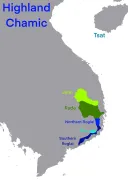
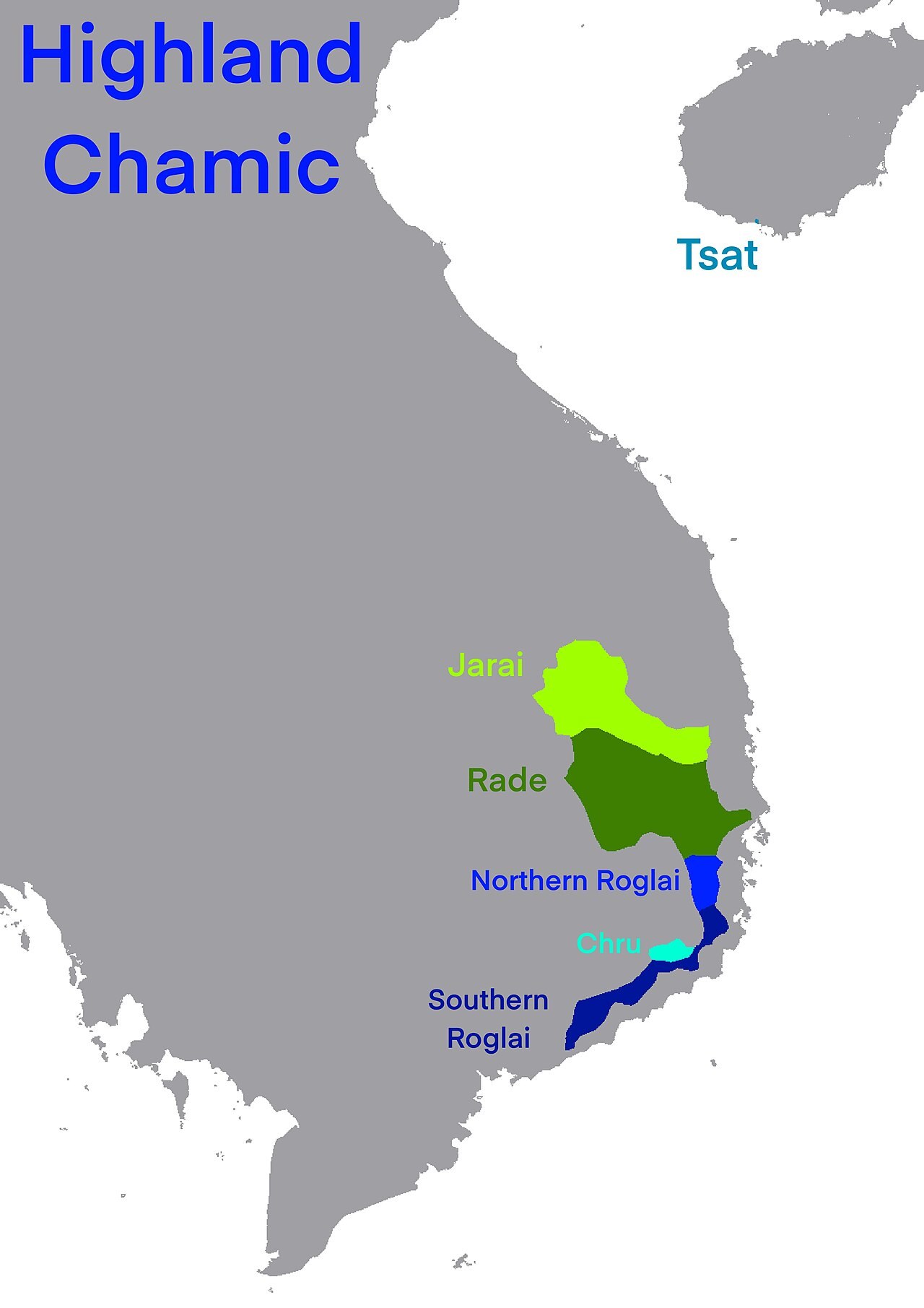
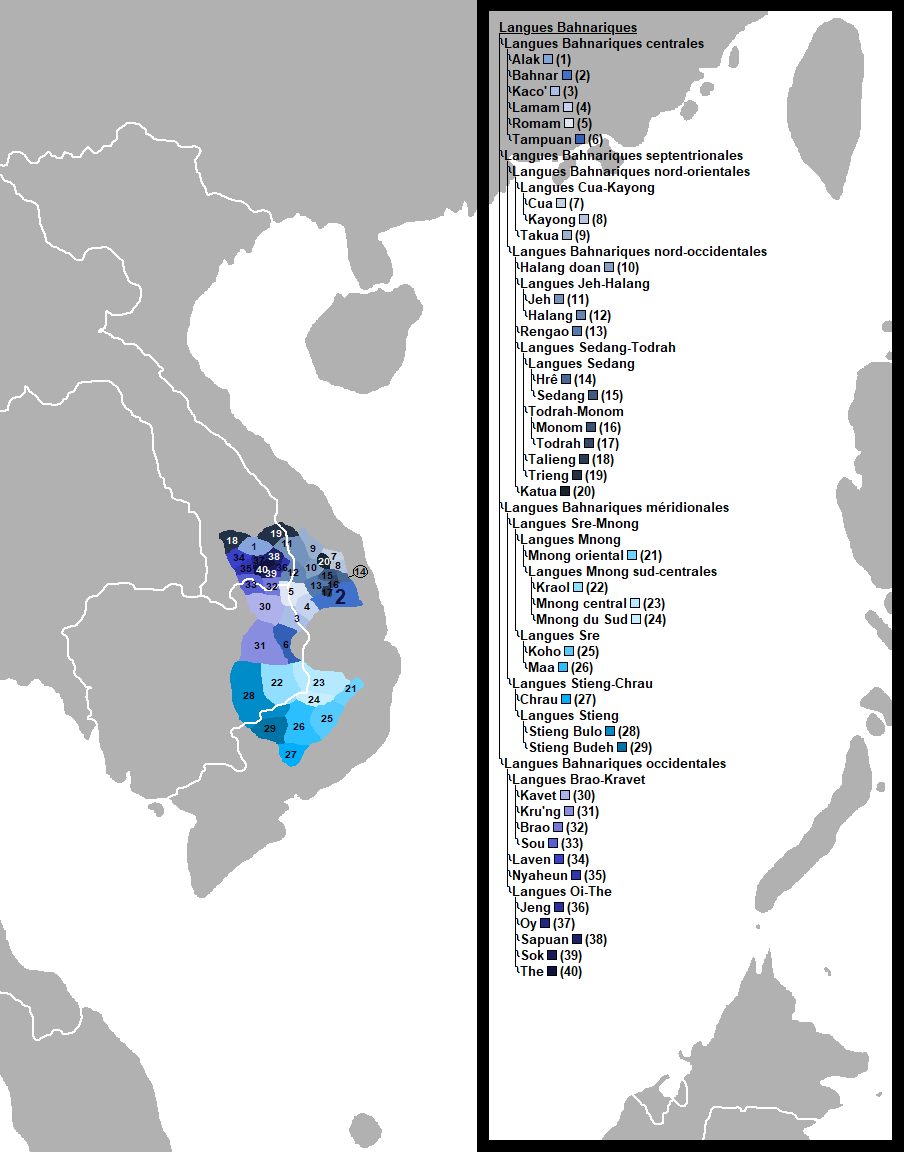
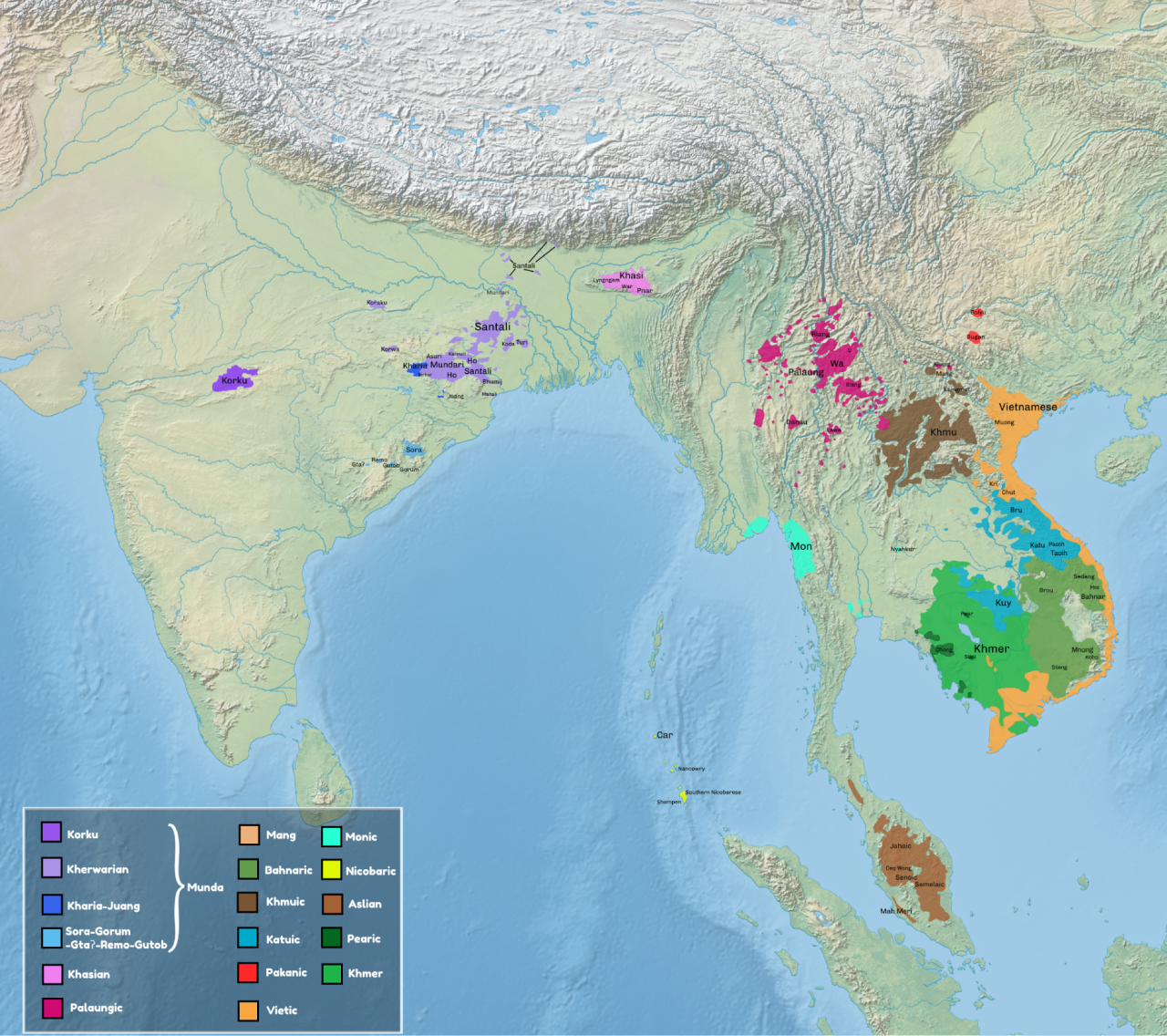
Our languages belong to two families that are not related to each other. The Chamic languages, Rhade, Jarai, Chru, Roglai and Haroi, are Austronesian, related to Cham on the coast and, further away, to Malay and Indonesian. The Bahnaric languages, Bahnar, Sedang, Koho, Mnong, Stieng, Hre and many more, and the Katuic languages of the northern end of the chain, Bru, Katu, Pacoh and Ta’oih, are Austroasiatic, related to Khmer. A Jarai and a Bahnar in neighboring villages speak languages of different families, and many of our people have always spoken more than one: the American army found in 1966 that the Rhade, Bahnar and Mnong who traded with the Jarai understood their language. See The tribes and their languages for the peoples themselves.


Codes
Linguists, libraries and software identify languages by codes. If you are publishing in, recording, or searching for material in one of our languages, these will find it. ISO 639-3 is the international standard; Glottolog is a free catalog of everything written about each language, and each link below goes to its page. The status column is Glottolog’s combined judgment, drawn from Ethnologue, the Catalogue of Endangered Languages and the UNESCO atlas.
| Language | Family | ISO 639-3 | Glottolog | Status |
|---|---|---|---|---|
| Rhade (Ê Đê) | Chamic | rad | rade1240 | not endangered |
| Bih | Chamic | ibh | biha1246 | nearly extinct |
| Jarai | Chamic | jra | jara1266 | not endangered |
| Chru | Chamic | cje | chru1239 | shifting |
| Northern Roglai | Chamic | rog | nort2994 | threatened |
| Southern Roglai | Chamic | rgs | sout3010 | threatened |
| Haroi | Chamic | hro | haro1237 | shifting |
| Bahnar | Bahnaric | bdq | bahn1262 | not endangered |
| Sedang | Bahnaric | sed | seda1262 | not endangered |
| Todrah | Bahnaric | tdr | todr1244 | not endangered |
| Monom | Bahnaric | moo | mono1268 | not endangered |
| Kayong | Bahnaric | kxy | kayo1245 | not endangered |
| Rengao | Bahnaric | ren | reng1252 | threatened |
| Halang | Bahnaric | hal | hala1252 | threatened |
| Jeh | Bahnaric | jeh | jehh1245 | not endangered |
| Hre | Bahnaric | hre | hree1244 | not endangered |
| Cua | Bahnaric | cua | cuaa1241 | threatened |
| Takua | Bahnaric | tkz | taku1254 | not endangered |
| Romam | Bahnaric | rmx | roma1331 | shifting |
| Trieng | Bahnaric | stg | trie1243 | not endangered |
| Brao (Lave) | Bahnaric | brb | lave1249 | threatened |
| Koho | Bahnaric | kpm | koho1244 | not endangered |
| Maa | Bahnaric | cma | maaa1253 | not endangered |
| Eastern Mnong | Bahnaric | mng | east2333 | not endangered |
| Central Mnong (Bunong) | Bahnaric | cmo | cent1992 | threatened |
| Southern Mnong | Bahnaric | mnn | sout2692 | not endangered |
| Bulo Stieng | Bahnaric | sti | bulo1242 | shifting |
| Budeh Stieng | Bahnaric | stt | bude1236 | moribund |
| Chrau | Bahnaric | crw | chra1242 | threatened |
| Eastern Bru | Katuic | bru | east2332 | threatened |
| Eastern Katu | Katuic | ktv | east1236 | not endangered |
| Pacoh | Katuic | pac | paco1243 | threatened |
| Upper Ta’oih | Katuic | tth | uppe1406 | not endangered |
Some of our kin languages are spoken only across the border: Western Bru and Lower Ta’oih in Laos, Tampuan (tpu) and Kaco’ (xkk) in Cambodia, where Glottolog rates Tampuan as moribund. Tareng (tgr) has been retired as a separate code in Glottolog’s latest version. Bih, a Rhade variety that the catalogs treat as a language of its own, is the most endangered language on this list: it is used only among the Bih themselves.
How endangered
By the catalogs’ reckoning, most of our larger languages are not yet endangered. Rhade, Jarai, Bahnar, Koho, Hre and Jeh are rated as developing, with some written use; Sedang, Maa and most of the Mnong varieties as vigorous. Chru is shifting, replaced by Vietnamese in many parts of life. Haroi, Bulo Stieng and Romam are shifting too; Budeh Stieng is moribund; the Roglai, Rengao, Halang, Cua, Pacoh, Central Mnong, Chrau, Bru and Brao are threatened. Two warnings go with these ratings. Much of the evidence behind them is thin: many of the threatened ratings are marked as only twenty percent certain. And the speaker figures in circulation are old; the ones most often quoted, about 177,000 Rhade, 242,000 Jarai in Vietnam and 97,000 Sedang, rest on estimates made in 2007. For Koho a grammar of 2014 gives more than 207,000.
The ratings do not measure what is happening in our own homes. In North Carolina, parents are often hesitant to speak our languages to their American-born children, and the young people say it plainly: the parents mostly do not speak English, and the children mostly do not speak their parents’ language. A language not taught to children is gone in two generations, whatever the catalogs say about the villages.
Dictionaries, grammars and studies
Free to download, and free to share with credit:
- James A. Tharp and Y-Bham Buon-ya, A Rhade–English Dictionary with English–Rhade Finderlist (Pacific Linguistics, Australian National University, 1980). The standard Rhade dictionary, 386 pages, made with a Rhade co-author. The free “Rhade Dictionary” app for the iPhone appears to be built on it.
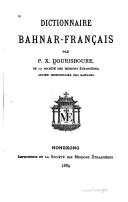
- Pierre-Xavier Dourisboure, Dictionnaire bahnar–français (Hong Kong, 1889), in our library and on the Internet Archive. The first dictionary of any of our languages.
- Kenneth D. Smith, Sedang Grammar: Phonological and Syntactic Structure (Pacific Linguistics, 1979).
- Paul Sidwell, Proto South Bahnaric (2000), on the history of Koho, Mnong, Stieng and their relatives; Paul Sidwell and Pascale Jacq, A Handbook of Comparative Bahnaric, vol. 1: West Bahnaric (2003).
- Mark J. Alves, A Grammar of Pacoh (2006); Ilia Peiros, Katuic Comparative Dictionary (1996); H. L. Shorto, A Mon-Khmer Comparative Dictionary (2006).
- David Thomas and others, eds., Chamic Studies (1977), with papers on Haroi and Chru; Further Chamic Studies (1998), with a paper on Roglai; Anthony Grant and Paul Sidwell, eds., Chamic and Beyond (2005).
- Joshua M. Jensen, The Structure of Jarai Clauses and Noun Phrases (University of Texas at Arlington, 2013). A technical account of Jarai sentence structure, free for non-commercial use.
Free to read online, but not licensed for copying:
- Neil H. Olsen, A Descriptive Grammar of Kơho-Sre (University of Utah, 2014). The fullest grammar of Koho, written, in its author’s words, for linguists and for Koho speakers who want to study their own language.
- Timothy M. Manley, Outline of Sre Structure (University of Hawaii dissertation, 1971; book, 1972).
In print or in libraries only: Paul Guilleminet and Jules Alberty, Dictionnaire bahnar–français (École française d’Extrême-Orient, 1959–63), about ten thousand words, still on sale; Pierre-Bernard Lafont, Lexique jarai, français, viêtnamien (1968); Jacques Dournes, Dictionnaire srê (köho)–français (1950) and his Jarai dictionary draft of 1964; R. Nicolle, Lexique français–jaray et jaray–français (Hanoi, 1940).
The Summer Institute of Linguistics, which worked in the highlands from the 1950s to 1975, keeps its papers in its Language and Culture Archives. They include language lessons for Jarai, Bahnar, Central Mnong, Hre and Pacoh, dictionaries of Bahnar, Sedang, Stieng, Halang, Eastern Mnong and Pacoh, and word lists such as the Koho list. The link above lists the Central Mnong items; change the three-letter code at the end for another language. Many items can be downloaded; we could not check their licenses, so check each one before copying. SEAlang keeps free back issues of the journal Mon-Khmer Studies, with comparative work on the Bahnaric languages. Ethnologue has a profile of each language; its full data needs a subscription.
Recordings of our speech
The largest bodies of recorded speech in our languages are in Paris, in the sound archive of the CNRS and the Musée de l’Homme, and most of them can be heard online free. Jacques Dournes recorded Jarai tales, ritual invocations, sayings of justice and conversations between 1966 and 1970, more than twenty-five hours in all. Georges Condominas recorded the Mnong Gar from 1953, and their neighbors, the Lac, Maa and Sre, in 1958, and went back in 1967 and 1982. Anne de Hauteclocque recorded more than fourteen hours of Rhade music in 1961. Geneviève de Chambure recorded Bahnar, Sedang, Rhade, Jarai, Koho, Mnong, Chru, Hre and others in 1957 and 1960. The archive’s anthology Viet Nam: musiques des Montagnards (1997) gathers fifty-three pieces with a long booklet. These recordings may be listened to; to republish them, ask the archive. They were made by outsiders, and the people in them are our grandparents. If you recognize a village or a name, tell us.
A long-playing record of 1967, Chants et danses des montagnards du Viet-Nam, recorded by Maurice Bitter, with Bahnar gongs, a Rhade xylophone and flute, and Sedang and Jarai ensembles, is on the Internet Archive for listening. Two of its fifteen tracks are Vietnamese songs, not ours. The Smithsonian’s Folkways record Music of Viet Nam (1965) includes Bahnar and Sedang pieces. Our own organization made a record of the music of the five major peoples, Anak Cu Chiang, with a booklet of songs, photographs and translations. For how to make recordings of your own elders, see How to record an elder.
Scripture and broadcasts
For many of our families the first book they owned in their own language was a Bible, and whatever your faith, the scriptures and the missionary broadcasts are among the largest bodies of written and spoken text in our languages. Bible.com has Jarai in three versions, one with audio; Rhade, the Klei Aê Diê Blŭ of 2015, with audio; Koho (2018) and Bahnar, both with audio; and Central and Eastern Mnong, Chru, Hre, Bulo Stieng, Chrau and Pacoh. The Global Recordings Network has short spoken programs in Jarai, Rhade, Bahnar, Sedang, Koho, Central Mnong, Chru, Hre, Stieng and Northern Roglai, free to copy for non-commercial use. The JESUS film gives more than two hours of spoken Bahnar, and there is a Rhade version.
Learning in the diaspora
Our communities in North Carolina have tried to teach the languages and have found it hard. The Montagnard Dega Association has tried to offer classes but has too few qualified teachers and too few materials. In 2019 members of the Montagnard American Organization translated a folktale into Rhade and Koho, with the English alongside, for younger children. The Montagnard Association of North Carolina runs a youth program in which young people learn and teach Jarai, Ede and Bunong. Some have learned through interpretation courses, some through the hymnbook and the Bible, and some from their grandparents. When the City of Greensboro needed to reach families during the pandemic of 2020, it made videos in Rhade. In Vietnam, UNICEF supported a pilot of mother-tongue teaching for Jarai children in Gia Lai from 2008 to 2015.
What families can do
Speak the language at home, every day, including to children who answer in English. Record grandparents telling stories, naming plants, singing, and write down who they are. Keep letters, school books and hymn books. If you teach a class in one of our languages anywhere in the diaspora, tell us, and we will list it here. We have not found a published curriculum, a list of teachers or an online course for any of our languages; if one exists, we want to know.
See also: The smaller peoples, Schools, language and the university gap, Writing our languages, Gongs and epics.
Sources
- Glottolog 5.3 (Hammarström, Forkel, Haspelmath and Bank), the page for each language linked in the table, and the map of the languages of Viet Nam — codes and endangerment ratings, which cite Ethnologue (2025), the Catalogue of Endangered Languages (2022) and the UNESCO atlas (2010)
- Ethnologue — the speaker estimates for Rhade, Jarai and Sedang, from Bradley (2007)
- Australian National University Open Research, Pacific Linguistics — the dictionaries and grammars linked above, released under Creative Commons licenses
- Neil H. Olsen, A Descriptive Grammar of Kơho-Sre (2014) — the Koho figure and the purpose of the grammar; Joshua M. Jensen, dissertation page — the license
- École française d’Extrême-Orient, catalog entry for Guilleminet and Alberty; Citizendium, Jarai language bibliography — the Jarai lexicons of 1940, 1964 and 1968
- SIL International, Language and Culture Archives, items 31000, 35754 and 43107
- CNRS – Musée de l’Homme sound archive (CREM), collections of Dournes (1966–70), Condominas (1953–82), Hauteclocque (1961) and de Chambure (1957, 1960), and the anthology of 1997; the record of 1967 on the Internet Archive, with its recordist named in the CREM catalog; Smithsonian Folkways FE 4352, Music of Viet Nam (1965)
- Bible.com, language pages; Global Recordings Network, language pages and copyright terms; JESUS film, Bahnar
- NBC News, “The young Montagnard generation in the U.S. is using art and social media to keep their culture alive” (2022); YES! Weekly, “Preserving Montagnard culture in the Triad through the arts” (2022); Triad City Beat, “How the younger generation is working to be the ‘voice of the unheard’ for Montagnard elders” (2021); Montagnard Association of North Carolina, programs page; Guilford College, “Found in Translation” (2019); City of Greensboro videos in Rhade (2020), Internet Archive
- UNICEF Viet Nam, “Bringing mother tongues into the classroom” — the pilot of 2008–2015
- Our own records — the record Anak Cu Chiang
Compiled September 2026. Endangerment ratings and speaker figures are the catalogs’, not ours, and several rest on weak or old evidence. Some Ethnologue and SIL pages require an account. Licenses were checked on the publishers’ own pages; check again before copying.