















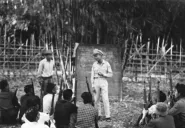
In Vietnam nobody owns land. The land belongs to the entire people, the State represents the people, and what a family holds is a right to use, written on a certificate with red covers. That arrangement did not have to be aimed at us to take our country from us. A registry that records the field a family is cropping this season, in one household’s name, cannot record a clan estate of rotating fields, sacred groves and twenty-year fallow held by a lineage through its women. One hectare under crop needs five to fifteen lying fallow. Register the one and the rest is unused land. Nothing had to be stolen. The units of measurement did the work.
How the land was held
The description of highland tenure that the state cannot dismiss is the one the state commissioned. The World Bank wrote it for the Vietnamese government in a customary land tenure study dated May 20, 2004, and the field survey in the Central Highlands was carried out by a highland researcher. The Bank’s own business in Vietnam was land titling and registration, so what follows is what a lender looking to register land found when it looked at ours. It describes what our elders describe. The difference is that this version was put in front of the government, which is why we lead with it, and we would rather have an elder’s own account of the same system beside it.
The study records that the village headman — khoa buon or khoa pin ea among the Rhade, khroanh bon by among the Mnong — represents the community and has full authority over the management and use of forest land. It names the law he decides under: klei duê or klei bhian for the Rhade, phat ktuoil for the Mnong, to loi phian for the Jarai. It records that all members of the community have equal access, on a first-come first-served rule. And it contains one sentence that is the whole argument of this page:
“Sacred forests, cemetery forests, and watershed protection forests are usually inalienable.”
Inalienable. Not held cheaply, not held informally — held under a rule that says they cannot be given away by anyone, including by the person holding them. There is no line on a Vietnamese land use certificate for that. See Customary law and Sabatier and the Rhade code.
Human Rights Watch described the same system in 2002 from the other side, from what people had lost:
“The customary lands of the indigenous minorities included paddy rice fields, swidden plots, graveyards, and house sites. Traditionally these lands were considered family property and inherited through the female line.”
“for each hectare of farmland currently under cultivation, another five (for relatively rich soils) to fifteen hectares must be kept fallow and held in reserve.”
Families kept their rights to a swidden plot whether it was in crop or in fallow. The village held streams, pastures, drinking water, and the forest nearby for rattan, bamboo, mushrooms and medicine. The elders set the boundaries.
Do the arithmetic and the mechanism appears. A survey that records only what is under crop this season records somewhere between a sixth and a sixteenth of what a village actually holds. Everything else appears on the map as empty. See The rice year.
Six moves
The law that governs our land was not made for our land. It is the law of the northern delta — landlords, land reform, cooperatives, household contracts — applied afterward to a plateau that had never had a landlord or a cooperative, and where the unit of tenure was the clan.
The northern sequence ran: land reform from 1953 to 1956 taking land from French-backed landlords and giving it to households under the slogan land to the tiller; collectivization from 1959, which put about 95 percent of northern farmland into cooperatives; Contract 100 in 1981, letting a farmer keep a share of the harvest; the reforms of 1986; and Contract 10 in 1988, which freed prices. Then that machinery was pointed at us.
1. 1975: the farms arrive
The figure to lead with is old and specific. It comes from a 1996 country profile by Neil Jamieson for Winrock International, and it reaches us through Human Rights Watch rather than from the profile itself. It rests on one writer and one count, and we have not found a second source for it:
“In combination, sixty-four state Farms and forty-two state Forest Enterprises controlled 86 percent of the land in Dak Lak, including virtually all of the high quality land, but encompassed only 20 percent of the population.”
Eighty-six percent of a province, virtually all of the good ground, for a fifth of the people. That is the largest single transfer in this whole story and it happened before any land law existed.
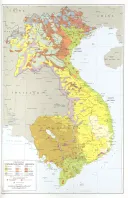
What the province looked like around it: in 1921 there were twenty ethnic Vietnamese living in Dak Lak. In 1943 there were about eighty thousand people in the province, of whom four thousand were Kinh. In 1975 the indigenous minorities were 48 percent of it; by 1978, Kinh were 61 percent; by 1997, of about 1.5 million people, Kinh were around 70 percent and we were around 20. Between 1976 and 1998 the province absorbed 623,000 new settlers. A 1996 survey found that planned and spontaneous migrants held an average of 1.26 hectares per household, at which rate provincial officials reckoned the new arrivals could have cleared as much as a hundred thousand hectares of forest in twenty years. See The great migration and How we got pushed off.
2. 1987: the first Land Law
The first unified land law of the unified state. We have not been able to obtain its text or an independent account of it, and rather than describe a statute we have not read, we say so and move on.
3. 1993: the household, the red book, and the fallow
The 1993 law is where the machinery reaches the village. It gave twenty-year use rights over agricultural land, recorded them on a certificate, and attached five legal rights to them: transfer, exchange, lease, mortgage, inherit. As Human Rights Watch put it, all land still belongs to the state, but individuals can acquire the right to use and occupy it and may buy, sell, inherit and lease that right.
Three sentences from the same report are the heart of this page:
“Plots of land customarily used by highlanders and left fallow to restore fertility are difficult to title and instead are often distributed to new settlers.”
“the law does not accommodate the customary communal ownership of land by many highlanders”
“The land law tends to recognize only one name per household on land use certificates, which are primarily issued to men”
And alongside them, the power that was always there: the government may recover possession of land if it is needed for national defense, security, or the national or public interest.
4. 2003: the community becomes a land user, on paper
The 2003 Land Law was the first to list a community of population among those who may hold land. It is a real change and it did not reach us, and the World Bank said why within a year. In a policy brief of July 2004 the Bank found that community was recognized for the allocation of agricultural land, but was not listed among those eligible to receive production and protection forest. Most of what a highland village actually holds — the groves, the rotational land, the watershed — is classified as forest land. The door was opened onto the part of the house we do not live in.
The same law extended terms to fifty years for perennial crops and allowed certificate holders to sell their land rights outright. From 2003 a red book was an asset that could be sold, and in the highlands it was.
5. 2013: the Constitution, and a law that names us
The 2013 Constitution states the principle at Article 53: land, water, minerals and the other natural resources “are public properties, coming under ownership by the entire people represented and uniformly managed by the State.” Article 54 allows the State to recover land “for the purposes of national defence, national security, and socio-economic developments for national and public interests,” with compensation. Article 5 promises that all nationalities are equal. Article 58 gives priority health care to highlanders and minorities.
Read together, the shape is worth noticing: the Constitution promises minorities development. It does not promise them land.
The 2013 Land Law does have an article about us. As quoted in a World Bank project document, Article 27 provides:
“The State is responsible for development of policies on residential land and land for public activities for ethnic minorities in accordance with customs, traditions, cultural dignity and the practical situation of each region; development of policies to facilitate for ethnic minorities who are directly involved in agricultural production in the countryside to have land for agricultural production.”
Article 110 exempts or reduces land use fees for minorities in difficult areas. Article 133 gives priority in allocation or lease to minority households without production land. Article 62 is the recovery power for socio-economic development in the national and public interest. Article 98, clause 4, requires certificates for common property to carry the full names of both spouses unless the couple agrees otherwise.
Reference sources disagree about whether the customs provision is Article 26 or Article 27. We give it as 27, because that is the number under which a World Bank project document quotes it verbatim, and we note the disagreement rather than hide it.
6. 2024: the new law
Law No. 31/2024/QH15 was passed on January 18, 2024. Its Article 12 restates the principle: “Land is under the entire-people ownership in which the State acts as the owner’s representative and performs the unified management.” The English text we have worked from is published by a private Vietnamese legal publisher, not by the state, and we say so because it matters what we are quoting.
Three things in it deserve attention, and one of them is genuinely new.
The clan enters the statute. Article 3, item 13 defines a residential community as a community of Vietnamese living in the same village, hamlet or residential group “who share the same customs and practices or the same family clans.” That is the first time Vietnamese land law has put a clan inside a definition. We should not oversell it — it is a definition, not a right — but the Rhade and Jarai unit of tenure was exactly a clan, and the law now has a word for it.
The State admits allocation did not hold. Article 16 sets out the State’s responsibilities toward ethnic minority people: land reserved for community activities in keeping with customs, beliefs and local conditions; first-time support for poor minority households, by way of residential land allocated with the levy waived, agricultural land allocated without levy, or non-residential land leased with the rent reduced. And then clause 3 provides support for minority people who were allocated or leased land by the State and no longer have land, or lack land. Read that again. The statute now contains a category for people the State gave land to who have since lost it. That is an official acknowledgment, in law, that the system does not hold what it hands out.
And community tenure is second class by construction. Article 39 gives a land-using residential community the same rights as an individual with the corresponding form of land use — except the right to bequeath. Where the land was allocated without a levy, the community may not convert, transfer, donate, lease or mortgage it, or contribute it as capital.
Consider what that means in a country where the whole practical value of a red book is that a bank will lend against it. A community may hold land and may not borrow against it, sell it, rent it or leave it to anyone. And inheritance is precisely what a matrilineal estate is. Of the rights removed, the removal of bequest is the one that cuts at us directly.
On recovery, a Vietnamese law firm counts 31 specific cases in Article 79 for which land may be recovered for socio-economic development in the national or public interest, and notes that the National Assembly may add further cases by an abbreviated procedure. We give the count as that firm’s, and we note the qualification: a fixed list is fixed only until it is amended.
The International Work Group for Indigenous Affairs asked the practical question about all of this, and it is the right one. Almost all land in Vietnam already has an assigned user. So where would land for minorities actually come from? Its answer: from land reclaimed from organizations, businesses and state entities using it inefficiently, and from areas where companies have encroached or rented out land in breach of the rules. The 2024 law’s promise to landless minority households is payable out of the state farms and the forest companies. Which is why they are the next section.
How a red book actually works
A giấy chứng nhận quyền sử dụng đất is a certificate of the right to use land, held from the State. Red covers; hence the name. Thirty-eight million had been issued nationally by 2013. By 2012 the ministry reported certificates covering 80 percent of agricultural land, 65 percent of forestry land and 75 percent of rural residential land.
Whose name goes on it is where matrilineal tenure dies, and the sequence is documented.
Under the 1993 law the certificate carried one name, and it was usually a man’s. The 2003 law required both spouses’ names on jointly held plots; the 2013 law restated it at Article 98. By 2014, agricultural certificates stood at 46 percent in a man’s name alone, 15.7 percent in a woman’s alone, and 38.3 percent joint; for residential land, 39 percent in a male household head’s name, 6.2 percent in a female head’s, 55.6 percent joint. Among women holding agricultural certificates in 2012, the rate was 36 percent for Kinh women and 21 percent for minority women.
Now look at what the correction corrected. The problem in 1993 was that the certificate assumed a household with a head. The fix in 2003 was to require the names of both spouses — which assumes that the marital couple is the unit and that the husband is the default the wife is being added to. Neither version has a box for a po lan: a senior woman holding clan land on behalf of a lineage that includes households she is not married into. A matrilineal clan estate cannot be written onto either form. Where it gets registered at all it is registered as a scatter of nuclear-household plots, and from that moment it behaves like private property. It can be sold. And it is sold. See The Rhade and Dega women.
The World Bank’s country social analysis of ethnicity in Vietnam described the result in two sentences in 2009:
“Land rights and land use have changed for most minority groups from a system in which community-managed land was not commoditized to a system where land is more owned by individuals and can be bought and sold.”
“Consequently, landlessness has increased in minority areas.”
And on the forest: minority regions are dominated by forest and forest land, and minorities cannot draw a livelihood from it, because forest land is under state control and is therefore no longer available for community use.
The state farms and the forest companies
This is the largest holding in the country and the one the 2024 law’s promises are drawn on. The story is in three acts: the enterprises took the ground in the 1970s and 1980s; from 2003 the state decided they were inefficient and ordered them restructured; and the handback handed back rock.
In 2005 the World Bank reported that state forest enterprises controlled about 40 percent of all forest land in Vietnam, that some 362 remained, and — a sentence worth reproducing exactly as a warning — that “There are no reliable, updated national statistics currently available on SFEs.” The state’s own accounting of its largest landholding was missing.
The instruments were Resolution 28/NQ-TW of June 2003, which mandated renovation; Decree 200/2004/ND-CP of December 2004, which turned business enterprises into one-member limited liability companies, converted those holding more than five thousand hectares of protection forest into management boards, and dissolved those with three straight years of losses; and Resolution 30-NQ/TW of March 2014, which carried it further. The Bank expected a reassessment of the land base and a redistribution of about one million hectares.
What happened, in hectares, is set out in a 2015 study by Forest Trends and Tropenbos International. State forest enterprises held 3.828 million hectares before 2005. By 2011, 1.904 million hectares was held by 148 forest companies. Two hundred and fifty-six enterprises had become 148 companies, three joint-stock companies and 91 management boards, and fourteen were dissolved. Forest management boards held roughly 4.5 million hectares. Households held some 3.4 to 4.5 million. Communities held almost 600,000 hectares — about four percent of allocated forest land. And 3.2 million hectares of forest land had still not been allocated to anyone.
Then the two sentences that are the handback entire:
“600.000 ha of land have been withdrawn for re-allocation to local people”
“most of this land is not suitable for cultivation as it lies in remote, impoverished areas”
A million hectares was the target. Six hundred thousand came back. And the study’s own judgment is that it was not land anyone could farm.
The same study records what followed: “On-going inequality in land access has led to conflicts between FC and local people, occurring almost everywhere FC have appropriated land.” The forest administration put the disputed area at about 7,600 hectares; the study says the real figure was much higher, and notes one dispute in the north that alone ran to 19,000 hectares, and a protection forest in Binh Phuoc of which 90 percent had been encroached on. It ends by asking why the state should not allocate land and forest directly to households instead of to unproductive companies and management boards. An indigenous organization is entitled to quote that approvingly.
The World Bank’s land governance assessment of December 2013 said the same thing about us by name:
“rights of ethnic minority forest dependent communities on the forest land, which were put under the control of state forest enterprises in 1970s-1980s and have been used by them ineffectively, still have not been recognized”
“land policies applied for ethnic minorities neglect their customary practices, which are based on community land management and use and have been proved as effective and sustainable in centuries”
Its recommendation was to give priority to reallocating land from the state enterprises to minority communities. That was written in 2013, and the 2024 law is still looking for the same land.
How much community land there could have been was costed twenty years ago. The Bank’s 2004 work estimated that some 2.5 million hectares of forest land were already being managed in fact by communities, that 1.1 to 1.4 million hectares had been allocated or contracted to them, and that a further half million to a million hectares could be transferred out of the state forest enterprises. A pilot in one northern province allocated 54 percent of its area to village communities between 2001 and 2003. The state was given an option, with numbers attached, and did not take it.
Where it ended up: as of 2015, about 2 percent of forest land had been allocated to communities, against 26 percent to individuals, the rest held by state enterprises, management boards or communes. Set that beside another finding, from research across three provinces including Dak Lak: 85 percent of ethnic minority villages still maintain forest protection rules, and 60 percent still have community forests protected by customary law.
Eighty-five percent of villages still governing their forest by their own law. Two percent of the forest legally theirs. That pair of numbers is the best single statement of what this page is about. See Forests and logging.
Meanwhile the landless were counted. More than 300,000 households in the mountain regions lack cultivation or residential land, according to a National Assembly evaluation cited independently by two sets of researchers; 340,000 households were recommended for land allocation between 2002 and 2011, at a cost of about 1.15 billion dollars. And land complaints are not a highland peculiarity: land accounts for 70 to 80 percent of all complaints the Vietnamese state receives every year. Of roughly a million complaints between 2003 and 2012, only about half were correctly or partly correctly handled.
Three cases
D village, Buon Ma Thuot, 1985 to 2000
Human Rights Watch obtained two petitions in September 2001 and published them, withholding the village’s name. It is a Rhade hamlet of 113 households, 615 people in 1995 and 644 by 2000, in Buon Ma Thuot city.
In 1985 the village was moved by government order, and officials promised that its former lands remained its own. In 1986 the province took 480 hectares for the provincial forestry service, to be a tree nursery; employment was promised and did not come. By 1990 two of the village’s sections and the reservoir ground had been distributed to ethnic Vietnamese, and what was left to 615 people was about ten hectares. In 1992 the forestry service contracted forty hectares of the nursery land to an outsider, who planted trees and cashews on it. In 1995 the forestry unit used armed men to take more; villagers worked their own former fields for a hundred thousand dong per tenth of a hectare.
They petitioned the Central Committee on Nationalities in 1995:
“As far as the nursery goes, we agree with the economic plan of the state as it was set out in the beginning. But [instead] the trees are being cut down and the land has been leased out and rent collected on it.”
“As a result of this situation the people in the hamlet of D are in desperate straits, and before long, deaths are going to result either as a result of starvation or struggles to make a living.”
And again on October 24, 2000:
“Five full years have gone by, and we have received no reply… Our difficult economic situation has become even worse.”
“If this land is indeed not being used for community purposes, which is the case, we ask that it be returned to the people of the village to use.”
Notice what they are not saying. They do not dispute that the state owns the land. They accept the economic plan as it was set out at the beginning. Their complaint is that the public purpose was a pretext — that the nursery became a lease and the lease became rent in somebody’s pocket. That was put in writing, twice, to the correct authority, and answered with five years of silence.
The land of “T”, Dak Mil district, 1999 to 2001
This is the case that shows a red book doing nothing at all. T was a Protestant youth group leader, interviewed in July 2001. He got his land use certificate in 1999. Asked what it meant, he said:
“It means that my whole life I will have the land.”
Inspectors came in 2000 and told him the land was already the government’s. He told them he would struggle with them even if he died, because it was his land. They answered:
“You can’t work it because the district government has decided already. You have no power to oppose us.”
On May 8, 2001 a tractor came. He tried to stop the driver, who called four other men, one of them a policeman.
“I asked him to help me. He said, ‘I don’t have the ability to help you-I can’t help you.’”
“When they plowed my land I was devastated. The coffee was to support my life. When they plowed it, it was like they killed me. They plowed it all-500 coffee plants, one well, and eighty-seven pepper plants. Afterwards, I had nothing left.”
“It was because I was the leader of the youth religious group that they took my land. They didn’t do this to my followers. The authorities had been monitoring me for some time.”
And when he asked for compensation, an official told him:
“This land belongs to the state, gained by the sacrifice of untold numbers of revolutionaries, and doesn’t belong in the slightest to America. Here you are practicing an American religion-why should you expect the state to come up with money for you?”
A certificate that a district government is not bound by is not a title. It is a receipt. And a 1993 police order in Dak Lak confiscating a church leader’s property on the ground of illegally propagating religion shows that land recovery and religious control have run on one track for a long time. See The evangelical church and registration.
Hoang Anh Gia Lai, and the border that decided everything
A company from Gia Lai took rubber land on both sides of the Cambodian border. Global Witness documented in 2013 that Hoang Anh Gia Lai held 47,370 hectares in Cambodia — five times the legal limit for a single concession — and some 26,549 in Laos; and that the Vietnam Rubber Group held 161,344 hectares in Cambodia, sixteen times the limit. Three subsidiaries operated in Ratanakiri. A villager told the investigators: “I told the bulldozer driver not to clear my land and he stopped. The next day my land had completely disappeared.” An elder said: “Losing the forest is like losing life.”
Then something happened that has never happened on our side of the line. In February 2014, fourteen villages — about fifteen thousand Jarai, Kachok, Tampuan and Kreung people — filed a complaint with the compliance office of the International Finance Corporation, because the company had taken money from institutions that have a complaints office. Compensation to that point had been fifty kilograms of rice per household, against land that produced three or four tons of rice a hectare a year. In September 2015 the company apologized, said it had made mistakes, and committed to return unplanted land. Between November 2017 and May 2018 a joint demarcation identified 64 sacred and traditional-use areas. In March 2019 the provincial governor announced that all 742 hectares in those areas would be returned for the indigenous people to practice their beliefs and traditions and support their livelihoods. The process then broke down — in March 2020, with communities sheltering during the pandemic, land earmarked for return was cleared, including spirit mountains, wetlands and burial grounds — and was rebuilt: in June 2024 a memorandum with twelve villages returned more than seven hundred hectares.
The Jarai of Ratanakiri got their burial grounds mapped, named and given back. The Jarai of Gia Lai, one border away, are the same people with the same claim, and they have no such mechanism, because on our side the land was taken by the state itself and there is nobody to complain to who is not the state. That contrast is the strongest argument on this page. See Rubber and Kin across the border.
The same lesson comes out of the dams. At Lower Sesan 2 nearly five thousand people were displaced — Bunong, Brao, Kuoy, Lao, Jarai, Kreung, Kavet, Tampuan and Kachok — and offered about five hectares in a resettlement area, a prebuilt house or six thousand dollars, and one year’s cash for the fish they would no longer catch, on soil described as rocky and less fertile. More than 180 families refused, and by 2021 those families had still not received the communal land titles they were promised. A Bunong man said: “I can’t leave my ancestors here…I will lose my identity.” A resident of another village said: “They determined things for us. They didn’t ask what we want.” The thing that did not arrive was the communal title. See Lower Sesan 2 and The dams.
What it sounds like
These are highland accounts recorded in 2001. They are the direct evidence of what the arithmetic above did to particular families, and the only part of this page where the loss is described by somebody who suffered it.
A Rhade man from Buon Cuor Knia, in April 2001:
“My grandfather had more than five hectares of land. The government took the land and gave only part of it to me-less than a hectare. In the past we did shifting agriculture, moving our farm plots around. The fallow land was part of our land. Now we just farm in one place. I have just enough land to feed my family, but nothing left over.”
A Jarai farmer, in June 2001:
“In the past, during the time of my grandparents, my family’s land was larger. We had about three hectares. I had that land during the war, and my grandparents before me. It was enough to support my family, planting rice. Later, after liberation, they plowed it for rubber. From 1977 until now, they started taking my land. They keep squeezing me. In 1977 they took a little bit and then in 1978 they took the rest. It was for a state rubber plantation. Since 1978, I’ve had less than half a hectare.”
“When we protested about the land problem, the authorities told us to complain to the province. But we don’t know how to write-how can we protest. Many people in my village have the same problem. Their land has been taken away.”
He was beaten in detention for saying he wanted the land back, and was asked whether he would stop. He said he would not.
A Mnong from Dak Mil, in July 2001:
“In my village from 1994-2000 the Vietnamese took our land—even plowing over our cemetery to build their houses. People were very unhappy when they plowed over the cemetery but did not dare oppose them.”
A Rhade man on how a dispute goes:
“When conflicts first arise, often it is just a small spat between a couple of highlanders and ethnic Vietnamese people over a patch of land. The next day many more Vietnamese come—how can we fight with them?”
And on what happens when you report it, from Buon Cuor Knia: “They dutifully write down a report. But the problem continues.”
A Jarai man from Dak Doa on the form of dispossession that needs no paperwork at all:
“In the dry season they redirect the water so it’s difficult for us to grow our crops. Then right before the rice is ready for harvest, our fields get completely flooded out. This has been happening since 1981.”
And one detail from a case in Phú Yên, where bulldozers razed a plot a man had farmed for nine years and he was offered two million dong against the more than seven million he had spent clearing and planting it. When the police came to make him take his house down, they arrived, he said, “fully equipped with guns and ammunition, a movie camera, and handcuffs.”
The movie camera is the detail to keep. Somebody wanted a record of a lawful proceeding.
What the law does not recognize
Our own law has no standing. Vietnam’s Civil Code permits customary practice only where it is consistent with formal law — which is to say, customary law is permitted to agree.
And we are not, in Vietnamese law, indigenous. As Minority Rights Group International puts it:
“Vietnam does not recognize that indigenous communities have customary ties to their lands and natural resources, even though this is enshrined in international law”
Until 2024 the village had no legal personality for a land transaction at all. Now it has one — the residential community — and with it, by Article 39, the explicit incapacity to transfer, mortgage, lease or bequeath. That is a real change with a real limit, and it should be described as neither nothing nor a solution. See Stateless in our own country.
What the treaty bodies have said
Vietnam ratified the Convention on the Elimination of All Forms of Racial Discrimination on June 9, 1982, and the Covenant on Economic, Social and Cultural Rights in September of the same year. See What Vietnam signed.
The Committee on the Elimination of Racial Discrimination set out the standard in its general recommendation on the rights of indigenous peoples in 1997, calling on states to
“recognize and protect the rights of indigenous peoples to own, develop, control and use their communal lands, territories and resources and, where they have been deprived of their lands and territories traditionally owned or otherwise inhabited or used without their free and informed consent, to take steps to return those lands and territories.”
That was on the table in 1997, while the D village petition was going unanswered.
In its 2012 concluding observations on Vietnam the Committee noted the displacement of minorities and the confiscation of ancestral lands without prior consent or appropriate compensation, and called on Vietnam to safeguard indigenous rights over ancestral lands. In the same observations it recommended respect for the principle of self-identification by the Khmer Krom and the Degar; recorded deep concern at the socio-economic gap between disadvantaged minorities and the Kinh majority; and named discrimination and restrictions on religious practice among the Khmer Krom, the Degar and the Hmong. A United Nations treaty body used our own word for ourselves, in a formal recommendation about who has the right to say what we are. See Who are Dega.
In 2023 the Committee recommended that Vietnam recognize indigenous peoples in accordance with the principle of self-identification, and called for an end to what it described as a systematic practice of violence, intimidation, surveillance, harassment, threats and reprisals against those defending minority and indigenous rights.
The Human Rights Committee, in 2019, recommended that Vietnam ensure meaningful consultation with these communities over development projects affecting their livelihood, lifestyle and culture, and carry out consultations with indigenous peoples with a view to obtaining their free, prior and informed consent.
Article 1 of the Covenant on Economic, Social and Cultural Rights says that all peoples may freely dispose of their natural wealth and resources and that in no case may a people be deprived of its own means of subsistence. The subject of that sentence is a people. The means of subsistence of a highland people is a rotational field system, and a rotational field system includes its fallow.
And the Declaration on the Rights of Indigenous Peoples, which Vietnam voted for in 2007, has an article for each stage of what is described above: Article 25, the spiritual relationship with traditionally owned lands; Article 26, the right to the lands themselves, with legal recognition to be given with due respect to indigenous customs, traditions and land tenure systems; Article 28, redress by restitution or fair compensation for lands taken without free, prior and informed consent; Article 32, the right to determine priorities for the development of those lands. See Vietnam and UNDRIP and Indigenous rights at the UN.
What would have to change
Article 27 of the Declaration is the one this page ends on, because it does not ask for land. It asks for a process — “a fair, independent, impartial, open and transparent process”, established with indigenous participation, to recognize and adjudicate indigenous land rights.
Every case above failed at exactly that point, and none of them failed for want of a law. D village wrote to the correct authority and waited five years. T held the certificate the system issues and a district government was not bound by it. The Jarai of Ratanakiri got 742 hectares back not because Cambodian law is better, but because the company that took their land had borrowed from institutions with a complaints office — and the Jarai of Gia Lai, the same people, had nowhere to go, because the taker was the state and the adjudicator was the state.
The specific asks are on What we ask for and Land taken for coffee. This page exists to justify one of them: that there should be somewhere to take a claim that is not the office that issued the certificate, and that when the claim is heard, our own law should count as evidence.
What we could not establish
The text and content of the 1987 Land Law. The full list of the thirty-one cases in Article 79 of the 2024 law, of which we have only the count. The article numbers of the Forestry Law of 2017, which we know exists and replaced the 2004 law but whose text we have not read. Any comparison of certification rates between highland and Kinh households on the plateau, which almost certainly exists in a World Bank chapter we could not open. And what the prime ministerial decisions of 2002, 2004 and 2013 on land for landless minority households actually delivered, which nobody appears to have evaluated independently.
Two figures that circulate about us — that by around 2010 minorities held certificates to only one percent of Vietnam’s forest land, and that only four percent of minority people in the Central Highlands reported access to forest use — we have not been able to trace to any source, and we do not use them. What can be said with a source is in the sections above. See What we do not know.
Sources
- Human Rights Watch, Repression of Montagnards: Conflicts over Land and Religion in Vietnam’s Central Highlands, April 2002 — chapter III on customary lands and the fallow arithmetic, chapter V for the 86 percent and the Dak Lak population series, chapter VI for the 1993 law, for T of Dak Mil, and for the highland voices quoted here, and its appendices for the D village petitions of 1995 and 2000. The 86 percent sentence and the passages from T were verified against the published report
- Neil Jamieson, “Ethnic Minorities in Vietnam: A Country Profile,” Winrock International, Hanoi, March 1996, p. 8 — the sixty-four state farms, the forty-two forest enterprises, and the 86 percent, as quoted by Human Rights Watch
- Elke Foerster and Ulrich Apel (team leaders), Vietnam: customary land tenure study, World Bank, May 20, 2004, and the companion Customary land titling in Vietnam: policy brief, July 26, 2004 — the headman, the named bodies of customary law, the inalienable forests, the gap in the 2003 law between agricultural land and forest land, and the estimate of how much community land there could have been
- To Xuan Phuc and Tran Huu Nghi, Forest Land Allocation in the Context of Forestry Sector Restructuring, Forest Trends and Tropenbos International Viet Nam, January 2015 — the hectare series for the state forest enterprises, the 600,000 hectares withdrawn and what was in them, the conflicts, and the landless households
- World Bank, State forest enterprise reform in Vietnam: review of policy and implementation framework for Decree 200, November 2005 — the 40 percent of forest land, the absence of reliable national statistics, and the restructuring instruments; and Improving land sector governance in Vietnam, December 2013 — the unrecognized rights of forest-dependent minority communities, the neglect of customary practice, and the recommendation to reallocate from state enterprises
- World Bank, Country social analysis: ethnicity and development in Vietnam, 2009 — the commoditization of community-managed land, rising landlessness, and the exclusion of minorities from forest livelihoods
- World Bank, Benefits of Joint Land Titling in Vietnam (2020), Two-name land use certificates and gender inequality (2013), and Revising the land law to enable sustainable development in Vietnam (2012) — the naming practice on certificates, the 2014 breakdown, and the coverage figures
- World Bank, Ethnic Minorities Development Plan for Quang Ngai Province, July 2020 — which quotes Article 27 of the 2013 Land Law verbatim, and cites Articles 110 and 133
- Constitution of the Socialist Republic of Vietnam, 2013, Articles 5, 53, 54 and 58
- Land Law 2024, No. 31/2024/QH15, in the English translation published by LuatVietnam, a private Vietnamese legal publisher and not a state source — Articles 3(13), 4, 12, 16, 32 and 39. The count of thirty-one cases in Article 79 is CNC Counsel’s, a Vietnamese law firm, as is the note that the National Assembly may add further cases by abbreviated procedure
- Phuc To, Sango Mahanty and Andrew Wells-Dang, “From ‘Land to the Tiller’ to the ‘New Landlords’? The Debate over Vietnam’s Latest Land Reforms,” Land 8, no. 8 (2019), 120 — the legal history from 1953 to 2013, the landless households, and the land accumulation policy
- Open Development Vietnam, land, communal land and forest pages — the certificate totals, the complaints figures, the 2 percent of forest land allocated to communities (attributed there to Wells-Dang, Pham Quang Tu and Ngo Van Hong, 2016), and the finding that 85 percent of minority villages still maintain forest protection rules
- Global Witness, Rubber Barons, May 2013, and Inclusive Development International, “Cambodia: Hoang Anh Gia Lai rubber plantations” — the concession figures, the complaint of February 2014, the 64 demarcated sacred areas, the 742 hectares, and the memorandum of June 2024
- Human Rights Watch, Underwater: Human Rights Impacts of a China Belt and Road Project in Cambodia, August 2021 — Lower Sesan 2, the peoples displaced, the compensation, and the communal titles that did not arrive; and Montagnard Christians in Vietnam, March 2011, for the economic defense zone of February 2001 and the clashes at Chu Prong in 2010
- Minority Rights Group International, “Highlanders” — on the non-recognition of customary indigenous land ties
- International Work Group for Indigenous Affairs, The Indigenous World 2024: Vietnam — the passage of the 2024 law, and where land for minorities would have to come from
- OHCHR compilations for Vietnam’s Universal Periodic Review, A/HRC/WG.6/18/VNM/2 (2014) and A/HRC/WG.6/46/VNM/2 — our route to the concluding observations of the Committee on the Elimination of Racial Discrimination in 2012 and 2023 and of the Human Rights Committee in 2019, since the originals were not reachable. Where we give the Committee’s position, we are giving the compilation’s summary of it and say so
- United Nations Declaration on the Rights of Indigenous Peoples, Articles 25 to 28 and 32
Compiled September 2026. No Vietnamese government or state media source is used. Two Vietnamese private sources are: a commercial legal publisher for the English text of the 2024 Land Law, and a law firm for the count of cases in Article 79, and both are named where they are used. Where the law itself is quoted, the text comes from the World Bank, from the Constitute Project, or from that publisher. Several things on this page we could not settle and have said so rather than smoothed over: the content of the 1987 law, the article numbers of the 2017 Forestry Law, whether the customs provision of the 2013 law is Article 26 or 27, and the thirty-one cases in Article 79. Two figures often quoted about minority forest certification we could not trace to any source and do not repeat. The argument here is not that Vietnamese land law is unusually harsh. It is that a system built to register individually held, continuously cropped parcels will, applied honestly and without malice to clan-held, long-rotation, partly inalienable land, hand that land to whoever is standing on it in the year of the survey.