
















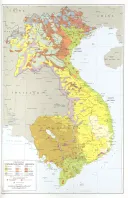


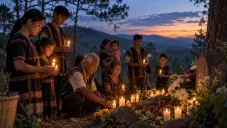



A village, the land around it held in common, kinship that decides obligation, and a moral order older than any state that has claimed us. Around thirty peoples, each with its own building, weaving, music and dance, held together by an animist thread that runs through all of them, and by a gong tradition that UNESCO has placed on the list of the intangible heritage of humanity. This page describes the village, the law, the things we make and play, what we believe, and then, in order, what three governments have done to all of it, in their own words where we have them.

The village is the unit
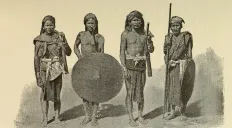
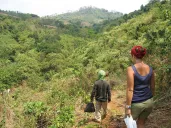
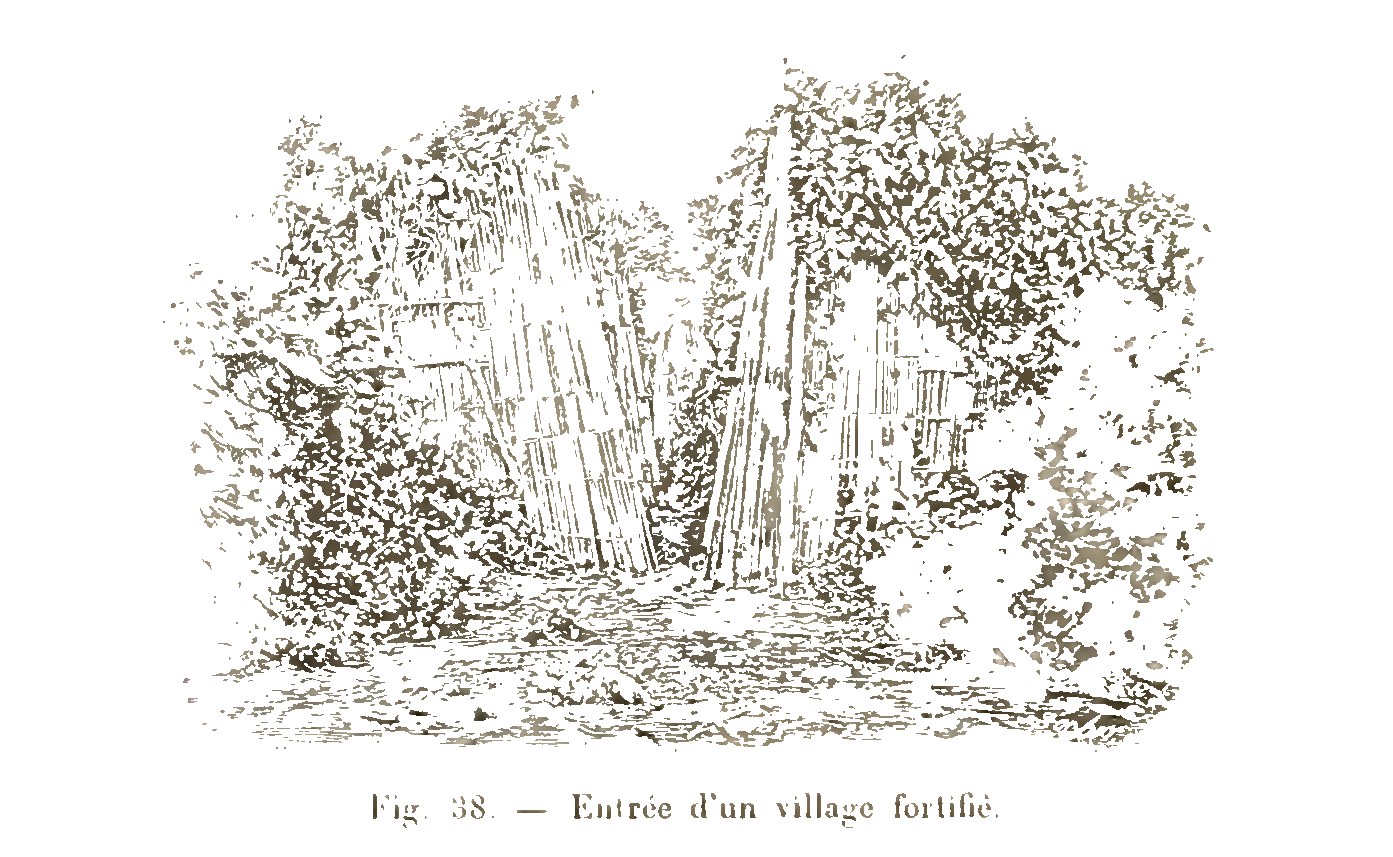
Dega life turns on the village: buôn in Rhade and Mnong, plei in Jarai, kon or plei in Bahnar. The village is not a place people happen to live near each other. It is the body that holds the land, settles disputes, feeds its old, and answers to the spirits of the ground it sits on. The first Frenchman to describe our villages from the inside, Captain Cupet of the Pavie mission, found them in 1891 “built in the center of an impenetrable thicket, forming an excellent defense,” with one or two paths cut in zigzags through the brush, a palisade, and at the gate a carved figure of the divinity charged with protecting the village against enemies and evil spirits, armed with a saber and a crossbow. Inside, among the Bahnar and their neighbors, the houses stood on the rim of a circle with the common house in the middle, “where people meet to talk after the day’s work, and where on feast days they drink rice beer together.” Among the Mnong, the Rhade and the southern Jarai, who built no common house, the houses stood close together “without concern for symmetry.” Villages took the name of their most influential man. The cemetery touched the houses. And the theft of rice, Cupet noted, was “considered a sacrilege and punished more severely than a murder.”
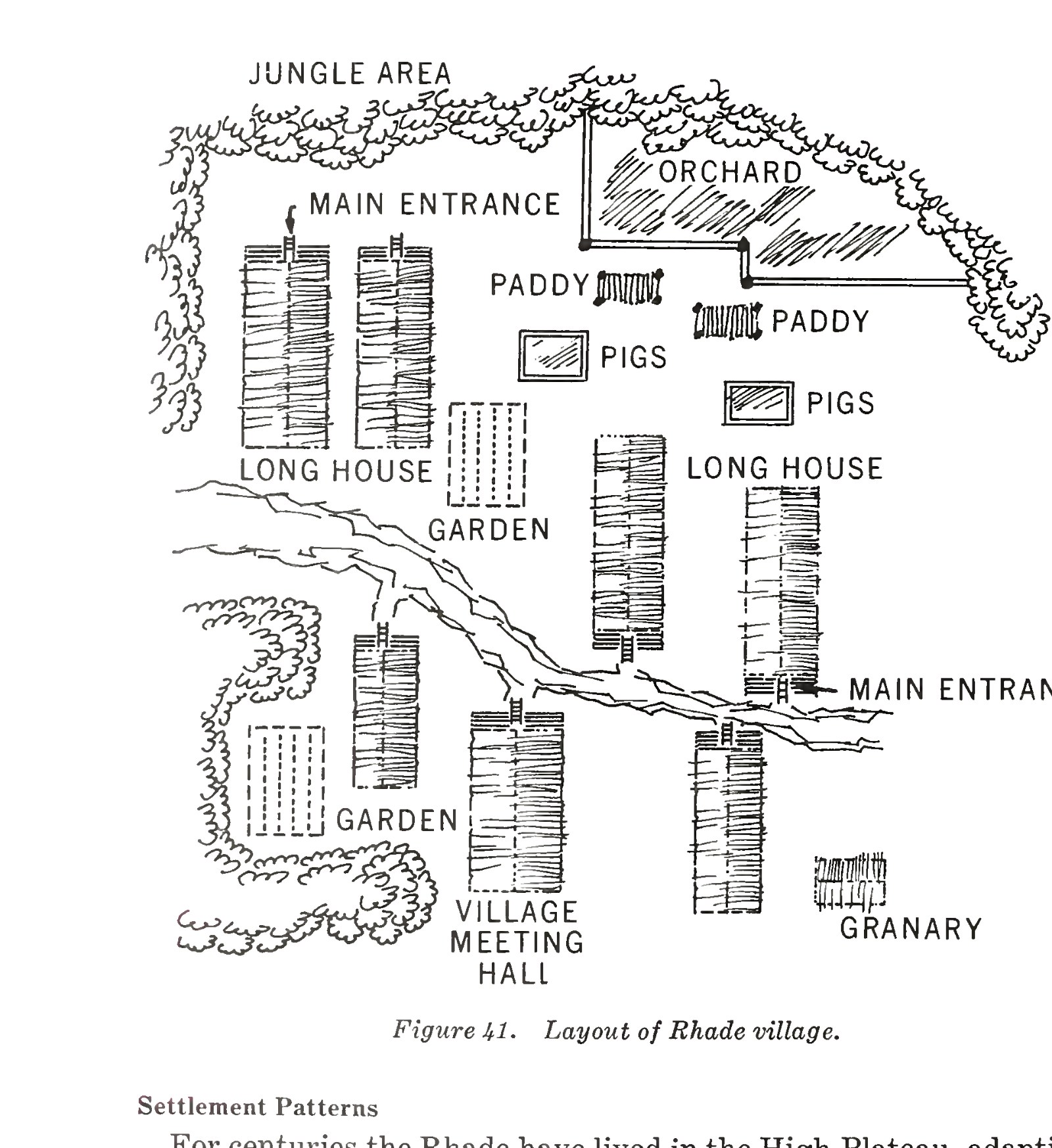
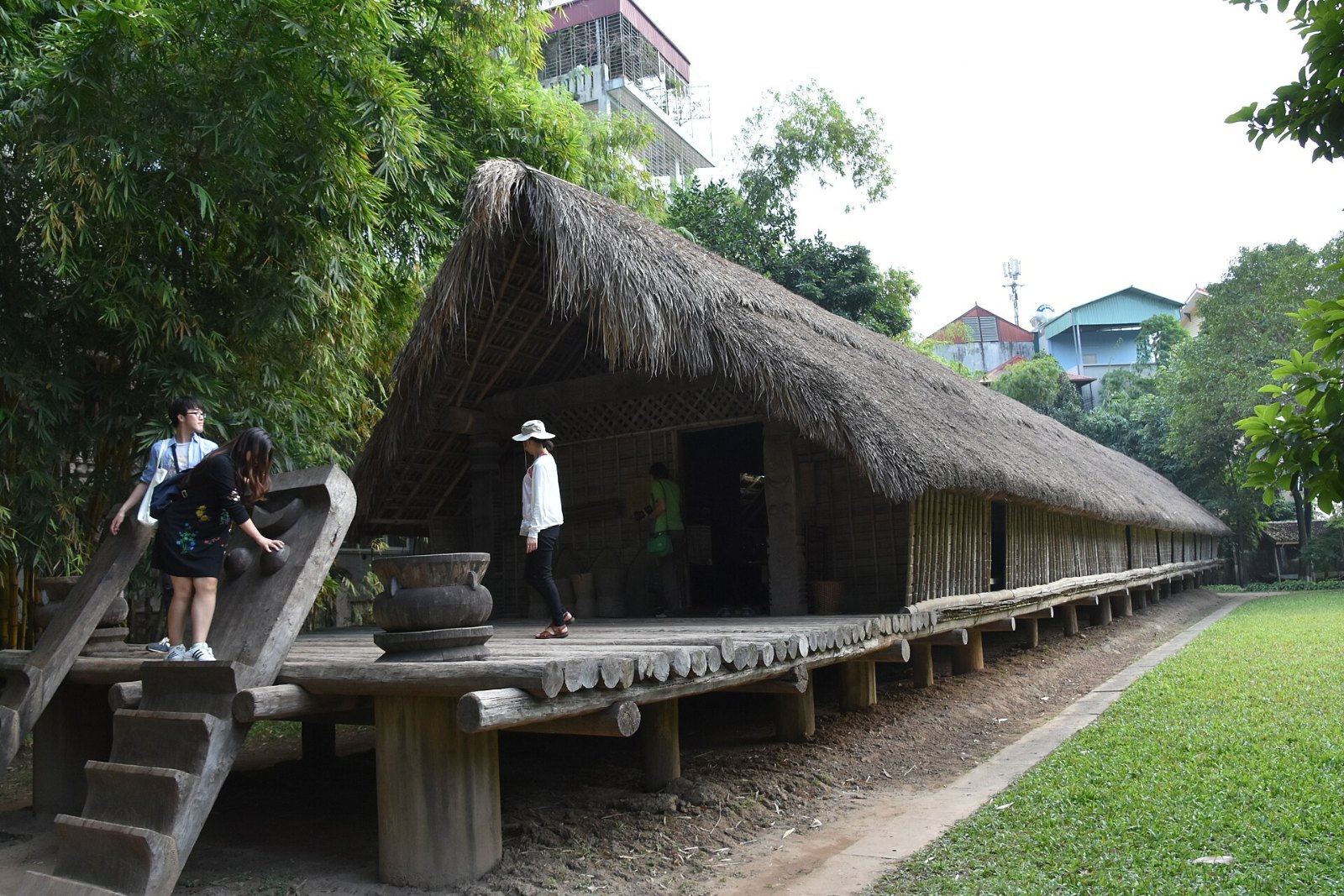
The American army’s handbook of 1966, compiled from every French and American source it could find, describes the Rhade village of fifty to two hundred people, its houses and fields placed near rivers and springs and grouped by kinship, its bamboo grove, which “because of its religious significance, is not cut down,” and its longhouses in parallel rows running north and south, so that they should not resemble the small east-west houses built over the dead. The Rhade Kpa built houses of about fifty meters; the Adham and the Ktul built them much longer. The women had their own stairs. A rich household showed its standing in the carving of the ladder posts, which were shaped for mounting and dismounting an elephant. Each longhouse had its own granary, apart.
Land belongs to the community and is worked by families within it, on a long rotation that lets forest and fallow recover: a field is cleared, burned, cropped for a few years and then left for ten or twenty years before it is opened again. Among the Bru, the village controls the land and allots it to families; game belongs to the hunter but is shared; a family owns its house, its animals, its gongs and its jars. Among the Rhade the land is the clan’s, “ancestral land” that cannot be sold, and for each tract there is a hereditary guardian, the po lan, the senior woman of the clan, who gives permission to farm it, walks its boundaries, and can recite the names of the fifteen generations of women who guarded it before her. Nothing in that arrangement produces a document, which is the single most consequential fact in our modern history: when a land registry arrived, customary tenure met certificated tenure, and the certificates won. Everything in the land articles follows from that sentence.

Among the Rhade, the Jarai, the Mnong, the Koho and the Raglai, descent and inheritance run through the mother’s line. A husband joins his wife’s household; the senior women of a longhouse hold the fields, the livestock and the heirloom jars and gongs, “the title to which is held by the senior female,” while a male head, usually the husband of the senior woman, manages the day-to-day, and is replaced at his death by a son-in-law or by the husband of one of his wife’s sisters. The men, the handbook adds, “are less leaders in their own right than they are instruments of the women.” Rhade personal names carry the prefix Y- for men and H’ for women, which is why almost every name in the prisoner records begins with one or the other. The Bahnar and the Sedang reckon descent on both sides or through the father, and their villages are held together by the common house instead of the longhouse. The women’s page sets out what this does and does not mean.
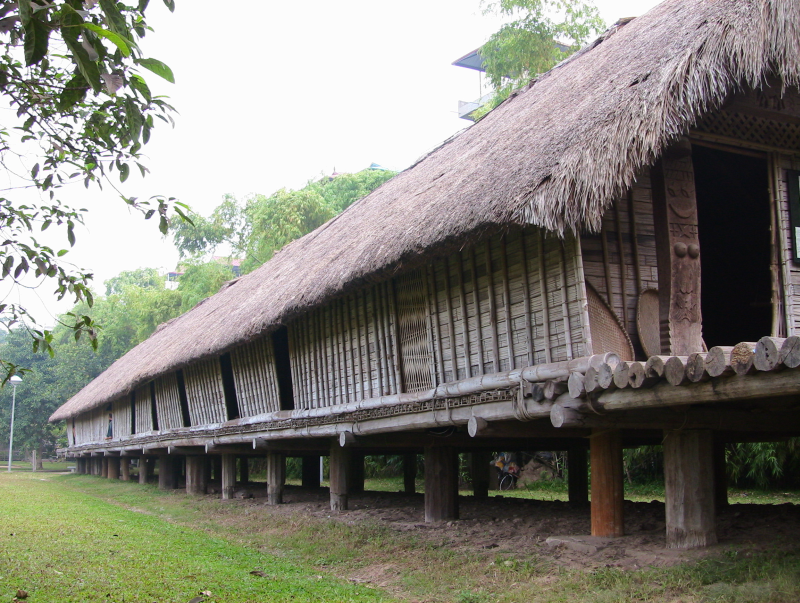

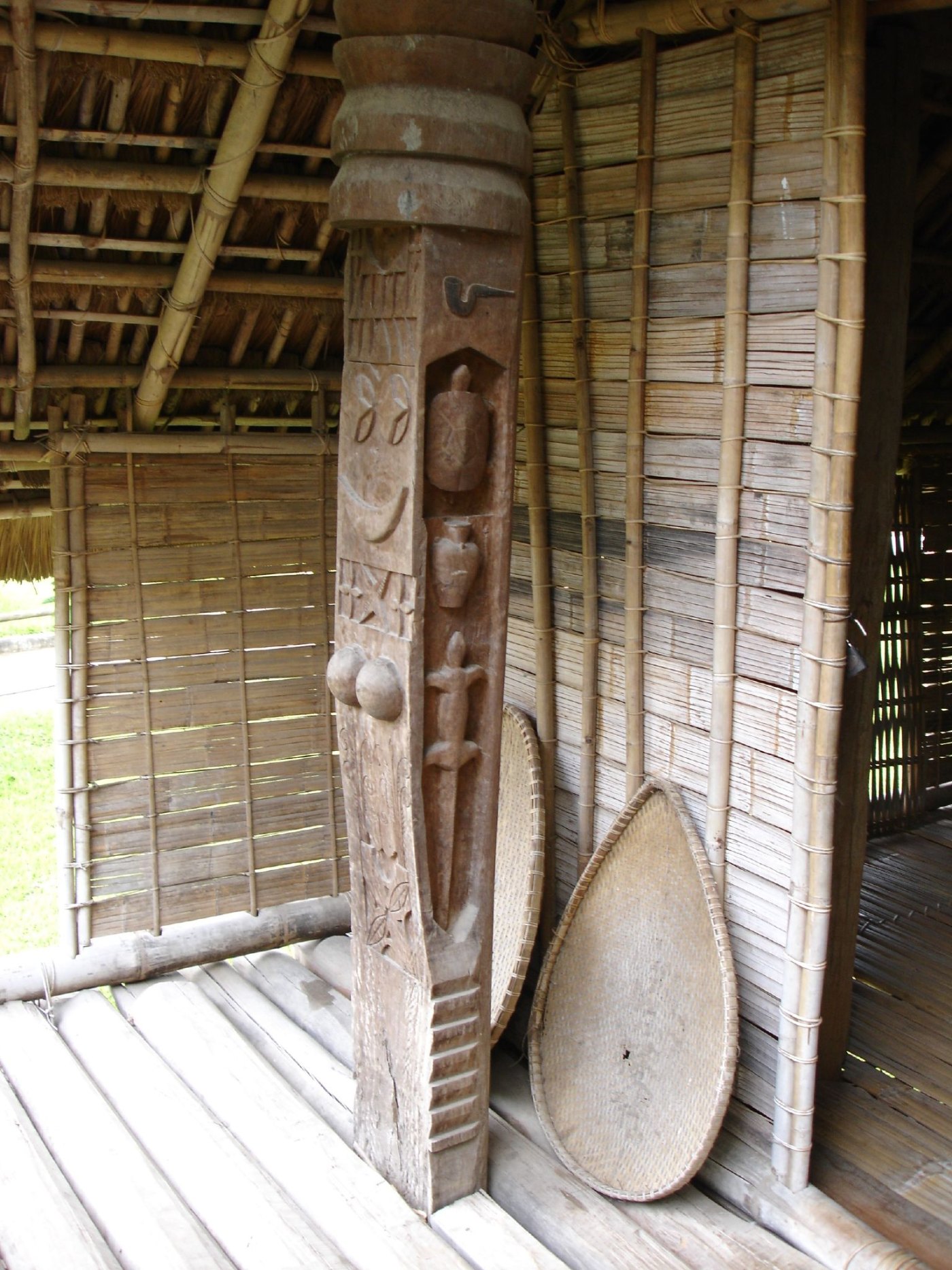

Obligation is mutual and specific. The longhouse is “the mutual aid group,” in the handbook’s phrase, which shares and maintains the house, “often shares food and always participates in cultivation of the common longhouse fields.” We have been told that the Rhade have a name for the custom by which a village builds a family’s house with it, some bringing timber and thatch and others their labor, and we cannot yet document the word; an elder who knows it should write to us. What the record does show is what happens when the custom is broken. A Rhade man moved into a small house in a resettlement program, the American handbook found, “misses the sociability and security of family life in the longhouse and usually takes the first opportunity to return to it.” A society organized this way does not need a welfare system, and it does not survive being dispersed into scattered plots. Dispersal is not a side effect of resettlement. It is what resettlement does.
Law before the courts came
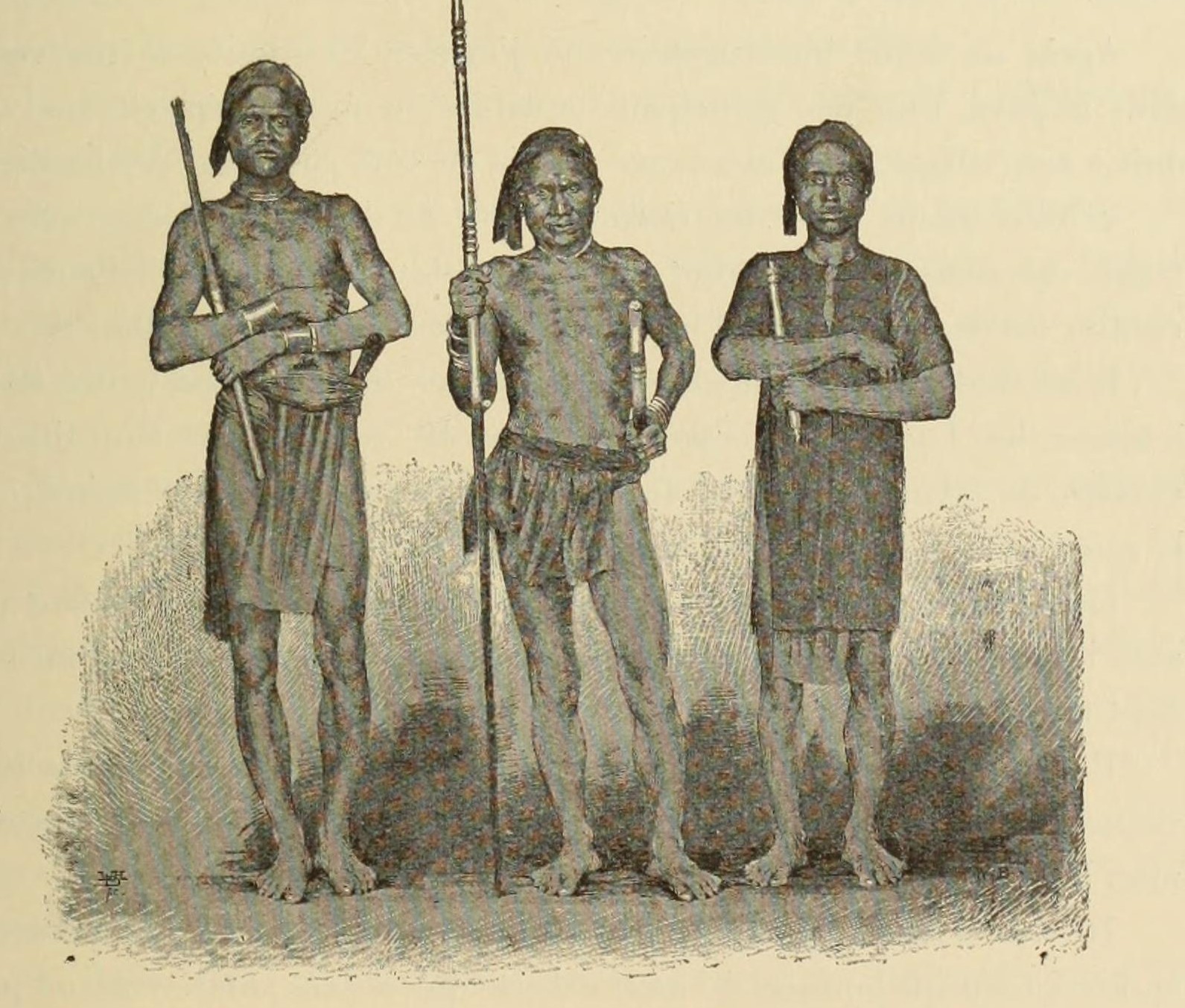
Disputes went to customary tribunals applying an oral body of law that was long, detailed and memorized in verse. Every village had its chief and its council of elders, drawn from the household heads, and the chief’s duties included the administration of justice in cases the families could not settle among themselves; there was no authority above the village, and no political leader who spoke for a whole people. Under the French résident Léopold Sabatier, who governed Darlac from 1914 to 1926, a Rhade court was set up in 1923, the customary law was collected, and it was printed at Hanoi in 1940 as the Recueil des coutumes rhadées du Darlac. Paul Guilleminet did the same for the Bahnar, Sedang and Jarai of Kon Tum, publishing in 1952 the law as it had been applied in the courts of that province from 1908 to 1939, and a lieutenant collected a Mnong Preh code in 1934 and 1935. The colonial motive was administrative convenience. The effect was that our legal traditions exist on paper, and they do not read like the lawless condition that later governments described themselves as civilizing.
They read like law. The Rhade code has no death penalty, “because the spirit of the executed would haunt the living forever.” A thief must return three of whatever was stolen. Incest is a crime against the land, because it endangers the crops, and the fine is paid twice, by the woman to the po lan and by the man to the chief. The land, the code says, “must never be like a horse without a master, like oxen without a guard,” and no one owns the land, the water or the woods: “nobody can lay hands on them, nobody can appropriate them.” A chief who does not protect his people and see that things are well run “is guilty of a crime.” Under the French, cases the chief could not settle went to the Tribunal Coutumier at Ban Me Thuot, which sat for the first seven days of every month, judged by the written collection of Rhade custom, and heard only cases in which both parties were Rhade; the “King of the Rhade” whom the Americans heard of at Ban Don was its president, and had no other power.
Those courts did not survive the Republic of Vietnam as it was made in 1955. They were not abolished by a single decree; they were, in the words of the American who studied them, “relegated to insignificance as Vietnamese legal codes were introduced for the first time,” while the Diem government attempted to substitute Vietnamese law for tribal practice, banned instruction in our languages, replaced our place names, and in one province ordered Jarai refugees to build their new houses on the ground, Vietnamese style, rather than on piles. It took the rising of September 1964 to reverse it: a decree of March 1965 restored the legal status of the tribal law and tribunals, and by 1967 had budgeted close to six million piastres for them. A people can lose its land slowly. It loses its jurisdiction in a decade, and gets a little of it back at the point of a gun. The customary law and Sabatier pages carry the detail.
What is made and played
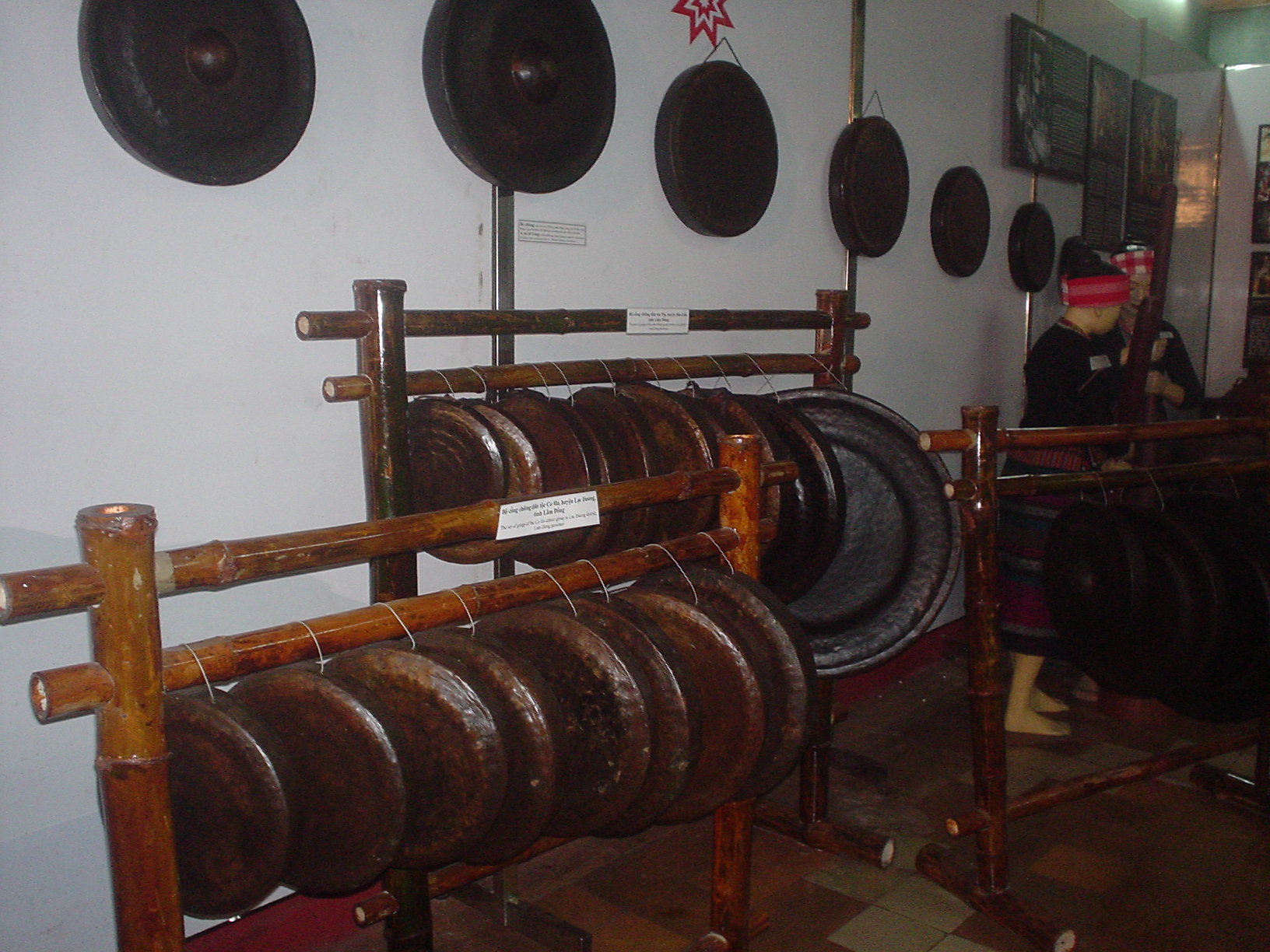
The gongs. Flat and bossed bronze gongs in tuned sets, three to twelve in a village ensemble, each from twenty-five to eighty centimeters across, played by men or by women, each player carrying one gong, so that a melody exists only in the group and cannot be performed alone. The gong is the instrument that connects, in UNESCO’s words, “men, divinities and the supernatural world”; every family owns at least one, and a gong signifies “wealth, authority and prestige.” UNESCO proclaimed the gong space of the Central Highlands a Masterpiece of the Oral and Intangible Heritage of Humanity in 2005 and inscribed it on the Representative List in 2008, naming seventeen Austroasiatic and Austronesian communities as its keepers. The same page names the threats: the transformation of the way of life, the death of the old craftsmen who could tune a set, and gongs “sold for recycling or exchanged for other products.” Gongs are also wealth: a set is an inheritance, a marriage payment, a record of a family’s standing, and consequently the first thing a poor family sells. The gongs page has the sets, the tunings and the recordings.

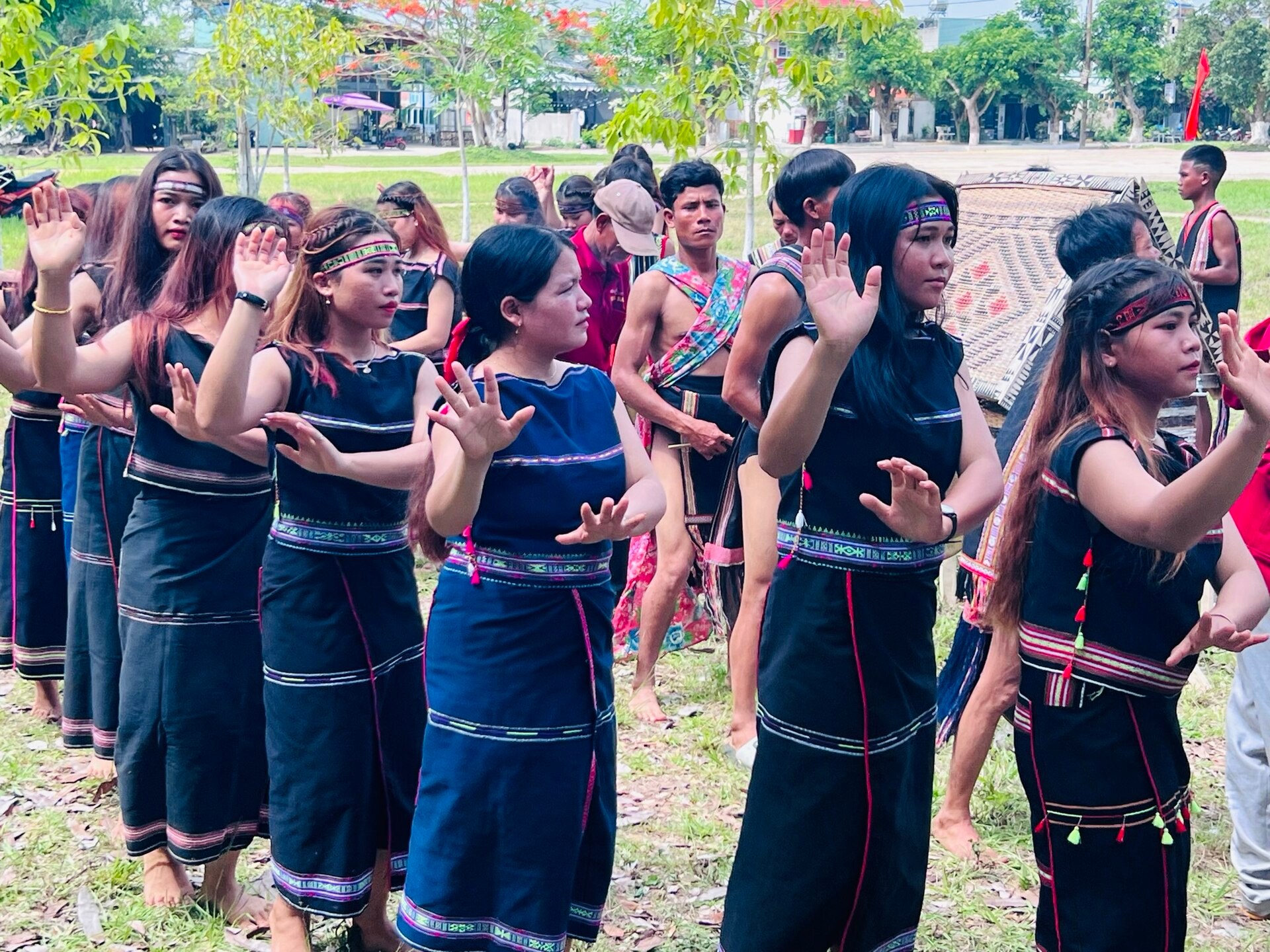

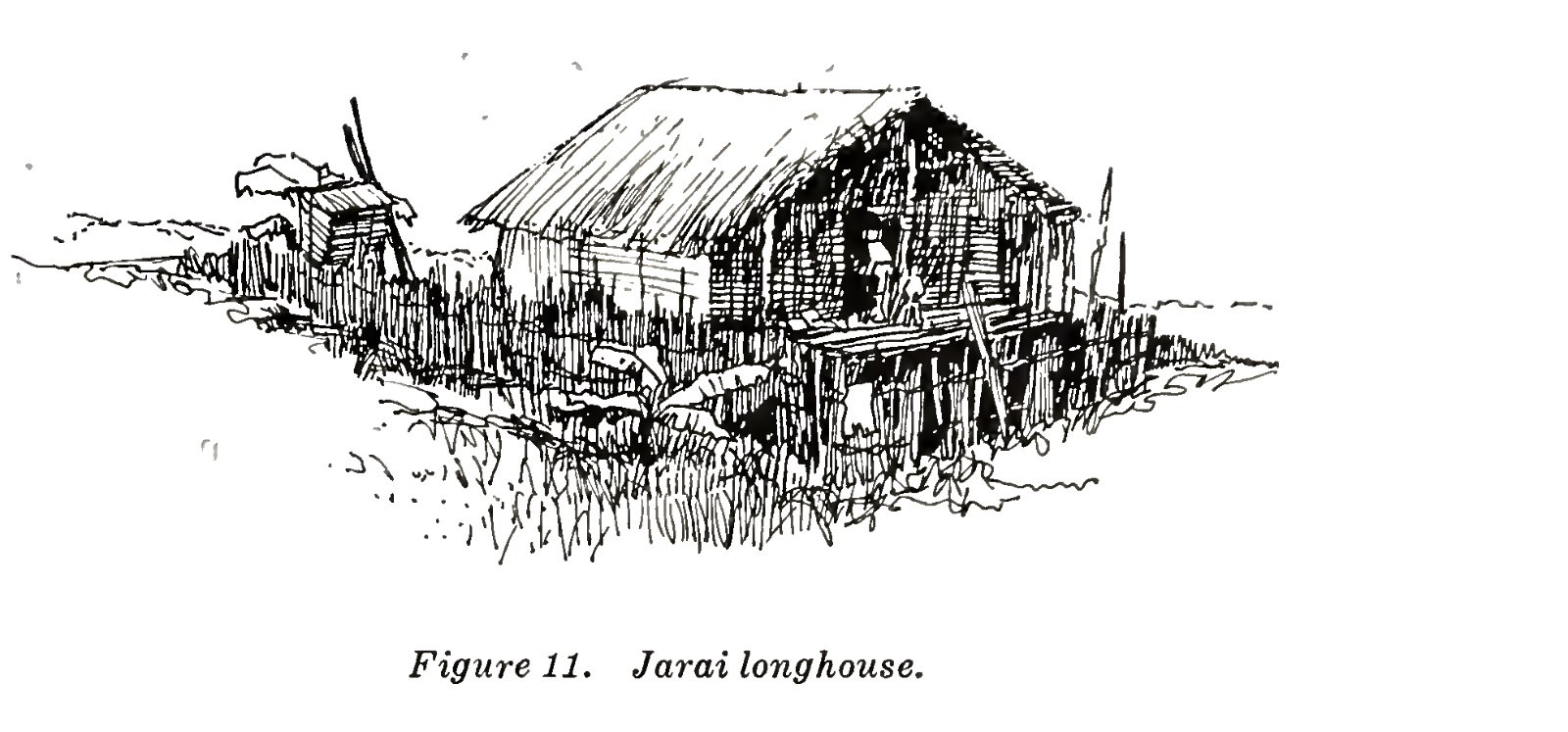
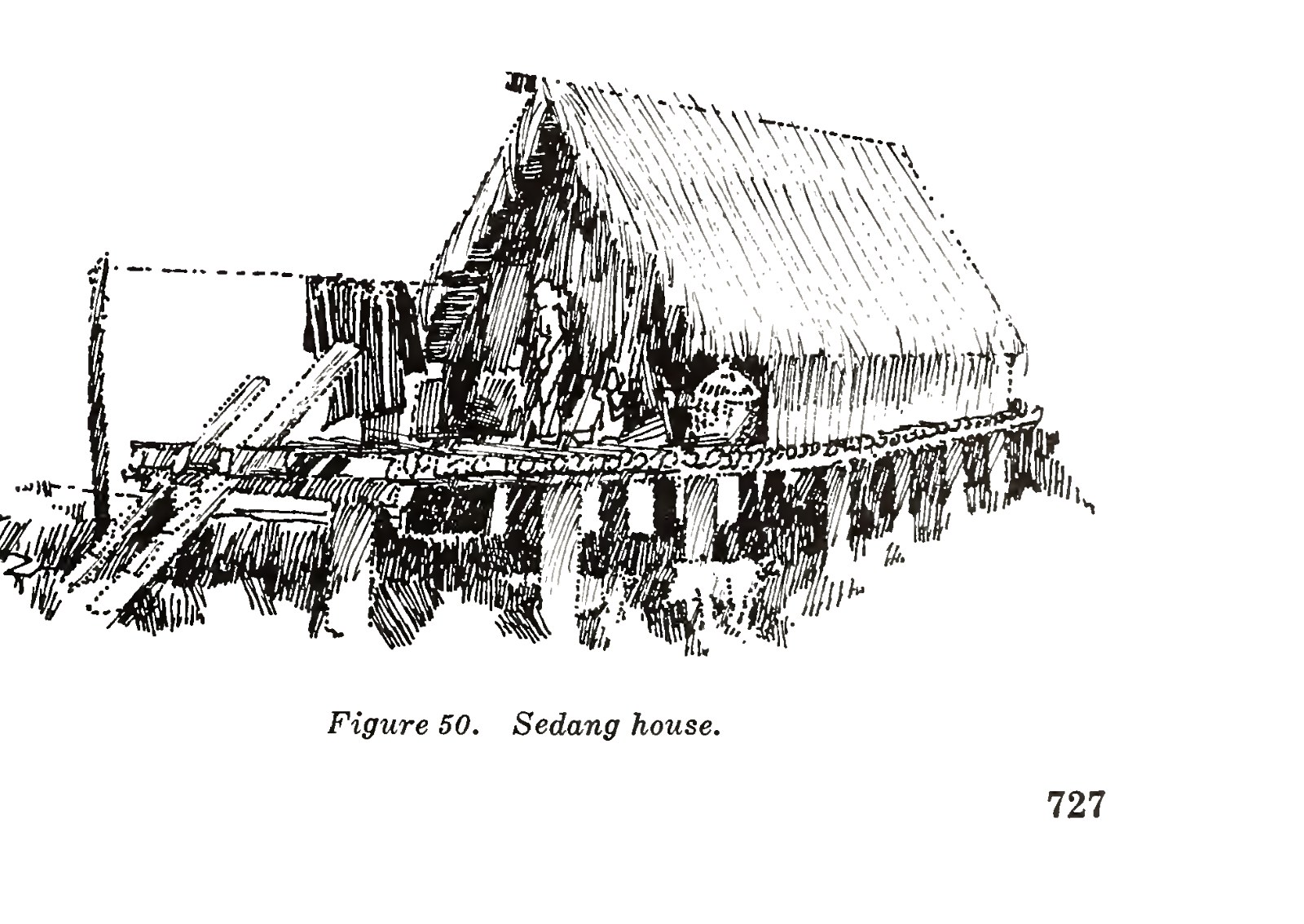
The longhouse. The Rhade longhouse runs to fifty meters and more, raised on piles, extended at one end as each daughter marries. Its length is a genealogy you can walk down. The Jarai longhouse could be a hundred feet, with a platform and a ladder at each end, a common room at one end where guests were received and ceremonies held, with a long bench, the wine jars, the gongs and the weapons, and a corridor along one side with a room off it for each family. The Sedang built longhouses too, with as many as thirty families under one roof, and a common house for the men beside them.
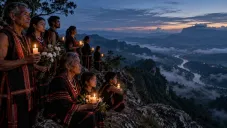
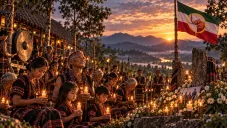
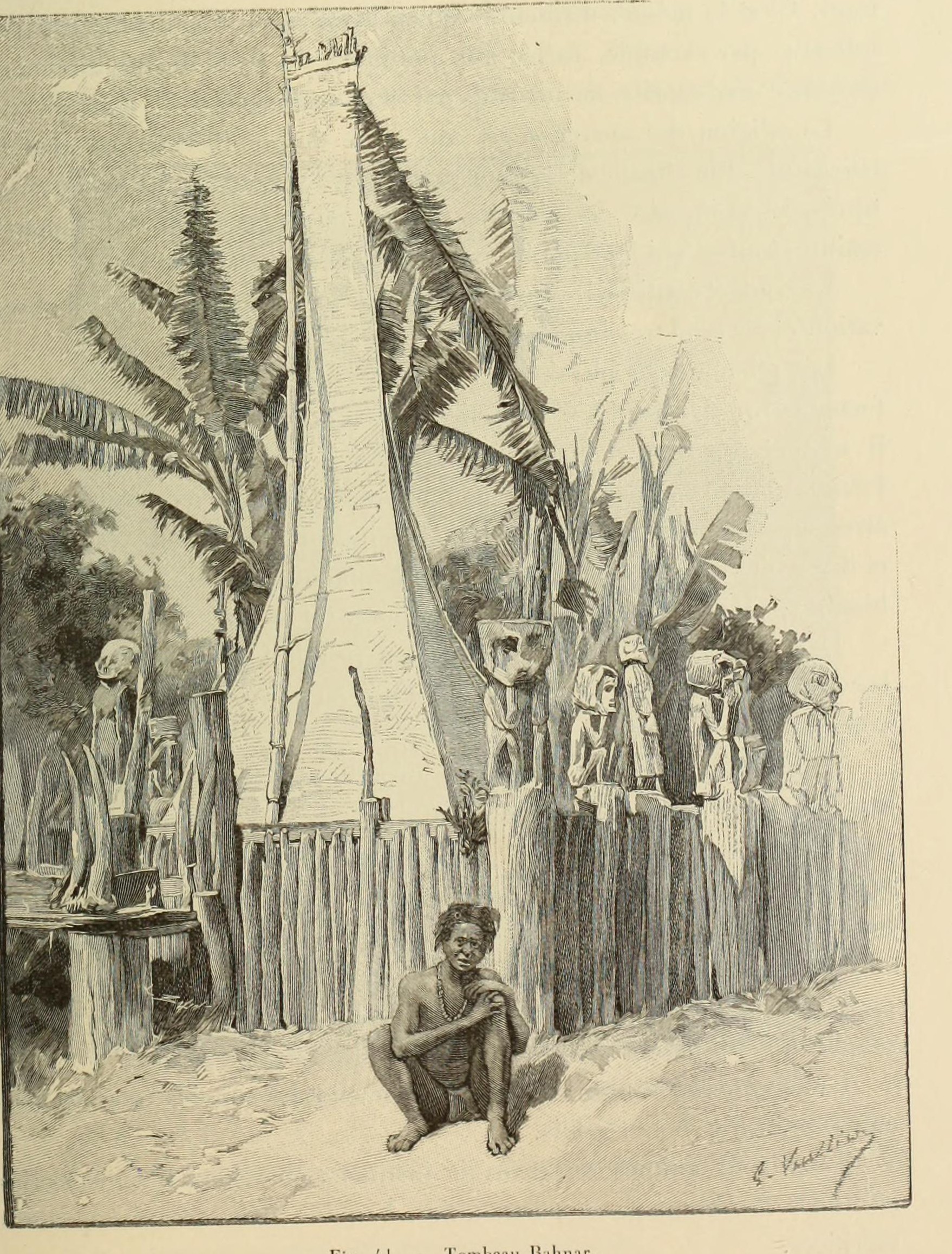
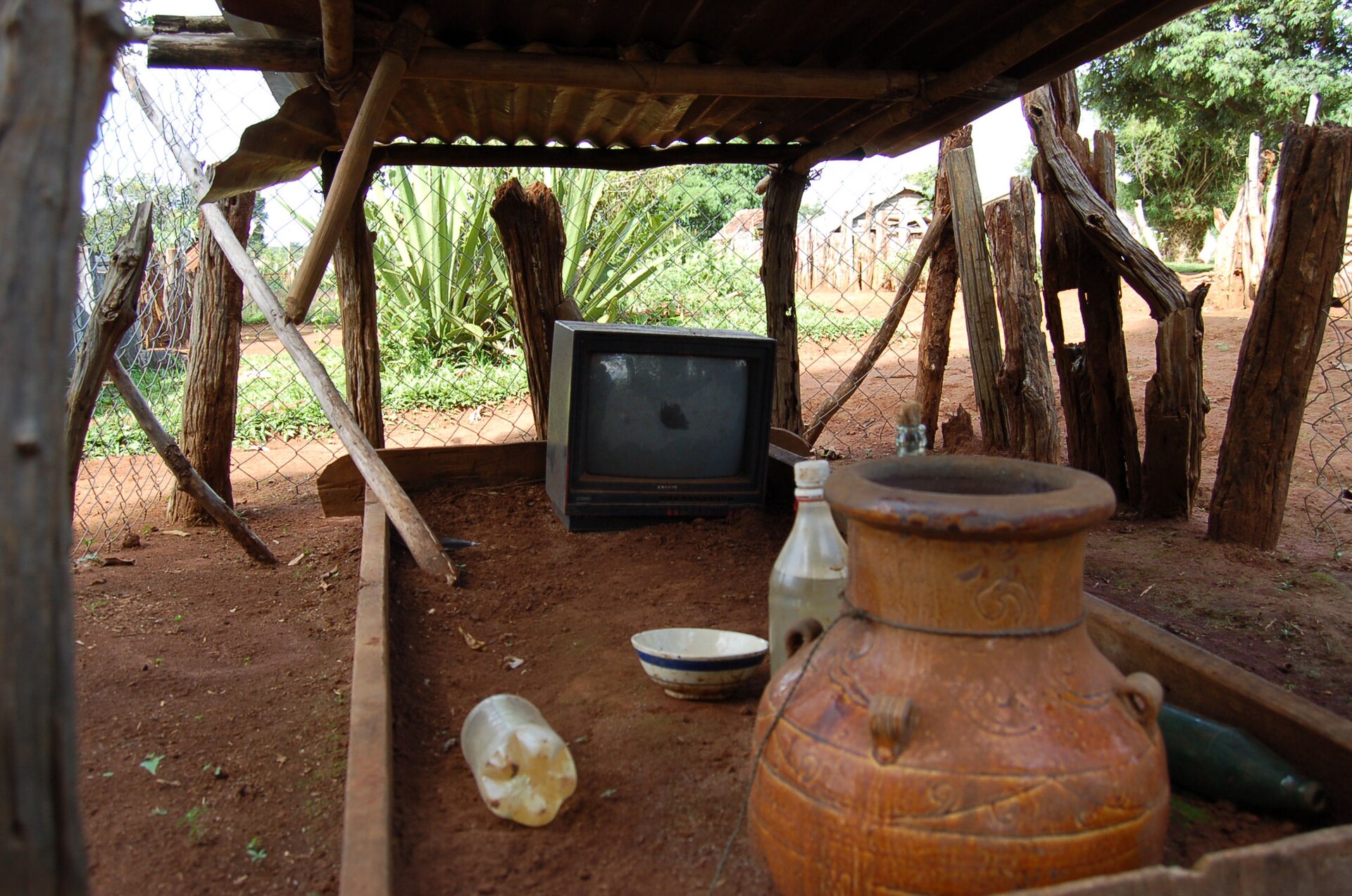
The tomb house. Among the Jarai and Bahnar, the dead are housed in carved and roofed tomb structures ringed by wooden figures, and are attended until the ceremony of the abandonment of the tomb releases the household from its obligation to them. A Bahnar funeral in the 1960s began with gongs at the house of the dead, the body wrapped in mats, and a procession at nightfall a day or so after the death, the gong players leading, the family in white behind; on the grave the men set jars and tools, and sometimes carved wooden figures of men or animals, two to five feet high, which the eastern Bahnar painted red and blue. Mourning lasted from six months to three years, and the surviving spouse stayed loyal to the dead until the tomb was abandoned. Among the Rhade the abandonment came after a year for the poor and five or six years for the rich, usually in March after a good harvest, with carved posts, rice houses on the mound, as many as five buffaloes sacrificed, and a chicken released to fly away, the soul escaping the tomb, so that “the deceased is no longer a prisoner of the spirits.” From that day the dead must ask the spirits for what he wants, and the family owes him nothing. Death, for the Jarai, “is not final until the ceremony of the abandonment of the tomb has been performed”; a widow may not remarry before it. The carvings are among the great sculptural traditions of mainland Southeast Asia. They are also wood, standing in forests, and they have been sold. The tomb house page follows the ceremony through.
.jpg)
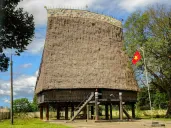
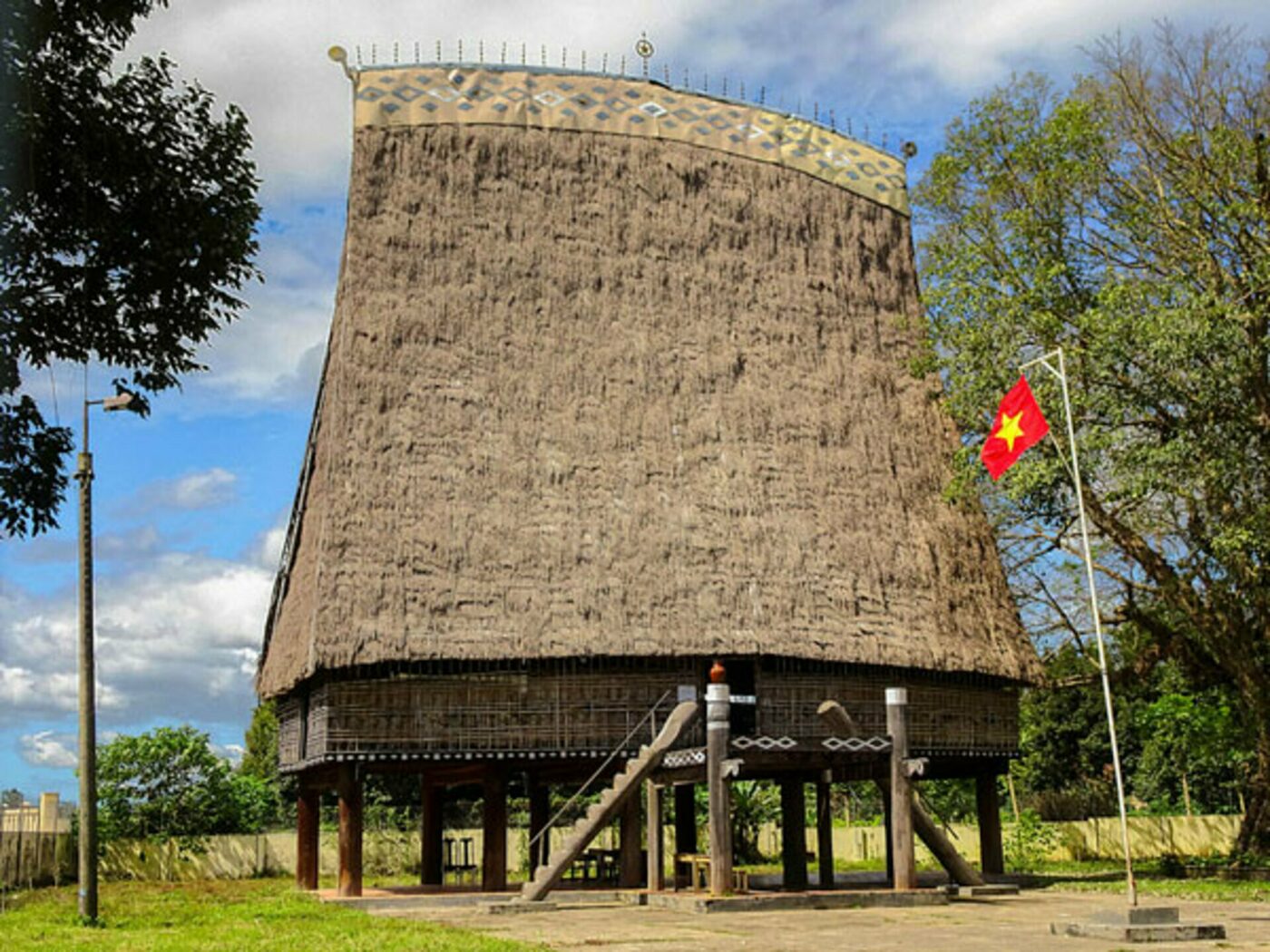
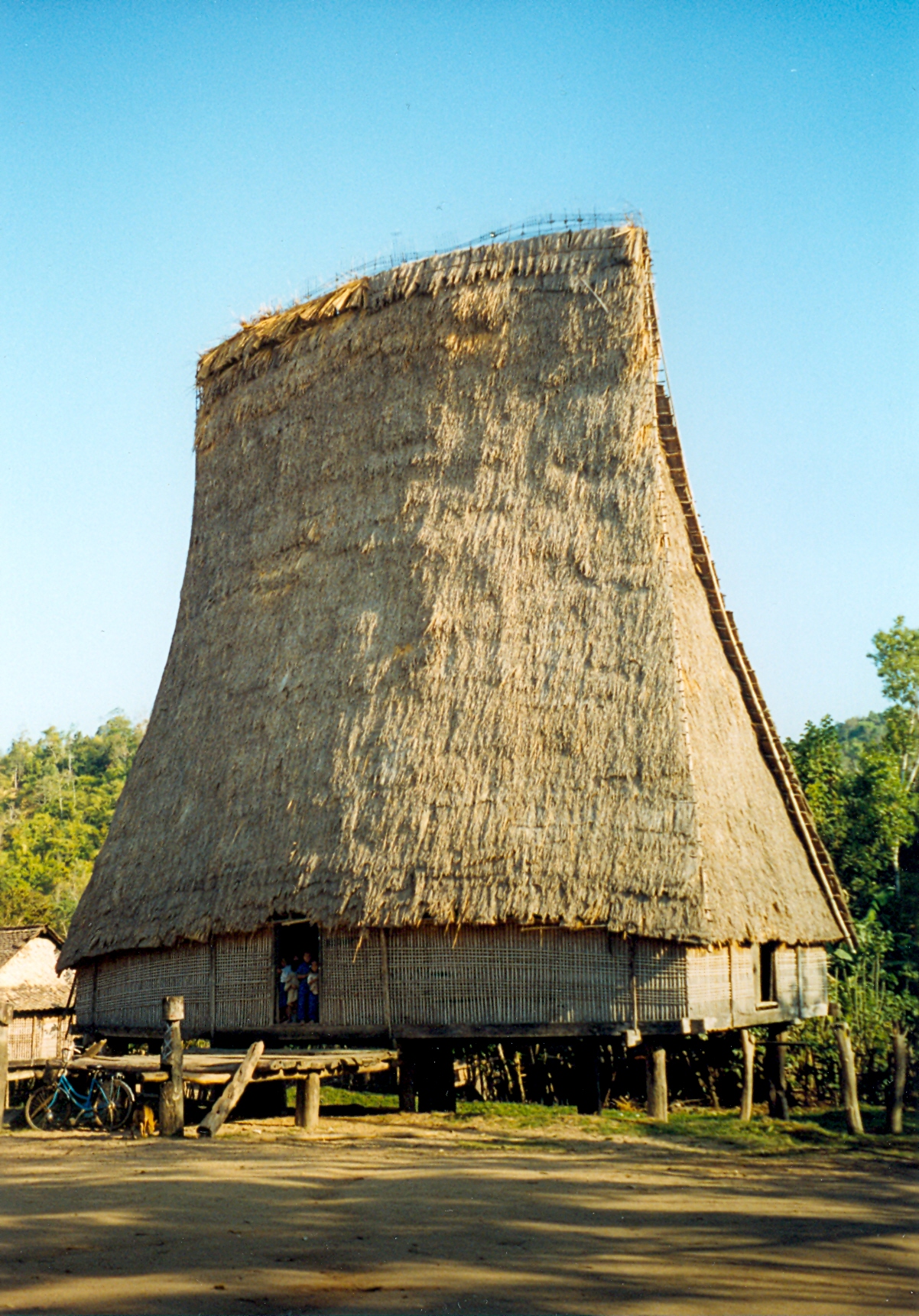
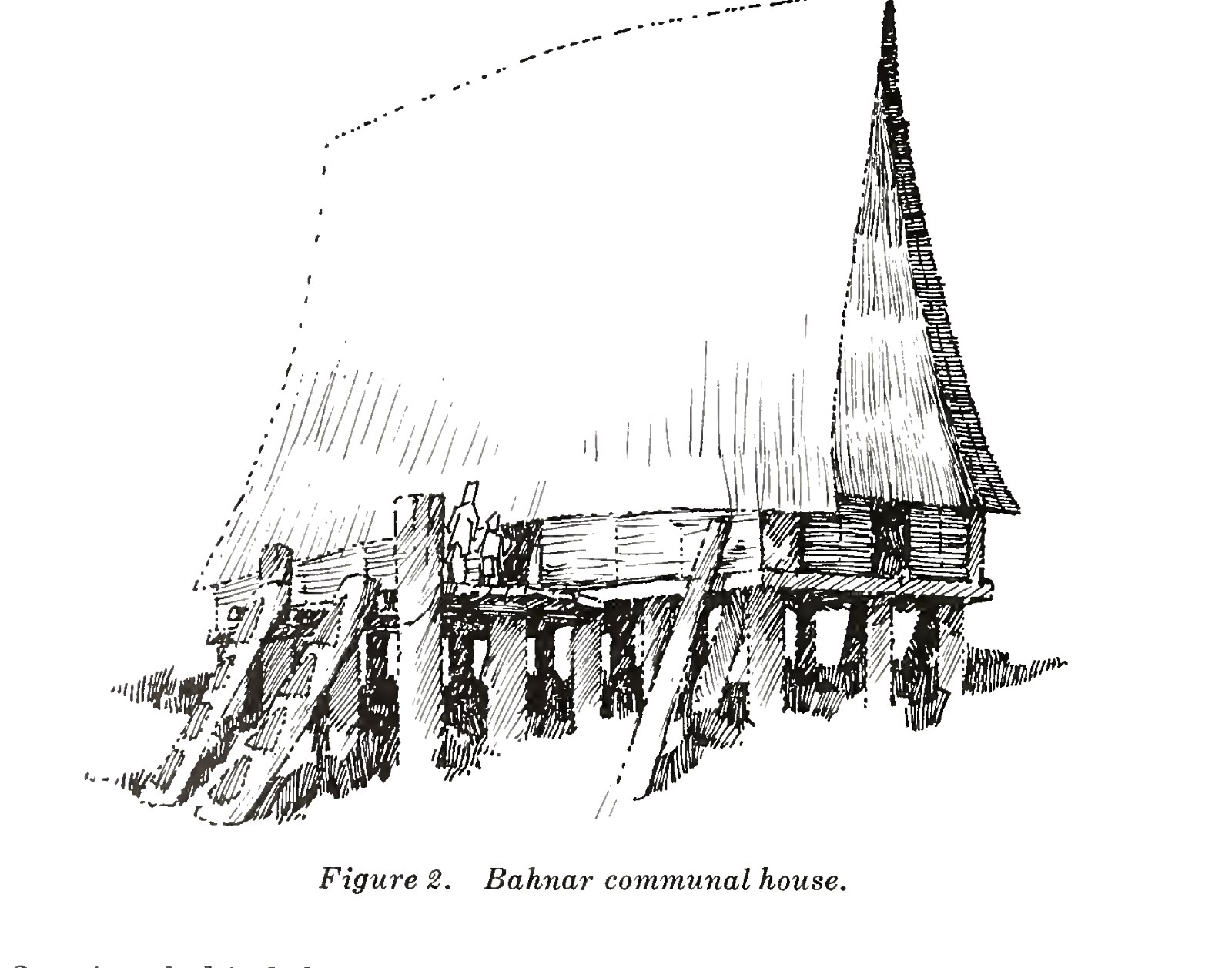
The rong. The Bahnar and Sedang communal house, with its enormous incurved roof rising to a point, is the civic architecture of the highlands: assembly hall, court, guesthouse, marketplace, sacrificial ground and school in one building. It stands on seven piles a side and two at each end, faces northeast to southwest, has a floor of crushed bamboo over four great beams “designed to prevent lance thrusts from below,” two big drums by the door, and for decoration a few geometric figures on the beams and an occasional skull. It is where the boys sleep from puberty until they marry, where the elders meet, where a stranger is received, and where the village assembles when a decision is to be made. The Halang built theirs on eight columns with roof peaks sixty feet high; the Katu hung theirs with the heads of the animals they had killed; and among the Sedang and the Katu no woman was allowed inside.
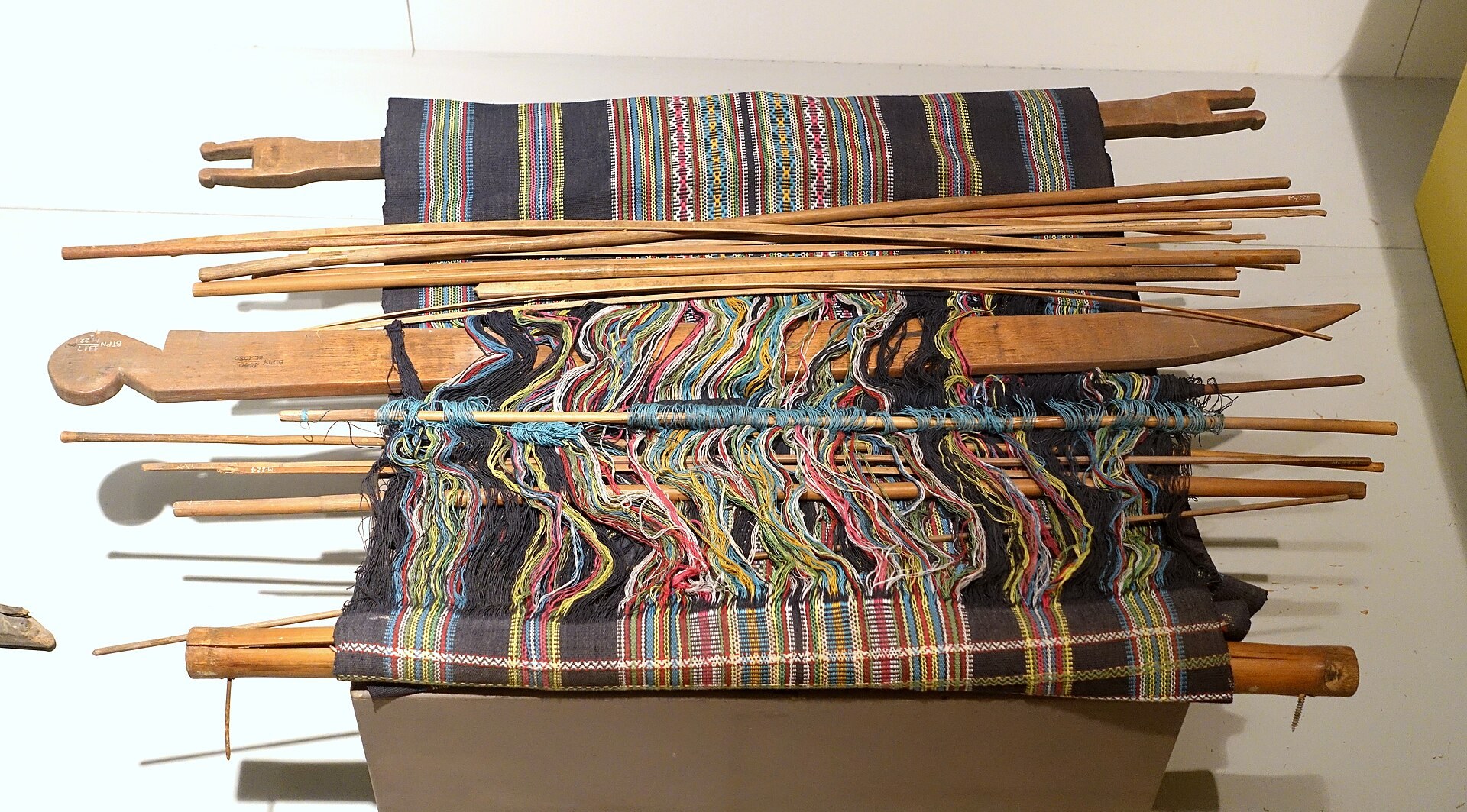
Weaving, rice wine, and the buffalo. Ma and Koho textiles, and the Rhade women’s “traditional red, black, yellow, and blue cotton thread,” woven on a backstrap loom in which the weaver’s own body holds the warp; the weaving page shows the looms and the cloth. Rice wine, drunk through long bamboo straws from a shared jar, was described in the 1890s by Father Guerlach of the Kon Tum mission: some days before the feast the women of the house cooked the millet, maize or rice and mixed in a ferment; the jars were tied to the house posts; the elastic bamboo tubes were pushed into the liquid, and each guest had to drink in one draft, on pain of offending his host, the measure of a coconut or a gourd, while a neighbor kept the level up with water. The invocation came first, and the spirit drank first; the liver of the animal was his, and the blood went on the fetishes; and “during the ceremony the musicians labor at the gongs.” The buffalo was killed only on the great occasions, tied to a post it could turn around, lanced, shot with arrows and hamstrung leg by leg until it fell; among the Bahnar, Cupet was told, the ceremony was called the Reulang. The Bru did the same, circling the beast with lances and long knives to gongs and drums, and their great sacrifices were tied to the rice year: the clearing, the planting and the harvest. The jars and the buffalo feast page follows the year round.

What we believe
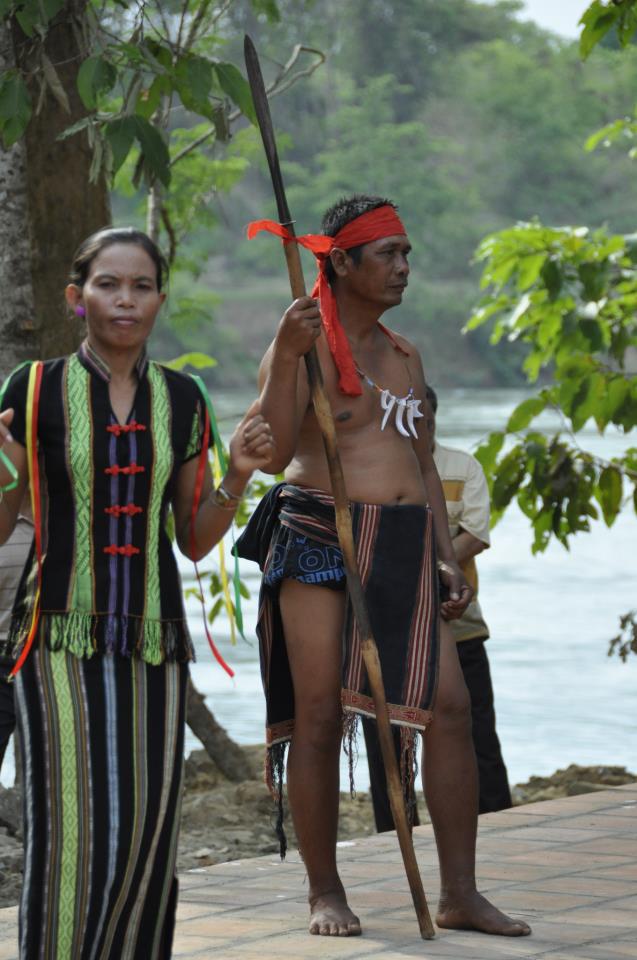
We have been animists throughout our existence, and a common animist thread still connects all our peoples: an obligation to keep harmony with the physical world and with the ancient powers, expressed through Yang, the spirits that inhabit places, objects and the dead. Cupet, who did not think much of it, described it honestly enough in 1900: a world “peopled” with “an infinity of divinities or spirits” with supernatural powers, among whom “anarchy reigns as it does among mortals; no Jupiter dictates his laws,” and to whom sacrifices were offered “about everything and often without motive,” at a death, at the work of the fields, at the building of a house, at the beginning of any undertaking, at an illness, “in a word, at every act and incident of life.” The Rhade say a person has three souls, and that the second, the yun, enters a newborn child through the bluish mark at the base of its spine and can be the returning soul of an ancestor. Among the Jarai, wealth is measured not by what a family owns but by the sacrifices it has offered. The Yang page goes further.

The Jarai held two ritual offices, the King of Fire and the King of Water, Pơtao Apui and Pơtao Ia, keepers of a sacred saber said to have come from the sky, whose authority was acknowledged by Champa, by the Cambodian court, which sent offerings every three years, and by the Nguyen court at Hue, which received their tribute missions. Cupet, who saw the saber’s keepers in 1891, recorded the sacrifice they made to the spirit of the relic, asking whether the strangers before them were “the masters of the Prak-Khan.” They were not kings in any territorial sense. They were masters of fire, water and wind, and the fact that three neighboring monarchies all found it prudent to deal with them says something about how the region understood our standing. The Kings of Fire and Water page tells it in full.
The Catholic missionaries of the Missions Étrangères de Paris went up from the coast in November 1850, settled among the Bahnar in 1851, baptized their first chief in 1853, and stayed; the Kon Tum mission converted many Bahnar and Sedang, wrote the first books in a highland language, and founded the first schools. Protestant missionaries of the Christian and Missionary Alliance were at Ban Me Thuot by the 1940s, when the pastor there was already sending Rhade evangelists out to the Mnong; the great growth came in the mid-1950s, when the Alliance, the Adventists and the linguists of the Summer Institute took up residence to preach and to translate the Bible into our languages, and then, after a generation of dormancy under the new state, from the late 1980s. There were perhaps 50,000 Protestants among us in 1975, 200,000 by 1990, and by 2002 somewhere between 229,000 and 400,000, in Dak Lak alone rising from 15,000 to as many as 150,000; a quarter of us, at least, are Christians. Most Dega families do not experience this as a contradiction with what came before. Both faiths have been treated by the state as a threat, and in 2000 an independent church movement, Tin Lanh Dega, Dega Protestantism, came into being that the state calls a cover for independence and its followers call a church. That story is in the church articles.
What has been done to it
The cultural damage of the last seventy years is not incidental. It was policy, stated as policy, by three successive governments.
Under the Republic of Vietnam, assimilation was declared. President Diem launched programs in 1956 to settle Vietnamese in “land development centers” in the highlands and to absorb us into Vietnamese society; when our leaders asked for autonomy in 1958 he closed the highland students’ section of the National Institute of Administration, admitted no highlander to it between 1958 and 1964, dispersed our civil servants to the lowlands, ordered our officers to take Vietnamese names, banned our languages from the schools, and requisitioned every crossbow in the highlands for fear they would be used in a revolt. The customary courts were left to wither, our land rights were restricted by a decree of 1956 and a letter of 1959, and the words of an army officer to our leaders in March 1964, that the highlander problem could be solved “the same way the Americans solved their Indian problem,” by reservations, are in the CIA’s file.
The Socialist Republic went further and said so. Hanoi’s program of “fixed cultivation and fixed settlement,” định canh định cư, had been launched in the North in 1968 to move “nomadic” highlanders into permanent villages, on the double ground that swidden farming destroyed the watershed forests and that minorities in the border country were a security risk; it was extended to the Central Highlands within a year of 1975, and Hanoi’s broadcasts of May and July 1976 announced that the highlanders would be settled in the valleys to grow rice and industrial crops rather than continue their “unstable nomadic life.” In 1978 the vice-minister of culture, Nông Quốc Chấn, wrote that “out-moded habits” and “obsolete and backward practices” were to be wiped out, and explained the method: “priests” were “unmasked” and made to sign an undertaking to accept punishment if they relapsed, and the number of gifts at a wedding was fixed by cadres who “advised” the families. The policy had a name, “selective cultural preservation,” under which state officials decided which parts of our cultures were valuable and which were to be eliminated; the parts eliminated were the sacrifices, the feasts at burials and marriages, the “groundless taboos,” and the longhouse itself, which the state’s ethnologists called a survival of “the familial communes of the primitive society” and set out to break up. The new villages put the houses far apart behind fenced gardens for cash crops, and the people in them, when an anthropologist asked, said the program was an attempt “to make them live like lowlanders.” In practice it moved an indigenous population off long-rotation land into small fixed plots, freeing the greater part of the highlands for settlement by others: the land law recognizes only “permanent agriculture,” so a fallow field is nobody’s and is given to a newcomer, and it recognizes no communal owner and one name per household, so the women who owned the land are not on the certificate. By 1978 the Vietnamese were 61 percent of Dak Lak; the Rhade and Mnong, who had been 48 percent of the province in 1975, were 20 percent by 2002, and sixty-four state farms and forty-two state forest enterprises held 86 percent of its land for 20 percent of its people.
.jpg)
Since then: the heirlooms sold, “bronze gong sets, drums, ancient Chinese jars, wooden funerary statues or intricately woven cotton fabrics,” in the anthropologist’s list, “by poor Highlanders in order to make a living”; the new tomb carvings, in the one scholarly study we have, “very different from traditional sculptures in many respects”; the elders, in the account of the American adviser Michael Benge, moved to “retirement villages” far from their families, which, if it is so, ends the transmission of everything that is learned by living alongside someone; churches burned at Dak Mil in 1996, bulldozed at Tanh My in 1997, destroyed at Dak N’Drung in 2000 and burned at Plei Lao in March 2001, with a man shot dead; more than 350 of us sentenced to long terms between 2001 and 2011; villagers made to renounce their faith in public in 2010, 2023 and 2024, an evangelist detained in September 2024 for refusing to join the state church, and a preacher, Y Pum Buonya, found dead in March 2024 after the police summoned him; and forest that fed our villages for two thousand years cleared for coffee and rubber. Every item on that list has a page in this library, and every page has a source.
Why culture belongs in a human rights library
Because the two cannot be separated in our case. The gong set that is sold, the tomb figure that is carted off, the longhouse that is not rebuilt because the village was split across four resettlement plots, the grandmother three hours from her grandchildren, the wedding whose gifts a cadre has counted: none of these is a criminal charge, and together they are the greater part of what has been lost. A people can survive the loss of its property. It is much harder to survive the loss of the things that told it who it was.
Further in this library
- Gongs and epics — the UNESCO gong culture, the Dam San epic, the Bahnar h’mon and the stone lithophone
- The tomb house and the abandonment of the grave
- The Kings of Fire and Water
- The Rhade law code
- Language resources and Books about the Dega
See also: The rice year, Weaving and dress, The elephants of Ban Don, Yang: the spirits and the old religion, Jars, rice wine and the buffalo feast, Customary law and the village court, Instruments beyond the gongs, Hunting, the crossbow and the forest, Food and the highland kitchen, Growing up Dega.
Sources
- P. Cupet, Mission Pavie, Géographie et voyages III (1900), DCHO library, chapter on villages, customs and religion — the thicket and the gate, the circle of houses, the theft of rice, Father Guerlach on the jar, the Reulang, the spirits, the Prak-Khan
- US Army, Minority Groups in the Republic of Vietnam (1966), DCHO library — the Rhade village, longhouse, matriliny, po lan, law and tomb; the Bahnar rong and funeral; the Jarai longhouse, clans and abandonment of the tomb; the Bru sacrifice and land; the March 1965 decree; the Rhade evangelists of the 1940s
- Gerald C. Hickey, Sons of the Mountains and Free in the Forest (Yale University Press, 1982); Hickey, RAND RM-4041 (1964), DCHO library — the council of elders and the headman, swidden, the Sedang bachelors’ house; Hickey, RAND RM-5281/1 (1967), DCHO library — the courts “relegated to insignificance,” the ban on our languages, the houses on the ground, the six million piastres, the decree of 1956 and the letter of 1959
- Oscar Salemink, The Ethnography of Vietnam’s Central Highlanders, 1850–1990 (2003) — on Sabatier, the 1923 Rhade court and the codification of customary law; Salemink, “Sedentarization and Selective Preservation among the Montagnards in the Vietnamese Central Highlands,” in Turbulent Times and Enduring Peoples (Curzon, 2000), and his 2003 paper “Enclosing the Highlands,” Indiana University — Nông Quốc Chấn (1978) on “out-moded habits,” selective preservation, the breaking up of the longhouses, the new village layout, the Protestant numbers, the heirlooms sold
- Paul Guilleminet, Coutumier de la tribu Bahnar, des Sedang et des Jarai de la province de Kontum (École française d’Extrême-Orient, 1952), EFEO — the courts of Kon Tum 1908–1939; L. Sabatier and D. Antomarchi, Recueil des coutumes rhadées du Darlac (Hanoi, 1940); Mathieu Guérin, Des casques blancs sur le Plateau des Herbes (2003), DCHO library — Sabatier’s years, the Mnong Preh code of 1934–35
- UNESCO, Space of gong culture, proclaimed 2005, inscribed 2008 — seventeen communities, three to twelve gongs, 25 to 80 centimeters, “men, divinities and the supernatural world,” gongs sold for recycling
- Human Rights Watch, Repression of Montagnards (April 2002), PDF and Refworld — Diem’s programs of 1956 and 1958, the crossbows, “Fixed Fields, Fixed Settlements” (p. 31), launched 1968, the broadcasts of May and July 1976, the land law and fallow, one name per household, 5 to 66 percent, Dak Lak 48 to 20 percent, 86 percent of the land, the churches burned, the Protestant numbers; HRW, Montagnard Christians in Vietnam (2011), DCHO library — Tin Lanh Dega, 350 sentenced
- US Commission on International Religious Freedom, annual report chapters on Vietnam, 2024 and 2025 — the renunciations, Y Thinh Nie, Y Pum Buonya; CIA, The Highlanders of South Vietnam (1966), DCHO library — the officer’s “Indian problem,” March 1964
- Missions Étrangères de Paris, IRFA notices of Jean-Pierre Combes and Pierre Dourisboure — November 1850, 1851, the baptism of 1853; IRFA, Jacques Dournes among the Jörai
- Thủy Xá and Hỏa Xá — the King of Water and King of Fire
- Georges Condominas, We Have Eaten the Forest (Hill and Wang, 1977) — borrow from the Internet Archive; Musée du quai Branly, “Nous avons mangé la forêt,” 2006
- Anne de Hauteclocque-Howe, Les Rhadés: une société de droit maternel (Éditions du CNRS, 1987)
- Jacques Dournes, Pötao: une théorie du pouvoir chez les Indochinois Jörai (Flammarion, 1977)
- Nhan T. T. Ho, “Wooden Funeral Sculptures of the Jrai and Bahnar in the Vietnam Central Highlands: Conservation or Destruction?” (Springer, 2022), abstract; Michael D. Benge, “The History of the Involvement of the Montagnards of the Central Highlands in the Vietnam War” (2010) — the “retirement villages,” an adviser’s account and the only one we have
- Our own records
Compiled September 2026. The customs are given with the people they were recorded for and, where the source is the American handbook of 1966, in its past tense; the handbook was compiled from French sources and returning soldiers, not from fieldwork. The Bahnar name of the buffalo feast is given as Cupet wrote it down in 1891, and we would like to hear it from a Bahnar speaker. This page is short on the Sedang, Ma, Stieng, Raglai and Chu Ru, and on women’s knowledge generally. If your family holds a practice, a song cycle or a craft we have not described, we would rather record it from you than from a book.