
























Our records hold 337 Dega by name, men and one woman imprisoned for their faith, their land or their people in five provinces, arrested between 2001 and 2006. This page explains what the records are, where they came from, what they show, how they compare with the lists kept by others, what the gaps mean, and how to search them for somebody, including the spellings you have to try.

The five records
- Gia Lai
- 233 people, arrested 2001–2006. A sentence is recorded for 63 of them. For 62 the record ends in “whereabouts unknown” or “family believes murdered”.
- Dak Lak
- 66 people, arrested 2001–2004. A sentence is recorded for 62, almost all of them served in Ha Nam.
- Binh Phuoc
- 14 people, all from Bu Dang district, arrested in 2005. A sentence is recorded for 6.
- Dak Nong
- 13 people, arrested 2004–2006. A sentence is recorded for 7. For 2 the record ends in “family believes murdered”.
- Kon Tum
- 11 people, arrested 2004–2005. No sentence is recorded for any of them.
Each entry carries, where it is known, the person’s name, age at arrest, village, district, date of arrest, sentence, place of detention and a note. The name is there for all 337. The rest is not: a village is recorded for 327 people, an age for 279, a date of arrest for 260, a prison for 200, and a sentence for only 138.
Where these came from, and what they are not
They are a community record, compiled from families, congregations and the diaspora, and inherited by DCHO from the Montagnard Foundation archive. They are not a court list, not a government list, and not a complete list. Vietnam does not publish the names of the people it detains, where they are held or what they are charged with, and it lets no independent monitor into its prisons. Every list of Montagnard prisoners, ours included, is therefore built from the outside, one family at a time.
What the records show
Read together, the 337 entries tell a story that no single one of them does.
- 2004 was the worst year. Of the 260 entries with a date, 142 fall in 2004, the year of the Easter demonstrations and the arrests that followed them. Thirty-one fall in 2001, the year of the first great protests.
- Chu Se district stands out. Ninety-one entries come from Chu Se (written Cu Se in the records) in Gia Lai, more than from any other district. In two weeks of December 2004 alone, Human Rights Watch recorded 85 arrests there.
- The sentences were long. Of the 138 recorded sentences, the most common is eight years; the shortest is two and the longest fifteen. The people sentenced were between 17 and 62 years old at arrest, and 37 on average.
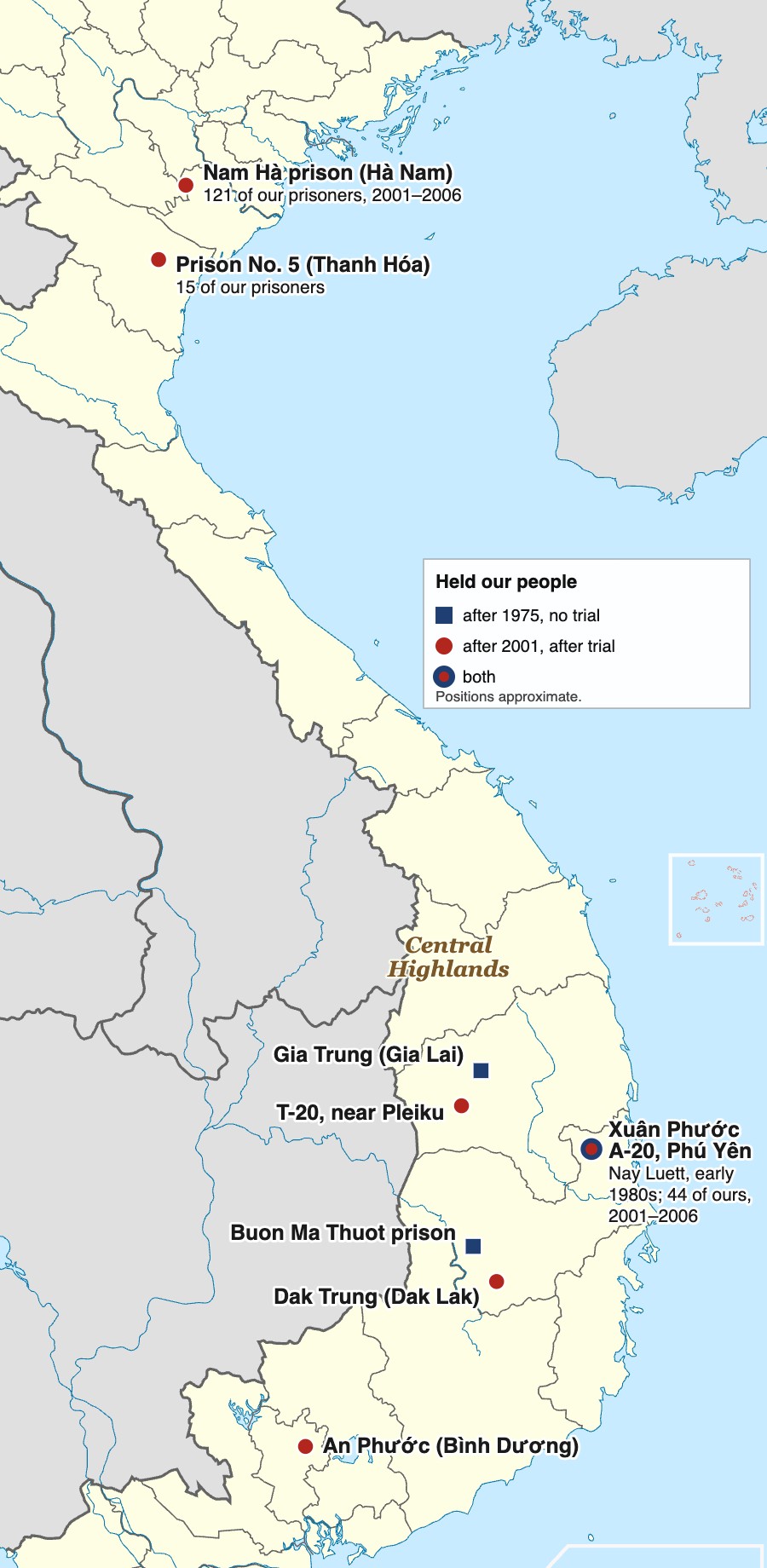
- They were sent far away. Of the 200 people whose prison is known, 121 were sent to the prison in Ha Nam province, south of Hanoi and about 1,000 kilometers from the highlands. Another 44 were held in Phu Yen, 13 of them recorded at Tuy Hoa, and 15 in Thanh Hoa. Only a handful stayed in the highlands. For a family with no money, the distance alone ended most visits.
- Some never came back. Sixty-four entries, 62 in Gia Lai and 2 in Dak Nong, end in “whereabouts unknown”, “family believes murdered; whereabouts unknown” or “family believes murdered”. Four are marked “not tried”.

Set against the other counts
Other organizations have kept their own lists, and their numbers differ because each counts something different: people sentenced, people still held, people named in one database. None of them is a total, and neither is ours. The main ones:
- Amnesty International, 2004
- At least 76 Montagnards tried and sentenced since 2001, in trials that did not meet international standards; 33 sentenced in 2003 alone.
- Human Rights Watch, January 2005
- The names of 188 Montagnards sentenced to up to thirteen years since 2001.
- Human Rights Watch, 2006
- At least 355 Central Highlanders in prison as of May 2006, listed by name in an appendix to No Sanctuary. Only 159 of their trials had been reported anywhere, by state media or foreign wire services.
- Human Rights Watch, 2011
- More than 350 Montagnards sentenced since 2001, at least 250 still in prison or awaiting trial, at least 65 of them caught trying to reach Cambodia, and at least 25 who had died in prisons, jails or police lock-ups.
- UK Home Office, December 2024
- 39 Montagnards recorded as detained across three databases.
- US Commission on International Religious Freedom, 2026
- Its victims list for Vietnam names 96 people, of whom 44 are Montagnards by our count.
Two things follow. First, 337 names is a floor, not a count: the Human Rights Watch figures alone show that more people were imprisoned than anyone outside has managed to name. Second, none of these lists, ours included, holds the roughly 100 people convicted by the mobile court in Dak Lak in January 2024 after the attacks at Cu Kuin. Nobody outside Vietnam has yet published all their names or where they are held.
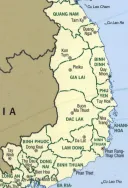
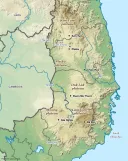
Our five provinces are also not the five that Human Rights Watch reported on. Its “five provinces of the Central Highlands” were Gia Lai, Kon Tum, Dak Lak, Dak Nong and Lam Dong. Our records have no Lam Dong table, and they include Binh Phuoc, which lies outside the highlands but is home to Stieng and Mnong villages, and where all fourteen people in our table came from a single district.
One name across the lists
The same person often looks different from list to list, and that is itself useful. Y Ngun Knul, from Krong Ana district in Dak Lak, is in our records as arrested on April 20, 2004, and sentenced to fifteen years in Ha Nam. In a letter to Vietnam in 2021, UN human rights experts give the date of arrest as April 29, 2004, and the sentence as eighteen years, and records his release on February 28, 2020. The differences do not mean that any of these sources is worthless. They mean that each was told something different, and that the truth is most likely where they agree.
Checking also shows what is missing. Y Pum Bya of Dak Lak, sentenced to fourteen years in 2019, is recorded by the US Congress’s human rights commission as having been arrested before, on February 28, 2002, and sentenced to eight years. That first arrest falls inside our years and our provinces, but he is not in our records. There will be others like him.
What the blank columns mean
A blank sentence column does not mean there was no sentence. It means nobody outside was told of one. In Kon Tum not a single sentence is recorded against eleven arrests, which says something about access to that province and nothing about what happened to those eleven people. A blank is a measure of what the family could find out, and that is worth reading as evidence in its own right.
“Whereabouts unknown” is the hardest note in the records. Behind each of those lines is a household that stopped receiving information and never started again.
How to search for somebody
Names in these records were written down by many hands, from several languages, over years. If a first search fails, the name is probably there under another spelling. Try all of these before concluding that somebody is not listed.
- Search the name without the prefix. Rhade and Jarai men’s names begin with Y and women’s with H, and the prefix is written variously as Y-, Y, Y joined to the name, H’ or H. Searching Not Eban finds Y- Not Eban, Y Not Eban and YNot Eban at once.
- Try the clan name several ways. The same Jarai clans appear as Rmah, R’mah, Ro Mah and Romah; Rcom, R’Com and Ro Cham; Rahlan, Rah Lan and Ro Lan; Kpa, Kpuih and Puih. Rhade family names shift the same way: our records write Buonya where the UN writes Bya, and Buondap where it writes Bdap.
- Try the name the family used. Many men are known as “father of” their eldest child: Ama followed by the child’s name among the Jarai and Rhade, Ba or Bă among the Bahnar. Other lists often give both, as in “Ksor Kam, also known as Ama H’Trum”. A family may know a man only by that name.
- Expect single names. Bahnar names do not carry a family or clan name, so Bahnar prisoners often appear under one name only, such as Ju or Runh. Some official records add a Vietnamese surname, most often Dinh.
- Remember that names change. A Jarai personal name is not fixed and can be changed if it seems unlucky, and Rhade children were once given a false name until they were about five. An older relative may know a person by a different name from the one in a record.
- Try the diacritics both ways. The same person appears as Byă and Bya, Đăp and Dap, Êñuôl, Enuol and Eñuol. Our records are inconsistent because the sources were.
- Try the village, not the name. Village spellings vary too, Plei, PLei, Ploi and Plou, Buôn, Buon and Bon, so search the distinctive part of the name rather than the word for “village”.
- Try the district. District names were spelled several ways: Dakdoa and Đăk Đoa, Krong Pac and Krông Pắc, Chu Se, Chư Sê and Cu Se.
- Check both neighboring provinces. Dak Nong was separated from Dak Lak in 2004, inside the period these records cover, so a person from what is now Dak Nong may sit in the Dak Lak table.
- Read every table. People were detained away from home, and the province in a record is sometimes the province of detention rather than of residence.
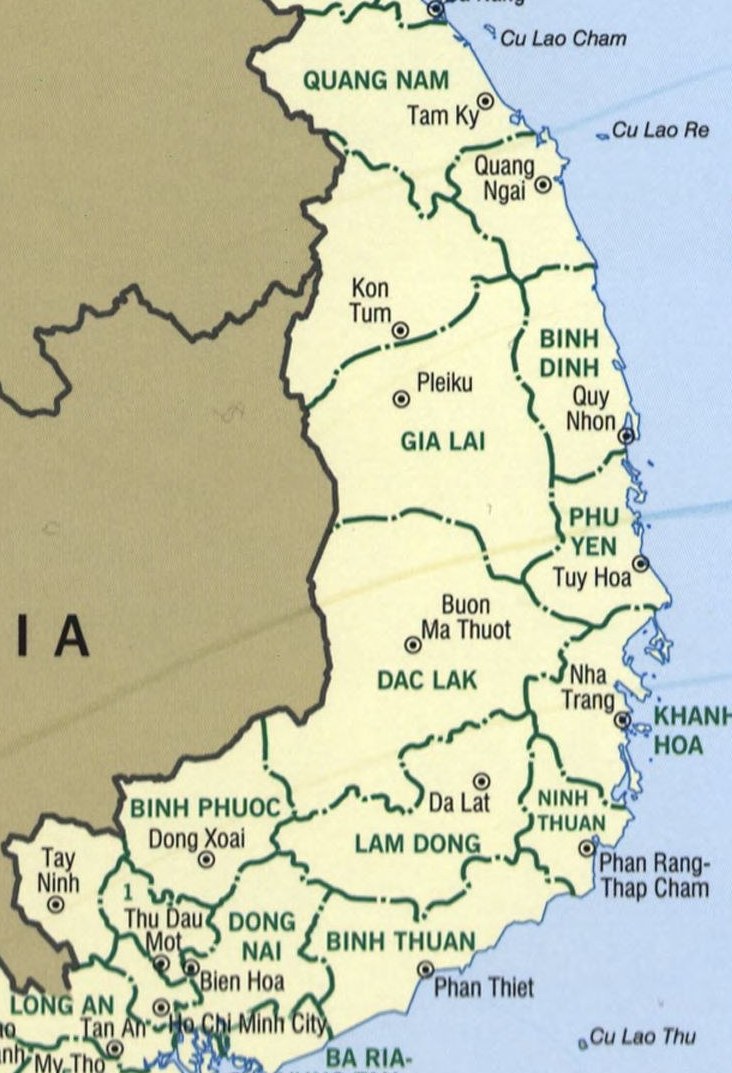
The map has changed again since. In July 2025 Vietnam cut its provinces from 63 to 34 and abolished districts altogether. As generally reported, Kon Tum was merged into Quang Ngai, Dak Nong into Lam Dong, Phu Yen into Dak Lak and Binh Dinh into Gia Lai. A report written today may name a province that did not exist when the person was arrested, and may give only a commune. That makes the old district names in these records more valuable, not less. The names and words page carries more spelling variants.
Other lists to search
- US Commission on International Religious Freedom, Frank R. Wolf Freedom of Religion or Belief Victims List. Search by name, not by ethnic group: the list files Montagnards under Jarai, Bahnar or Ede, and some of the newest under “Montagnard”.
- The 88 Project, database of persecuted activists in Vietnam, searchable by name, ethnicity, charge and year. Its entries are not always current.
- Human Rights Watch, No Sanctuary (2006), whose appendix lists Central Highland prisoners by province as of May 2006. The appendix is in the full edition on Human Rights Watch’s website; the copy in our library ends where the list begins.
- Amnesty International, Prisoners of Conscience in Viet Nam (2016 and 2019), which give aliases and places of detention.
- The UN special procedures, whose letters to Vietnam name individual prisoners. See The UN record.
If you find somebody
- Tell us what you know that the record does not say: a sentence, a transfer, a release, a death, a correction to a spelling or a date.
- Tell us if you are the family. We will not publish that you contacted us, and we will not add anything that identifies you.
- If the person is still held, an accurate entry, with full name, date of arrest, charge, court and prison, is what a UN working group, an embassy or a lawyer needs before anything can be raised.
- Read Reporting safely first, then how to report.
If somebody has just been taken
These tables are the long record. For the first hours and days, when the information that matters is easiest to lose, go to If a family member is detained.
Why we publish names at all
Because the alternative is worse. A person who is on a list that someone outside the country is keeping is harder to make disappear than a person who is not. Every name here was given to us by a family or a congregation for that purpose. We do not add a name unless somebody asked us to, and we will remove one on request from the family without asking why.
See also: Our defenders and prisoners, The laws used against us, The memorial register.
Sources
- Montagnard Foundation, Inc., prisoner records (archive held by DCHO), compiled from family and congregation reports; the counts on this page are our own tally of the five tables
- Human Rights Watch, Vietnam: Torture, Arrests of Montagnard Christians (January 2005); No Sanctuary (June 2006), in our library; Montagnard Christians in Vietnam (March 2011), in our library; World Report 2025 and 2026, Vietnam
- Amnesty International, Socialist Republic of Viet Nam: Renewed concern for the Montagnard minority (April 2004); Prisoners of Conscience in Viet Nam (2016 and 2019)
- UN special procedures, AL VNM 6/2021 (November 22, 2021), on Y Ngun Knul and four other Montagnard prisoners, and AL VNM 4/2024 (June 14, 2024), on the January 2024 trial
- US Commission on International Religious Freedom, Frank R. Wolf FoRB Victims List, Vietnam, and 2026 Vietnam country profile
- Tom Lantos Human Rights Commission, Defending Freedoms Project, Vietnam: Y Pum Bya
- UK Home Office, Country Policy and Information Note, Vietnam: Ethnic and religious groups, version 4.0 (December 2024)
- The 88 Project, database of persecuted activists
- The Vietnamese Magazine, “Viet Nam 2025: redrawing the administrative map at breakneck speed” (January 6, 2026)
- Minority Groups in the Republic of Vietnam (US Army, 1966), in our library — Jarai clan names, name changes and Bahnar names
Compiled September 2026. Every one of these records is incomplete, and we would rather be corrected than left alone. Corrections cost nothing and are the most useful thing anyone reading this page can send us.