









The human rights record of our people since 1975 is written mainly in reports: by Human Rights Watch and Amnesty International, by the United Nations, by governments, and by our own organizations. This page lists the ones we rely on, in order, with what each contains and where to find it. Most are free to read, and many are in our own library.

For asylum claims
If you are preparing a claim, the documents most often cited by decision-makers are the Human Rights Watch reports of 2002, 2011 and 2015, the US State Department’s annual reports, the UK Home Office country note of December 2024, Australia’s country report of February 2025, and the UN findings in What the United Nations has said. The British and Australian governments read the same facts differently, and a claim is stronger for answering both. Cite the document itself, with its date and page, not this page. We are not lawyers; read Reporting safely before you send anything to anyone.
How to read these reports
Every report on this page was written from outside the highlands, because no independent investigator has been allowed to work freely inside them. Each one rests on some mixture of three things: the accounts of our people who reached a researcher, often after fleeing to Cambodia or Thailand; what the Vietnamese state itself published; and the reports of our own organizations abroad. The mixture matters, and the reports say what theirs is. Human Rights Watch’s report of 2011 says it rests largely on Vietnamese state media, supplemented by interviews with people who fled and by our organizations’ reports. Its report of 2002 rests on more than a hundred interviews with highlanders who could not be named. Our own documents rest on what families told people they trusted.
Numbers differ from report to report because each counts something different: people sentenced, people still held, people named in one database, people killed in one period. Where two figures conflict, our articles set them side by side and say who counted, when and how. None of these reports is the whole record, and together they are still far from it.
Human Rights Watch
No organization outside our own has written more about us. Its reports run from the first deportations from Cambodia in 2001 to the extradition of Y Quynh Buondap in 2025, and its researchers took the accounts of hundreds of our people who could not safely be named.
- May 2001 — Cambodia: Deportation of Montagnard Refugees to Vietnam
At least 89 highlanders expelled from Cambodia after the February 2001 protests, seventy of them in ten days, among them a Mnong family that had received UNHCR protection papers two weeks before. - April 2002 — Repression of Montagnards: Conflicts over Land and Religion in Vietnam’s Central Highlands
Two hundred pages, built on interviews with more than a hundred highlanders who could not be named. The 2001 protests, land confiscation, forced renunciations, the flight to Cambodia, and a history chapter that runs from our own oral history through BAJARAKA and FULRO to the years after 1975. PDF. In our library. - September 2002 — New Crackdown on Montagnards in Vietnam
At least thirty arrests since June 2002; between ten and thirty police posted in each village in many districts of Gia Lai and Dak Lak; 273 Christian books and Bibles seized. - January 2003 — New Assault on Rights in Vietnam’s Central Highlands
A backgrounder of 21 pages: more than two hundred highlanders detained and as many as seventy serving long sentences after the protests. In our library. - April 2004 — Vietnam: Violence against Montagnards During Easter Week Protests
Eyewitness reports of protesters beaten to death on April 10, 2004, and forty injured people recorded at the provincial hospital in Dak Lak that night. See Easter week, 2004. - May 2004 — Vietnam: Montagnards Under Lockdown
Hundreds of people hiding in village graves and in pits dug in the forest after Easter 2004. - January 2005 — Vietnam: New Evidence of Torture, Mass Arrests of Montagnards
One hundred and twenty-nine people arrested in Gia Lai alone between December 12 and 24, 2004, eighty-five of them in Chu Se, and Cambodia’s police chief ordering more border police in Ratanakiri. The briefing paper behind it, Vietnam: Torture, Arrests of Montagnard Christians. Cambodia Slams the Door on New Asylum Seekers, runs to 25 pages. In our library. - June 2006 — No Sanctuary: Ongoing Threats to Indigenous Montagnards in Vietnam’s Central Highlands
At least 355 highlanders imprisoned since 2001, of whose trials only 159 had been reported anywhere; ninety-four people forcibly returned from Cambodia in July 2005; what became of those sent back. Its appendix lists the prisoners by name and province as of May 2006; the full edition, with that appendix, is in our library. - March 2011 — Montagnard Christians in Vietnam: A Case Study in Religious Repression
More than 350 of our people sentenced since 2001 on vague national-security charges, at least 250 still in prison or awaiting trial, at least 65 caught trying to reach Cambodia, and at least 25 dead in custody. The report says it rests largely on Vietnamese state media, supplemented by interviews with people who fled and by reports from our own organizations abroad. In our library. - June 2015 — Persecuting “Evil Way” Religion: Abuses against Montagnards in Vietnam
The official campaign against Dega Protestantism and Ha Mon Catholicism as “evil way” religions, drawn from interviews with 21 asylum seekers and from Vietnamese official media, which put the number of people identified as followers in Gia Lai, Dak Lak and Kon Tum at 1,758 as of October 2014. At least 54 of our people returned from Cambodia between late 2014 and mid-2015. In our library. - September 2017 — Cambodia: Protect Montagnards Refugees
Twenty-nine refugees facing forced return, and the apparently forced confessions of returnees shown on Vietnamese television that May. - June 2024 to December 2025 — Thailand: Don’t Return Montagnard Activist to Vietnam; Thailand: Vietnamese Activist at Risk of Forced Return; Thailand: Montagnard Activist Extradited to Vietnam
From his arrest in Bangkok on June 11, 2024, through the criminal court’s ruling that September, to his extradition on November 28, 2025. See Y Quynh Buondap. - July 2025 — Submission to the UN Human Rights Committee
For the Committee’s review of Vietnam: article 116 of the penal code used against highland activists who join religious groups the government disapproves of. - November 2025 — Thailand: Vietnamese Refugees at Risk from Hanoi
Seventy of our people detained in Nonthaburi on October 29, 2025, forty-two of them recognized refugees or asylum seekers awaiting a decision; more than sixty taken at a funeral on February 23; Vietnamese police allowed to visit detainees. - Every January — World Report, Vietnam chapter
The annual summary. The 2025 chapter records the thirteen-year sentence of Y Krec Bya; the 2026 chapter the sentences of Ro Cham Grong, Y Po Mlo and Y Thinh Nie, seven to nine years each under article 116.
Amnesty International
Amnesty’s documents on us are fewer and shorter, but its lists of prisoners of conscience give the aliases our people are known by at home and the prisons where they are held, which no other source does as consistently.
- December 2002 — Socialist Republic of Viet Nam: No sanctuary: The plight of the Montagnard minority (ASA 41/011/2002)
Twenty-one pages on what was done to our people after the protests of 2001. - April 2004 — Socialist Republic of Viet Nam: Renewed concern for the Montagnard minority (ASA 41/005/2004)
At least 76 of our people tried and sentenced since 2001, 33 in 2003 alone; the conclusion that the authorities used “disproportionate and brutal force” against the Easter protests. - July 2016 — Prisoners of Conscience in Viet Nam (ASA 41/4389/2016)
Eighty-four prisoners of conscience, 29 of them Montagnard Christians, most from Gia Lai and arrested between 2008 and 2012, with the names their families used and where each was held. Updated in 2018 (ASA 41/8162/2018) and May 2019 (ASA 41/0303/2019), when the list reached 128. - July 2016 — Prisons Within Prisons: Torture and Ill-Treatment of Prisoners of Conscience in Viet Nam (ASA 41/4187/2016)
Torture and ill-treatment of prisoners of conscience, with a note on the mass arrests of our people in 2001, 2004 and 2008. - July 2024 — Thailand: Montagnard Indigenous activist must not be extradited
On Y Quynh Buondap’s arrest for “overstaying” his visa, on Vietnam’s extradition request. Amnesty also published the joint open letter of civil society organizations to the Thai prime minister and foreign minister of October 18, 2024 (ASA 39/8662/2024). - November 2025 — Thailand: Extradition of Montagnard activist to Viet Nam places him at grave risk of torture
On the Court of Appeal’s ruling of November 26, 2025. Amnesty’s report on Viet Nam for 2024 records that Y Pum Buonya died in custody on March 8, 2024, after being tortured.

The United Nations
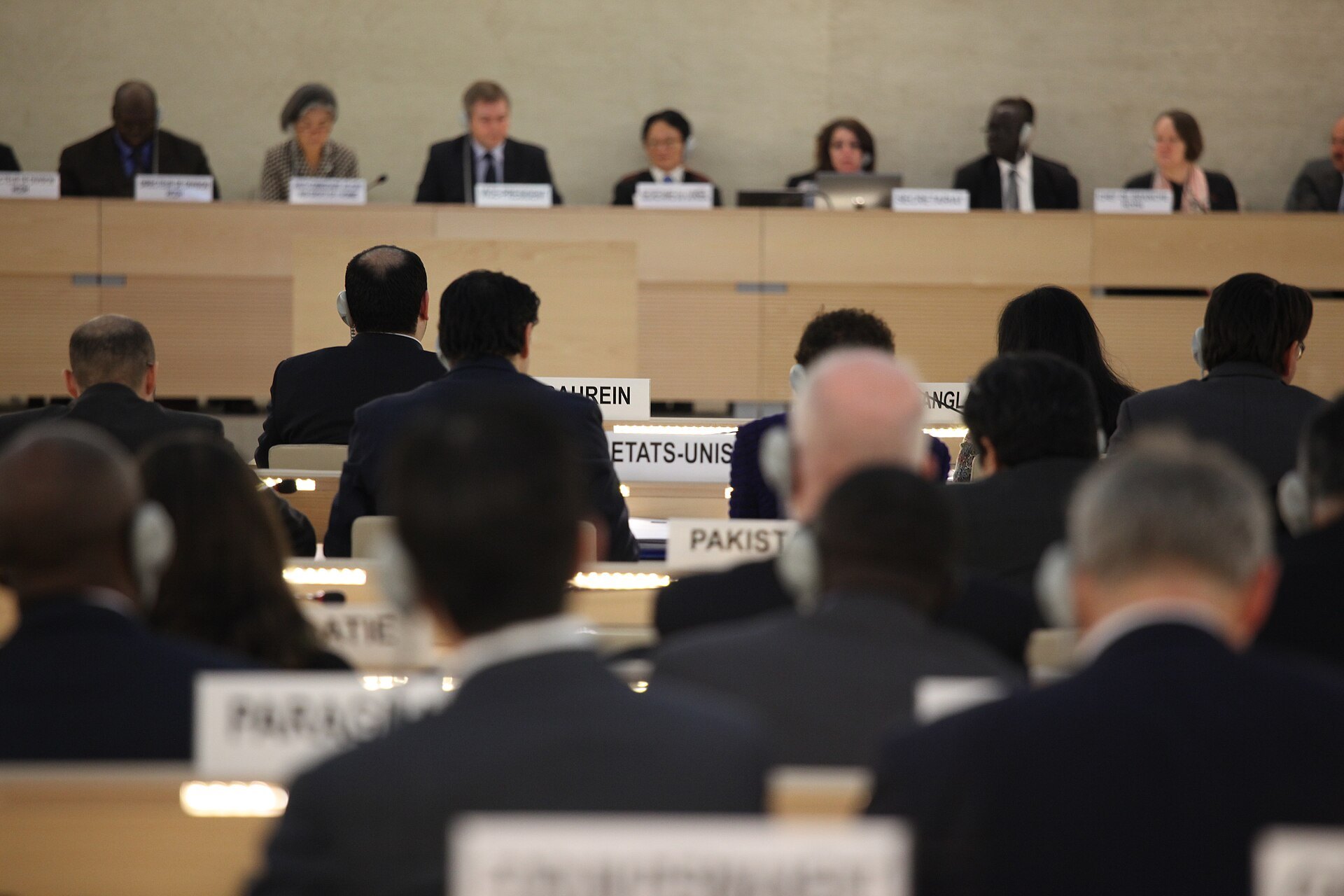
The UN’s committees and experts do not investigate on the ground in Vietnam; they review what the government reports, what organizations submit, and what families send. Their findings matter because governments must answer them. The documents most often cited are these; the full record is in What the United Nations has said.
- April 2012 — Committee on the Elimination of Racial Discrimination, concluding observations on Viet Nam (CERD/C/VNM/CO/10-14)
Names us as “Degar (Montagnard)” and raises the confiscation of ancestral lands without prior consent. - January 2015 — Report of the Special Rapporteur on freedom of religion or belief, mission to Viet Nam (A/HRC/28/66/Add.2)
Heiner Bielefeldt’s report on his visit of July 2014, whose stops in Gia Lai and Kon Tum could not be completed, with his account of reprisals against people he met and the allegation that hundreds of ethnic minority churches in the highlands had been forced to close. - December 2023 — CERD, concluding observations on Viet Nam (CERD/C/VNM/CO/15-17)
The Committee’s second review, in which some 20,000 stateless households in the Central Highlands were raised in the dialogue. - June 2024 — Special procedures, AL VNM 4/2024 and AL THA 6/2024
The UN experts’ letters to Vietnam and Thailand about the mobile-court trial of January 2024, the terrorist listing of Montagnards Stand for Justice, and the danger of returning Y Quynh Buondap. The experts’ press release of August 28, 2024 made them public. - June 2024 — Universal Periodic Review of Viet Nam, report of the working group (A/HRC/57/7)
The recommendations made to Vietnam in its fourth review by the Human Rights Council, and Vietnam’s answers. - July 2025 — Special procedures, AL VNM 3/2025
On transnational repression: the listing of overseas Montagnard groups as terrorist organizations, and concern that Vietnam and Thailand were exchanging information to identify Montagnard refugees in Thailand. - August 2025 — Human Rights Committee, concluding observations on Viet Nam (CCPR/C/VNM/CO/4)
Concern for religious minorities, “in particular Montagnard and Hmong Protestants”, and for the “education” imposed on Montagnard prisoners after their release. - December 2025 — UN experts alarmed by Y Quynh Bdăp’s extradition by Thailand to Viet Nam
The experts’ statement after the extradition, saying his whereabouts in Vietnam were unknown. - Various — What the United Nations has said
Every UN finding about us that we have been able to trace, in order.
Governments and intergovernmental bodies
We do not list documents published by the Vietnamese government or its press. The government documents below are those of the United States, Britain, Australia, Canada and the European Union. They were written for their own purposes, intelligence, foreign policy or asylum decisions, and they are read here with that in mind. The oldest are the most candid, because they were never meant to be read by the public.
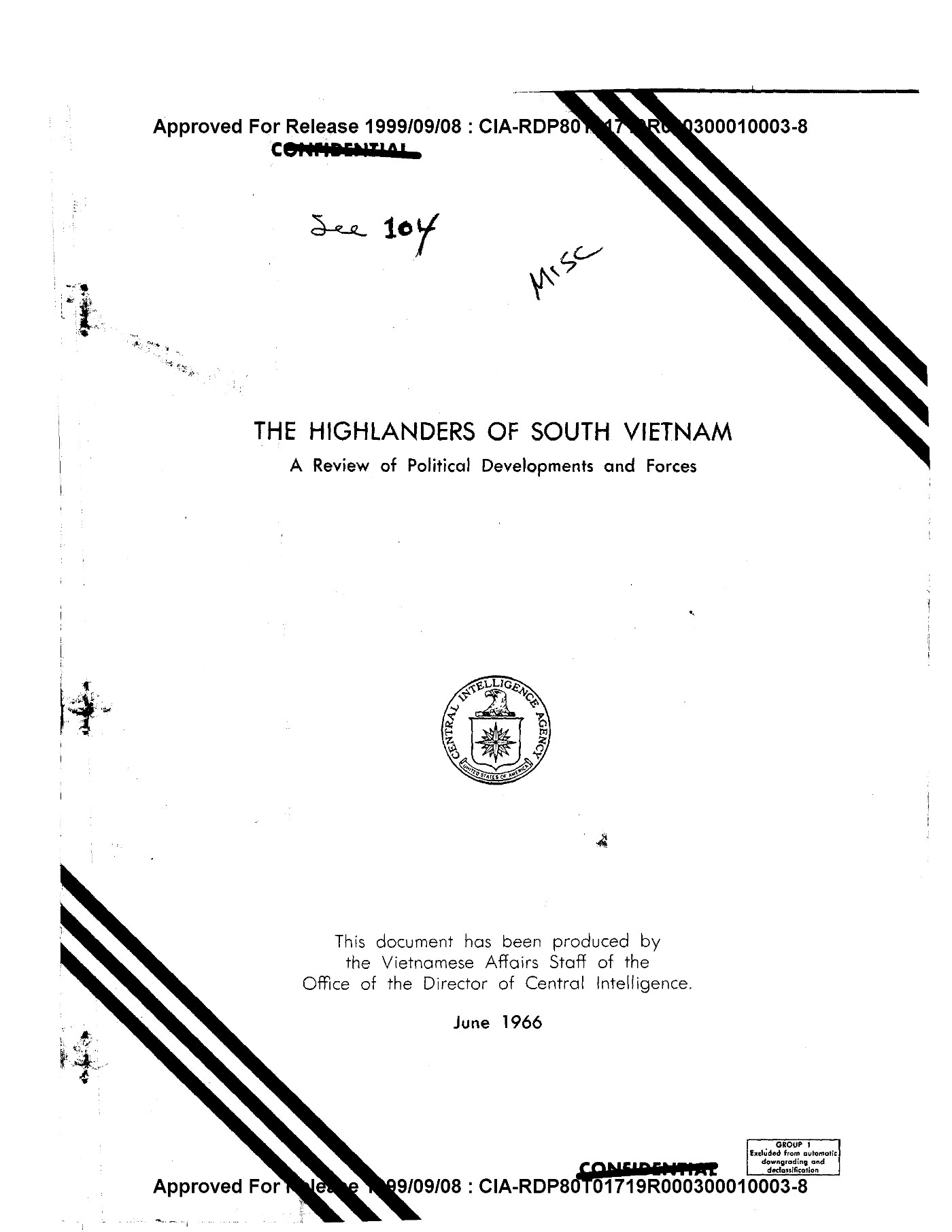
- 1966 — CIA, The Highlanders of South Vietnam: A Review of Political Developments and Forces
Declassified. The years from 1954 to 1965, including the revolt of September 1964 and the FULRO rising of December 1965. In our library. A one-page covering memorandum of June 27, 1966, titled The Montagnard Problem in South Vietnam, sent it to the CIA’s Deputy Director for Plans. In our library. - December 1983 — CIA, Vietnam: Repressing Ethnic Minorities and Religious Groups (EA 83-10237)
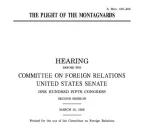
Declassified. Rare contemporary evidence of the early postwar years: military force or police repression against nearly every religious group and ethnic minority, tens of thousands of Vietnamese settled in the highlands, and Vietnamese imposed as the language of highland schools. In our library. - March 10, 1998 — US Senate, Committee on Foreign Relations, The Plight of the Montagnards (S. Hrg. 105-465)
A hearing devoted to our people. The later hearings are listed in What Washington has said. In our library. - August 2002 — International Organization for Migration, Cultural Orientation for Vietnamese Montagnard Refugees
The preparation of 905 refugees in a transit center outside Phnom Penh for resettlement in the United States. In our library. - Annual — US State Department, Country Reports on Human Rights Practices: Vietnam and International Religious Freedom Report
The religious freedom report for 2023 names the Central Highlands provinces as the most difficult for Catholics. The human rights report for 2024, released in August 2025, does not use the word Montagnard, though it records the search of Y Thinh Nie’s home and visits by Vietnamese security officials to refugee communities in Thailand. - Annual — US Commission on International Religious Freedom, Annual Report, Vietnam
The 2026 chapter records the sentences of Montagnard Christians and the raid on the funeral in Bangkok in February 2025. The Commission’s country update of December 2025 and country brief of September 2026 carry the raids on house-church preachers in Dak Lak in March 2026 and the arrests in Gia Lai that followed. Its earlier reports on state-controlled religion and on Vietnam are in our library and our library. - December 2024 — UK Home Office, Country Policy and Information Note: Vietnam – Ethnic and religious minority groups, version 4.0
The guidance British asylum decision-makers use. It concludes that Montagnards are likely to face persecution or serious harm from the state, particularly if they are, or are thought to be, politically active or Christian. No newer version had been issued by September 2026. - February 2025 — Australian Department of Foreign Affairs and Trade, Country Information Report: Vietnam
Australia’s assessment for its own asylum decisions. It finds a low risk of discrimination on ethnicity alone, and a high risk of harassment, monitoring, arrest and prosecution for Montagnards involved in political activism or unregistered religious practice. It and the British note weigh the same facts differently, and a claim should address both. - November 2003 — European Parliament, resolution on Vietnam
Condemned “the new and more serious wave of repression” against the Unified Buddhist Church and against Christian Montagnards. - February 2004 — Immigration and Refugee Board of Canada, response to information request VNM41980.E
Canada’s answer to a research request about Montagnards, of the kind its refugee judges rely on.
Our own documents, and our allies’
These are our own documents and our allies’, written to make a case, as every report on this page was, including the ones by governments. They hold names, places and dates nobody else recorded, gathered from families by people the families would talk to. Where their figures differ from a figure published elsewhere, our articles set the two side by side and say who counted, when and how.
- July 1993 — Human Rights Violations: The People of the Dega Republic
Our own submission to the UN Working Group on Indigenous Populations, for its session of July 19–30, 1993: our account, in our own name, of what had been done to us since 1975. - 2003 to 2016 — Unrepresented Nations and Peoples Organization, Degar-Montagnards member profile
The Degar were members of UNPO in those years, represented by the Montagnard Foundation; the profile and its news archive hold many documents, including the Foundation’s report on Easter 2004. - May 2008 — Montagnard Foundation, Vietnam’s Blueprint for Ethnic Cleansing
An advocacy report, circulated to the European Parliament’s human rights subcommittee in August 2008. It records more than 47 of our people killed by Vietnamese security forces and cites Human Rights Watch for more than 350 prisoners. - February 2012 — Racial Discrimination and Ethnic Cleansing Policies perpetrated against the Montagnard Indigenous Peoples in the Central Highlands by the Government of Vietnam
Our own submission to the Committee on the Elimination of Racial Discrimination for its 80th session: prisoners, deaths in custody and education. - May 2025 — Christian Solidarity Worldwide, general briefing: Vietnam
Recent sentences of Montagnard Protestants, including ten life sentences after the Dak Lak trial and Y Krec Bya’s thirteen years. - DEGAR Foundation — Website and statements archive
News and statements.
Land, forests, rivers and mines
Much of what has been done to us has been done to our land, and the best evidence of it comes from environmental researchers, journalists and organizations that watch rivers and forests rather than prisons.
- May 2000 — Ian G. Baird et al., A Study of the Downstream Impacts of the Yali Falls Dam in the Se San River Basin in Ratanakiri Province, Northeast Cambodia
The foundational study of what the Yali dam did to villages downstream in Cambodia. - February 2007 — 3S Working Group, “Sharing the Srepok River”, World Rivers Review
The downstream effects of the Vietnamese dams on the Srepok and Se San. - April 2009 — Radio Free Asia, “Politburo Approves Bauxite Mining”
The bauxite decision and General Võ Nguyên Giáp’s letter. See Bauxite. - May 2013 — Global Witness, Rubber Barons
Vietnamese rubber companies taking indigenous land in Cambodia and Laos. - April 2024 — Mongabay, “Forests in Vietnam’s Central Highlands at risk as development projects take priority”
Some 58,915 hectares in Lam Dong approved for removal from forest status, with 0.14 percent of the land converted for economic development allocated to ethnic minority communities. - June 2026 — Coffee Watch, Robusta’s Reckoning
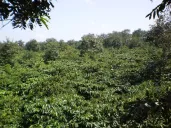
Forest cover in the Central Highlands fell from 42.8 percent of the land in 1990 to 19.0 percent in 2020 as coffee spread. See Land taken for coffee.
What is missing
We have not found a UN document symbol for our submission of 1993, or the text of the agreement that UNHCR signed with Vietnam and Cambodia in January 2005 about the people in the Cambodian camps. No independent report yet says where Y Quynh Buondap is held or whether he has been tried again since his extradition. If you hold any of these, or know of a report that belongs here, please tell us.
See also: Theses and academic studies, Books about the Dega, Sources and method.
Compiled September 2026. Links change; if one of these no longer works, the title and date will usually find it.