

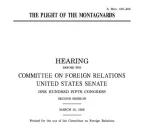
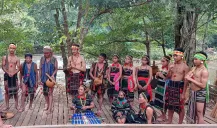


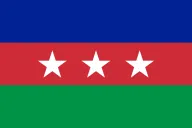
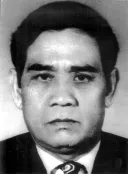
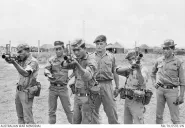
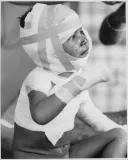
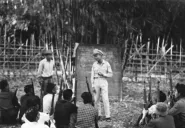
On the night of September 19, 1964, the strike forces of four American-trained camps in Darlac and Quang Duc rose against their Vietnamese officers and marched on Buon Ma Thuot, and a movement announced itself: the United Front for the Struggle of the Oppressed Races, FULRO. It was made by the men of BAJARAKA, released from Diem’s prisons seven months earlier. It fought, negotiated, split, fought again, and outlived the war that produced it by seventeen years. It ended in October 1992, when its last four hundred fighters walked out of the forest of Mondulkiri and handed their rifles to United Nations peacekeepers. This page is the movement’s history. Its men are on The men of FULRO.

What it was
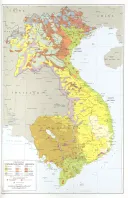
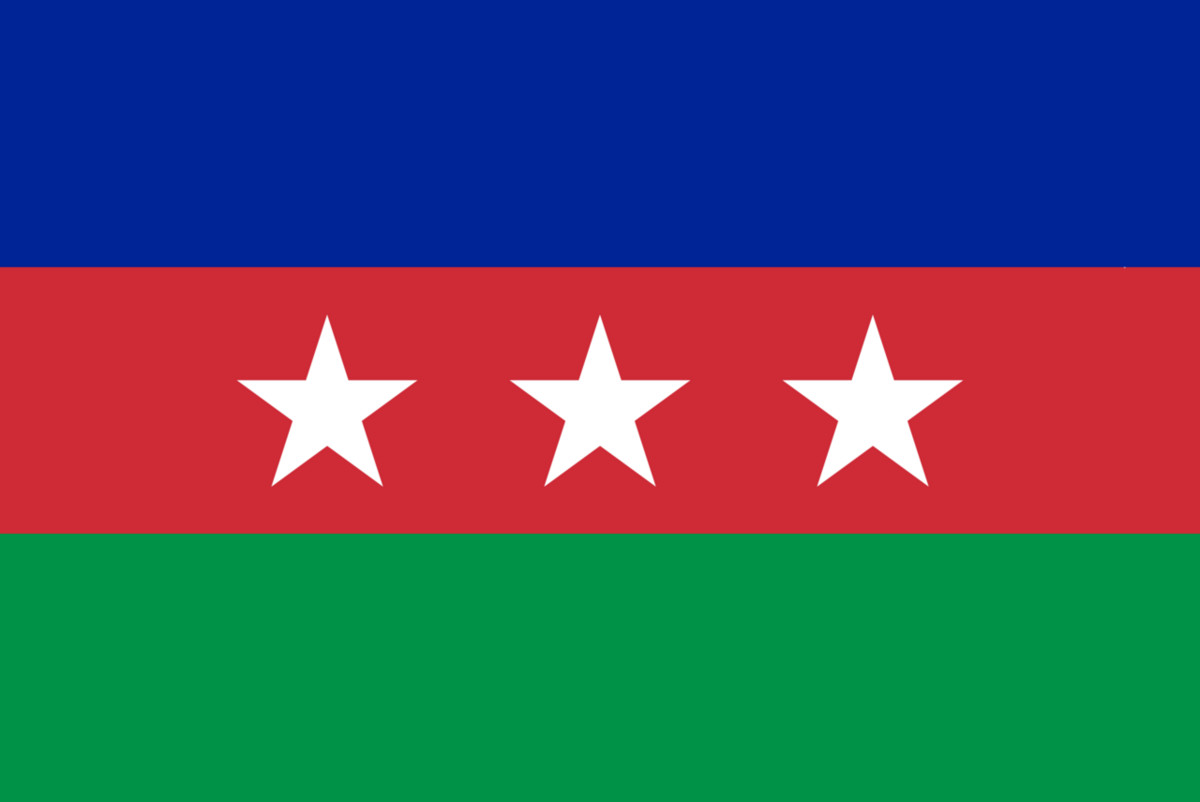
FULRO was formed in the summer of 1964, on August 1 by its own documents and by our own 1993 account to the United Nations, from three organizations. The first was the Front for the Liberation of the Highlands (FLHP), which was BAJARAKA reconstituted the previous March. The second was the Front for the Liberation of Champa, led by Les Kosem, a Cham officer of the Royal Cambodian Army. The third was the Front for the Liberation of Kampuchea Krom, led by Chau Dara. The Dega leader was Y Bham Enuol, who had led BAJARAKA and spent more than five years in prison for it; some of the movement’s own documents list Chau Dara as president at the founding, with Y Bham and Les Kosem as vice-presidents. Its headquarters were in Cambodia.
The three fronts are why the name speaks of oppressed races in the plural. FULRO spoke for the indigenous and dispossessed peoples of the whole south of the peninsula: highlanders, Cham, and the Khmer of the Mekong delta. It also meant that from the first day FULRO contained men whose first interest was Cambodia and not us, and that shaped a great deal of what followed.
The three aims
- That the Dega be recognized as the legal and rightful masters of the Central Highlands.
- That the Vietnamese administration of those lands be dismantled and its military forces withdrawn.
- That Dega sovereignty be restored and the independence of the Dega people guaranteed.
These were adopted by what the movement called the free representatives of the Dega people. Our position has been that no assembly sitting under an occupying power can rescind them, which is why they are still quoted sixty years later by an organization that has had no army since 1992. What has changed is the means: since 1992 the aims are pursued by peaceful means only.
Before the rising: the spring and summer of 1964
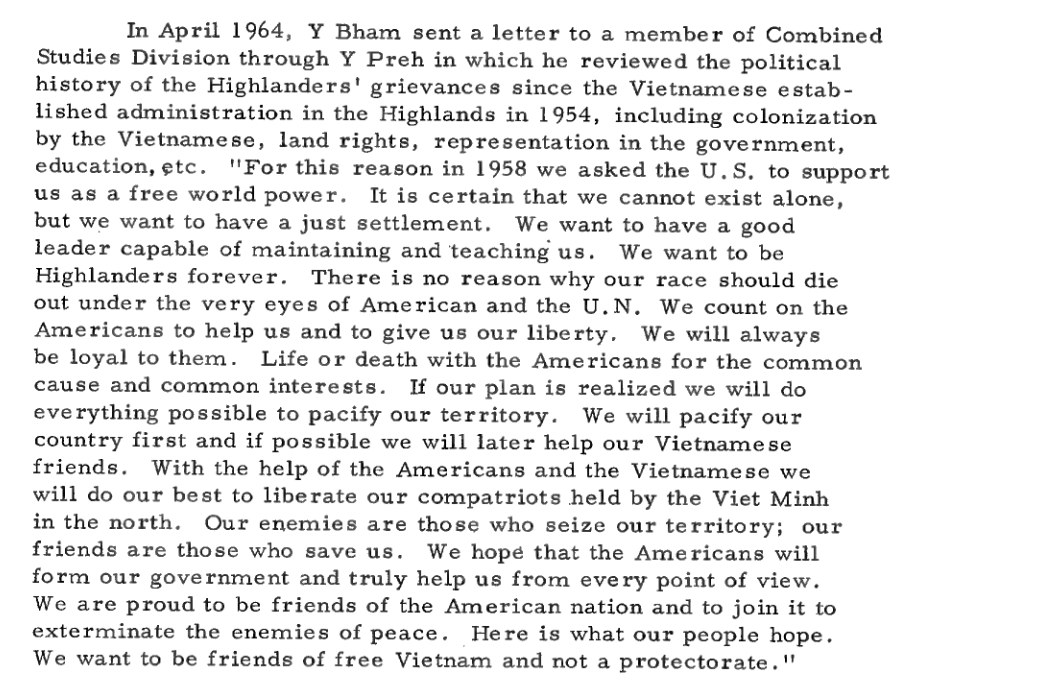
When the BAJARAKA leaders came out of prison in February 1964, they were given posts, and they went on asking. In April 1964 Y Bham wrote, through a Rhade intermediary named Y Preh, to a member of the CIA’s Combined Studies Division, the office that had armed our villages at Buon Enao. The CIA quoted the letter in its 1966 history of the highlands:
“For this reason in 1958 we asked the U.S. to support us as a free world power. It is certain that we cannot exist alone, but we want to have a just settlement. We want to have a good leader capable of maintaining and teaching us. We want to be Highlanders forever. There is no reason why our race should die out under the very eyes of American and the U.N. … Our enemies are those who seize our territory; our friends are those who save us. … We want to be friends of free Vietnam and not a protectorate.”
In May he told American officials that if he were in charge of the highlands, the war against the Viet Cong would be over in six months, and proposed a highland army of 50,000 men supported by the United States. In July Y Bo, the Rhade commander of the strike force at Buon Brieng, proposed the same things to the Americans: a special status for the highlands, a separate government, highland forces under highland officers.
Meanwhile, the CIA records, the Vietnamese officials had stopped going to our villages after Diem fell, and by the rains of July 1964 the Viet Cong were collecting the weapons of outlying hamlets; Darlac lost nearly five hundred in one month.
September 19–20, 1964: the rising
In early September the Americans heard that a rising was planned for that month. The Vietnamese commanders did not believe it, and the American Special Forces advisers in the camps were not told. On the morning of September 19 word came that it would happen that night.
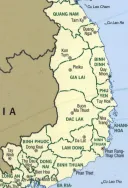
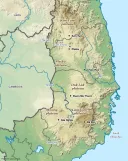
That night the strike forces of four camps rose: Bu Prang and Buon Sar Pa in Quang Duc, and Ban Don and Buon Mi Ga in Darlac. The CIA puts the number at about 2,000 men, mostly Rhade with some Mnong; other accounts give about three thousand. At Buon Brieng, where a fifth rising was expected, the strike force stayed in camp, and so did the Truong Son force at Buon Enao, which the CIA believed had served as the planning base. Vietnamese Special Forces soldiers were killed at Buon Sar Pa and Buon Mi Ga, and Regional Force soldiers at the Three Frontiers post. The CIA gives about 73 Vietnamese killed, the highest count we have; other accounts run from about three dozen to more than fifty. Sixty-one Vietnamese were taken hostage from the district town of Dak Mil. The Americans in the camps were disarmed and put under what the Rhade called “protective custody,” and were not harmed.
By the morning of September 20 the rebels had surrounded Buon Ma Thuot, held the radio station and were moving on the 23rd Division’s ammunition dump. Y Bham was at the radio station with the province chief that morning, trying to talk the troops back to their camps. About noon two or three jeeps of men from Buon Sar Pa drove into the town and took him away to the rebel headquarters south of Buon Ma Thuot. The CIA wrote in 1966 that it was “the last time Y Bham has been seen by either Vietnamese or American officials.” Whether he went willingly nobody outside knows. The CIA thought he had come to believe his place was with his people.
The military leader of the rising, the CIA says, was Y Dhơn Adrong, a Rhade schoolteacher from Lac Thien who had been the treasurer of the BAJARAKA central committee and had proposed a general rising as early as January 1963, at a meeting at Buon Ea Ana. He became FULRO’s first vice-president. A handbill in French and Rhade, issued by the rebels on September 20, said that the Vietnamese had pushed our people around for ten years, with American help, and that we wanted autonomy.
The Vietnamese commander of II Corps, General Nguyễn Hữu Có, told the Americans in Buon Ma Thuot that night:
“I told the Montagnards that the CIDG is not controlled by me. They are armed by America, trained and paid by Americans. Their grievances should be directed against their camp commanders not the Vietnamese Government.”
The American Special Forces got the men back toward their camps. Buon Ma Thuot was not attacked, and there was no more killing. The American ambassador, Maxwell Taylor, cabled Washington that the demands came down to four: better treatment, highland appointments, development programs and “substantial autonomy,” and that there was no clear sign of Viet Cong involvement. The hostages at Buon Sar Pa were released and the camp was occupied by the South Vietnamese army on September 27. General Nguyễn Khánh made promises to our people on September 24 and 28. During the talks, Y Bham crossed into Cambodia, and about two thousand FULRO men followed him.
On October 17, 1964, FULRO announced a Provisional Government of the High Plateau from Cambodia, with a council of twenty-eight ministers, and issued a proclamation reminding Khánh of his promises and calling on our people to rise again if they were not kept. They were not kept. The Vietnamese closed Buon Sar Pa at once, Bu Prang in January 1965, and Ban Don soon after, and sent the men elsewhere; 166 of them deserted with 47 weapons.
1965: Buon Brieng, the name, and December
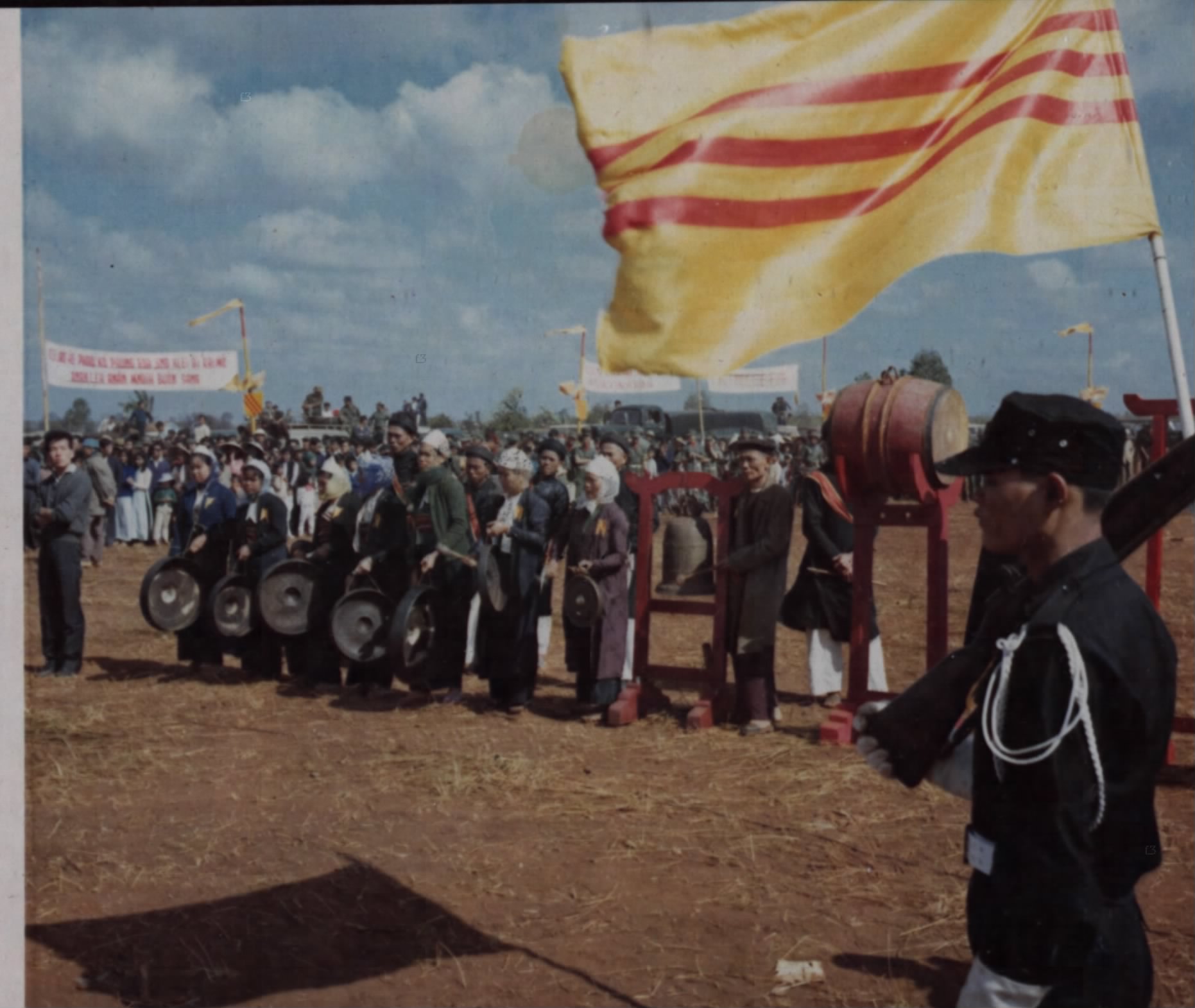

Buon Brieng, July 1965. On July 29, when the government negotiators were late, FULRO took over the Buon Brieng camp; it gave it back when they arrived. On July 31 FULRO took it again and this time disarmed the American Special Forces team. The camp went back to the government once more, but more than two hundred of its strike force went out to join about two hundred FULRO men waiting nearby. On September 7 the South Vietnamese army entered Buon Brieng and disarmed the men who were left. Three days later two Vietnamese Marine battalions surrounded FULRO’s 28th Battalion, about 485 men, in Buon Ho district, and its commander brought his men in. Our own 1993 account to the United Nations records that six hundred FULRO men were arrested after Buon Brieng and killed in secret. Killings done in secret leave no public count, and no outside body has gone looking for one. If a family holds a name, a date or a place from those arrests, that is what turns six hundred into a list.
The name. At the Conference of Indochinese Peoples in Phnom Penh in 1965, Y Bham Enuol used the word Dega for our people before an international gathering. It was the first time our own name for ourselves was put on that kind of record. Every page in this library that says Dega rather than Montagnard goes back to that moment.
December 17–18, 1965. FULRO rose again, in Pleiku, Phu Bon, Darlac and Quang Duc, and this time, the CIA noted, the Jarai were in it in large numbers for the first time. The government had warning: by December 18 it had arrested 76 highlanders in Pleiku, and 92 in the end, including ten instructors at the Pleiku Highlander Training Center. At Phu Thien in Phu Bon, the 296th Regional Force company, a highland unit, rose and took the district town; the district chief was among 32 Vietnamese killed, and 22 were wounded. Regular troops from Cheo Reo retook the town by three in the afternoon, and 110 men of the company surrendered. At Gia Nghia, the capital of Quang Duc, a FULRO unit under an army captain, Y Mip, took the town and killed the deputy province chief for security; the province chief retook it within hours and captured Y Mip and 120 men. At the Lac Thien camp, highland leaders talked the strike force out of joining. A FULRO force under a Colonel Y Nam sent against Buon Ma Thuot was held off and withdrew toward Cambodia by December 21.
The government tried the leaders. On December 27, 1965, the commander of the 296th company and his three platoon leaders were executed. Of the 92 held in Pleiku, three were sentenced to twenty years at hard labor: Ksor Kham, the former director of the Pleiku highland boys’ school; Y Ba Ya, a ranger sergeant; and Nay Bhon, the school’s former vice-principal. Captain Nay Beo and one other were given fifteen years. The CIA recorded that most highlanders were indignant at the executions, and that a Catholic priest in Buon Ma Thuot reported the unrest among the Rhade was acute.
In Kon Tum there was no rising. Paul Nưr, the deputy province chief and an admitted member of FULRO, said there was good FULRO and bad FULRO, and that the bad FULRO had organized the revolt. The general commanding II Corps had ordered his arrest; the province chief told him about the order instead and hoped he would not have to carry it out.
Inside the American war
FULRO and the American war cannot be separated. The Americans recruited, armed and paid tens of thousands of our men through the CIDG and the Mike Forces, and many of those men were FULRO; see Mike Force, SOG and the special operations war. The veteran Jim Morris, who served in the highlands, writes that the II Corps Mike Force was almost entirely FULRO and that the movement had perhaps ten thousand armed men in II Corps in the mid-1960s; other estimates are lower. Kpa Doh, the interpreter who was in effect the highland commander of the Pleiku Mike Force, was also its FULRO political officer. Y Kdruin Mlô, whom the Americans called “Philippe Drouin” or “Cowboy,” rose from interpreter to FULRO colonel commanding a division in Darlac, and was killed in 1968.
That double loyalty, to the Americans who armed them and to a movement the Americans’ ally called rebellion, is the central fact of our military life between 1964 and 1975. The Americans had been warned about September 1964, too. The Special Forces veteran Jim Morris writes that an American captain near Cheo Reo had obtained FULRO’s plan, its founding documents and its flag before the rising, and was not believed.
1968–1969: the settlement, and the split
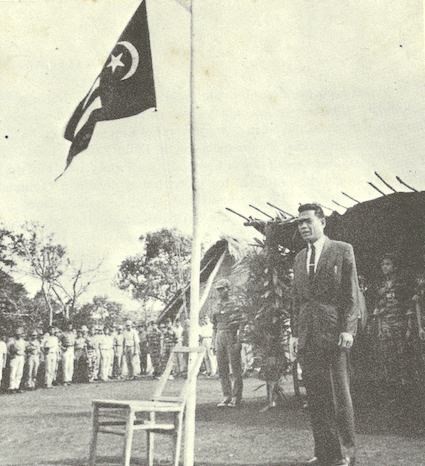
From August 1968 a South Vietnamese delegation negotiated with FULRO at Buon Ma Thuot. On December 11, 1968, an agreement was reached that recognized minority rights and set up a ministry for ethnic minorities in Saigon.
It held for nineteen days. On December 30, 1968, Les Kosem, whose aims were Cambodian and who had no interest in a Dega settlement inside South Vietnam, seized Camp le Rolland and put Y Bham Enuol under house arrest in Phnom Penh. Y Bham never left Cambodia again. On February 1, 1969, the final treaty was signed by Paul Nưr for the Republic of Vietnam and Y Dhơn Adrong for FULRO: a Dega man on each side. A large part of the movement came in, more than 1,300 FULRO soldiers and their families in January 1969 alone. That is usually taken as the end of FULRO as a political movement in South Vietnam. It was not the end of FULRO. The ministry that came out of the settlement is on Paul Nưr and Nay Luett: the ministry years.
1970–1975: Cambodia
After the coup in Phnom Penh in March 1970, Les Kosem became a brigadier general of the new Khmer Republic, commanding its 5th Brigade, and took control of what remained of FULRO in Cambodia. Bunong and other highland soldiers from FULRO served in that army. In 1974 Y Bham, still under house arrest, named Kok Ksor FULRO’s chief of staff. When the Khmer Rouge took Phnom Penh on April 17, 1975, Y Bham, Kpa Doh and many FULRO families were in the French Embassy compound. They were handed over to the Khmer Rouge, and Y Bham died with about 150 of his people. Les Kosem escaped to Malaysia, where he died in 1976. See 1975, and what came after.
After 1975: the forest
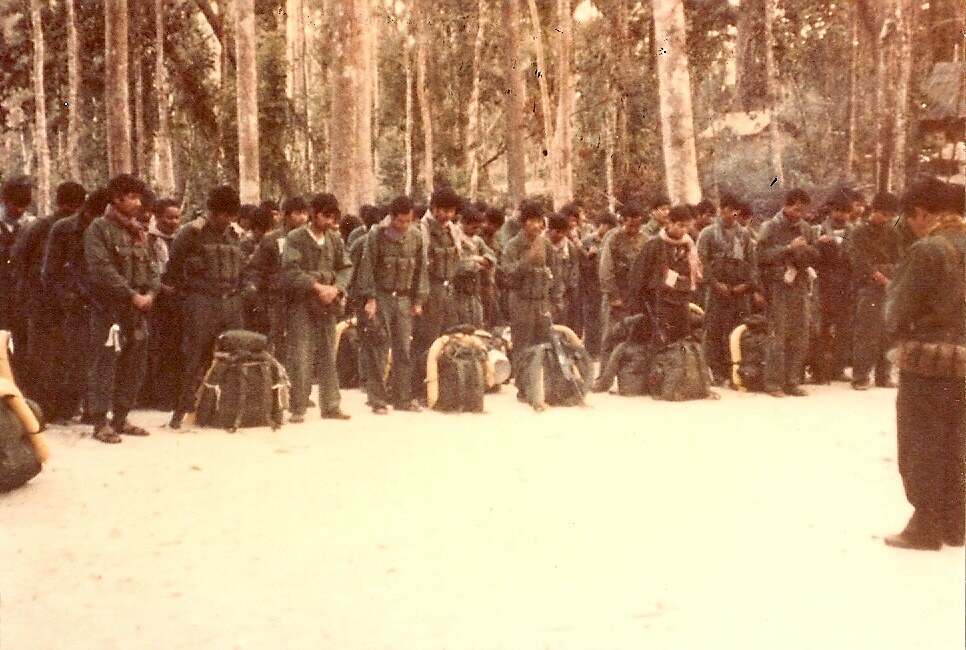
FULRO fought the Socialist Republic for another seventeen years. After 1975 it fielded about ten thousand fighters, still armed with American weapons, and struck in four regions, Quang Duc, Darlac, Pleiku and Kon Tum, from bases in the highlands. By 1977 its main outside backer was the Khmer Rouge: that year the two signed an agreement to exchange information and training, and the Khmer Rouge supplied the movement with arms and provisions. The cost was heavy: by 1979, the survivors later told the journalist Nate Thayer, the movement was running short of ammunition and had lost more than eight thousand killed or captured.
In 1979 the survivors left their bases in the highlands for the forest on the Cambodian side of the border, where the Khmer Rouge gave them sanctuary in the areas it held. Estimates of their strength in the early 1980s run from about two thousand to Human Rights Watch’s seven thousand. By 1986 the Khmer Rouge had parted ways with the movement and stopped supplying it. That year several hundred of our fighters and their families, who had made their way overland through Cambodia to Thailand, were resettled in the United States as refugees, the beginning of our community in North Carolina. The rest stayed. As late as 1990 a six-man FULRO patrol went back into Vietnam; four were killed in an ambush, and the two survivors reached a United Nations unit only in May 1993. In January 1992 the Khmer Rouge expelled what was left of FULRO into the remotest part of Mondulkiri.
The men in Mondulkiri did not learn until 1992 that Y Bham Enuol, under whose authority they had been fighting, had been dead for seventeen years. In October 1992 the last of them, some four hundred fighters and their families, handed their weapons to the peacekeepers of UNTAC and came out. That story is on Mondulkiri, 1992: the end of the armed struggle, and the years in the forest on Re-education and the forest, 1975–1992.
What we do not claim
FULRO was an armed movement and it fought a long war. On the night of September 19, 1964, our men killed Vietnamese soldiers in their camps, and at Phu Thien in December 1965 they killed a district chief and others with him. At times FULRO fought the South Vietnamese army while other Dega were serving in it. It took weapons from the Khmer Rouge, whose purposes were not ours and were monstrous. People were killed who had not chosen any of this. A library that means to be used as evidence cannot present that record as unblemished, and we do not.
What we do say is that every peaceful road had been tried first, by the same men, and that the prison sentences of 1958 are the reason the rifles of 1964 exist. The letters of BAJARAKA are on BAJARAKA, 1958.
What we do not know
The six hundred whom our own account says were arrested and killed in secret after Buon Brieng in 1965: their names, and where they were buried.
The dead of the forest years, 1975 to 1992, by name.
The names of the twenty-eight of the Provisional Government of October 1964, most of whom even the CIA could not identify, and of the men executed on December 27, 1965.
Our veterans in North Carolina, and their families, can tell us all of these. Please record what you know: read how to document first.
The books
For most of its history FULRO was written about only in passing. That has changed.
- William H. Chickering, A War of Their Own: FULRO — The Other National Liberation Front, Vietnam 1955–75 (Casemate, 2025). The first full history in English. Chickering commanded a Mike Force battalion of Dega soldiers in the late 1960s, later became a doctor, and moved to Phnom Penh to find and interview the movement’s surviving veterans in Cambodia, Malaysia and France. It is strongest on the men and on the 1964 rising, and argues that FULRO was a real political and military movement, a third side in a war usually told as having two. Reviewers have praised it as a first-hand account and faulted its limited use of archives.
- Po Dharma, Du FLM au FULRO: une lutte des minorités du sud indochinois, 1955–1975 (Les Indes Savantes, 2006). By a Cham scholar who served in FULRO from 1968, built on the movement’s own documents. In French.
- Gerald C. Hickey, Free in the Forest (Yale, 1982). The standard account of BAJARAKA and FULRO to 1976, by the anthropologist who knew the leaders and took part in the negotiations, and who worked for many years under RAND contracts funded by the US government.
- Oscar Salemink, The Ethnography of Vietnam’s Central Highlanders (2003), on how every outside power tried to use the movement; William Noseworthy’s article on the Cham and Khmer side of FULRO’s founding (2013); and Daniel Ford’s biography of Y Kdruin Mlô, Cowboy (2018).
- Nate Thayer’s reporting for the Far Eastern Economic Review and the Phnom Penh Post in 1992, which is almost the only record of the forest years in the words of the men who lived them.
The full list is on Books about the Dega.
See also: The men of FULRO, Y Bham Enuol: president of FULRO, 1964 to 1968, The Dega flags, Kok Ksor, Highlanders on the other side.
Sources
- Central Intelligence Agency, Vietnamese Affairs Staff, The Highlanders of South Vietnam: A Review of Political Developments and Forces (June 1966; declassified 1999), chapters XII–XV and the account of December 1965, DCHO library — the April 1964 letter, the September 1964 rising, Buon Brieng and December 1965. The CIA ran the Buon Enao program and dealt with FULRO’s leaders; it is writing partly about itself.
- US Army Special Operations History, Civilian Irregular Defense Group: The First Years, 1961–1967 — the September 1964 rising from the American side
- Ambassador Maxwell Taylor’s cable on the September 1964 rising, US Department of State
- Robert W. Jones Jr., “A Team Effort: The Montagnard Uprising of September 1964,” Veritas 3:2 (2007); and John D. Howard, “The Revolt of the Montagnards,” Vietnam (2019) — camp-by-camp accounts
- Human Rights Watch, Repression of Montagnards (2002), chapter III — the January 1969 rallying and the strength in the 1980s
- William H. Chickering, A War of Their Own (Casemate, 2025), ISBN 978-1-63624-560-7
- Po Dharma, Du FLM au FULRO (Les Indes Savantes, 2006)
- William B. Noseworthy, “Lowland Participation in the Irredentist ‘Highlands Liberation Movement’ in Vietnam, 1955–1975,” ASEAS 6:1 (2013) — the August 1, 1964 founding
- Gerald C. Hickey, Free in the Forest (Yale University Press, 1982)
- Nate Thayer, “Montagnard Army Seeks U.N. Help,” Phnom Penh Post, September 12, 1992, and “The Last ‘Lost’ Patrol,” July 2, 1993 — the forest years
- Mark Lioi, “The Montagnards — a 70-year saga of betrayal,” Phnom Penh Post, June 8, 2001
- Michael Hayes, “FULRO: a war of their own in Cambodia,” Asia Times, April 9, 2025
Compiled September 2026. Quotations from the CIA report were checked against the declassified text in our library.