





The largest community of our people outside Vietnam is in North Carolina, in Greensboro, Charlotte, Raleigh and New Bern. It is there because the American soldiers we fought beside came home to Fort Bragg and would not let the subject drop, and because when the survivors of the resistance walked out of the forest in 1985 and 1992 those soldiers were waiting. This page tells how each wave came, what each arrived with, and why the houses of Greensboro now hold the archive of a people of half a million.
Why North Carolina
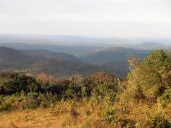
Three reasons are usually given, and all three are true. Fort Bragg is in North Carolina, and a great many Special Forces veterans, the men who had served with our units in the highlands, had settled around it. The piedmont had entry-level work. And the country there, red soil and pine and rolling hills, is not unlike home.
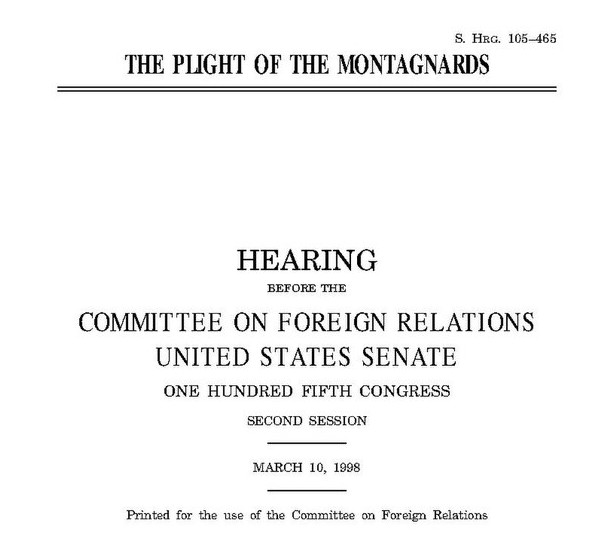
The first reason is the one that decided it. In 1998 the State Department told the Senate, in the words of Assistant Secretary Julia Taft:
“These Montagnards were resettled in North Carolina because of the intense interest of North Carolina communities, led by Vietnam veterans in the area, in resettling the Montagnards. Because of the outstanding record of North Carolina and the Lutheran Immigration and Refugee Service in refugee resettlement, the State Department agreed to this concentrated approach to Montagnard resettlement.”
Lutheran Family Services and Catholic Social Services did the placing. The veterans did the rest: they met the flights, found the jobs, vouched for men whose only papers were the ones the war had given them, and in 1986 founded Save the Montagnard People to keep doing it. Their side of the story is on Our veterans in America.
The waves
1986: the soldiers
In 1985 a group of FULRO fighters walked the width of Cambodia to the Thai border after ten years in the forest; the story is on The men of FULRO. The State Department told the Senate in 1998 that “a group of 201 Montagnards made their way to the Thai-Cambodian border following ten years’ of resistance activities based in the jungles of Cambodia” and was resettled in North Carolina in November 1986. Another count, from the Site II camp, gives 209: 159 men, 17 women and 33 children. About a hundred Rhade were settled in Greensboro, fifty to seventy Jarai in Raleigh, and the rest in Charlotte.
The plane landed in Greensboro in the last week of November 1986. United Press International reported that it “was greeted by 200 Americans — many of them Green Berets who fought with the fierce mountain warriors 20 years ago,” and quoted one of them, John Amundson: “As far as I’m concerned, these people are POWs just returning from the war.”
They were soldiers, most of them without families. Most had English from the war, American units in their histories, and veterans waiting who could vouch for them to an employer. A generation of them built households in a country they had reached alone.
1987 onward: the families
From 1987 the community grew slowly, by family reunification and through the Orderly Departure Program, the in-country scheme under which the United States took people who had been imprisoned for their association with it. The State Department’s figures to the Senate in 1998 show how hard that road was. Since 1985, when it began counting our people separately, 2,504 Montagnards had been found eligible for consideration as refugees. Of those, 1,042 had been approved, 531 refused, and 893 had been scheduled for interview and failed to appear. Taft told the Senate why: “Many of these applicants have informed us that this has been due to their inability to secure exit permission, a requirement of the Vietnamese government. This is a serious problem.” Of 58 with immigrant visa petitions on file, 30 had not come to their interviews for the same reason. More than 1,600 of our people had been admitted as refugees by 1998, most of them through this program.
Y Hin Nie of Greensboro told the same hearing what it looked like from the other end: “Many Montagnard had to wait year after year to be reunited with loved ones. They are eligible to emigrate from Vietnam, but they cannot obtain their exit visa. Often, letters from the U.S. ODP officer never reach Montagnard villages because local security destroys the information.”
1992: out of the forest
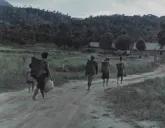
In September 1992 United Nations peacekeepers found the last FULRO unit in Mondulkiri, 398 people by the State Department’s count, and “Because of security concerns in Cambodia at the time, the group was quickly processed and moved to the United States.” They came in November and December, at very short notice and with almost no preparation, from seventeen years in a forest into an American city. The State Library of North Carolina’s history gives the group as 269 men, 24 women and 80 children. Those numbers tell you what the camps had been. The story is on Mondulkiri, 1992: the end of the armed struggle.
2002: the villagers
In the summer of 2002 close to 900 people who had fled to Cambodia after the protests of February 2001 were resettled in Raleigh, Greensboro and Charlotte, and at a fourth site, New Bern. They were villagers, not fighters: families who had run for the border after the crackdown, spent a year in the Cambodian camps, and arrived with the least preparation of any wave and the hardest adjustment. They were also the first to come because of something happening now rather than something that had happened in the war. See The 2002 resettlement.
What it was for
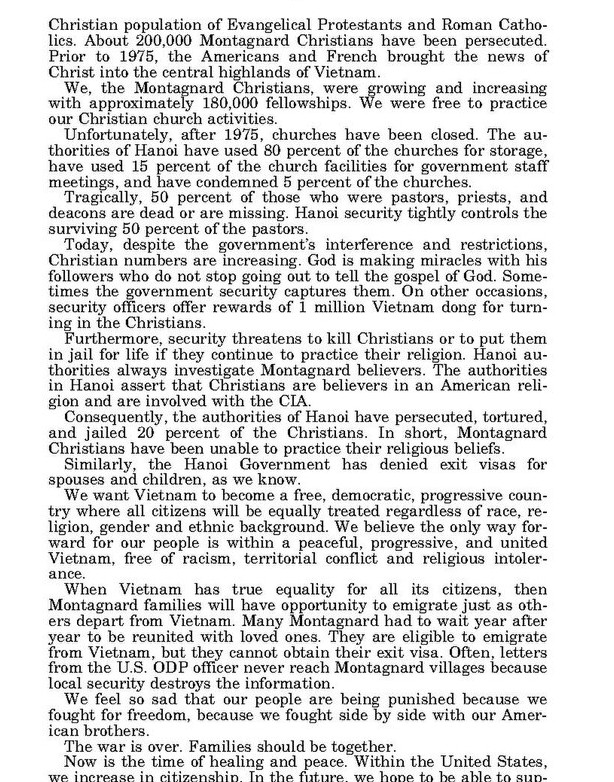
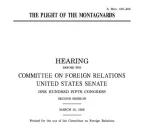
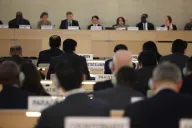
The community came to speak for the people at home almost at once. On March 10, 1998, Senator Jesse Helms of North Carolina held a hearing of the Senate Foreign Relations Committee on the plight of the Montagnards, and welcomed the witnesses from our community as “my fellow Tarheels.” Y Hin Nie, president of the Montagnard Dega Association in Greensboro, told the Senate what had become of the churches:
“Unfortunately, after 1975, churches have been closed. The authorities of Hanoi have used 80 percent of the churches for storage, have used 15 percent of the church facilities for government staff meetings, and have condemned 5 percent of the churches. Tragically, 50 percent of those who were pastors, priests, and deacons are dead or are missing.”
And why:
“We feel so sad that our people are being punished because we fought for freedom, because we fought side by side with our American brothers. The war is over. Families should be together.”
Helms answered: “I think it is perfectly obvious that there is still resentment because you stood with the United States in that conflict … I am going to insist that you be restored of your rights.” The whole record is in our library. Since then, most of what reaches the US Congress and the United Nations about the highlands has come from people in North Carolina; see What Washington has said.
What the community became
Our families in North Carolina work mostly in manufacturing, food processing, warehousing and construction. The churches, Rhade, Jarai and Bahnar congregations, mostly evangelical Protestant with a Catholic minority, are the center of community life as they were in the highlands, and they do much of the work a state agency would do elsewhere: interpreting, funerals, housing, finding a cousin a job. The organizations date from the first years: Save the Montagnard People, founded by Special Forces veterans in 1986; the Montagnard Dega Association in Greensboro, founded in 1987; the Montagnard Association of North Carolina, founded in 1988 and now raising money for a community center of its own. See Our organizations.
A second and now a third generation has grown up American. In 2021 a Greensboro reporter wrote about them: Risuin Ksor, a Guilford College graduate working as a contractor for the United Nations and translating for his father; H’thu Nie, a graduate of UNC Greensboro working for the Montagnard Dega Association and taking courses to improve her Rhade. She said what every family knows: that the young “can have a harder time maintaining the language because they were either born in the United States or moved here at such a young age.” That is the ordinary strain of any diaspora, grandparents who speak Rhade and grandchildren who speak English, on top of the unusual one: that the elders’ whole adult lives were a war the country they now live in has largely forgotten it fought.
How many
Nobody has counted properly. The figures we can source:
| When | Figure | Who says |
|---|---|---|
| 1998 | more than 1,600 admitted to the United States as refugees, most through the Orderly Departure Program | US State Department, to the Senate |
| 2000 | about 3,000 in North Carolina: almost 2,000 around Greensboro, 700 around Charlotte, 400 around Raleigh | Raleigh Bailey, Center for Applied Linguistics |
| 2016 and 2023 | “an estimated several thousand Montagnards currently reside in North Carolina” | US Senate resolutions S. Res. 362 and S. Res. 395 |
| 2021 | more than 12,000 in the United States, most in North Carolina | Triad City Beat, Greensboro |
| 2024 | about 5,000 in North Carolina, about half of them in Greensboro | Next City |
The last two cannot both be right, and neither gives its source. If your church, association or county holds a count, send it and we will cite it.
Why this matters to the case
North Carolina is where the documentary record of our people survives. Families there hold service papers, camp rosters, photographs, letters, and the memories of villages that no longer exist under the names they had. Inside the highlands almost none of that can safely be kept. If the history in this library is ever tested before a tribunal, a large part of the evidence will come out of houses in Greensboro, Charlotte, Raleigh and New Bern, which is why how to document and how to record an elder are written for that audience as much as for anyone in Vietnam.
See also: Our veterans in America, The wider diaspora, The 2002 resettlement, Kok Ksor, Weaving and dress.
Sources
- US Senate, Committee on Foreign Relations, The Plight of the Montagnards, hearing of March 10, 1998 (S. Hrg. 105–465), DCHO library — the testimony of Y Hin Nie, the prepared statement of Julia V. Taft on the 1986 and 1992 resettlements and the Orderly Departure Program, and the chairman’s remarks
- Raleigh Bailey, The Montagnards: Their History and Culture (Center for Applied Linguistics, 2002), and as reproduced by ANCHOR: A North Carolina History — the 1992 breakdown, the 2000 figures and the 2002 arrivals
- North Carolina Museum of History, “Collecting Carolina: Montagnards, Vietnam’s Central Highlanders”
- United Press International, “Soldiers aid resettlement of Montagnard warriors,” November 26, 1986
- Lauren E. Raper, “Blest be the Ties that Bind”: The 1986 Montagnard Resettlement to Greensboro, NC (MA thesis, North Carolina State University, 2009) — the 209 of 1986
- US Senate, S. Res. 362 (February 4, 2016) and S. Res. 395 (October 4, 2023)
- Sayaka Matsuoka, “How the younger generation is working to be the ‘voice of the unheard’ for Montagnard elders,” Triad City Beat, May 12, 2021
- Marielle Argueza, “How Vietnamese Refugees Are Helping a New Wave of Afghans Resettle,” Next City, July 19, 2024
- Montagnard Association of North Carolina and the Montagnard Dega Association, Greensboro — their own accounts of themselves
- Thomas Pearson, Missions and Conversions: Creating the Montagnard-Dega Refugee Community (Palgrave Macmillan, 2009) — the main scholarly study of the community
Compiled September 2026. Quotations from the Senate hearing were checked against the printed record.