






A guide to the doctoral and master’s theses and the academic studies written about our peoples and the highlands, in Vietnam, Cambodia and Laos and in the communities we built abroad. It is for students, researchers and anyone who wants to go deeper than this library can. Every item was checked against a thesis register, a library catalog, the publisher or the DOI registry, and where a work is free to read online, we say so.
What this literature is
Almost everything on this page was written by people from outside, in French, English and German, at universities in Paris, Toulouse, Amsterdam, Canberra, Chapel Hill and elsewhere. Much of it is careful and some of it is very good. All of it sees us through its authors’ questions: the French colonial state and how it ruled us, the land and who took it, the war and how the Americans used us, the languages and how they work, the refugees and how they settled. Read it alongside what our own elders say, and where the two differ, do not assume the university is right.
We found no thesis written by a Dega author in any register we searched. We found none whose main subject is the protests of 2001 or 2004, and none on FULRO for its own sake rather than as a chapter in the story of the American Special Forces. Those are the gaps a new generation of our own students could fill.
The highlands of Vietnam
The doctoral work on our homeland is mostly French, because French universities kept the colonial archives and the tradition of study. The Dutch anthropologist Oscar Salemink’s dissertation of 1999 is the one to read first: it is about how outsiders described us, and why.
- 1997 — Nguyen Van Huy, Les politiques d’intégration des montagnards des hauts plateaux du centre du Vietnam (des origines à 1958)
PhD, Université Paris 7. How successive governments set out to integrate the peoples of the highlands, from the earliest contacts to 1958. - 1999 — Oscar Salemink, Beyond Complicity and Naiveté: Contextualizing the Ethnography of Vietnam’s Central Highlanders, 1850–1990
PhD, University of Amsterdam. How outsiders’ descriptions of our peoples between 1850 and 1990 were shaped by the times and purposes they were written for. The dissertation behind his book of 2003. Free to read. In our library. - 2000 — Albert-Marie Maurice, Croyances et pratiques religieuses des Montagnards du Centre-Vietnam
Doctorate, École des hautes études en sciences sociales, Paris. The religious beliefs and practices of the Rhade, Jarai, Bahnar, Mnong, Maa, Sre and Lach in the first half of the twentieth century, drawn from the fieldwork of a French army officer who lived among the Rhade and the Mnong Nong from the 1930s to 1954. Published by L’Harmattan in 2002. - 2003 — Mathieu Guérin, Des casques blancs sur le plateau des herbes. La pacification des aborigènes des hautes terres du Sud-Indochinois, 1859–1940
PhD, Université Paris 7. How French Indochina brought the highland peoples under its rule, from 1859 to the Second World War. In our library. - 2003 — Frédéric Fortunel, L’État, les paysanneries et les cultures commerciales pérennes dans les plateaux du Centre Viêt Nam : l’autochtonie en quête de territoires
PhD, Université Toulouse 2. How the planting of coffee and other perennial cash crops reshaped belonging and territory in the highlands, and indigenous claims to land. - 2003 — Daniel Müller, Land-use Change in the Central Highlands of Vietnam: A spatial econometric model combining satellite imagery and village survey data
PhD, University of Göttingen. Changes in land use in the highlands, measured from satellite images and village surveys. - 2006 — Stan Boon Hwee Tan, Dust beneath the mist: state and frontier formation in the Central Highlands of Vietnam, the 1955–61 period
PhD, Australian National University. How the South Vietnamese state made the highlands a frontier and extended its hold over them in the first years of the Diem government. Free to read. - 2010 — Phan Viet Ha, Les conflits fonciers dans le contexte de la transition agraire aux Hauts Plateaux du centre Vietnam : le cas de la province du Dak Lak
PhD, Université Toulouse 2. A typology of land conflicts in Dak Lak, which the author calls a very sensitive and emerging subject. - 2016 — Doan Ngoc Tu, Le patrimoine bâti dans les villages de la minorité Jarai : le cas des deux villages de Pleikep et de Pleiop à Pleiku au Vietnam
PhD, Université Toulouse 2. Two Jarai villages at Pleiku, their houses and layout, and their place in the growth of the city. Free to read. - 2016 — Trang Thi Thuy Nguyen, Maintaining in transforming: bilingual identity of ethnic minority students in the Central Highlands of Vietnam
PhD, University of Queensland. How highland students keep their own languages while studying in Vietnamese. - 2017 — Chi Trung Tran, Understanding long-term livelihood resilience of resettled ethnic groups in the Yali Falls Dam basin, Central Highlands of Vietnam
PhD, University of Queensland. What became of the villages moved to make way for the Yali Falls dam. - 2019 — Anh-Minh Nguyen-Dang, Land Property, Land Politics: a History of the Bahnar in Kon Tum, Vietnam (1820–1945)
PhD, École pratique des hautes études, Paris Sciences et Lettres. Land and power among the Bahnar from 1820 through the colonial period, including the Bahnar’s loss of territory to the Jarai. Not yet online. - 2019 — Chau Le Minh Doan, Governmentality, resettlement, and resistance of ethnic minority migrants in Vietnam: a case study in Dak Lak province
MA, Chulalongkorn University. State resettlement policy seen from Cu Kbang commune in Ea Sup district. Free to read, under a Creative Commons license.
Our languages
Linguists have written full grammars of several of our languages in recent years. They are the most useful academic works for anyone teaching a Dega language, and some are free to read.
- 2013 — Joshua Martin Jensen, The Structure of Jarai Clauses and Noun Phrases
PhD, University of Texas at Arlington. The grammar of Jarai sentences. Free to read, under a Creative Commons license. - 2014 — Noellie Bon, Une grammaire de la langue stieng, langue en danger du Cambodge et du Vietnam
PhD, Université Lyon 2. The first full grammar of Stieng, an endangered language of Cambodia and Vietnam. - 2014 — Neil Hayes Olsen, A Descriptive Grammar of Kơho-Sre: A Mon-Khmer Language
PhD, University of Utah. The grammar of Koho, spoken by more than 207,000 people in Lam Dong.


The highlands of Cambodia and Laos
Our people across the border in Ratanakiri, Mondulkiri, Stung Treng and southern Laos have their own literature, much of it on land, which is the subject there too.
- 2008 — Ian George Baird, Various Forms of Colonialism: The Social and Spatial Reorganisation of the Brao in Southern Laos and Northeastern Cambodia
PhD, University of British Columbia. The Brao, some 60,000 people in Attapeu, Champasak, Ratanakiri and Stung Treng, and how successive states rearranged their villages and lands. - 2011 — Jonathan Padwe, Garden Variety Histories: Social and Environmental Change in Northeast Cambodia
PhD, Yale University. Social and environmental change in northeast Cambodia. Published in 2020 as Disturbed Forests, Fragmented Memories: Jarai and Other Lives in the Cambodian Highlands. - 2012 — Jeremy Ironside, Thinking outside the Fence: Exploring Culture/Land Relationships: A Case Study of Ratanakiri Province, Cambodia
PhD, University of Otago. The rapid change in land use in Ratanakiri over ten to fifteen years, and what it meant for the peoples whose culture is bound to their land. - 2014 — Catherine Scheer, La réforme des gongs : dynamiques de christianisation chez les Bunong protestants des hautes terres du Cambodge
PhD, École des hautes études en sciences sociales, Paris. How the Bunong of Mondulkiri made Protestant Christianity their own. - 2016 — Asikin Yoeu, Integrating ecosystem services into agricultural land use analysis and planning in Mondulkiri Province, Cambodia
PhD, Montpellier SupAgro. Farming, forests and planning in Mondulkiri. - 2023 — Téphanie Sieng, Intégration et dynamiques territoriales dans le Nord-Est du Cambodge : le cas des transformations socio-spatiales dans les villages tampuan de Ratanakiri
PhD, INALCO, Paris. The Tampuan villages of Ratanakiri from the French period to the present. - 2025 — Phasy Res, Mutation de la microfinance : capitalisme frontalier, violence liée à l’endettement et contestation locale dans le nord-est du Cambodge
PhD, Université Paris 1. Microfinance debt and the land security of indigenous communities in the Cambodian highlands.
The war years
Officers at the US Army’s Command and General Staff College have written several theses on the Civilian Irregular Defense Group, the program that armed our villages from 1961. They are written for the Army’s purposes, to learn how to raise local forces, and they say little about what the program cost our people afterward. As US government works they are in the public domain, and three are in our library.
- 1990 — Scott Ewbank, A comparison of Vietnamese government policies towards the Montagnards before and after 1975
MA, University of Michigan. Saigon’s policies toward us set beside Hanoi’s. - 1995 — Victor Holman, Seminole Negro Indians, Macabebes, and Civilian Irregulars: Models for the Future Employment of Indigenous Forces
Master of Military Art and Science, US Army Command and General Staff College. Three cases of indigenous peoples raised as fighting units by the United States, the highland program among them. In our library. - 2004 — Christopher K. Ives, Knowledge and strategy: operational innovation and institutional failure, U.S. Army Special Forces in Vietnam 1961–1964
PhD, Ohio State University. How the Special Forces adapted to the villages they worked in, in the years of the first highland programs. - 2012 — Jesse R. Stewart, Controlling the Population: A Study of the Civilian Irregular Defense Group
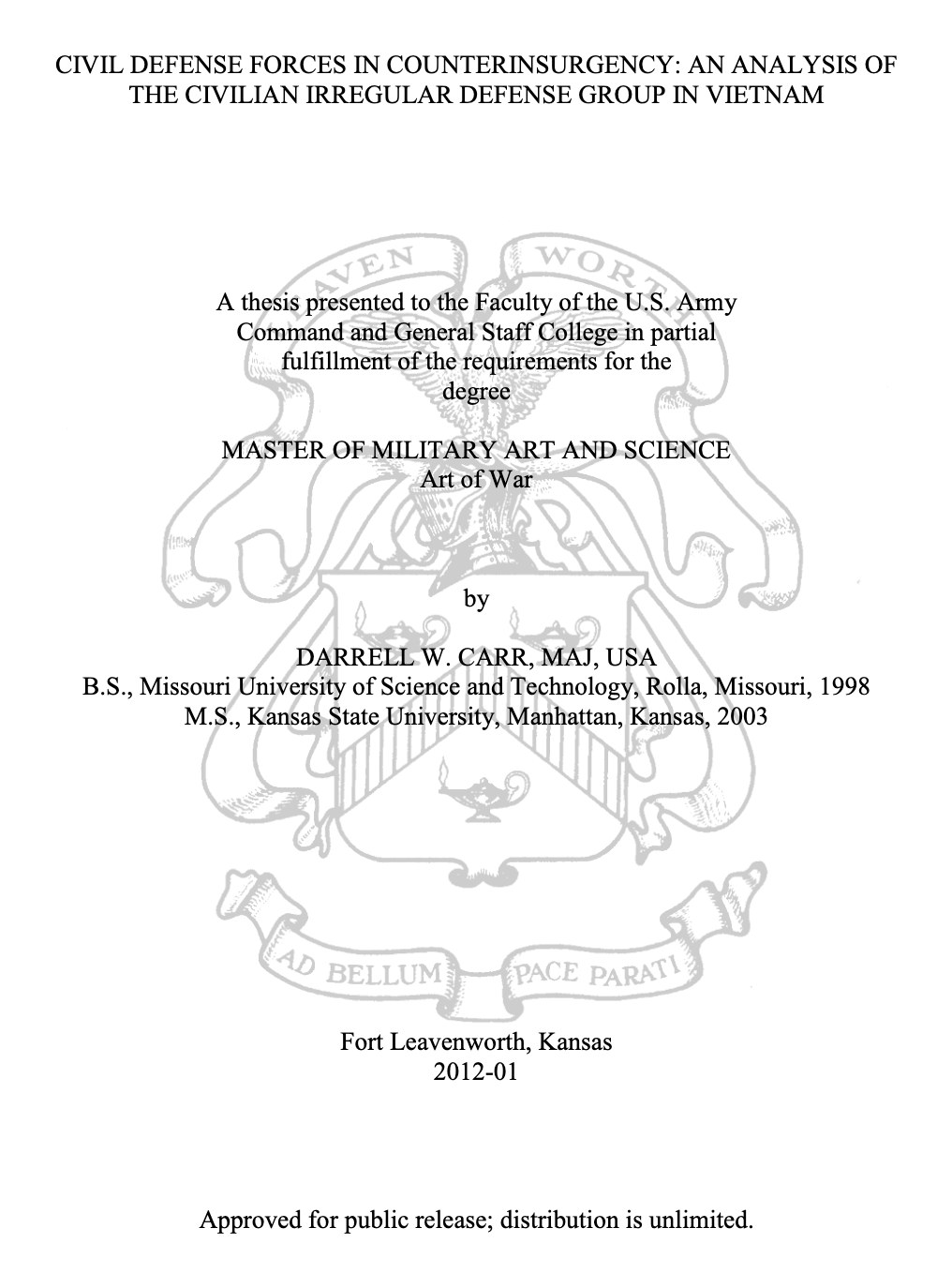
Master of Military Art and Science, US Army Command and General Staff College. The program that armed and trained highland villages from 1961. In our library. - 2012 — Darrell W. Carr, Civil Defense Forces in Counterinsurgency: An Analysis of the Civilian Irregular Defense Group in Vietnam
Master of Military Art and Science, US Army Command and General Staff College. The same program as a case of village defense forces, which the author argues are decisive against an insurgency when balanced with conventional forces. In our library. - 2014 — Sean Patrick Hoey, The Civilian Irregular Defense Group: Behind the Decision to Change Operational Control
Monograph, School of Advanced Military Studies, US Army Command and General Staff College. How the program passed from the CIA to the US military command in Operation Switchback. - 2025 — Jake L. Brooks, From Essential to Expendable: Montagnards, Kurds, and U.S. Army Special Forces in Vietnam and Northern Iraq
MA, James Madison University. Why our people and the Kurds allied with the Special Forces, and what happened when the Americans left. Free to read.
Our communities in America
The largest Dega community outside Indochina is in North Carolina, and most of the research on it comes from universities there. The best of the recent work is done with our own people as partners and co-authors, not only as subjects.
- 2001 — Thomas Pearson, Missions and Conversions: Creating the Montagnard-Dega Refugee Community
PhD, University of North Carolina at Chapel Hill. How the refugee community in North Carolina was built, through churches above all. Later published as a book by Palgrave Macmillan. - 2009 — Lauren Raper, Blest be the Ties that Bind: The 1986 Montagnard Resettlement to Greensboro, North Carolina and the Reshaping of the Memory of the Vietnam War
MA, North Carolina State University. The resettlement of 1986 and how it changed the way Greensboro remembered the war. See Mondulkiri, 1992. - 2023 — S. Sudha, Sharon D. Morrison, Imani Mitchell, Melina Ksor and H’Thu Nie, Our Elders, Our Legacy: Needs Assessment of Older Adults in the Montagnard Refugee Community, Greensboro NC
White paper, University of North Carolina at Greensboro. Written with our own community researchers. Free to read, under a Creative Commons license. - 2021–2026 — Sharon D. Morrison, S. Sudha, H’Yua Adrong and others, community-based research on the health of Montagnards in North Carolina and on the Montagnard Hypertension Project
Articles, Journal of Immigrant and Minority Health (2021) and Frontiers in Public Health (2026). Research done with our community as partners rather than as subjects. The second is free to read. - 2010 — Etsuko Kinefuchi, “Finding home in migration: Montagnard refugees and post-migration identity”
Article, Journal of International and Intercultural Communication. How Montagnard refugees made a home and an identity after migration. - 2014 — Brenda Burgin Ross, “An oral history project with elderly Montagnard refugees”
Article, Open Journal of Social Science Research. Life stories of elderly Montagnard refugees. - 1996 and 2009 — Paxton and others; Goswami and others, on imported malaria and on parasitic infection
Articles, American Journal of Tropical Medicine and Hygiene. Medical studies of refugees on arrival in North Carolina.
Books, chapters and articles
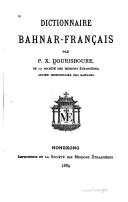
- 1895 — R. Verneau, “Note sur les Moïs Ba-Hnars”
Article, Bulletin du Muséum d’histoire naturelle. A museum naturalist’s note on the Bahnar, from 1895. - 1964 — Gerald C. Hickey, The Major Ethnic Groups of the South Vietnamese Highlands
Report, RAND RM-4041. A survey of the highland peoples written for the research agency of the US Defense Department. - 1979 — Jörg Schaeffer, Traditionelle Gesellschaft und Geschichte der Rhádé im südvietnamesischen Hochland
Doctoral dissertation, University of Freiburg. Rhade society and history, in German. - 1979 — Kenneth D. Smith, Sedang grammar: phonological and syntactic structure
Book, Pacific Linguistics, Australian National University. The grammar of Sedang. - 1987 — Anne de Hauteclocque-Howe, Les Rhadés. Une société de droit maternel
Book, CNRS Éditions. Rhade society and its matrilineal law. - 1994 — Oscar Salemink, “The return of the Python god: multiple interpretations of a millenarian movement in colonial Vietnam”
Article, History and Anthropology. A millenarian movement of the colonial period, read from several sides. - 2001 — Hjorleifur Jonsson, “French natural in the Vietnamese highlands: nostalgia and erasure in Montagnard identity”
Chapter, Of Vietnam, Palgrave. How the French image of the “natural” highlander lives on. - 2001 — Patrick Rérat, “Les montagnards, peuples autochtones des hauts plateaux du Vietnam central”
Article, Cahiers d’outre-mer 54. Our peoples as indigenous peoples. - 2003 — Oscar Salemink, The Ethnography of Vietnam’s Central Highlanders: A Historical Contextualization, 1850–1990
Book, University of Hawai’i Press; Routledge reissue 2019. The book made from his dissertation. - 2003 — Oscar Salemink, “Enclosing the Highlands: socialist, capitalist and Protestant conversions of Vietnam’s Central Highlanders”
Draft paper, marked not for quotation, Vrije Universiteit Amsterdam. Written after the protests of 2001. Free to read. - 2004 — Stan B.-H. Tan, “Rethinking approaches to the study of the Central Highlands of Vietnam”
Review essay, SOJOURN. A review of Salemink’s book and of Hickey’s Window on a War. - 2006 and 2007 — Thomas Sikor, Tran Ngoc Thanh and Nguyen Quang Tan, three articles on forest land allocation
Articles, Forest Policy and Economics, Land Use Policy and World Development. The handing of forest land to households and villages in the highlands, and why it did not always benefit the poor. - 2009 — Frédéric Bourdier, Ethnographie des populations indigènes du nord-est cambodgien : La montagne aux pierres précieuses (Ratanakiri)
Book, L’Harmattan. The indigenous peoples of Ratanakiri. Free to read. - 2011 — Truong Huyen Chi, “‘They think we don’t value schooling’: paradoxes of education in the multi-ethnic Central Highlands”
Chapter, Education in Vietnam, ISEAS. The paradoxes of schooling in the multi-ethnic highlands, and the charge that highland families do not value it. - 2015 and 2016 — Oscar Salemink, “Revolutionary and Christian ecumenes and desire for modernity”; “Described, inscribed, written off: heritagisation as (dis)connection”
Article, Asia Pacific Journal of Anthropology; chapter, ANU Press. Conversion and heritage in the present-day highlands. The chapter is free to read. - 2016 — Krisna Uk, Salvage: cultural resilience among the Jorai of northeast Cambodia
Book, Cornell University Press. Jarai communal life in Ratanakiri after the American bombing of the war years. - 2021 — Hoai Tran, Doing “gong culture”: heritage politics and performances in the Central Highlands of Vietnam
Book, LIT Verlag. The gong culture of the highlands as heritage, and who controls it. - 2024 — Oscar Salemink, “The French Indochina War in the Central Highlands”
Chapter, The Cambridge History of the Vietnam War. The highlands in the war of 1946 to 1954. - 2024 — Joe P. Dunn, “Kok Kosor and the struggle for cultural survival, human rights, and religious freedom for the Montagnards of the Central Highlands”
Article, Athens Journal of History 10:1. A life of Kok Ksor, whose name the title spells Kosor. Free to read.
How to read them
- Links to theses.fr go to the French national register of theses, which says whether the full text can be read online. Links to doi.org go to the publisher.
- Many articles are behind a paywall. A public or university library can often get them for you free.
- Some authors in this field work for Vietnamese state institutions. Following our rule on sources, we do not list works published by the Vietnamese state or theses defended at Vietnamese state universities. Work by Vietnamese scholars published abroad is listed on its merits. See Sources and method.
Missing from this list
We know there are more theses, particularly master’s theses at universities in North Carolina, that we have not been able to find in a register. If you wrote a thesis about the Dega, or know of one, please tell us and we will add it. If you are a Dega student thinking about a thesis, the gaps above are yours to fill. For books, see Books about the Dega; for reports, Reports and documents.
Compiled September 2026.