
















Our people have been named in United Nations documents for more than thirty years: in our own submissions, in the findings of the treaty bodies that examine Vietnam, in the reports of experts who visited, in letters from independent experts to the governments of Vietnam and Thailand, and in the Secretary-General’s reports on reprisals. This page is a register of those we can point to, in order, with what each actually says. The words have grown more precise over the years. The answer Vietnam gives has not changed.
.jpg)
How the UN machinery works, briefly
Treaty bodies are committees of independent experts that examine each state that has ratified a treaty, every few years, and publish concluding observations. The two that matter most for us are the Committee on the Elimination of Racial Discrimination (CERD) and the Human Rights Committee, which oversees the International Covenant on Civil and Political Rights; the committees on economic, social and cultural rights, on children and on women have also examined Vietnam. Special procedures, the special rapporteurs, independent experts and working groups, can write to a government about particular cases at any time, and can visit a country if it invites them; their letters are published after sixty days, with any reply. The Universal Periodic Review is an examination of every state by the others, every four or five years. Each year the Secretary-General reports to the Human Rights Council on reprisals against people who cooperate with the UN. The legal background is on Indigenous rights at the UN and What Vietnam has signed.
The record
1993 to 2011
- July 1993 — We submit Human Rights Violations: The People of the Dega Republic to the UN Working Group on Indigenous Populations in Geneva, the first Dega document placed before the UN in our own name. The Working Group’s report of the session, attended by more than six hundred people from indigenous organizations, lists a Montagnard organization among those represented.
- 1998 — The Special Rapporteur on religious intolerance, Abdelfattah Amor, visits Vietnam.
- August 15, 2001 — Six months after the highland protests of February 2001, CERD’s findings on Vietnam do not mention them. They do ask about the reported forced sterilization of mountain minority women, about religious discrimination against minorities, and about the alleged transfer of population into territories inhabited by indigenous groups.
- July 19, 2002 — The Human Rights Committee becomes the first treaty body to name us. It is concerned at the abundance of information about the treatment of the Degar (Montagnard), indicating serious violations of the ban on torture and ill-treatment and of minority rights, and at the lack of information about indigenous peoples. It asks that non-governmental organizations and other monitors be let into the Central Highlands, and puts the point on its list for follow-up within a year.
- August 21, 2007 — The Special Rapporteur on the rights of indigenous peoples, Rodolfo Stavenhagen, tells the General Assembly that the Degar (Montagnard) and Hmong peoples still suffer repression for their part in the Cold War, that some survive by hiding in the forest, and that those who escape to Cambodia or Thailand are sometimes detained or returned.
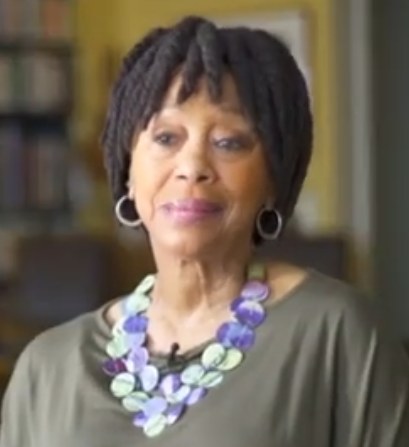
- July 5–15, 2010 — The Independent Expert on minority issues, Gay McDougall, visits Vietnam, including the Central Highlands. Her report of January 2011 finds the extreme poverty rate among ethnic minorities nine times that of the majority, and records that she was largely confined to meetings arranged by the government.
_in_the_video_'Values_of_racial_equality_and_non-discrimination'.png)
2012 to 2019
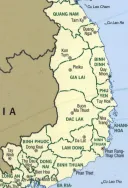
- March 6, 2012 — CERD notes Vietnam’s reluctance to discuss recognizing indigenous peoples and asks it to respect the self-identification of the Khmer Krom and the Degar (Montagnard) and to consider ratifying ILO Convention 169. It is concerned at the confiscation of ancestral lands without consent or compensation; at discrimination against Christians among the Khmer Krom, the Degar and the Hmong through registration, surveillance and imprisonment, and at the 2004 Ordinance on Belief and Religion; and at the forced return of indigenous asylum seekers with the help of neighboring governments, and the crime of fleeing abroad. It asks for a report on land and recognition within a year.
- August 2012 — The Committee on the Rights of the Child finds birth registration lowest in the North West and the Central Highlands, and tells Vietnam to end all efforts to assimilate ethnic minorities into the Kinh majority.
- July 21–31, 2014 — The Special Rapporteur on freedom of religion or belief, Heiner Bielefeldt, visits Vietnam. His visits to An Giang, Gia Lai and Kon Tum are cut short from July 28 to 30, and people he wanted to meet are watched, warned, intimidated, harassed or stopped from traveling by the police. His report of January 2015 records the harsh persecution of followers of “Montagnard” churches such as the Ede: hundreds of churches closed, pastors imprisoned, thousands fled or in hiding after protests for land and religious freedom.
- November 28, 2014 — The Committee on Economic, Social and Cultural Rights is concerned that Vietnam does not recognize indigenous peoples, calls self-identification a fundamental principle, asks Vietnam to ratify ILO 169, and criticizes sedentarization, land revocation and a policy of phasing out ethnic minority customs the state considers obsolete.
- August 31, 2018 — Four special rapporteurs, among them the rapporteur on minority issues, write to Vietnam about Christians of Ea Bhôk and Ea Drông communes in Dak Lak, among them Y Pum Bya, arrested and made to sign pledges to leave their church or stop worshiping together, and ask Vietnam to explain what appears to be an organized campaign.
- January 22, 2019 — At the Universal Periodic Review, Peru asks Vietnam to open vocational training and finance to minority women, “particularly the Jarai people” and the Khmer Krom. Vietnam does not accept it.
- March 25, 2019 — The Human Rights Committee is concerned that Vietnam does not recognize its indigenous peoples, that they are not consulted when their traditional and ancestral lands are taken for projects, and that believers are forced to renounce their faith and assaulted, sometimes fatally. In the dialogue its members ask about police sent to stop Montagnards seeking asylum in Cambodia and Thailand.


2020 to 2023
- April 30, 2020 — Two rapporteurs write about religious leaders questioned after a conference abroad. Nay Y Ni was interrogated on his return in November 2019, his room was searched, and he lost his job at a hospital in Bình Dương.
- November 22, 2021 — Eight mandates, including the Working Group on Arbitrary Detention, write about thirty-nine human rights defenders, among them our prisoners Y Yich (twelve years, his health seriously deteriorated and treatment reportedly refused), Rah Lan Hip (seven years, for sharing articles on Dega Protestantism on Facebook), Ksor Ruk (ten years), Rmah Hlach (twelve years) and Y Ngun Knul (eighteen years, released February 28, 2020, in critical health).
- February 2022 — The Special Rapporteur on human rights defenders, Mary Lawlor, expresses utmost concern at the long detention of defenders in Vietnam, repeating those cases.
- September 6, 2022 — Four mandates, including the Special Rapporteur on minority issues, write about Y Čung Niê, Y Thinh Niê and Y Don Niê, Montagnard Protestants who asked their communes how their groups could register, were arrested and questioned without a lawyer, and were each fined four million dong for marking the UN day for victims of religious violence.
- April 28, 2023 — Four mandates write about Y Khiu Niê and Y Sĩ Êban, stopped at Tân Sơn Nhất airport on November 6, 2022, on their way to a religious freedom conference in Bali. Y Khiu Niê was held and questioned for more than a day and made to sign a promise to stop reporting to the UN; Y Sĩ Êban was beaten about the face and head and made to promise to leave his church. Vietnam did not reply in time, and the letter was published in June.
- November 29–30, 2023 — In its dialogue with Vietnam, CERD raises the arrest and prosecution of a hundred Montagnards after the Dak Lak attacks of June 2023 and some 20,000 stateless households in the Central Highlands. A member asks whether Vietnam will accept that indigenous peoples exist on its territory and whether it will ratify ILO 169. The delegation says it speaks of minority people, not indigenous peoples, for historical reasons, and gives no answer on ILO 169.
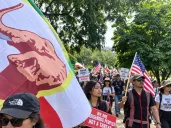
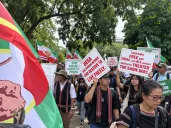
- December 27, 2023 — CERD’s findings name the Montagnards among the Indigenous Peoples whose recognition Vietnam refuses to discuss, and note that land can be taken on fifteen days’ notice with no free, prior and informed consent. They record reports of racial profiling, torture, deaths in custody and excessive force during the investigation of the Dak Lak attacks, the conviction of eighty-one Montagnards on a terrorism charge, attacks by so-called Red Flag Associations that the government described as patriots, and reprisals against Y Khiu Niê and Y Sĩ Êban for trying to cooperate with the UN.
2024 to 2026
- May 7, 2024 — At the Universal Periodic Review, Vietnam does not accept Mexico’s recommendation to recognize Indigenous Peoples by self-identification and ratify ILO 169, Malta’s to end reprisals against people who cooperate with the UN, or the United States’ to end forced renunciations of faith. No state mentions the Dak Lak trial.
- June 14, 2024 — Thirteen mandates, among them the Special Rapporteur on the rights of Indigenous Peoples, write to Vietnam and to Thailand. The letter to Vietnam describes villagers urged by state media to hunt down suspects, arming themselves with knives, machetes and sticks, and the death of Y Bŭm Byă, found hanging near his home after a police summons, his body badly beaten. It judges the treatment of the Montagnards inconsistent with Vietnam’s obligations toward indigenous peoples under customary international law, as the Declaration on the Rights of Indigenous Peoples reflects. The letter to Thailand warns against returning Y Quynh Buondap.
- July 4, 2024 — Thirteen experts publicly urge Thailand to refuse his extradition. See Y Quynh Buondap.
- August 12, 2024 — The Special Rapporteur on counter-terrorism, Ben Saul, files a brief as friend of the court with the Bangkok Criminal Court on terrorism charges and the absolute ban on returning anyone to torture, the first intervention we know of by a UN expert in a court case about one of our defenders.
- August 20, 2024 — The Secretary-General’s report on reprisals records developments in the cases of Y Khiu Niê and Y Sĩ Êban.
- August 28, 2024 — Fourteen UN experts, among them the Special Rapporteurs on counter-terrorism, on the rights of Indigenous Peoples, on minority issues and on human rights defenders, condemn the misuse of counter-terrorism law against Montagnard Indigenous Peoples: vigilantes from the majority group incited against them, torture and forced confessions, the mass trial by a mobile court in January 2024, the death in custody of Y Bŭm Byă after torture, and the listing of an overseas Montagnard group as a terrorist organization. They call it part of a larger and intensifying pattern of historical discrimination against the Montagnards.
- October 16, 2024 — After the Bangkok court rules on September 30 that Y Quynh Buondap can be extradited, twelve experts point out that Thailand has no extradition treaty with Vietnam and can refuse.
- July 2025 — The Human Rights Committee’s fourth review of Vietnam. Its members name persistent discrimination against the Khmer Krom and the Montagnards, and Vietnam again rejects the word indigenous. The findings of July 18 remain concerned that Vietnam does not recognize the Indigenous Peoples in its territory, note the forced post-prison education of Montagnard prisoners, tell Vietnam not to use national security and counter-terrorism laws against religious minorities such as the Montagnard Protestants, and raise enforced disappearances and transnational repression.
- July 24, 2025 — In two of six joint letters on transnational repression in the Mekong region, ten mandates write to Vietnam and twelve to Thailand about Y Quynh Buondap and the 2024 trial, in which ninety-nine of the hundred defendants were Montagnards. The letters record that sixty-five Montagnards, five of them recognized refugees, were detained in Bang Yai on February 23, 2025, that forty-three were sentenced two days later, and that bail was refused to three refugees, Y Phuong Enuol, Y Duong Bkrong and H Leo Nie, because Vietnam had warrants for them.
- August 22, 2025 — Twelve mandates write to the Secretary-General of ASEAN that Vietnam may be sharing information with Thailand to identify Montagnard refugees for forced return.
- September 17, 2025 — The Secretary-General’s report on reprisals describes the mass trial of a hundred people, mostly Indigenous Montagnards, and Thailand’s cooperation in efforts to return Vietnamese Montagnards.
- December 3, 2025 — Experts say that the extradition of Y Quynh Buondap on November 28 violated the ban on returning people to danger, and that his whereabouts are unknown.
- February 3 and 23, 2026 — In its review of Vietnam, the women’s committee hears that Montagnard, Hmong and Khmer Krom Christian mothers are refused birth certificates for their children to make them renounce their faith. Its findings speak of rural, Indigenous and ethnic minority women.

What the record adds up to
Read in order, the documents say the same three things more and more precisely: that we are a distinct people whose own name should be used; that our land has been taken without consent; and that the law is being used against our religion and our advocates. The vocabulary has moved with them. In 2002 and 2012 the committees wrote of the Degar (Montagnard); from 2023 the treaty bodies, the special procedures and the Secretary-General write of Montagnard Indigenous Peoples. What the record also shows is that Vietnam’s answer has not changed in thirty years. It does not accept that it has indigenous peoples, and it does not accept the premise of the questions.
The record also has silences. No treaty body finding and no Universal Periodic Review recommendation names the uprisings of 2001 or 2004. The committees wrote around them. No state named the Dak Lak trial at the review four months after it.

Using these documents
UN findings are not court judgments, but they carry weight with asylum tribunals, foreign ministries and journalists. If you are preparing an asylum claim or a submission, cite the specific document and paragraph, not this page. Where we have read a document only as others quote it, we say so in the sources.
What we do not know. What Gay McDougall wrote about the Central Highlands in her 2011 report; we have not been able to read those paragraphs. What the Working Group on Arbitrary Detention found in 1994 and Abdelfattah Amor in 1998. The paragraph numbers of CERD’s findings of December 2023, which we know from quotations. Whether the special rapporteurs wrote to Vietnam about Easter 2004. What has happened to Y Quynh Buondap since his return. Whether any UN body has named our people in 2026 beyond the women’s committee.
Sources
- Our own submission to the UN Working Group on Indigenous Populations, Geneva, July 1993; UN, report of the Working Group’s eleventh session, E/CN.4/Sub.2/1993/29
- CERD, concluding observations on Viet Nam, A/56/18 (2001), paragraphs 408–428; CERD, concluding observations on Viet Nam, CERD/C/VNM/CO/10-14, 2012 (text via University of Minnesota Human Rights Library), paragraphs 12, 15, 16, 18 and 27
- Human Rights Committee, CCPR/CO/75/VNM (2002), paragraph 19; Human Rights Committee, CCPR/C/VNM/CO/3, 2019, paragraphs 43, 55 and 56, in our library; OHCHR, summary of the dialogue of March 12, 2019
- Rodolfo Stavenhagen, A/62/286 (2007), paragraph 55; OHCHR, press release on the visit of the Independent Expert on minority issues, July 2010; Gay McDougall, A/HRC/16/45/Add.2 (2011), as quoted in the CORI country report on Vietnam (2012)
- Committee on the Rights of the Child, CRC/C/VNM/CO/3-4 (2012), paragraphs 37 and 40; Committee on Economic, Social and Cultural Rights, E/C.12/VNM/CO/2-4 (2014)
- OHCHR, end-of-visit statement of the Special Rapporteur on freedom of religion or belief, July 31, 2014, and the full report A/HRC/28/66/Add.2, paragraphs 1–4 and 69
- Universal Periodic Review of Viet Nam: A/HRC/41/7 (2019), recommendation 38.278; A/HRC/57/7 (2024), recommendations 42.34, 42.148 and 42.309; UPR Info database — the responses
- UN special procedures: UA VNM 9/2018 (August 31, 2018); AL VNM 2/2020 (April 30, 2020); AL VNM 6/2021, November 22, 2021; AL VNM 4/2022 (September 6, 2022); AL VNM 2/2023 (April 28, 2023); AL VNM 4/2024 and AL THA 6/2024 (June 14, 2024); AL VNM 3/2025, July 24, 2025; AL THA 8/2025 (July 24, 2025); AL OTH 84/2025 (August 22, 2025)
- Special Rapporteur on human rights defenders, February 3, 2022
- OHCHR, CERD dialogue with Viet Nam, November 30, 2023, and CERD/C/VNM/CO/15-17, as quoted by the UK Home Office, Country Policy and Information Note: Vietnam, Ethnic and religious minority groups (December 2024)
- OHCHR, press releases of July 4, 2024, and October 16, 2024; OHCHR, “Experts condemn misuse of counter-terrorism law against Montagnards in Viet Nam,” August 28, 2024; Special Rapporteur on counter-terrorism, amicus curiae brief to the Bangkok Criminal Court, August 12, 2024
- Secretary-General, Cooperation with the United Nations, its representatives and mechanisms in the field of human rights, A/HRC/57/60 (2024), paragraph 105, and A/HRC/60/62 (2025), paragraphs 97, 106 and 107
- OHCHR, Human Rights Committee dialogue with Viet Nam, July 2025; Human Rights Committee, CCPR/C/VNM/CO/4 (2025), paragraphs 44, 45, 54 and 55; FIDH summary of CCPR/C/VNM/CO/4
- OHCHR, December 2025
- OHCHR, summary of the CEDAW dialogue with Viet Nam, February 3, 2026, and press release of February 23, 2026
Compiled September 2026. The UN’s own search tools, the special procedures communications database and the treaty body database, will find anything newer than this page.