






Knowledgebase
The Dega people
Who we are, how many, which tribes, and the country we come from.
Articles
32 articles
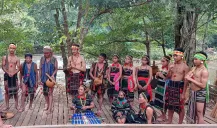
Who are the Dega
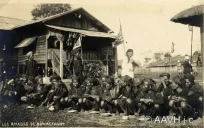
We are the indigenous peoples of the Central Highlands of Indochina: some thirty peoples, two unrelated language families, one plateau, and a single shared experience of what has been done to it. Almost every name the outside world knows us by was given to us by somebody else, and each one carries an argument about who we are and who has the rig...
How many Dega there are
There are more of us than there have ever been, and we have never been so small a part of our own country. The state’s own census counted about 768,000 people in the thirteen highland peoples in 1979 and about 2,125,000 in 2019 — almost a trebling in forty years. Over the same span the population of the four highland provinces went from 1.2 mill...
The tribes and their languages
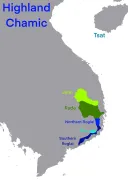
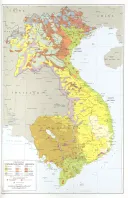
Around thirty peoples, in two language families that are not related to one another. The Chamic-speaking peoples, Jarai, Rhade, Raglai, Chu Ru and Haroi, are Austronesian, cousins of the Cham of the coast and, further out, of Malay and Indonesian. Most of the rest speak Bahnaric languages of the Austroasiatic family, related to Khmer; the Bru, K...
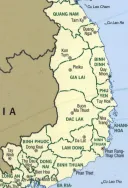
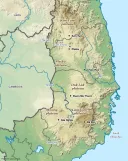
A map of the highlands
Our country is the high plateau between the Annamite mountains and the Mekong, in what Vietnam now calls the Central Highlands and across the borders in Cambodia and Laos. This page gives the map, and then the country behind it: the mountains and the red basalt plateaus, the rivers that run east to the sea and west to the Mekong, the rains, wher...
The country itself
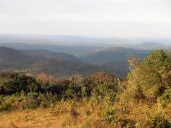
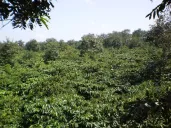
Our country is a stair of high plateaus behind the Annamite mountains, between about 500 and 1,500 meters above the sea: red basalt soil, forest, grassland and river valleys, from Kon Tum in the north to the Lam Vien plateau around Da Lat in the south. Its rivers run both ways, west to the Mekong and east to the sea. Its soil is why everyone who...
Dega culture
A village, the land around it held in common, kinship that decides obligation, and a moral order older than any state that has claimed us. Around thirty peoples, each with its own building, weaving, music and dance, held together by an animist thread that runs through all of them, and by a gong tradition that UNESCO has placed on the list of the...
Dega women, and a record written about men
Among the Rhade, the Jarai, the Mnong, the Koho and the Raglai, the house, the land, the livestock and the heirloom jars pass through women. Yet almost every source this library is built from is about men, because soldiers, prisoners and petitioners are who got written down. This page sets out what the record can establish about what our women h...
Gongs and epics
Much of what the Dega know was never written down. It was played on gongs and sung through the night. In 2005 UNESCO recognized the gong culture of the Central Highlands as a masterpiece of the world’s intangible heritage, and in 2008 put it on the Representative List. This page is about what that heritage is, about the stone instrument at Ndut...
The tomb house and the abandonment of the grave
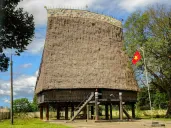
Among the Jarai a person is not finished dying at the funeral. The marriage is not dissolved, the widow is still a wife, and adultery against a dead husband is still adultery. The grave is visited every day and offered to every month, for as long as it takes — and how long it takes is not set by custom. It is set by what the family can afford. O...
Kin across the border: Ratanakiri and Mondulkiri
The border between Vietnam and Cambodia runs through the middle of our country. On the other side of it, in the Cambodian provinces of Ratanakiri and Mondulkiri, live Jarai, Bunong and other highland peoples who are our kin by language, by marriage and by history. It is where FULRO’s last fighters came out in 1992, where our refugees ran in 2001...
The rice year
For most of our history the year was measured by rice. A village chose a piece of forest, cleared it, burned it, planted it when the rains came, harvested it, and after a few years let it grow back while it moved on to the next. Outsiders called this “slash and burn” or “nomadic farming” and set out to end it. This page describes the rice year a...
Weaving and dress
Before there was a flag, there was cloth. A Rhade skirt, a Jarai loincloth, a Maa blanket or a Bahnar skirt hung with seeds told anyone who knew how to read it which people the wearer belonged to. The cloth was woven by women on a loom tied to their own bodies, from cotton they grew and dyed themselves. In North Carolina it still is.
The elephants of Bản Đôn
For more than a century the village of Ban Don, on the Srepok west of Buon Ma Thuot, was known across mainland Southeast Asia for one thing: the men there caught wild elephants and tamed them. The hunters were Mnong, Lao, Jarai and Rhade, and the most famous of them was given a title by the King of Siam. The hunting ended in the 1990s. In 1980 D...
Four highland towns
The four towns of the highlands that the world knows, Buon Ma Thuot, Pleiku, Kon Tum and Da Lat, all carry highland names, and all grew up on highland land as posts of someone else’s government: a Rhade chief’s village made a French residence, a Jarai village made a militia post, a Bahnar village made a mission and then a province, and a pine-co...
Yang: the spirits and the old religion
Everything written down about the old religion of our country was written by somebody else. French missionaries, French administrators, an American army analyst working from their books, and lately a team of researchers who state in print that they are not indigenous. We have looked for one published account by a Dega person describing a yang, o...
The Rhade (Êđê)
The Rhade are the people of the Darlac plateau, the red basalt shelf around Buon Ma Thuot where the Krong Ana, the female river, joins the Krong No, the male river, and becomes the Srepok. They speak a Chamic language, cousin to Cham and more distantly to Malay. They count descent through women: a house belongs to its women, land belongs to a wo...
The Jarai
The Jarai are the largest of our peoples and the largest Chamic-speaking people on the mainland — larger than the Rhade, and far larger than the Cham themselves. Their country is the Pleiku plateau and the valleys falling away from it into the Ayun and the Ba, and it does not stop at the border: a fifth of Ratanakiri province in Cambodia is Jara...
The Bahnar
The Bahnar are the people of Kon Tum and eastern Gia Lai, with a wing that spills over the Annamite crest into the hills of Bình Định. They are the counterweight to the Rhade and the Jarai in any honest account of who we are: they speak a Mon-Khmer language, not an Austronesian one; they count descent through both parents rather than through wom...
The Sedang (Xơ Đăng)
The Sedang hold the high northern end of the plateau — the ridges above Kon Tum, the country of Dak To and Tu Mo Rong, and the shoulders of Ngoc Linh, the highest mountain in the southern Annamites. They are the people who smelted iron and sold lances and sabers to buy salt; whose language has one of the largest vowel systems ever described in a...
The Mnong (Bunong)
The Mnong hold the southern half of the plateau — Dak Nong, the Lak basin below Buon Ma Thuot, and Mondulkiri across the Cambodian line, where they call themselves Bunong and are the largest of Cambodia’s recognized indigenous peoples. They are the people of N’Trang Lơng, who kept the French out of his country for twenty-three years; of the elep...
The Stieng (Xtiêng)
The Stieng live at the southwestern edge of the highlands, where the plateau falls toward the plains north of Saigon: in what was Phuoc Long and Binh Long, then Song Be, then Binh Phuoc, and across the border in Kratie and Mondulkiri. They were the first of our peoples a European lived among and wrote about, in 1859, and among the last the Frenc...
The Koho, Maa, Churu and Raglai
Four peoples hold the southern end of our country, from the Lang Biang plateau around Da Lat down to the hills behind the old Cham coast. Two of them, the Koho and the Ma, speak Mon-Khmer languages and are close kin. Two of them, the Churu and the Raglai, speak languages almost identical with Cham. The Koho and the Ma are easy to run together, a...
Jars, rice wine and the buffalo feast
A jar has a soul. The Êđê call it mngắt cheh, and if a jar stands empty for a while someone will put a handful of rice and an egg inside to feed it. A jar is also money: among the Êđê Bih a tang pôk jar was worth a buffalo and a tuk navi jar was worth an elephant. And a jar is law — when a man was killed, the killer set one jar at the feet of th...
Customary law and the village court
Our law was not a book. It was verse, held in the memory of men who could stand up in a village and recite the clause that settled the case. It priced a human life in gongs measured against a man’s own forearm, made failing to help the unfortunate an offense, and devoted more of itself to the wrongs a chief can commit than to theft. The French w...
The smaller peoples of the highlands
Beyond the large peoples, the Rhade, Jarai, Bahnar, Sedang, Mnong, Koho and Stieng, the highlands are home to a dozen smaller ones, some of only a few tens of thousands, whose names rarely appear in the record and whom the Vietnamese state files under larger names of its own choosing. This page gathers what the sources say about each of them, so...
Instruments beyond the gongs
The gongs are the voice of the highlands, but they are not the only one. Our peoples made music from bamboo, gourds, stone and a single string: xylophones, mouth organs, tube zithers, one-string fiddles, jaw harps, flutes and panpipes, and, once, from stones cut before any of our languages were spoken. Most of it was recorded by outsiders in the...
Hunting, the crossbow and the forest
Every highland household farmed, and hunting was part of most men’s lives, with the crossbow as its mark; among the Bru, boys began to learn it at five or six. The forest gave meat, fish, fruit, medicine and poison, and our peoples knew it the way farmers know a field. This page sets down what the record says about how we hunted, fished and trap...
Lower Sesan 2: the dam downstream
The Se San and the Srepok carry the water of our highlands into Cambodia, where the same peoples live on both banks. In 2017 the gates closed on Lower Sesan 2, a dam just below the rivers’ meeting in Stung Treng. It flooded some 30,000 hectares and displaced nearly 5,000 people, most of them Bunong, Brao, Lao, Jarai and their neighbors; more tha...
Food and the highland kitchen
Our food begins with upland rice grown in the forest clearing, and most of what else we eat grows beside it, is raised for the spirits, or is taken from the forest and the rivers. The written record of our kitchens is thin and mostly the work of outsiders; this page sets out what it says, people by people, and where it stops.
Growing up Dega: birth, naming and coming of age
A Dega child was born beside the hearth in some of our peoples and in the forest in others, named by the ancestors, given a false name to hide it from the spirits, and raised with a freedom that outsiders remarked on in every village they visited but one. This page sets out what the older written sources record about growing up in the highlands,...
Writing our languages
Our languages were spoken for thousands of years before any of them was written. Between the middle of the nineteenth century and the 1970s, French missionaries, a French administrator and his teachers, American missionaries and linguists, and our own people put them into the Latin alphabet, one language at a time, each for its own reasons and e...
The bracelet
A ring of brass or copper on the wrist is one of the oldest bonds among our peoples. It settles an engagement and ends one; it pays the midwife and the broker; it is heated in coals and dropped into a jar of blood and rice beer so that men who should be enemies can drink and be bound. In 1964, on the morning of a mutiny, a Rhade shaman put three...
Powered by WBAMS