



How this library is built, what it is made of, what it does with its sources, and the rules it holds itself to. If you intend to use anything here in a submission, a filing, a court case or an article, this page tells you what you are relying on and how far it can be pushed.
What this library is for
It is not a campaign leaflet and it is not a memorial. It is meant to be usable: by a lawyer preparing an asylum case, by a UN working group drafting a letter to a government, by a journalist checking a claim, by a student, and by a family looking for a name. Each of those readers needs the same thing, which is to be able to see where every statement came from and how much weight it will bear.
That is why the sourcing is heavy, why there is a page on what we do not know, and why the disagreements between our sources are printed rather than tidied away. A record that can be checked is worth more than a record that is merely moving.
What the sources are
- Our own people’s testimony
- Accounts given to us by families, congregations and elders. It is primary evidence: the account of the people to whom things were done, and in many cases the only account there is, because Vietnam does not publish what it does in the highlands and does not let independent observers in to see. We record who gave it, when, and in what setting, and we publish it only with the consent of the person who gave it.
- Our own records
- The organization’s own documents and lists, kept since the 1990s, among them the prisoner records. We cite them as ours, and say what they rest on.
- The archives of other Dega organizations
- Chiefly the Montagnard Foundation’s. Used as a source, checked where it can be checked, and named as the source. See below.
- Independent human rights reporting
- Human Rights Watch from 2001 onward, Amnesty International, UN special procedures and treaty bodies, and journalists at Radio Free Asia, BenarNews and elsewhere. Cited with a link and a date wherever a statement rests on it.
- Published scholarship
- Gerald C. Hickey’s Sons of the Mountains and Free in the Forest, Oscar Salemink, Mathieu Guérin, and the literature on forests, dams and resettlement. Used above all for the history before 1975. See Books about the Dega and Theses and academic studies.
- Records of outside governments
- French colonial records, the American military and intelligence record of the 1960s, and the reports that American, British and Australian officials write today for their own purposes. Read with those purposes in mind.
- What the Vietnamese state has said and decreed
- Laws and decrees, census totals and statements to UN committees. We treat them as evidence of what the state says, not as a neutral account, and we reach them through independent reference works, UN records and human rights reports, never through the state’s own publications or its press.
The rules we work to
- Every article names its sources. At the foot of the page, linked where a link exists, with dates. If a statement has no source it does not belong in an article.
- We say whose account it is. A statement that rests on one teller, one family or one foreign book is attributed to that teller, that family or that book, in the sentence. We do not hide an account behind words like “reportedly”, and we do not rank our own people’s accounts below a foreign document by default.
- One standard in both directions. If a figure rests on one of our elders, we say so. If the outside record of the same event runs back to a single book by a single foreigner, or to a government counting a people it governed, we say that just as plainly. A single foreign source is single-sourced too.
- Disagreement is printed, not resolved quietly. Three founding dates for BAJARAKA, two figures for the resettlements of 1986 and 1992, two totals for the war dead. Where we choose one, we say which and why. Where we cannot settle it, we say so.
- The gaps are published. What we do not know lists what is missing. It is meant to shrink, and it is meant to be the first page a hostile reader finds, not the last. Where something is missing, we ask our own people first and the archives second.
- Nothing identifies a person in the highlands without their consent. Not even where it would strengthen the case. Even with consent, we weigh the risk before we publish. The UN asks the same of its own human rights officers: consent is necessary, and it is not enough on its own.
- We do not dress research as testimony, or testimony as research. What we read in a report is cited as that report. What somebody told us is attributed as their account.
- We do not use the Vietnamese state’s own publications or its state-controlled press. Where a figure originates with the state, census totals for example, we cite it through an independent work and say where it came from.

Why independent sources are scarce
Anyone who uses this library should know why its sources look the way they do. Vietnam strictly controls its domestic media, does not let foreign journalists travel freely to sensitive areas outside Hanoi, and turns away independent international human rights investigators. Human Rights Watch said so in plain terms in 2011, and in 2006 it recorded that many highland villages were off-limits to outsiders unless the government arranged and controlled the visit.
When a UN special rapporteur did visit, in July 2014, his planned stops in Gia Lai and Kon Tum could not be completed, and people he tried to meet were watched, warned, intimidated or stopped from traveling. In 2026 Reporters Without Borders ranked Vietnam 174th of 180 countries for press freedom. In December 2025 a revised press law allowed the authorities to compel journalists to reveal their sources in investigations and trials.
The result is that most of the outside record of the highlands since 1975 was assembled from the edges: from refugees in Cambodia and Thailand, from what the state chose to publish, and from what our own organizations abroad were told by families. Human Rights Watch’s report of 2011 says it rests largely on Vietnamese state media, supplemented by interviews with people who fled and by the reports of our organizations abroad. We cite that report, as we cite others, knowing what it rests on, and we say so where it matters. Our own people’s testimony is not a lesser substitute for a record that does not exist. It is the record.
How much weight a statement will bear
Different readers need different standards, and the library is built so that each can find what they need.
- UN fact-finding
- UN human rights officers report a violation publicly when there are “reasonable grounds to believe” it occurred: corroborated information that would satisfy an objective observer that it is likely to have happened. Where they cannot corroborate a fact, they say so and keep it apart from what they could. The UN’s fact-finding mission on Venezuela applied the same standard in 2020 without ever being allowed into the country, working from people outside it. Our pages on UN procedures follow that model: what is corroborated, what is one account, and whose.
- Asylum
- The UN refugee agency’s handbook says a refugee can rarely prove every part of a claim, that cases in which every statement can be documented are the exception, and that the applicant should often be given the benefit of the doubt, provided the account is coherent, plausible and does not run counter to generally known facts. A library of dated, checkable sources on the highlands is one way to establish what the generally known facts are. See Reports and documents for the documents decision-makers cite.
- Courts and history
- Historians hold themselves to leaving a clear trail for those who follow, to not omitting evidence that runs against their view, and to acknowledging that multiple, conflicting perspectives are among the truths of history. So do we.
The standards we measure ourselves against
There is no single code for a library like this one, kept by an indigenous people about itself, in exile, about a country that denies what it has done. We measure ourselves against several.
- Journalism. The Society of Professional Journalists asks that sources be identified clearly, that anonymity be reserved for people who face danger, that advocacy be labeled, and that illustrations be marked as illustrations. Ours are.
- Archives. The Society of American Archivists asks archivists not to alter or destroy records to conceal facts, to be open about how collections are selected and described, and to protect the privacy of people who had no say in how their lives were recorded. In 2018 it endorsed the Protocols for Native American Archival Materials, written in 2006, which ask institutions to collect what indigenous people created, not only what was written about them, and to treat traditional knowledge systems as having equal integrity with written ones.
- Indigenous data. The CARE Principles for Indigenous Data Governance, published in 2019, rest on collective benefit, the authority of indigenous peoples to control data about themselves, the responsibility of those who use it, and ethics. The principles are published in Vietnamese and Khmer as well as English. We measure ourselves against them, and against the First Nations principles of ownership, control, access and possession known as OCAP, without claiming either as our own.
- Our rights as a people. The UN Declaration on the Rights of Indigenous Peoples, for which Vietnam voted in 2007, recognizes our right to transmit our histories, languages and oral traditions, and to keep our own names for communities, places and persons (article 13), and to control our cultural heritage and traditional knowledge (article 31). It is the ground of our naming rule below.
- Oral history. The Oral History Association asks for informed consent before an interview, for the narrator’s right to review and restrict what they said, and for respect for the communities narrators come from. See How to record an elder.
- Traditional knowledge labels. Local Contexts offers labels that let a community say how its knowledge may be shared and used. Only a community can apply them. If Dega communities choose to apply them to material here, we will display them.
The Montagnard Foundation’s archive
A great deal of the older narrative in this library, the 1946 boundary, the 1951 statute, the account of our territories before the colonial period, the list of what was done after 1975, descends from material published by the Montagnard Foundation, Inc., in its DegarWeb archive. The Foundation, led by Kok Ksor and based in South Carolina, organized support in the highlands from 2000 through telephone calls, faxes and smuggled letters and tapes, and represented the Degar at the Unrepresented Nations and Peoples Organization from 2003 to 2016.
That archive is the Foundation’s, and its copyright is the Foundation’s. We use it as a source: read, checked where it can be checked, rewritten in our own words, and cited. We do not republish it under our own name, and we do not present the Foundation’s research as our own reporting. Where a statement rests on it alone, the article says so. Some of the material shows the marks of machine translation and retelling; where the meaning is clear we use it, and where it is not we say so.
The Foundation’s old web address, montagnard-foundation.org, no longer carries its material; in September 2026 it was showing an unrelated French marketing article. Readers looking for the archive should use saved copies in the Internet Archive’s Wayback Machine, not the live address.
An old precedent
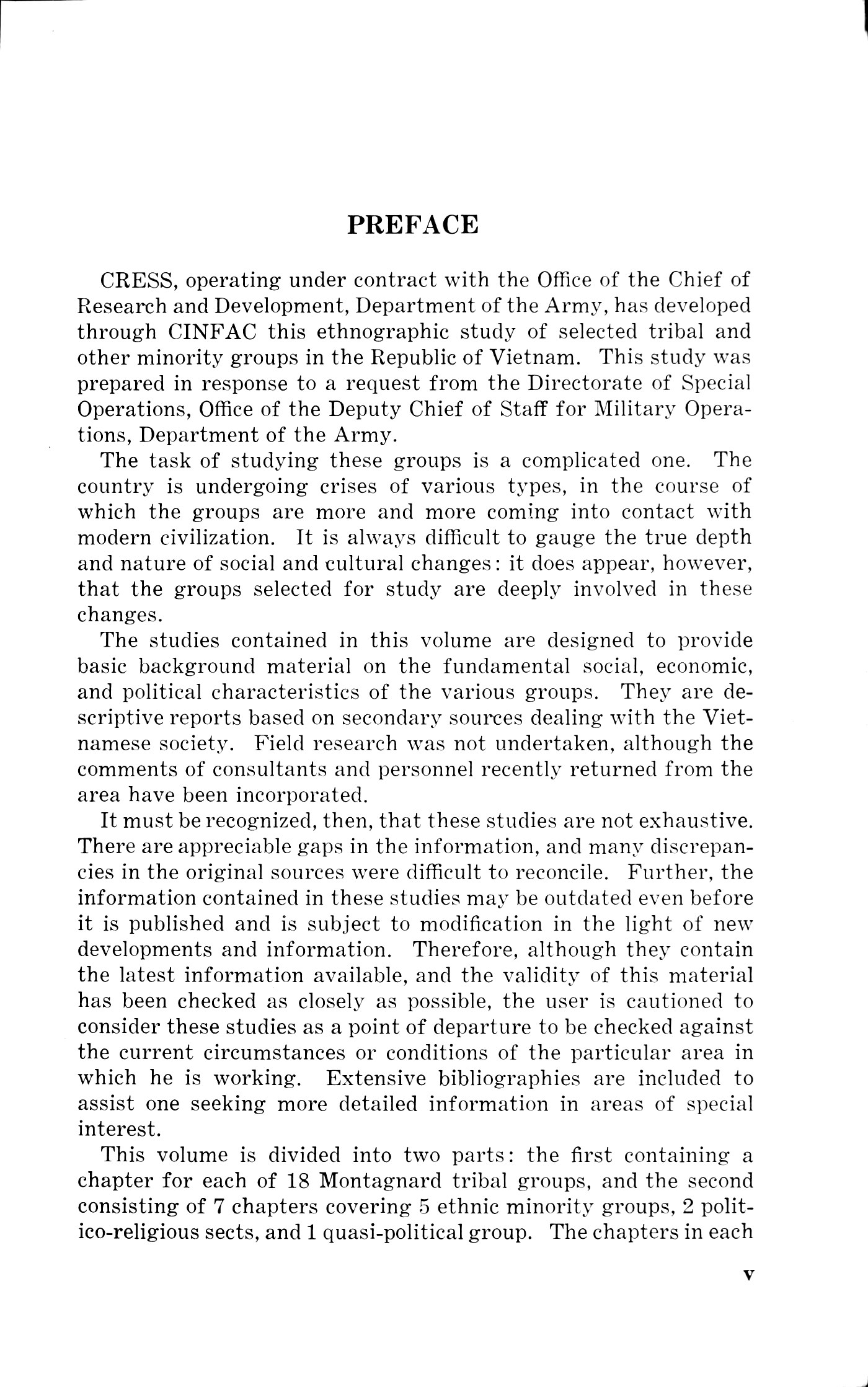
One of the most used books in this library is the US Army’s Minority Groups in the Republic of Vietnam of 1966. Its authors said in the preface that it was built from published sources, that “field research was not undertaken,” that there were appreciable gaps in its information, and that many discrepancies in its sources could not be reconciled. They asked readers to treat it as a point of departure and to send corrections. We use it often, and we use it knowing that. We ask to be read the same way.
Language and terms
This library says Dega throughout, and Montagnard where it quotes or points to a source that uses it, which is most of the human rights literature, most of the American military record and most of the resettlement paperwork. Dega, sometimes written Degar, comes from the Rhade phrase Anak Ede Gar, “sons of the mountains”. The reasons for the choice are in who are the Dega, and they are not sentimental: the choice of word decides which body of international law applies. Vietnam voted for the Declaration on the Rights of Indigenous Peoples but does not recognize any of its peoples as indigenous; its delegation told the UN committee on racial discrimination in 2023 that it speaks of “minority people” instead. That committee, in 2012, called on Vietnam to respect self-identification, and named us in its own words as “Degar (Montagnard).”
Spellings vary because the sources vary. Names and words carries the variants, and anyone searching the records needs them.
Two rules follow. Our own places are written plainly, Dak Lak, Dak Nong, Lam Dong, Buon Ma Thuot, Buon Don, Da Lat, Cu Kuin, and not in Vietnamese orthography, because they are our places and that is how we write them. Our people’s names are written as our people write them: Y Quynh Buondap, Y Pum Buonya. Vietnamese places outside the highlands keep their Vietnamese spelling, because those are Vietnamese places.
The one exception is a title. Where we cite a report, a book or an article, its title stands exactly as it was printed, diacritics and all, so that a reader can find it, and even where the title uses a word we would not, such as the old French Moï. Where such a word matters, the text explains it rather than silently changing the title. That is why a source line may spell a name differently from the paragraph above it.
We also say the Central Highlands of Indochina rather than the Central Highlands of Vietnam. Our country was divided by borders drawn around us: Dega live in Vietnam, in Cambodia and in Laos, and a description that names only one of the three states writes some of our people out. Where a page is about what the government of Vietnam did, it says Vietnam, because that is the state that did it.
Corrections
We would rather be corrected than left alone, and a correction costs us nothing.
- If a date, a name, a figure or a spelling here is wrong, tell us, with your source, whether it is a document or your own memory. We will change it.
- If you are named in the prisoner records, or your family is, and you want an entry corrected or removed, we will do it on request from the family and will not ask why.
- If you can close one of the gaps on what we do not know, we will add what you found, and credit you unless you ask us not to.
How to reach us. Read reporting safely first if you are inside Vietnam.

The reading and research shelf
The sources behind this library are gathered in four reference pages: Books about the Dega, Reports and documents, Archives and collections and Language resources. Two more collect what official bodies have said: What the United Nations has said and What Washington has said. For pictures, see Where to find photographs, and how to credit them.
Sources
- Society of Professional Journalists, Code of Ethics (2014)
- Society of American Archivists, Core Values Statement and Code of Ethics (revised 2025); SAA Council endorsement of the Protocols for Native American Archival Materials (August 13, 2018); First Archivist Circle, Protocols for Native American Archival Materials (2006)
- Global Indigenous Data Alliance, CARE Principles for Indigenous Data Governance (2019); S. R. Carroll and others, “The CARE Principles for Indigenous Data Governance,” Data Science Journal 19 (2020); First Nations Information Governance Centre, OCAP
- UN Declaration on the Rights of Indigenous Peoples (2007), articles 11, 13, 15 and 31, in our library; Local Contexts, Traditional Knowledge and Biocultural Labels
- Oral History Association, Core Principles and Statement on Ethics (2025); American Historical Association, Statement on Standards of Professional Conduct (2023)
- Office of the UN High Commissioner for Human Rights, Manual on Human Rights Monitoring (2011), chapters 2, 10 and 13; Berkeley Protocol on Digital Open Source Investigations (2022), in our library; Independent International Fact-Finding Mission on Venezuela, A/HRC/45/CRP.11 (2020)
- UNHCR, Handbook on Procedures and Criteria for Determining Refugee Status (reissued 2019), paragraphs 196, 203 and 204; UNHCR, Beyond Proof: Credibility Assessment in EU Asylum Systems (2013)
- Human Rights Watch, Repression of Montagnards (2002), in our library; No Sanctuary (2006), in our library; Montagnard Christians in Vietnam (2011), in our library
- Heiner Bielefeldt, UN Special Rapporteur on freedom of religion or belief, press statement (Hanoi, July 31, 2014) and report A/HRC/28/66/Add.2 (2015)
- Reporters Without Borders, World Press Freedom Index 2026, Vietnam; “RSF condemns Vietnam’s latest legal crackdown on independent journalism” (December 11, 2025)
- Committee on the Elimination of Racial Discrimination, concluding observations on Viet Nam, CERD/C/VNM/CO/10-14 (2012), and summary of the dialogue with Viet Nam (November 2023); IWGIA, Vietnam
- Unrepresented Nations and Peoples Organization, Degar-Montagnards member profile
- Minority Groups in the Republic of Vietnam (US Army, 1966), foreword and preface, in our library
Compiled September 2026. This page describes the library’s practice as of that date; where the library falls short of it, that is a fault to be reported, not a change of policy.