




















At Stung Treng in the last century of the trade a person from our highlands sold for three or four bars of silver. The Lao word for us, Kha, means servant or slave. The Frenchman who wrote both of those things down in 1898 added a third sentence about us that we reproduce here because of what it shows about the men who came to abolish the traffic. And the traffic was not only done to us: our own stronger peoples raided the weaker ones and sold them down the rivers, and our own law provided for selling a man.

The word
Étienne Aymonier, a French colonial official surveying the Mekong for his government, wrote in 1898 that the Lao give these people the generic name Kha, which he believed meant servant or slave. Then he wrote the next sentence: “C’est en effet de la chair à esclavage.” It is built on chair à canon, cannon fodder. He is saying we are slave-meat.
We keep the sentence because of who wrote it and why. Aymonier was arguing that France must police her new Lao possessions, and the argument worked better if we were a category of goods and France the only conceivable protector. That is the voice of the abolition as it reached us. The Khmer name for us, Phnong, carried the same freight — the Dutch agent Gerrit van Wuysthoff, going up the Mekong in 1641, already used it that way.
Who took whom
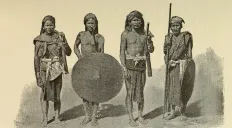
The lowland states took us, and they had been pushing us out of the valleys for a long time before that. The encroachment of Lao, Siamese, Khmer and Vietnamese drove the highland peoples from the valleys into the hills, and the Siamese, Lao and Khmer raided among them.
And some of our peoples raided others. The stronger among the tribes — the Sedang, the Ta Oi and the Jarai are the ones named — preyed upon weaker ones for their own profit in selling slaves to the Siamese, the Lao and the Khmer. The Sedang were the most heavily involved, relied on war to take captives, and did not confine themselves to other highlanders: they also took Vietnamese off the plains, from Quảng Nam, Quảng Ngãi and Bình Định.
The traffic ran into our country as well as out of it. When a Brao leader in southern Laos defeated a rival somewhere around 1817 to 1821, he is said to have taken his new slaves and sold them to Jarai and Sedang buyers in our highlands. The Brao were themselves frequent victims of raids organized by Lao, Siamese and other highland groups. Tribute and raiding were two settings of the same relationship: pay, or be taken.
Inside our own societies there were two distinct conditions, and the distinction matters. Big men among us held people who had been captured and people whose households were in debt. The captured were mostly sold on to the slave traders from Laos, Cambodia and as far as Thailand. The indebted were added to the household and were practically indistinguishable from the other people in it. One kind of bondage was for export; the other stayed and was absorbed. Our own customary law names the sale of a person as one of its penalties, and it was not a dead letter — the French résident at Attapeu thought his own administration had made a mistake in attacking debt-slavery, because it cut the Lao and the merchants off from their servants and only angered them.
Those same big men owed their standing to long-distance trade and to what one historian puts in a single clause: their military prowess, especially in the capture and trade of slaves and elephants. The man our Ban Don elephant hunters are descended from is inside that sentence too.
The markets, and the price
Aymonier: slaves carried off from among the highlanders formed at Stung Treng, as in the neighboring countries, an important article of commerce; and at Stung Treng a slave sold for three to four bars of silver. We have not found what a bar of silver converts to, and that is a piece of work someone should do.
Above Stung Treng the trade went up into tribute. Aymonier again, on the vassal rulers below Bangkok: besides the tribute in silver, they send substantial gifts in wax, ivory and rhinoceros horn, and probably in slaves, though on this last article people keep silent. People moved up the same channel as the wax and the horn, and that part of the manifest was the part nobody wrote down.
At the Cambodian end the state taxed slaveholding as an ordinary form of property. Slaves of all races, a French official recorded in 1883, cannot be called up for war or public works, and the master pays the state a quarter of what is required for a free citizen. And the Cambodian king’s own guard was made up largely of men he had bought.
What we do not have is any count. Not for a decade, not for a year. The standard history of slavery in nineteenth-century Siam says why, in a footnote: its author omitted the hill peoples for lack of information, and supposed only that they could have followed the same pattern as other war captives. The standard account of the institution leaves us out because nobody wrote enough down about us. That is a fact about the archive, and it belongs on this page.
What a raid was like
We do not know. That is the plainest statement we can make. We have found no description of a raid on a highland village — not the season, not the approach, not the weapons, not how captives were bound, not how far they walked.
From one watershed away, in the hills of northern Siam, there are accounts of how it was done to the Karen: dealers threw bundles of bamboo interwoven with thorns over people while they slept, then picked them out one at a time and tied their hands; captives were driven off in droves through the jungle, and those who grew too weak were left where they fell. Of one group of 5,700 taken, over half died on the road. That is not our country and those are not our raiders, and we give it only so that a reader knows what kind of sentence exists in the record when somebody troubled to write one.
The lethality of the forced marches in this region generally is not in doubt. Of the Lao deported from Vientiane in 1779, fully two-thirds are reckoned to have died on the way to Siam.
What it did to us
It moved us. The pressure of the lowland states pushed our villages out of the valleys and up into the hills, and the raiding came on top of that. The fortified village is part of how we remember ourselves, and that memory is evidence. What we do not have is anything written down about it: no description of a highland stockade, palisade, ditch or spike-trap built against raiders. The men writing in this region were Lao and Siamese chroniclers, French officials surveying land they meant to take, and traders. None of them had a reason to walk into a highland village and set down how it was defended. If your family carries an account of how a village was built against raiders, or where one stood, that is the part of this page that is missing.
It named us. The Lao called us slaves and the Khmer called us slaves, and both words were still in use when the French arrived to abolish the thing the words described.
And it priced us. A French museum record of 1931, cataloguing a large Chinese jar from our country, notes that around 1887 one jar was worth to us about twenty slaves. Our ritual wealth and the trade in our people were quoted against each other. See Jars, rice wine and the buffalo feast.
When it ended, and whether it did
- 1874 — Siam frees those born after October 1, 1868, the first of three stages of abolition there.
- 1884 — The Siamese Ministry of the Interior issues a decree to its easternmost territories forbidding the capture and sale of Kha slaves. It is known through a chronicle testimony about Attapeu. It interrupted the trade on the east bank of the Mekong badly, before that bank passed to France.
- 1893 — France takes the left bank.
- Mid-1890s to 1900 — a resurgence of the old Lao-highland trade. The French send militiamen into the interior to interdict it, to suppress banditry, and to build fortified posts.
- 1897 and 1905 — Siam restates the prohibition and then credits debt slaves with four baht a month against what they owe.
- 1901–02 — When the French occupation of Kon Tum cuts the route into Vietnam, the leaders of the Bolovens Plateau, whose revenues came from the slave trade, react with fury. The rebellion that follows is the end of the raids and the beginning of something else.
- The 1920s — In Stieng country a French post chief still records the going rate: a man four or five buffalo, a young woman up to eight.
Read as a list of decrees it looks like a march to abolition. It was not. Ten years after the Siamese ban the trade was back; the French attacked debt-slavery and their own officials thought they had gone too far; and the men who lost their income when the Kon Tum road was closed went to war over it.
What we do not have
No count of how many of us were taken, in any decade. No description of a raid on one of our villages. No named captive, no named ransomed person, no witness — not one, in any language, in anything we could reach. Nothing on what captives were exchanged for. No text of the Cambodian proclamation of 1877 or of the slavery clause in the Franco-Cambodian convention. And we have not been able to read the missionary record at Kon Tum, where the priests knew about the raids and sometimes bought people back; the archive is in Paris and the published memoir of the first missionary among the Bahnar has not been available to us in any form we could read.
Two books would close most of these gaps: that memoir, and Paul Guilleminet’s collection of Bahnar, Sedang and Jarai customary law of 1952, which is where the provision on selling a person will be written out in full.
Sources
- Étienne Aymonier, Voyage dans le Laos, tome premier (Ernest Leroux, Paris, 1898) — the name Kha and the sentence that follows it, the market at Stung Treng and the price in bars of silver, and the tribute to Bangkok. Translations ours
- John B. Murdoch, “The 1901–1902 ‘Holy Man’s’ Rebellion,” Journal of the Siam Society 62:1 (1974) — the pushing of highland peoples into the hills, the Sedang, Ta Oi and Jarai as raiders, the Sedang taking Vietnamese from Quảng Nam, Quảng Ngãi and Bình Định, the Siamese decree of 1884 and its chronicle source, the resurgence of the 1890s and the French response, and the Bolovens leaders’ fury at the occupation of Kon Tum
- R. B. Cruikshank, “Slavery in Nineteenth Century Siam,” Journal of the Siam Society 63:2 (1975) — the Siamese abolition of 1874, 1897 and 1905, and the footnote omitting the hill peoples for lack of information
- Ian G. Baird, “Contested History, Ethnicity and Remembering the Past: The Case of the Ay Sa Rebellion in Southern Laos,” Crossroads 18:2 (2007) — the Brao as victims of raids by Lao, Siamese and other highland groups, and captives sold on to Jarai and Sedang buyers in our highlands
- Oscar Salemink, “A View from the Mountains: A Critical History of Lowlander–Highlander Relations in Vietnam,” in Upland Transformations in Vietnam (NUS Press, 2011) — captured slaves sold on and indebted slaves absorbed into the household, the big men and the trade in slaves and elephants, and van Wuysthoff on the Khmer name for us
- Katherine A. Bowie, Slavery in Nineteenth-Century Northern Thailand (Yale Southeast Asia Studies, 1996) — the mechanics of a raid and a forced march, in a neighboring region and not in ours
- “Under Duress: Lao War Captives at Bangkok,” Journal of the Siam Society 97 (2009) — the deportations of 1779 and the deaths on the road
- Jean Moura, Le Royaume du Cambodge (1883) — slaveholding taxed at a quarter of the free rate. Étienne Aymonier, Notice sur le Cambodge (1875) — the palace guard of purchased men. Translations ours
- Musée Khải Định, Huế, catalogue record of a large Chinese jar from the highlands, 1931 (ark:/17103/fvvx) — the valuation of a jar at about twenty slaves, around 1887
Compiled September 2026. Nineteenth-century French and Siamese sources wrote about us in terms we have kept where the wording is itself the evidence, and we have said each time whose voice it is and what it was arguing for.