





















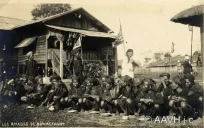



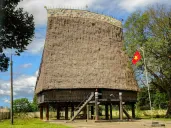









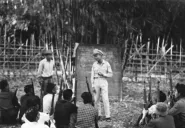
A jar has a soul. The Êđê call it mngắt cheh, and if a jar stands empty for a while someone will put a handful of rice and an egg inside to feed it. A jar is also money: among the Êđê Bih a tang pôk jar was worth a buffalo and a tuk navi jar was worth an elephant. And a jar is law — when a man was killed, the killer set one jar at the feet of the body and another at its head. The buffalo tied to the carved post is the largest thing a household can promise, and most people promise it once in a lifetime.
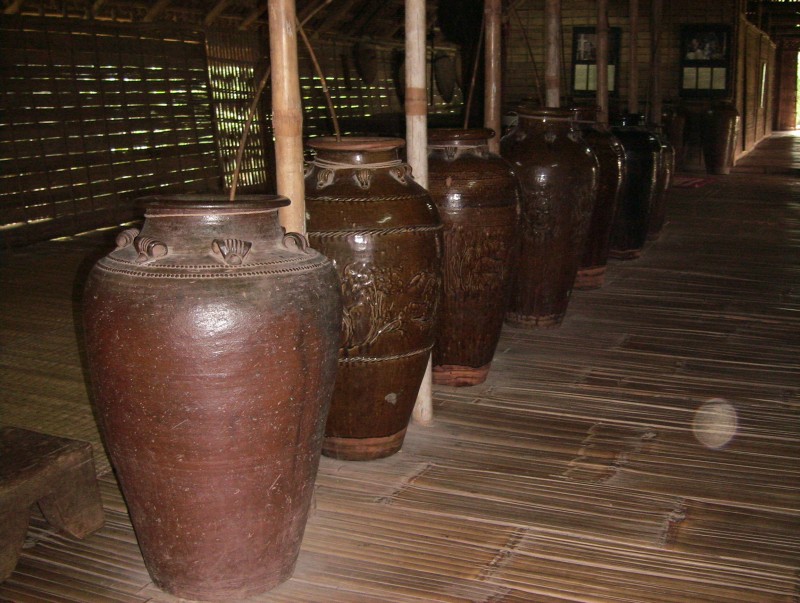

The jars, and what they are worth
Jars are used all over Vietnam, and the largest concentration of them is here. They were not made here. They came in from the Kinh and the Cham inside the country, and from Laos, Cambodia, Thailand and China; the oldest, Chinese and Angkorian, date to about the thirteenth century. A few of our women who make earthenware cooking pots also make jars, but only a handful.
They are ranked, and the ranking is not the same from people to people.
| People | The ranking |
|---|---|
| Êđê | tuk jars are the most expensive, then pô, then tang. By the lugs, the eight-ear jar is most valuable, then the four-ear, then the six-ear. |
| Mnong Rlam | From most to least valuable: jông, rlôh, rlung, rliêng, bông, lager. The tall, slender jong always carries a dragon motif. |
| Mnong Gar | jăng is the class; of the round jars bought from the Cham, jăng jau is the most expensive. |
| Bahnar | sơtôk is the most expensive kind, and it has a spirit of its own. |
The prices convert. Among the Êđê Bih, a tang kroa or tang brăh jar was worth two buffalo and a tang pôk one buffalo; a tuk êba jar was worth five gongs and a tuk navi jar an elephant. Among the Mnong Gar a jăng rlơh jar was worth a big elephant, and a jăng jong two male buffalo or five or six female ones. A big elephant is thirty buffalo; a male buffalo is two or three female. Run the arithmetic and a single tuk navi jar stands for thirty buffalo, which is why a rich family might own hundreds of jars and why owning them was the measure of being rich at all.
There is an older and uglier conversion. A French museum record of 1931, cataloguing a large Chinese jar from our country, notes that around 1887 a jar was worth to us about twenty slaves. Set that beside The slave raids and the two pages explain each other.
Nobody dates a jar by its glaze. People date them the way families date anything: this one came down from our ancestors, or I saw it when I was small. The line between old and new is money — a jar made before the middle of the twentieth century, when money was not in general use, is old. And the older it is, the more precious.
A jar is a person
Old and precious jars are sacred jars. Like a person they have a soul, which the Êđê call mngắt cheh. A jar may also be inhabited by a spirit: the Jarai law says plainly that tuk jars are possessed by spirits, and because tuk jars are so expensive people hold that they may be bought only with the spirits’ permission. The 1931 French record puts it in one line — a spirit lives in every jar — and notes that offerings were made before a sale.
They are read as bodies. The lugs are ears; moulded knobs are noses. Some communities sex them, the female with the larger body. Rarest are the mother-and-child jars, a small vessel joined to a large one, sometimes plumbed so that the liquid passes between them while people are drinking.
And they are handled accordingly. If a jar is not being used to make wine, people put handfuls of rice and some eggs in it to feed it. Êđê children do not touch a tuk jar and the young do not drink from one. In Mnong country a rlung jar must not be carried to the spring to be washed, or there will be heavy rain and thunder. The Mnong Gar do not drape a skirt or a loincloth over a jar’s mouth. When a woman of the house gives birth, the jar is taken into the forest. A precious jar that breaks is not thrown away; it is dealt with ceremonially and set inside a fence.
The wine, and how it is drunk
Making the wine is women’s work. The base is rice or millet, and nowadays manioc; the yeast is rice powder, or certain roots and leaves. Cooked grain, yeast and rice husks are sealed into the jar and left, and the fermentation may take weeks, months or years. A jar that has held salt, salted meat or sour bamboo shoots can never be used for wine.
It is drunk straight from the jar through a long, narrow, curved bamboo tube. A missionary who watched a Bahnar Rơngao feast in 1896 described the mechanism that lets a village drink all night from one jar: as the first solution is drawn down, water is added, the water turns into wine, and so a single jar carries the whole night — which, he noted, gives the drinkers only a relatively measured gaiety. From the great jars, only the elders and the guests drink.
The jar as an instrument
This is the part that is usually left out, and it is the part that matters. In a society with no writing, the jar is how a thing is made binding.
- It is the register. Every villager knows when a family buys or sells a jar, because they are invited to drink wine and witness the transaction. The feast is the record of the transfer.
- It is the inheritance. Êđê law names the red tuk jars and the êbah Mnong jars, with the bracelets and the silver and gold bowls, as property from rich ancestors, and it is the eldest daughter who must preserve them. Matrilineal transmission, stated inside the law itself (see Dega women).
- It is the price of a life. A killer must offer a duê jar to set at the feet of the dead person and a bơng jar at the head, with other goods besides. The jars are not an abstract fine. They are placed on the body, at its two ends.
- It is the penalty for theft. A thief repays each head of stolen game with an êbah jar.
- It is the marriage. In Mnong verse there must be enough jars to give the wife’s family, and the set to ransom a wife must be complete — complete, not merely numerous.
- It is the punishment, and the punishment is a feast. A Mnong widow who breaks the mourning rule must provide pigs and jars as offerings for her children and her parents-in-law, a lot of meat and wine to feast people, and jars to console her mother-in-law.
The sets are graduated, and the ceremony is named by what it costs: three jars of wine with three roosters; five jars with a hog; seven jars with a male buffalo. The position of each kind of jar in a rite is fixed by custom. For the biggest rituals the Êđê use a set of seven tang jars, and for those that include a buffalo sacrifice, a set of seven tuk. More of this law is on Customary law and the village court.
The buffalo
A buffalo is not killed lightly. Among the Bahnar the promise is called tơl — to answer, or to promise the spirits a buffalo — and a couple makes it once in a lifetime, usually when they are in trouble over health, or trade, or their hill plots. It is paid years later, when the omens or their improved fortunes say the time has come. One couple, some years on, found that their means had grown from the first buffalo they had ever owned, and concluded that the first one was owed to their ancestors. Otherwise buffalo are offered only for the most important occasions, such as building or restoring the rong, the communal house. Among the Jarai a family or a whole village makes the sacrifice to thank the yang or to ask their favor, and it runs two or three days.
The village builds the post. At Kon K’tu in Bahnar country, dozens of men work about two days on it, in bamboo and wood, painted red, white and pale blue, hung with bamboo-fiber and woven ornaments that stand for birds and sun figures; on top is a single carved wooden bird, the Kơ tơp or earth eagle, which gives omens for work in the forest. The post is the gâng — the same word the French recorded at Kon Tum in the 1930s, and not the bronze gong. Beside it stands a decorated bamboo mast, the holuk.
The one account we have of the whole arc is the 1896 one, of a Bahnar Rơngao funeral feast repeated a year after the death: an evening of gongs and wine, a night of the village drinking through the straws, and then at daybreak the buffalo killed with sabre blows, and the pieces shared out among everyone present — including the dead man, who also has his share.
The gongs play through it. Jarai gong pieces do not have names, with three exceptions that are obligatory in this ceremony among the northern Jarai: pơ juar, trum and bŏng sap. The northern groups play all three and the southern play only trum. See Gongs and epics.
The liver is the spirits’ portion. Bahnar prayers tell them so directly: you can eat chicken liver and drink wine; may the gods come down to drink wine and eat liver. In a Rhade longhouse a drum is hollowed from a log and covered with buffalo hide, and carved poles in the rafters kept the record of the feasts a household had given.
Jars and the dead
The Ma buried their dead in jars, cutting away the necks and shoulders of two tall đrắp jars and joining them. Among the Bahnar Rơngao in 1896 a jar was set over the coffin, buried almost to its neck with the mouth above ground; a year later the family came back and poured the dead man’s food down through the neck of it in little earthenware bowls. See The tomb house.
Whether it still happens
It does. A buffalo sacrifice by Lak and Koho villagers at Lac Duong in Lam Dong was filmed in 1988 and the reels are in the Smithsonian’s Human Studies Film Archives in Washington, along with an Êđê celebration at Cu Pong in Dak Lak. A Bahnar buffalo sacrifice was recorded at Plei Hven in 2019 and published as a record. At Kon K’tu the gâng was built in the village in December 2022 and again in December 2023.
What the churches did is not one story. Among the Bahnar Catholics of Kon K’tu the rite was kept and turned: at Christmas the village builds a gâng and offers it to Ba Yang, and in 2023 the men carried one into Kon Tum city and raised it in the grounds of the cathedral. The old agricultural prayers were rewritten into a Bahnar prayer book. Among evangelical Protestant converts the break was sharper — some would not own a gong at all. See Yang, the spirits and The highland Catholic church.
One American who spent eleven years in our country writes that since 1975 our people have not been permitted to make rice wine for ceremonies, to hold sacrifices, or to own buffalo. The film of 1988 and the recordings of 2019 and 2023 say otherwise, at least for those places and years. We print both and do not pretend to settle it.
What we have not found
We do not have the invocation. We have not found a source that describes what is done with the blood, the horns or the tail, or who eats which part, or who strikes the animal and what his relation to the household is. We have not found the measure — the gauge or marked stick by which each drinker’s portion at the jar is fixed — nor the order in which people drink, beyond elders and guests first. We could not verify the Mnong Gar rite of alliance between two men or two villages, the tâm bôh, and we will not describe it from second-hand accounts. We have found no oath sworn over a jar, though our law is full of jars. We have found no scientific dating of any jar actually standing in a highland village, no price for a buffalo today, and no account of what became of the old jars after 1975.
All of this is known to people who are alive. If you have given a buffalo, or seen one given, tell us what happened and in what order. See How to record an elder.
Sources
- Lưu Hùng, “Introduction to Jars in the Life of Ethnic Groups in the Central Highlands of Vietnam,” in Ceramics in Mainland Southeast Asia: Collections in the Freer Gallery of Art and Arthur M. Sackler Gallery (Smithsonian Institution, 2008) — the ranks and names of the jars, the equivalences in buffalo, gongs and elephants, the jar’s soul, the taboos, the witnessing of a sale, the graduated sets, the making of the wine, and the Ma jar burials. The author is a scholar of the Vietnam Museum of Ethnology in Hanoi; his law texts are quoted from the bilingual editions published in Hanoi in 1996, 1998 and 1999, and the essay itself is published by the Smithsonian. That is the whole chain, and we give it
- Smithsonian Institution, Human Studies Film Archives, HSFA.1988.15, Montagnard-Dega Ethnic Minority People of the Highlands of South Vietnam, filmed by Lương Đức, 1988 — the buffalo sacrifice by Lak and Koho villagers at Lạc Dương, and the Êđê celebration at Cư Pông in Buôn Hồ district
- Musée Khải Định, Huế, catalogue record of a large Chinese jar from the highlands, 1931, digitized by Université Côte d’Azur (ark:/17103/fvvx) — a spirit in every jar, offerings before a sale, and the valuation of about 1887
- Fonds Guilleminet, Kon Tum, photographic plates of the Bahnar buffalo sacrifice (ark:/17103/63kp and related) — the sacrificial post and the decorated bamboo mast, named
- “Les Bahnars Reungao,” a missionary account of 1896 — the sequence of the funeral feast from evening to daybreak, the buffalo killed with sabre blows, the share set aside for the dead, the refilling of the jar with water, and the jar set over the grave
- Trần Hoài and others, on ritual and heritage at Kon K’tu, Kon Tum (fieldwork of December 2022 and December 2023) — the tơl promise, the building and painting of the gâng, the earth eagle, and the Christmas post raised at the cathedral in 2023
- Vincenzo Della Ratta, Gongs of the Bahnar: A Buffalo Sacrifice Ceremony, recorded at Plei Hven, 2019 (Akuphone AKULP1050), and his notes on Jarai gong ensembles — the čĭng arap and čĭng trum ensembles and the three obligatory pieces
- Mike Benge, The History of the Involvement of the Montagnards of the Central Highlands in the Vietnam War (2010) — the buffalo-hide drum and the carved record poles in the longhouse, and the claim about prohibition after 1975, which we set against the film and recordings above
Compiled September 2026. Jar names and values differ between our peoples and we have kept them apart rather than merging them; where a name is spelled differently by different recorders we have said so.