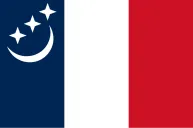





Dega is the name the indigenous peoples of Vietnam’s Central Highlands chose for themselves. Its meaning is told three ways; here is each, and who says it.
The short answer
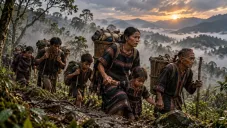
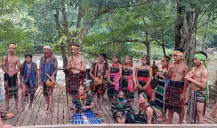
Dega, also written Degar, is our own name for the Jarai, Rhade, Bahnar, Koho, Mnong, Sedang and the other indigenous peoples of the Central Highlands. The French called us Montagnards, mountain people, and that is still the name most English readers know. The Vietnamese state calls us ethnic minorities. Dega is the only one of these names we chose.
What the word means in itself is not settled. Our own organization, an American resettlement guide and Human Rights Watch give three different accounts, and no linguist has decided between them. We set them out side by side.
Three accounts of the meaning
“The first” or “the original.” This is how our own organization explains the word: a Rhade word for the first people of the country. It comes from our own records, and we know of no outside source that gives it.
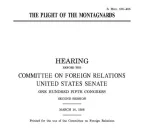
“Sons of the mountains.” Human Rights Watch wrote in 2002 that the name comes from the Ede (Rhade) phrase anak ede gar, “sons of the mountains.” Researchers writing for the UNHCR in 2006 gave the same meaning, from the Rhade de ga, “according to some accounts.” The name our organization put on a record of our songs, Anak Cu Chiang, “Children of the Mountains,” says the same thing in other words.
The first man and woman, De and Ga. The guide written in 2002 for the American caseworkers who resettled our families, Raleigh Bailey’s The Montagnards: Their History and Culture, says the word comes from a Rhade creation story in which the first two people were named De and Ga. Mike D. Benge gives a version of the same story in a 2010 paper: Dega is short for Anàk Dega, the children of Y-De and H-Ga, the first man and woman. He writes that it is what the Rhade call themselves, and that it is a mistake to use it for all the highland peoples. His paper argues a case and is critical of the Montagnard Foundation. We cite it for what it records about the story.
Whatever its origin, by the 1960s the word reached beyond the Rhade. The anthropologist Gerald Hickey recorded that among the Rhade of that time it was the word for all highlanders.
Dega or Degar?
Both spellings are in use, and both name the same people. Degar, with a final r, is the spelling of the Montagnard Foundation, the organization of Kok Ksor. The Foundation took the name “Degar-Montagnards” into the Unrepresented Nations and Peoples Organization, where it was a member from 2003 to 2016. Our organization has long held that Degar is a newer form, made by the Foundation.
United Nations bodies have used the r spelling too. The Human Rights Committee wrote “Degar (Montagnard)” in 2002. The Committee on the Elimination of Racial Discrimination did the same in 2012, and wrote “Montagnards” in 2023. This library writes Dega.
When the word first appears in writing
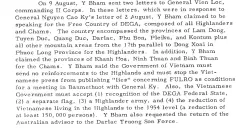
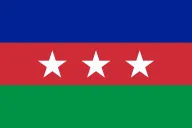
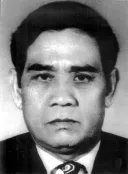
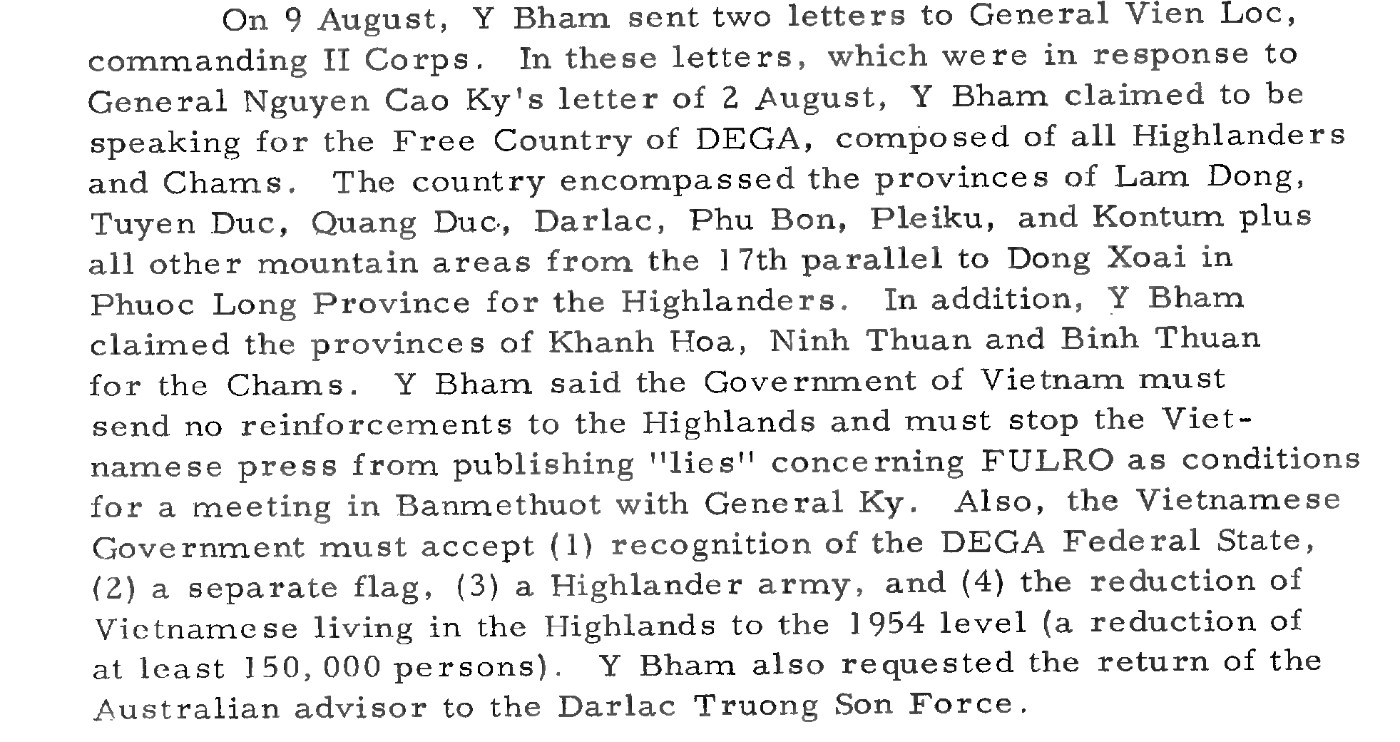
The earliest written use we have found is August 9, 1965. That day Y Bham Enuol, the president of FULRO, wrote two letters to the commander of II Corps in the name of “the Free Country of DEGA, composed of all Highlanders and Chams.” We know them from the summary the CIA made the next year, in The Highlanders of South Vietnam (June 1966). In those years FULRO was also known as the Movement for the Liberation of the DEGA-Chams. The word was a political program before it was anything else; see FULRO.
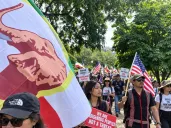
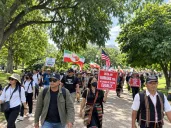
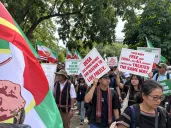
It came to America with the first refugees, who chose it over Montagnard because of the colonial associations of the French word. In 1987 the elders in Greensboro put it into the name of the first organization they founded, the Montagnard Dega Association. In September 2026 the Governor of North Carolina used it too, when he proclaimed Montagnard Dega People’s Day.
How the Vietnamese state uses it
In Vietnam the word is also an accusation. Human Rights Watch found in 2002 that “Dega” stood for three things: cultural pride, a particular evangelical Christianity, and the homeland the movement seeks. It also found that the authorities used the word as a derogatory term for rebels.
The state treats Tin Lành Dega, Dega Protestantism, as a political front rather than a religion. The Prime Minister’s Instruction No. 01/2005/CT-TTg of February 4, 2005, allowed worship only to groups with no connection to it. Radio Free Asia reported in 2024 that Vietnam uses “Degar” for Protestant Montagnards who worship outside the state-sanctioned churches. See The church they closed and The laws used against us.
Where to go next
- Who are the Dega: the names in the order they were put on us, and why the name is the argument
- Names and words: every name and term you will meet in the records, with their spellings
- The tribes and their languages: who the peoples are
- Montagnard Dega People’s Day: September 20
Sources
- Our own records — “the first,” “the original,” and Anak Cu Chiang
- Human Rights Watch, Repression of Montagnards (April 23, 2002), chapter II — anak ede gar; and chapter III — what “Dega” stands for and the authorities’ use of it
- Writenet for UNHCR, Vietnam: Situation of Indigenous Minority Groups in the Central Highlands (June 2006), PDF — “sons of the mountains,” from de ga
- Raleigh Bailey, The Montagnards: Their History and Culture (Center for Applied Linguistics, 2002), in our library — De and Ga, and the choice of the name in the United States
- Mike D. Benge, The History of the Involvement of the Montagnards… (December 2010) — Anàk Dega, Y-De and H-Ga
- Gerald C. Hickey, The Highland People of South Vietnam, RAND RM-5281 (1967), in our library — the Rhade meaning of Dega in the 1960s and FULRO’s names
- Central Intelligence Agency, The Highlanders of South Vietnam (June 1966), in our library — the letters of August 9, 1965
- Unrepresented Nations and Peoples Organization, Degar-Montagnards — membership 2003–2016
- UN Human Rights Committee, concluding observations on Viet Nam (July 2002), as cited on our Timeline; UN Committee on the Elimination of Racial Discrimination, concluding observations on Viet Nam, CERD/C/VNM/CO/10-14 (April 16, 2012) and CERD/C/VNM/CO/15-17 (December 27, 2023)
- Prime Minister’s Instruction No. 01/2005/CT-TTg (February 4, 2005), as on Names and words
- Radio Free Asia, Mike Firn, “EXPLAINED: Who are Vietnam’s Montagnards…” (September 2, 2024) — the state’s use of “Degar”
- Governor of North Carolina, Montagnard Dega People’s Day proclamation (signed September 8, 2026)
Compiled November 2026. The meaning of our name is given as each account gives it. A Rhade speaker who can settle it should write to us.