





















Almost every one of our prisoners of the last twenty-five years was convicted under a handful of articles of Vietnam’s Criminal Code. Most are national security offenses written so broadly that praying in an unregistered church, talking to a foreign diplomat, posting on Facebook or crossing the border can be made to fit them. This page sets out those articles in the law’s own words, what they carry, how they have been used against us, what the United Nations has said about them, and what the Ministry of Public Security proposed in 2026 to make them worse.

The two codes
Vietnam’s Criminal Code was adopted in 2015 and, after amendment in 2017, took effect on January 1, 2018. It replaced the Penal Code of 1999. The national security crimes moved from articles 78 to 92 of the old code to articles 108 to 122 of the new one, so the same offense appears under two numbers depending on the date of the case, and English translations differ: people’s administration, people’s government and people’s authority all render the same Vietnamese phrase. An English translation of the 2015 code is in our library.
The articles
| 2015 code | 1999 code | Offense, in the translation’s words | Penalty (2015 code) |
|---|---|---|---|
| Art. 116 | Art. 87 | Sabotaging the implementation of solidarity policies: “sowing divisions between the classes of people, between the people and people’s government”; “causing hostility, discrimination, secession, infringement upon equality rights among the ethnic communities of Vietnam”; “sowing division between religion followers and non-followers, between religions, between religion followers and people’s government” | 7 to 15 years; 2 to 7 in a less serious case; 6 to 36 months for preparation (1999: 5 to 15) |
| Art. 109 | Art. 79 | Establishing or joining “an organization that acts against the people’s government” | organizers 12 to 20 years, life or death; accomplices 5 to 12; preparation 1 to 5 |
| Art. 113 | Art. 84 | Terrorism to oppose the people’s government: infringing upon life “for the purpose of opposing the people’s government”; joining a terrorist organization; threats | 12 to 20 years, life or death; 10 to 15 for membership; 5 to 10 for threats; 1 to 5 for preparation |
| Art. 117 | Art. 88 | “Making, storing, spreading information, materials, items” with “distorted information about the people’s government” or “to cause psychological warfare” | 5 to 12 years; 10 to 20 in an extremely serious case; 1 to 5 for preparation |
| Art. 118 | Art. 89 | Disruption of security: inciting or gathering others “to disrupt security, resists law enforcement officers … obstruct the operation of agencies or organizations” | 5 to 15 years; accomplices 2 to 7 |
| Arts. 120 and 121 | Art. 91 | Organizing, coercing or instigating illegal emigration, and illegal emigration, “for the purpose of opposing the people’s government” | organizers 5 to 15 years, up to 20 or life; the person who leaves, 3 to 12 |
| Art. 331 | Art. 258 | “Abusing the freedom of speech, freedom of the press, freedom of religion, freedom of association, and other democratic freedoms to infringe upon the interests of the State” | warning, up to 3 years’ non-custodial reform, or 6 to 36 months; 2 to 7 years where there is “a negative impact on social security, order, or safety” |
Read Article 116 again. A pastor who tells his congregation that the state has taken their land has, in the state’s reading, sown division between religion followers and the people’s government. A man who says his people are treated differently has caused discrimination among the ethnic communities of Vietnam. The article criminalizes the description of the offense.
How they have been used
Undermining unity is the main charge. It is the article most often used against our church leaders and activists. More than 350 highlanders were sentenced on national security charges between 2001 and 2011, in Human Rights Watch’s count. In 2024 Y Krec Bya received thirteen years under it; in March and May 2025 courts in Gia Lai and Dak Lak sentenced Ro Cham Grong, Y Po Mlo and Y Thinh Nie to between seven and nine years “for ‘undermining the national great unity’ under article 116 of the penal code”; in October 2025 pastor Y Nuen Ayun was arrested under it. See The church they closed.
Fleeing is a crime. At least 65 highlanders were imprisoned between 2001 and 2011 for trying to reach asylum in Cambodia, under an article that requires the prosecutor to show an intent to oppose the government in a person whose only act was to walk across a border; see Asylum today.
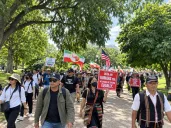
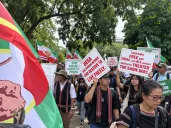
Protest. After the protests of 2001 and 2004, disrupting security was charged alongside undermining unity; see The 2001 protests and Easter Week 2004.
Terrorism. After the attacks of June 11, 2023 at Cư Kuin, in which nine people were killed, a single court sat for four days in January 2024 and convicted 100 people: “53 were convicted of ‘terrorism aimed at opposing the people’s government,’ and 45 were convicted of ‘terrorism’”; one of organizing illegal departures and one of concealing a crime. Ten were sentenced to life, the other ninety to between three and a half and twenty years; 93 of the hundred were from ethnic minorities. Fourteen United Nations experts said afterwards that “the mobile court lacked a clear legal basis and was not independent of political influence,” that “the mass prosecution did not guarantee individual rights to prepare a defence, to access and choose legal representation, and to examine and cross-examine witnesses,” and that “some detainees were subjected to torture and cruel, inhuman or degrading treatment or punishment in detention, including forced confessions.” They condemned “the discriminatory misuse of counter-terrorism law … against Montagnard Indigenous Peoples and Christian religious minorities.” On March 6, 2024 Vietnam designated Montagnards Stand for Justice a terrorist organization, and in November 2025 Thailand handed its founder back; see Cư Kuin, June 2023 and Y Quynh Buondap.
Church and diplomats. Article 331 is the catch-all. Human Rights Watch counted “at least 124 people” convicted under it between 2018 and February 2025. One of them is ours: Nay Y Blang, an Ede church member of Sông Hinh in Phú Yên, arrested on May 18, 2023 because, in the authorities’ own account, “he frequently used his private house for followers to gather, pray, and carry out online communion with key figures of the church,” and sentenced on January 26, 2024 to four years and six months. He had already served five and a half years under the old Article 87 from 2005. Named cases are on Our defenders and prisoners and The prisoner records.
What the United Nations has said
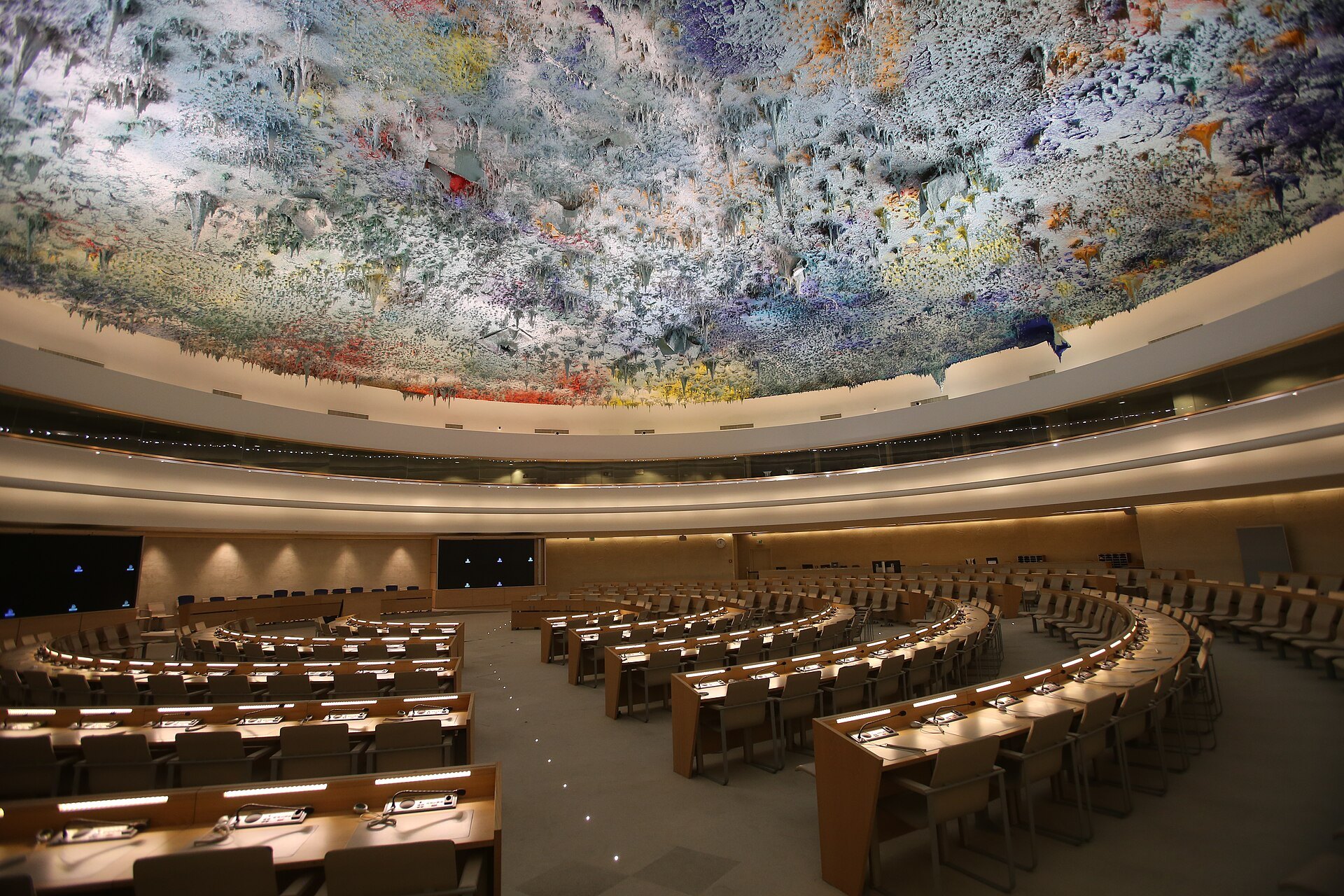

In 2019 the UN Human Rights Committee, reviewing Vietnam under the International Covenant on Civil and Political Rights, expressed concern at “severe restrictions on freedom of opinion and expression in the State party,” at the “vague and broadly formulated offences in articles 109, 116, 117 and 331” of the Criminal Code, and at the “definition of certain crimes related to national security to encompass legitimate activities.” It told Vietnam to “take all necessary steps, including revising legislation, to end violations” of the right to expression. On religion it found that members of unregistered communities “are forced to renounce their faith, pressured to join a competing sect” and “subject to physical assaults, which sometimes leads to death,” and told Vietnam to “bring its legislation into conformity with article 18 of the Covenant.” On us it noted that “the State party does not recognize the indigenous peoples in Viet Nam.” The full text is in our library; see also The UN record.
In 2014 the Special Rapporteur on freedom of religion had already said of the old Article 258: “The wide and vague formulation in Article 258 gives the relevant authorities a carte blanche to sanction people for all sorts of activities.” The article was renumbered 331 and left as it was.
What is coming
In August 2026 the Ministry of Public Security sent the National Assembly a revised code for its session of August 3 to 24, with adoption expected after October 20. Human Rights Watch reported that Article 117, which prohibits material that aims “to oppose the State of the Socialist Republic of Vietnam,” “has been amended to broadly prohibit acts that ‘aim to oppose the Communist Party of Vietnam’”; that the minimum sentence under Article 331’s aggravated clause would rise from two years to three; and that a new offense against the Party flag would carry up to three years. “Vietnam’s criminal laws need to be revised to become more protective of people’s rights,” HRW’s Asia director said, “not to facilitate greater abuse by the police.”
See also: The Law on Belief and Religion, What Vietnam signed, Land law and customary land.
Sources
- Criminal Code of Vietnam, Law No. 100/2015/QH13, English translation, DCHO library (as hosted by policinglaw.info); Penal Code of 1999, English translation (International Commission of Jurists)
- Human Rights Watch, “Vietnam: Reject Repressive Penal Code Revisions” (August 10, 2026); “We’ll All Be Arrested Soon” (April 21, 2025); Montagnard Christians in Vietnam (2011), DCHO library; World Report 2026
- UN Human Rights Committee, concluding observations on Viet Nam, CCPR/C/VNM/CO/3 (2019), DCHO library
- OHCHR, “Experts condemn misuse of counter-terrorism law against Montagnards in Viet Nam” (August 28, 2024); summary of the CERD dialogue (November 2023); Heiner Bielefeldt, press statement (July 31, 2014)
- Radio Free Asia, “10 defendants given life sentences for Dak Lak attacks” (January 22, 2024); USCIRF, victims database: Nay Y Blang
Compiled September 2026. This is not legal advice. If someone in your family has been arrested, see If a family member is detained.