



A Jarai from Bon Broai who joined BAJARAKA at fourteen, went over the border at seventeen, came home from a war by way of a Khmer Republic training course in Virginia, and spent the second half of his life in a small city in South Carolina making our case in rooms where states have to listen. For thirty years Kok Ksor was the Dega most foreign governments had heard of and the one Vietnam most often named. In July 2004 the Economic and Social Council of the United Nations voted on whether an organization should be punished for letting him into the building, and decided by two votes that it should not.
Bon Broai
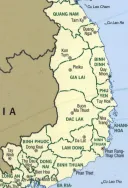
He was born in the Jarai village of Bon Broai, in the Cheo Reo district of what is now Gia Lai. Joe P. Dunn, who had the family’s cooperation for his biographical study, puts it in one line: Ksor, a member of the Jarai tribe, was born in 1944 in Bon Broai village, Cheo Reo district. The obituary published in the Spartanburg Herald-Journal gives the date as February 26, 1944.
The year 1945 is printed nearly as often — in the encyclopedias, and in the memorial notice written after his death by his own political allies in Rome. He dealt with it himself, in writing, in February 2004, answering a list of allegations Vietnam had published about him:
“These statements are all incorrect. I was actually born in 1944 and I never joined FULRO in 1969 but instead I joined FULRO in 1964. I also never proclaimed the establishment of independent Degar state in 1999.”
Three of the four contested facts of his life, in his own voice, in three sentences.
His mother was Ksor H’Ble, and she will come back at the end of this page. Of his father we have found nothing at all; Dunn’s study, written with the family’s help, gives only the barest details. We would rather record the silence than fill it.
He was at secondary school in Buon Ma Thuot in 1958, the year the highland teachers and civil servants formed BAJARAKA and marched in Kon Tum, Pleiku and Buon Ma Thuot, and the year the leaders were jailed for it. Dunn says he joined the movement as a boy. He does not say Kok Ksor was among those arrested, and neither do we.
One thing does not fit, and we leave it showing. Dunn’s narrative opens with combat beginning in 1961 at age fourteen, and a museum notice summarizing his lecture says the boy left school at fourteen to become a full-time soldier. A boy born in February 1944 was seventeen in 1961. Either the age or the year is wrong somewhere in the retelling, and we have not been able to settle which.
Over the border
In 1961 he left his studies in Buon Ma Thuot and went with an uncle into Cambodia. In 1964 he joined FULRO, in the year of the revolt.
What he did for it was the most dangerous ordinary work there was. Dunn: dispatched as FULRO’s representative in his native Cheo Reo–Pleiku region, he survived Viet Cong attacks several times as he traveled into Vietnam carrying FULRO messages. That is a young man walking back and forth across a front line with paper on him, for years.
He also fought. He served first as an interpreter and then in several combat roles with American units, among them the 4th Infantry Division at Pleiku and the 5th Special Forces Group. During Tet 1968 he was captured by North Vietnamese troops in a firefight defending H’li’s village near Buon Ma Thuot; some of his comrades were executed on the spot and he was held as a prisoner for several months. He was wounded, and he received the Purple Heart. That comes from his family, who gave it to his biographer and to the funeral home, and a family knows which of its men came home wounded and what he was given for it. The citation and the service record are in American files we have not been able to pull; if a relative holds a copy, we will add the unit and the date.
H’li
She was Rhade, and the sister of the Protestant minister Y Ham Nie Hrah — very probably the pastor from Buon Ma Thuot recorded on The men of FULRO as having died in prison in the early 1980s. They had met at school in Buon Ma Thuot, before he left.
When she turned eighteen she went to find him. Dunn:
“With the help of numerous guides along the way, she and two other young women who had boyfriends in Cambodia set out on the perilous trip.”
“Arriving on an elephant, H’li found Kok in a secret FULRO camp deep in the jungle in the northeastern part of the country. The couple married the next day.”
Three schoolgirls walked to Cambodia because their young men were there. She came into the camp on an elephant, married him the day after she arrived, and he left again at once for his recruiting work. See Highland women in the war.
In April 1975 it was she who got the children out. Through the evangelical relief organization World Vision the family was taken from Phnom Penh to Thailand before the city fell, with three small sons. She outlived him by some years. The obituary names her H’li Ksor.
Chief of staff, and the accident of April 1975
After Lon Nol’s coup in 1970 Kok Ksor and several other highlanders took commissions in the Cambodian army. Between 1971 and 1975 Lon Nol sent him three times to the United States for military training, including to the American intelligence officers’ school in Okinawa and to transportation officer training at Fort Eustis, Virginia. In 1974 Y Bham Enuol, by then under house arrest in Phnom Penh, appointed him FULRO’s chief of staff.
And then the hinge. When the Khmer Rouge entered Phnom Penh in April 1975, Kok Ksor and another highland officer of the Cambodian army were in the United States on the last of those courses. The men who were in the city — Y Bham Enuol, Kpa Doh, the families who had taken refuge in the French embassy compound — were killed. See Y Bham Enuol in Phnom Penh.
His foundation later told the story differently. Its own account of itself says he was sent to the United States by the founder and leader of FULRO, General Y Bham Enuol, to secure international assistance for the Degar people. We give both and we say which is better evidenced: Dunn’s version is dated, circumstantial and checkable — a named army, named schools, three courses across four years — and the foundation’s is a claim of mandate. They do not agree, and we do not pretend they do.
One more silence worth marking. We have looked for any record placing Kok Ksor at Camp le Rolland, or in any dealing with Les Kosem, and found none. The seizure of the camp on December 30, 1968 and Y Bham Enuol’s house arrest are set out on FULRO; that is the world his 1970 Cambodian commission sits inside. It is not evidence that he was in it.
Charleston, then Spartanburg
The family came to the United States under the care of a Baptist church in Charleston, South Carolina. He took a high-school equivalency diploma and then an associate degree in electrical engineering technology at Trident Technical College in Charleston. He worked in technology for the textile company Milliken & Company and afterwards for another engineering firm until he retired in 1998. He held American citizenship by 1986, though we have found no date for it.
In 1988 the daughter of the family’s original Charleston sponsor brought them to Spartanburg, where she and her husband lived, and there the Ksors stayed. He was ordained, pastored highland congregations in North Carolina, and belonged to Covenant Baptist Church in Spartanburg. Of the four sons, two became information technology specialists and two became physicians in joint practice.
There were seven grandchildren, and the obituary names them: Hannah, Hayleigh, Mary H’li, Y’Kok Bajaraka, Caroline Neihrahla, Y’Yohan Toeh, Rebecca. A child born in South Carolina in this century carries the name of a movement founded in the highlands in 1958.
A note on his name. The obituary, the funeral home and the local paper all give Y’Kok Ksor. The foundation, UNPO and the United Nations records give Kok Ksor or Ksor Kok. This library writes Dega names plainly, so Kok Ksor it is.
What the foundation actually was
He founded it in 1990. The Internal Revenue Service granted it exemption in August 1992, and the file is straightforward.
| Legal name | The Degar Foundation Inc |
|---|---|
| Public name | Montagnard Foundation, Inc. (MFI) |
| Employer identification number | 57-0925222 |
| Place | Spartanburg, South Carolina |
| Exemption granted | August 1992, under section 501(c)(3) |
| Address in 2008 | P.O. Box 171114, Spartanburg, SC 29301 |
| Returns on record | Form 990-EZ for the tax years 2004, 2006, 2007, 2008 and 2010 |
| Last return | Tax year ending December 2010 |
The 990-EZ is the short return, filed by organizations small enough not to need the long one. Five filings in twenty-eight years, none of them carrying extracted financial figures, and nothing at all after 2010. The published contact address was a post-office box and the published e-mail address was the president’s own. No officer list has ever been published; the foundation’s own account of itself names one person.
That is the honest shape of the story. The organization that stood in front of the Economic and Social Council of the United Nations, that had a motion tabled about it in the Italian Chamber of Deputies, and whose report was circulated in the European Parliament, was in practical terms one man, a mailing list and a fax machine. He signed as President in 1993, in 2004 and in 2008, and as Executive Director in 2010.
Two things said about the foundation should be left where they were found. A report commissioned by UNHCR in 2006 calls it a South Carolina organization founded in 1993; the tax exemption of August 1992 makes that impossible. And an encyclopedia article describes it as having begun as a registered student organization at the University of Chicago; we can find nothing whatever behind that. See Our organizations.
Geneva, July 1993
The first document our people ever put before the United Nations in our own name was placed there that summer. The Center for World Indigenous Studies holds it in its Fourth World Documentation Project: Human Rights Violations — The People of the Dega Republic, by our own organization under the name it used then, presented to the United Nations workshop on the rights of indigenous peoples in 1993, with the author recorded as Ksor-Kok. It covers, in the archive’s own summary, policies, administration, livelihood, education, health, justice and law.
The Center also keeps the text in plain form, as the supplemental materials presented at the session of July 19 to 30, 1993, on the Montagnard Foundation’s letterhead and signed first by Kok Ksor as its president, with two of our own leaders. Among much else it names seventy of our people killed in Gia Lai and Kon Tum on May 24, 1975. See What the United Nations has said.
One detail in those three signatures is worth pausing on. The two who signed beside Kok Ksor would later lead our own organization. The first Dega document at the United Nations was signed by people from two organizations that would soon go separate ways.
How a Jarai from Cheo Reo got a hearing in Rome
In 2000, at a United Nations indigenous forum in New York, he met two Italians — Marco Perduca and Matteo Mecacci — and through them Marco Pannella. He joined the General Council of the Transnational Radical Party, and for the next fifteen years the Italian Radicals were the vehicle that carried him into European institutions. Nothing else in his life produced as much documentation.
- April 6, 2002, Geneva — he spoke at the 38th Congress of the Transnational Radical Party, held at the international conference center on the rue de Varembé. Radio Radicale recorded it and still holds the tape.
- October 9, 2002, Rome — he gave evidence to the standing human rights committee of the third commission of the Chamber of Deputies. From the stenographic record: “Attualmente, nel mio paese, l’altopiano centrale del Vietnam, è in vigore la legge marziale. Migliaia di soldati governativi pattugliano il nostro territorio, perseguitando gli abitanti dei villaggi perché sono cristiani…” — at present, in my country, the central highlands of Vietnam, martial law is in force; thousands of government soldiers patrol our territory, persecuting the inhabitants of the villages because they are Christians. He asked Italy to end European assistance to Vietnam or to make it strictly conditional.
- July 6, 2003 — Radio Montagnard went on the air, short-wave into the Central Highlands, financed and managed with Radio Radicale after an Italian tour in which several dozen members of parliament signed a motion on the persecution of our people. It was the most concrete thing anybody abroad ever did to reach the villages, and it is also the most concrete fact behind the charge that the highlands were being organized from outside. Both of those are true at once.
- November 4, 2003, Rome — a press conference with Marco Pannella on the parliamentary motion.
- November 14, 2003 — the Degar-Montagnards, represented by the foundation, were admitted to the Unrepresented Nations and Peoples Organization. The membership ran until April 29, 2016.
- March 30, 2004, Geneva — he addressed the 60th session of the Commission on Human Rights under item 10, on behalf of the Transnational Radical Party.
- June 29, 2004, Latronico — a meeting in Basilicata with Pannella and the local authorities, also on tape.
- July 22, 2004, Rome — the chair of the Italian committee closed a later sitting with the remark that the testimony of Kok Ksor, leader of the Montagnards, “ci ha aperto ancora di più gli occhi su una realtà che, molto spesso, è stata tenuta in secondo piano” — opened our eyes further to a reality that has very often been kept in the background.
- May 2008, Brussels — the foundation’s report Vietnam’s Blueprint for Ethnic Cleansing, on its own letterhead with the Spartanburg post-office box, was circulated as a meeting document of the European Parliament’s human rights subcommittee, where it remains.
- November 19, 2009, Rome — he appeared again before the Italian committee, chaired that day by Furio Colombo, alongside Vanida Thephsouvanh of the Lao Movement for Human Rights.
- December 14, 2010, Geneva — he spoke to the third session of the United Nations Forum on Minority Issues. The full text is on the OHCHR server, and it is the best primary document of his voice that anyone can read today.
- February 20, 2012 — a statement to the 80th session of the Committee on the Elimination of Racial Discrimination, which was reviewing Vietnam.
What he said in Geneva in March 2004 opened like this:
“Thank you Mr. Chairman. My name is Kok Ksor and I am honored to speak today on behalf of the Transnational Radical Party, also as a member of it’s General Council.”
“I was born in Vietnam’s central highlands, a region of the world that is home to one of the oldest races of indigenous people in South East Asia.”
and closed like this:
“The Montagnards inside the Central Highlands, today know that the Transnational Radical Party is speaking about them at the Commission on Human Rights and await a word of hope.”
The slips of grammar are in the published text and we leave them there. He was speaking his fourth or fifth language in a room that does not forgive.
Six years later, at the Forum on Minority Issues, he had stopped talking about rooms and started talking about fields:
“When the current government took power in 1975 we found our ancestral farmlands confiscated and conferred upon new incoming migrants and corporations. We then found ourselves forcibly relocated to infertile areas.”
“Our traditional farming practices, called swidden farming which we have used in a sustainable manner for centuries was deemed not acceptable to the new government… In addition our communal land ownership system was not recognised by authorities and therefore easily confiscated.”
“On the most basic level, poverty, hunger and malnutrition prevents our children from attending school.”
“We have tried to use domestic channels to voice our concerns and grievances, but we are regularly silenced, allegedly for national security reasons.”
“Thank you and God bless.”
Land, language, literacy, communal tenure. In the whole of that statement there is not one word about independence. See Land law and customary land.
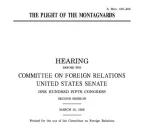
And here is a fact about the shape of his influence that is worth more than any characterization of him: we can find no testimony by Kok Ksor before the Congress of the United States. Not once. When the Senate Foreign Relations Committee held a hearing called The Plight of the Montagnards in March 1998, the highland witnesses were Rong Nay and Y Hin Nie, and the Montagnard Foundation filed no statement. At every later hearing we can locate, the witness is from another organization. He was heard in Geneva, in Rome and in Brussels. He was not heard on Capitol Hill.
February 2001
Thousands of people came down into the towns of Gia Lai and Dak Lak in the first days of February 2001, over land and over churches. What happened is on The 2001 protests. What belongs here is his part in it, and it has to be told from both directions, because both are on the record.
Vietnam said he organized it. Human Rights Watch records that former FULRO members led by him were among those the Party accused of organizing the demonstrations, and a Time reporter in April 2001 was shown documents seized in Gia Lai that officials attributed to him, calling for a general uprising and an autonomous highland state.
What Human Rights Watch itself found, after its own interviews and its own documents, was this:
“When the U.S.-based Montagnard Foundation, Inc. (MFI), led by Jarai-American Kok Ksor, launched a renewed effort to build support for an independent ‘Dega’ homeland in 2000, it found an extremely receptive audience. While many MFI members, and highlanders in general, are former FULRO supporters, there is no indication that there was any armed component to MFI’s efforts and, to Human Right[s] Watch’s knowledge, MFI has never advocated the use of violence as a means of achieving independence.”
“According to documents obtained by Human Rights Watch and interviews conducted with MFI members, the political platform propagated by a handful of MFI organizers in the Central Highlands in 2000 and 2001 was threefold: independence, non-violence, and redress of longstanding grievances. MFI sought the return through peaceful struggle of ‘their country,’ currently under Vietnamese control, with Kok Ksor as the leader.”
Both halves of that are findings. He was not running an armed movement and nobody serious has ever said he was. He was running a campaign for independence inside the highlands, by peaceful means, with himself named as the leader. Anyone who quotes the first half without the second is not quoting Human Rights Watch.
The assessment commissioned by UNHCR in 2006 went further into what the villagers themselves thought they were doing, and its sentence is the fairest description of the whole affair that any outside body produced:
“many, if not most, of the people who attended the February 2001 demonstrations were villagers who appeared to have little knowledge of MFI aims but responded positively to MFI’s call for demonstrations… Interviews with some of these participants suggested that they saw MFI’s advocacy of independence as equivalent to ‘getting our land back’ in both the immediate sense of recovering family homesteads and land lost in recent decades to government plantations.”
People walked into town for their fields. A word came down from South Carolina that gave the walk a name.
Easter 2004
Over the weekend of April 10 and 11, 2004, thousands gathered again, in thirty-nine communes across seventeen districts of Gia Lai, Dak Nong and Dak Lak. Human Rights Watch put the total at about thirty thousand people and recorded as many as ten demonstrators killed. The competing figures are set out on Easter week 2004 and this page will not re-argue them.
What this page has to carry is what he did with them. On April 15 the foundation published its own report: 44,049 participants in Gia Lai, 87,610 in Dak Lak, 131,659 documented, perhaps two hundred thousand in all — and approximately four hundred Dega killed on April 10, on eyewitness accounts, with bodies described as loaded onto trucks.
Four days later he published an article under his own name. It is the best short statement of his case that he ever wrote:
“For our people – the Montagnards – the Vietnam War did not end in 1975. The war continues today in a somewhat different manner, but it just as savage.”
“I warned my people not to demonstrate knowing how the police would react.”
“Their desperation prevailed and they decided to worship Christ in public. They told me that they cannot wait ‘because they are killing us now.’”
“I urged them to pray peacefully in the spirit of Christianity and to use the non-violence principals proposed by Gandhi.”
“I must say also that our people have no word for independence in our language. We do however, have a word for freedom. And it is only basic freedoms that we want.”
Two months later a reporter from Time found him in a Red Lobster restaurant in Spartanburg and wrote that he hardly appeared fearsome. The article records that he admitted having been in contact with highlanders, that the organizers had told him they meant to demonstrate nonviolently and had rejected his advice to wait until the fall, that he had suggested they call it a prayer vigil rather than a protest, and that international attention rather than an independent state was the goal. And then this:
“However, he didn’t help his cause by claiming later that 400 people were ‘massacred’ over the Easter weekend.”
“This wild estimate was a gambit, he says, to force Hanoi to open the region to external observers.”
That is the most serious thing in his record and it is not an allegation by an enemy. It is what he told a reporter, within weeks, about a number his own organization had published over the bodies of our own dead. The figure that can be stood behind is Human Rights Watch’s: as many as ten killed, which is a floor arrived at by investigation and not a ceiling. A people who cannot count its dead is the subject of another page on this site. A leader who inflates the count because it may be useful makes counting harder for everyone who comes after.
There was a price, and his family paid it. On May 26, 2004, five of his relatives, his mother among them, were made to speak at a gathering in his own village, where a local official said they had confessed to being directed by him to attend the demonstrations and to incite others.
“A terrorist, Kok Ksor”
Vietnam never published a formal terrorist designation of the Montagnard Foundation. What it did instead was to go to the United Nations and try to have punished the organization that had let him into the room.
The complaint was that the Transnational Radical Party had accredited him, as president of the Montagnard Foundation, to the fifty-eighth session of the Commission on Human Rights in 2002. It went first to the Committee on Non-Governmental Organizations, which meets in New York and decides which organizations may hold consultative status with the United Nations.
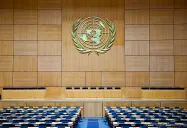
May 21, 2004. Viet Nam’s representative told the Committee that the week before he had presented undeniable evidence that Kok Ksor was a terrorist and that his organization Montagnard Foundation Inc. was engaging in terrorist activities. Germany answered that the Committee was not a forum to label individuals terrorists, and that the person in question was not listed as such by the United Nations or the European Union. The Committee voted nine in favor, eight against, two abstaining, and recommended the maximum penalty: suspension of the Radical Party’s consultative status for three years.
| For suspension | Against suspension |
|---|---|
| Sudan, Zimbabwe, China, Côte d’Ivoire, Cuba, India, Iran, Pakistan, Russian Federation | Turkey, United States, Cameroon, Chile, France, Germany, Peru, Romania |
July 23, 2004. The recommendation went up to the Economic and Social Council, where fifty-four states sit. Viet Nam put it in these words:
“The Committee on NGOs had decided to suspend for three years the consultative status of TRP because it had abused its status by admitting to its ranks a terrorist, Kok Ksor, and his subversive organization, the Montagnard Foundation, Inc. (MFI)…”
The Netherlands answered for the European Union:
“Neither Mr. Ksor nor the Montagnard Foundation appeared on any United Nations or European Union list of terrorist individuals and associations.”
“There was no reliable evidence to substantiate the claim that Mr. Ksor was a terrorist, and on no occasion had the Party attempted to undermine the sovereignty or territorial integrity of Viet Nam.”
The United States said the comments made by Viet Nam should be taken seriously, but that terrorist action should be taken up in another forum, and that the Security Council had not characterized the Radical Party as such an organization.
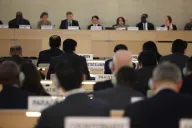
The Council rejected the suspension by recorded vote: twenty in favor, twenty-two against, eleven abstaining. Two votes.
That is where the matter rests. Vietnam has called him a terrorist, in those words, on the record of a principal organ of the United Nations, and the organ declined to act on it. When Vietnam did begin publishing formal terrorist designations of highland organizations abroad — on March 6, 2024, naming two highland organizations abroad over the attack in Dak Lak in June 2023 — the Montagnard Foundation was not among them. See Dak Lak, June 2023.
What was said against him, including by us
He was not a man our community agreed about, and a library that says otherwise is not a library.
On the protests. Two of his own statements sit against each other. Human Rights Watch found his organizers carrying a platform of independence, non-violence and redress through highland villages in 2000 and 2001, with him named as leader. He wrote in April 2004 that he had warned his people not to demonstrate. Both are documented. The reader can hold both.
On independence. He denied in February 2004 that he had ever proclaimed a Dega state, and said in April 2004 that our languages have no word for independence and do have a word for freedom. Human Rights Watch had already found that independence was on the platform his organizers carried in 2000 and 2001. By December 2010 he was asking the United Nations for land, language and schools. Whether that is a change of mind, a change of tactics, or a distinction between proclaiming a state and campaigning for one is for the reader to decide; the dates are above.
On the name. Mike Benge — an American, a former aid officer, five years a prisoner of the North Vietnamese, not one of us — wrote in 2010 that Kok Ksor “bastardized this Rhadé term Dega and refers to all hillstribes people as Degar,” so that many people who know no better now call all Montagnards Degar. This library uses Dega as its own word, and we print the criticism rather than hide from it. See Who are Dega.
Among ourselves. Even his sympathetic biographer records the quarrel and then stops: church politics, clashes between strong personalities, congregations splitting over persons rather than doctrine, and a note that there was conflict between Kok Ksor and some other highland pastors. No critic is named and no criticism is described, in his study or anywhere else we could reach.
What can be shown is the shape of the split, by roll call. In March 1998 the Montagnard Foundation’s own assistant director was one of the highland witnesses before the Senate Foreign Relations Committee. By the end of that year he was leading our own organization, founded that year in Raleigh, North Carolina. From then on, at every Congressional hearing we can find, the highland witness comes from our organization or from the Montagnard Dega Association, and never from the Montagnard Foundation. Three separate registered bodies, three separate tax numbers, three separate cities. We record that without imputing motive to anyone; the men involved are living and can speak for themselves. See Our organizations.
And one line of his own, from the February 2004 reply, which is the best sentence he ever wrote and is also an answer to the charge that Dega Protestantism was a political front:
“Our religion is not restricted to ethnic minority people and we state any decent human being may visit and worship with us.”
“we only refuse to worship Ho Chi Minh as a god.”
Ksor H’Ble
His mother stayed in Bon Broai, and the work he did in Geneva was paid for in the village.
After the protests of February 2001 she was arrested, and three of her ribs were fractured. She was put in front of a television camera and told to denounce her son, and she would not. In 2004, after another prayer vigil was broken up, she was arrested again, given electric shocks and beaten; witnesses said security forces threatened her life in a paddy field until her other sons came. In October 2010 officials asked her once more to condemn him on video, and she answered with a question:
“How can I tell people not to follow him?”
She died in her sleep on August 18, 2011, aged eighty, of heart failure that those around her attributed to what had been done to her over ten years. An estimated sixteen thousand Dega Christians came to the funeral, past the roadblocks.
Her son could not come. He had last seen her in the mid-1960s.
Both accounts of her come from the family, which is where an account of Ksor H’Ble ought to come from; nobody outside that house was in the room when the camera was set up. We name the provenance so that a reader knows whose telling it is, not because it needs an excuse. A woman of seventy who was told to disown her child on television, and would not, is a matter of record in the only place such a thing is ever recorded.
The last years
Through the Radical Party he came to know Sam Rainsy, and in April 2013 the two signed an agreement in the United States on Degar indigenous rights in Cambodia — taking the language of the UN Declaration on the Rights of Indigenous Peoples but putting “autonomy” where the Declaration says “self-determination.” Five years later the Cambodian Justice Ministry said the document might amount to treason under article 440 of the criminal code, which carries life imprisonment, and Rainsy answered that nobody was talking about independence and there was no question of a separate state. The agreement was reaffirmed in North Carolina in the autumn of 2018. See Vietnam and UNDRIP.
In February 2014 he met Marco Pannella for the last time, at a European Parliament convention in Brussels on the rule of law against reason of state. In December 2017 he received the Radical Party’s representative to the United Nations at his home in Spartanburg. Those are the last two public appearances we can date.
January 2019
He died on Wednesday, January 9, 2019, in Spartanburg, of liver cancer, aged seventy-four. The visitation was on the Saturday at Floyd’s Greenlawn Chapel on East Main Street; the funeral on the Sunday afternoon at Covenant Baptist Church on Evangel Road, conducted by the Reverend Gary Hensley and the Reverend Skip Purdy; the burial at Greenlawn Memorial Gardens. The obituary describes him as a member of the Jarai, a Vietnam War veteran with United States Army Special Forces, a Purple Heart recipient, president of the Degar Foundation, Inc., and an ordained pastor.
The day after he died, Radio Radicale in Rome cleared three hours and seventeen minutes of its schedule and built a program out of its own recordings of him: Geneva in April 2002, the Chamber of Deputies in October 2002, the press conference with Pannella in November 2003, Latronico in June 2004. A Jarai from Bon Broai, on Italian radio, for a whole afternoon.
The foundation did not survive him in any working sense. His biographer records that the family tried to keep it going and that it is largely moribund, supplanted by other organizations; the tax record shows the last return filed for 2010. No successor has ever been named. The work passed to the younger organizations, and to the people the state names now. See The years between and Human rights defenders.
Sources
- Joe P. Dunn, “Kok Kosor and the Struggle for Cultural Survival, Human Rights, and Religious Freedom for the Montagnards of the Central Highlands,” Athens Journal of History 10, no. 1 (2024), 9–26 — the biographical spine of this page: Bon Broai, BAJARAKA, the crossing of 1961, the messenger’s war, Tet 1968, H’li’s journey, the Cambodian commissions and the three American courses, the 1974 appointment, Charleston and Spartanburg, and Ksor H’Ble. Written with the family’s cooperation, which is its strength and its limit
- United Nations press release NGO/538, Committee on Non-Governmental Organizations, May 21, 2004 — Viet Nam’s statement, Germany’s answer, and the vote of 9–8–2 with the delegations named
- United Nations press release ECOSOC/6136, Economic and Social Council, July 23, 2004 — “a terrorist, Kok Ksor, and his subversive organization”; the European Union and United States replies; the recorded vote of 20–22–11
- Human Rights Watch, Repression of Montagnards: Conflicts over Land and Religion in Vietnam’s Central Highlands, April 2002, pp. 8–10 — the two paragraphs on the Montagnard Foundation quoted in full above, and the definition of Tin Lanh Dega
- Writenet for UNHCR, Vietnam: Situation of Indigenous Minority Groups in the Central Highlands, June 2006, pp. 5–7 — the recruitment from 2000, what the villagers understood by independence, and the Easter 2004 figures. Its statement that the foundation was founded in 1993 is contradicted by the tax record
- Phil Zabriskie, “Vietnam’s Tribal Injustice,” Time Asia, July 18, 2004 — the Red Lobster in Spartanburg, the prayer vigil, and the four hundred dead described as a gambit. Verified against the published article
- Kay Johnson, “Brewing Discord,” Time, April 2, 2001 — the documents seized in Gia Lai and attributed to him
- Kok Ksor, reply to the Vietnamese government, February 25, 2004 — the birth year, FULRO in 1964, the denial about 1999, and “we only refuse to worship Ho Chi Minh as a god”
- Kok Ksor, statement to the Commission on Human Rights, 60th session, March 30, 2004
- Montagnard Foundation, report on the Easter demonstration, April 15, 2004 — the participation figures and the claim of four hundred killed
- Kok Ksor, “Montagnards: The Forgotten Allies,” April 19, 2004
- Kok Ksor, statement to the third session of the UN Forum on Minority Issues, Geneva, December 14, 2010 — the fullest text of his own voice that is freely readable
- Montagnard Foundation, Vietnam’s Blueprint for Ethnic Cleansing, May 2008, circulated to the European Parliament’s Subcommittee on Human Rights — the foundation’s own figures, which we report as the foundation’s
- Camera dei Deputati, III Commissione, Comitato permanente sui diritti umani — October 9, 2002, July 22, 2004, and November 19, 2009 — the stenographic records of his appearances in Rome
- Radio Radicale — the recordings of Geneva (April 6, 2002), the Pannella press conference (November 4, 2003) and Latronico (June 29, 2004), and the three-hour program of January 10, 2019
- Center for World Indigenous Studies, Fourth World Documentation Project, Human Rights Violations — The People of the Dega Republic, 1993, item 280dp00176 — catalogued and located; the scan has no readable text and we have not read the body
- UNPO, Degar-Montagnards member page (membership November 14, 2003 to April 29, 2016), and “Degar-Montagnards: A Mother’s Silent Pain,” September 14, 2011, credited to the Montagnard Foundation — the account of Ksor H’Ble
- United States Senate, Committee on Foreign Relations, The Plight of the Montagnards, S. Hrg. 105-465, March 10, 1998 — the witnesses were Rong Nay and Y Hin Nie
- ProPublica Nonprofit Explorer, The Degar Foundation Inc, EIN 57-0925222 — the exemption of August 1992, the Spartanburg address, and the five Form 990-EZ filings ending with the 2010 tax year
- Mike D. Benge, The History of the Involvement of the Montagnards of the Central Highlands in the Vietnam War, December 2010 — the criticism of the name
- Niem Chheng, “Rainsy’s vow of ‘autonomy’ for ethnic group sets off treason probe,” Phnom Penh Post, March 8, 2018
- Radio Free Asia, on the designations of March 6, 2024 — which do not include the Montagnard Foundation
- J. F. Floyd Mortuary, obituary of Y’Kok Ksor, and the Spartanburg Herald-Journal, January 11, 2019; Matteo Angioli, “In memory of Kok Ksor”
Compiled September 2026. We hold no photograph of Kok Ksor that we are free to publish. Photographs of him exist in family hands, in a South Carolina museum’s files and in Radio Radicale’s video archive; if his family, the foundation or any of those holders would permit one to be used here, please get in touch. One thing in this account rests on a source we could not open and is marked where it occurs: the body of the 1993 Geneva submission. Where his own account and an outside finding conflict, both are given. Vietnamese government and Vietnamese state media sources are not used on this site, and the Vietnamese positions quoted here are taken from United Nations records and from non-Vietnamese reporting.