






















Among the Jarai a person is not finished dying at the funeral. The marriage is not dissolved, the widow is still a wife, and adultery against a dead husband is still adultery. The grave is visited every day and offered to every month, for as long as it takes — and how long it takes is not set by custom. It is set by what the family can afford. Only the pơthi, the abandonment of the tomb, finishes the death; and the recognized excuse for not waiting that long is poverty.
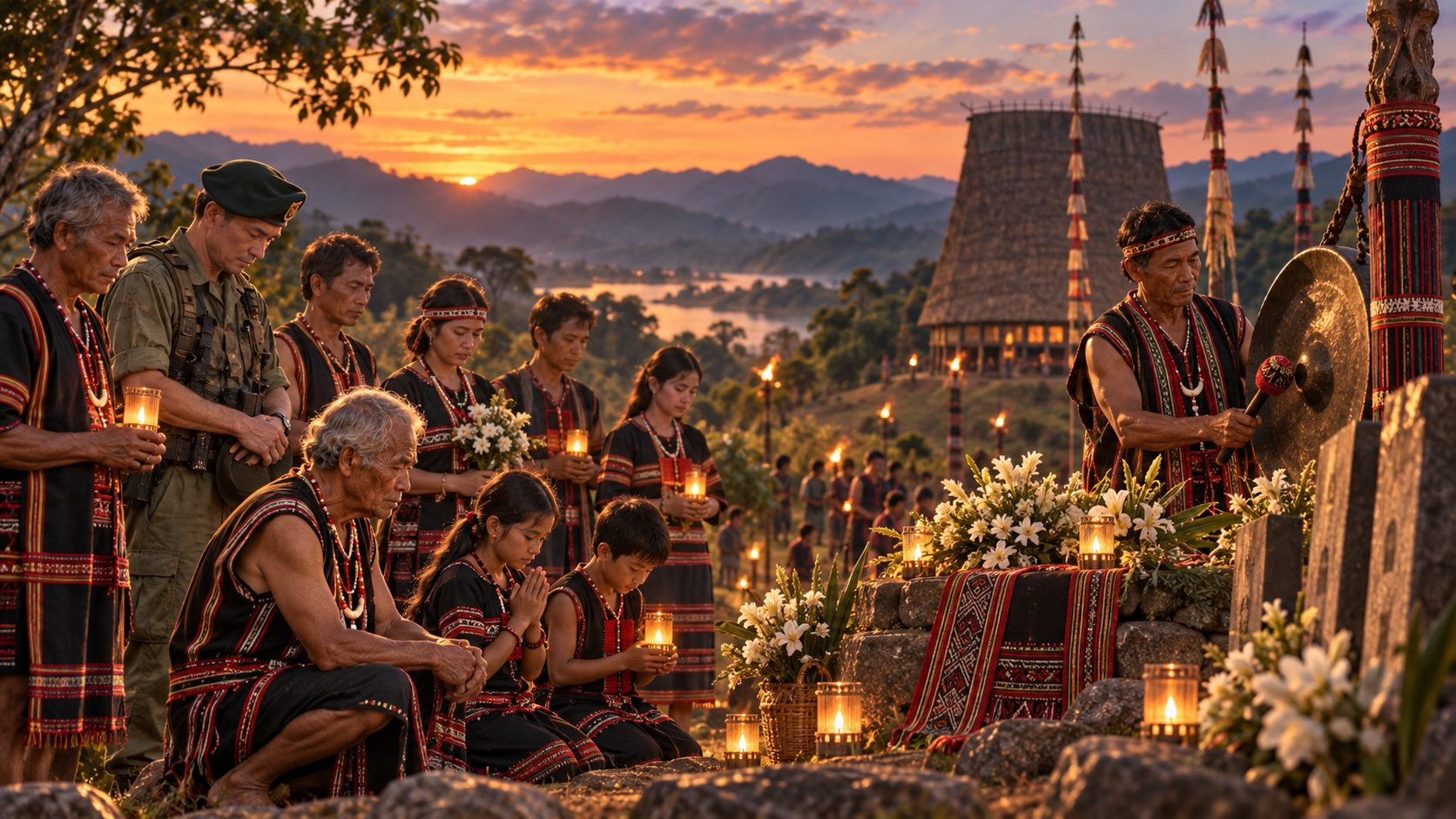
Death is not final
The plainest statement of it was written down in 1966 by the survey team that produced the US Army’s handbook on us, prepared so that American personnel could work in our country during the war, and drawing on the French résident of Kon Tum’s customary-law collection. It is a foreign army reading a colonial administrator reading our law, two removes from anyone who ever held a pơthi. It is also the clearest thing on paper, and we would rather have a Jarai family’s own account of the same rule:
“Death itself does not dissolve a marriage, for death to the Jarai is not final until the ceremony of the abandonment of the tomb has been performed.”
Everything else follows from that. Between the burial and the pơthi the dead person is neither here nor gone, and the living are held in place alongside them. The mourning period begins at death and ends with the closing of the tomb, “during which the grave is visited daily and sacrifices are made monthly.” The surviving husband or wife keeps faith with the dead; sexual relations in that interval count as adultery, which among the Jarai is a serious crime. If a widower has other wives, one of them makes the daily visit. If the dead person was unmarried, the parents or the brothers and sisters hold the monthly feast at the grave until the tomb is closed.
And then the sentence that decides how long a person stays in that condition:
“The length of the mourning period depends primarily on the wealth of the family of the deceased.”
For a widow it is long; for a widower it is shortened. A widower might in exceptional circumstances remarry as soon as a month after his wife’s death, with her family’s agreement, and the justifications recorded for that are “poverty and small children.” A poor widow need not wait for her husband’s tomb to be abandoned either.
Read that the other way round and it is harder. The poor are let out early because the poor cannot finish killing their dead.
The house
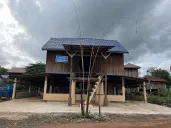
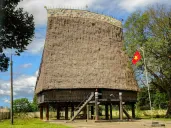
Over the grave stands a small open-sided case of wood and bamboo with a pointed roof ten to fifteen feet high, “in the form of an iron ax.” There is a lattice of bamboo worked with flowers and stylized figures, and sometimes a panel of carved figures set high on the roof. And under the roof there is a wooden figure of the dead person — distinct from everything on the fence, and easy to miss in any account that runs the two together.
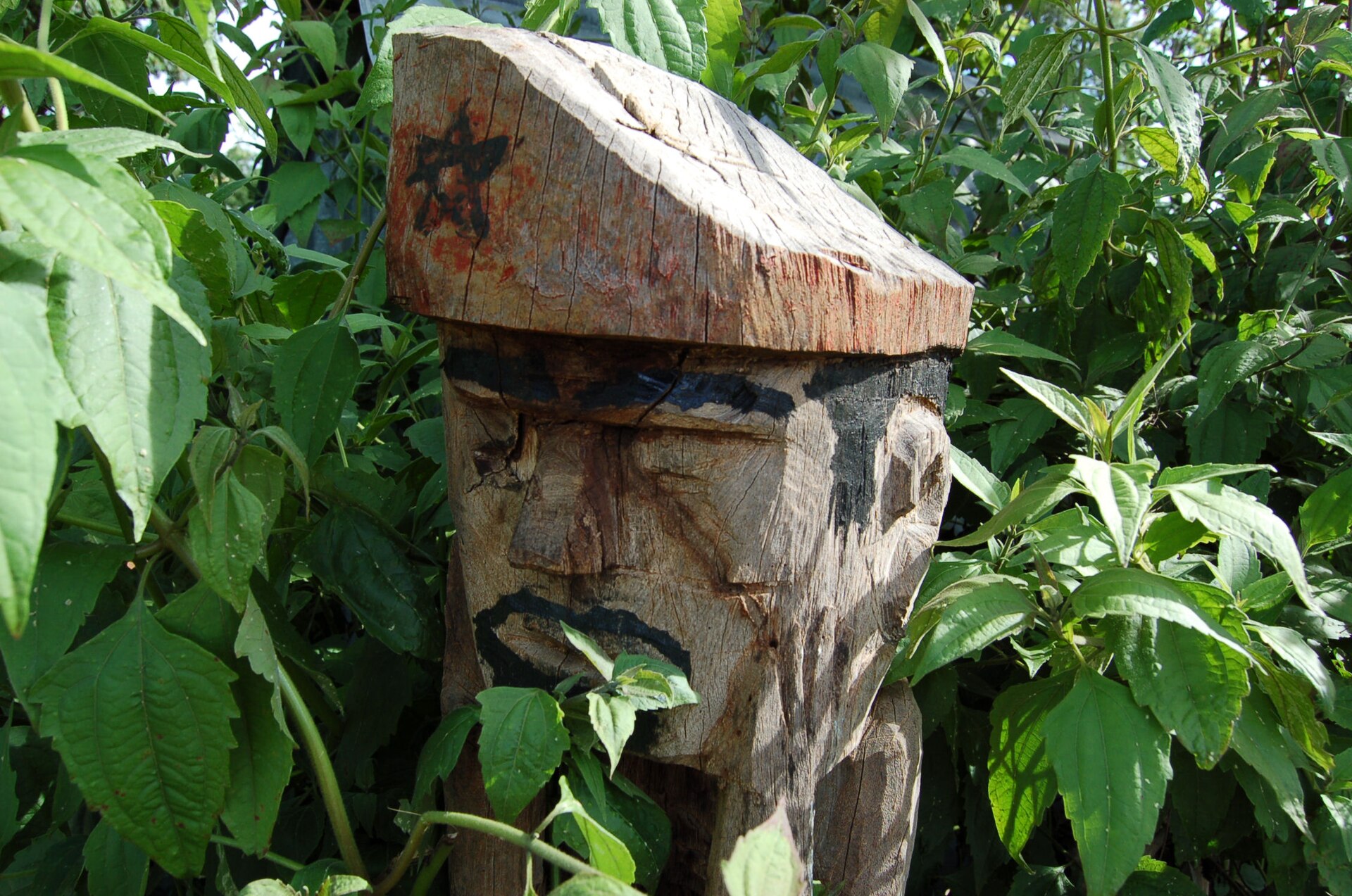

Around it runs a square fence, ten to fifteen feet a side, of joined logs about a yard long set upright. Some of the logs are topped with carved figures. The mourners are “persons crouched with elbows on their knees.” At the four corners are carved comic faces. And on one side of the fence stand a carved man and woman face to face.
The fieldworker who has recorded the ceremony most recently, among the Jarai Arap, describes the roof instead as boat-shaped with a carved tree on top. We keep both descriptions rather than choosing: one is a French colonial account of the 1950s reaching us through a 1966 translation, the other is a filmmaker with one subgroup in the 2010s, and the difference may simply be which Jarai.
What the figures are
The repertoire sorts into about five kinds: the figures of grief; figures of sex and lineage; figures of daily work and ceremony; portraits with the features pushed; and animals and ritual objects. Newer carvings take in what is around — soldiers, aircraft, people on motorcycles.
Two things are usually left out of popular accounts and both belong here. The sexual figures are real and are reported as a trait of the Arap Jarai in particular, not of all of us — the decorous 1966 line about “a man and woman standing face to face” is describing them. And the squatting figure that every visitor calls a mourner may not be a mourner at all. The Jarai name recorded for the death-figure is Kra Kôm, glossed as the monkey who cannot act; kra in Jarai and dok in Bahnar name something between a man and a monkey. We flag that gloss as resting on one researcher and a dealer’s note, and worth checking. But it is suggestive, because a few valleys north the Katu put the identical posture — “squatting figures with chin resting on knees and head between hands” — on the trails and at the doors, to keep a bad death away from the village. The same body has been read three ways: grief, paralysis, and a ward.
Who carves them we do not know. Among the Hroi, three or four months after a burial, “hired workers” build the new hut and its fence and set the statues on it — paid work, not kin work. Among the Hre the carving on the posts is done by lowland Vietnamese and not by the Hre at all. The ethnographers of that period noticed who did the carving and wrote it down when they saw it, which makes their silence about the Jarai carver interesting but not conclusive. We have found nothing on the wood, the tools, the days of work, or whether the carver is paid or is family.
The abandonment
The tomb is decorated in the months before the ceremony, not at the burial — so the carved fence a visitor photographs is usually a sign that a pơthi is coming, not that one is long past. The ceremony itself runs three days, by one account, four or five by another, and draws people from all the villages nearby. There are gongs, dancing, a parade of masked and disguised figures, and the sacrifice of buffalo and oxen. Every guest has to join the sacrificial meal and drink the rice wine from the jar. That obligation is the whole economy of it: you are not feeding a family, you are feeding everyone who comes.
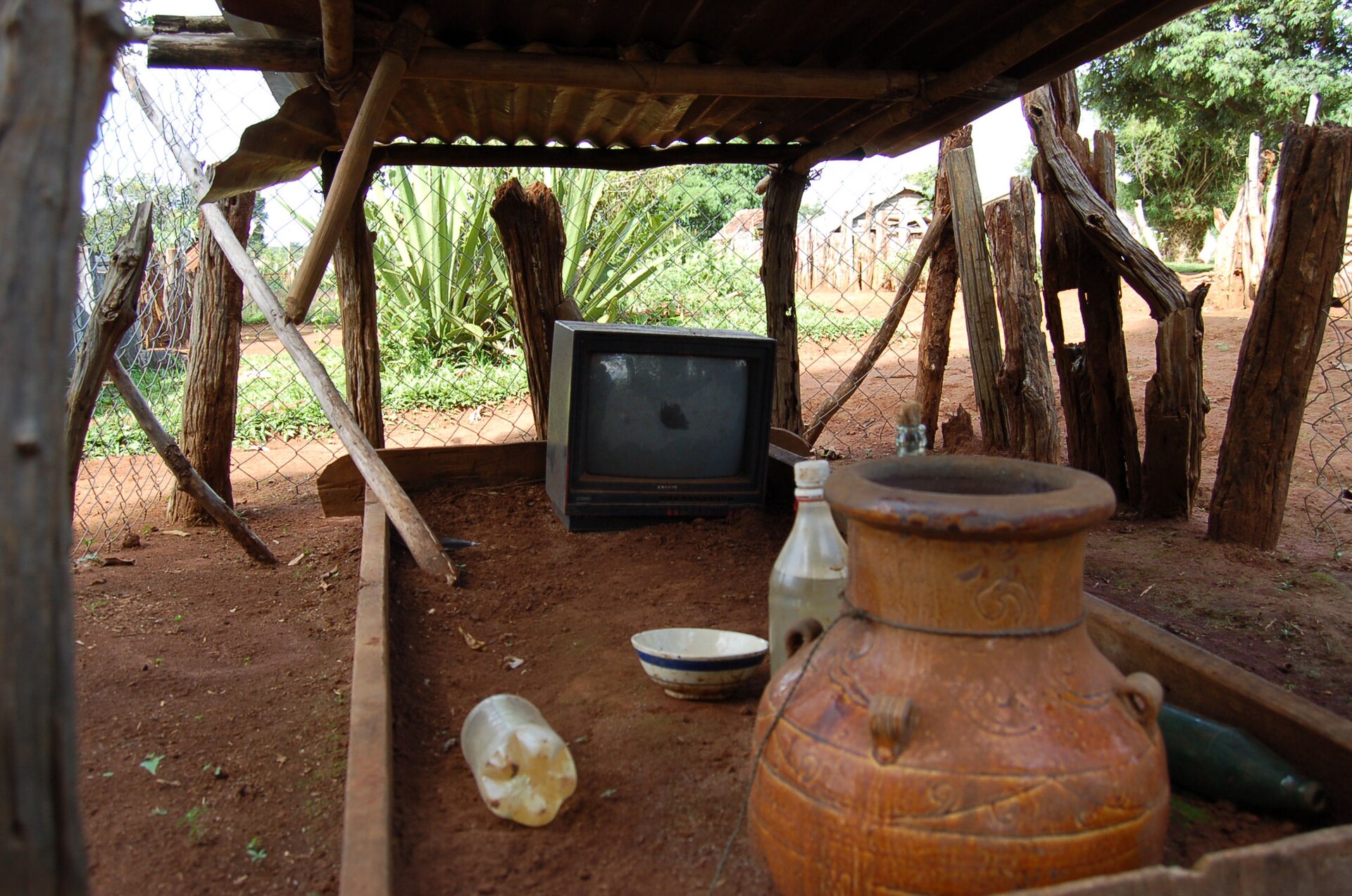

Afterward the tomb is not tended again. It is left, and the forest takes it. The widow or widower may remarry. The dead person has gone to what is recorded as Plei Atâo — and plei is the ordinary Jarai word for a village. The land of the dead is not an abstraction with a special name. It is a village, called a village.
The Bahnar hold the same idea from the other end. Their second world is the world of the ancestors, and it “includes any objects or sacrificed animals which have been placed on the tomb of the deceased.” The jar on the grave is not a symbol of a gift. It is already over there. Which is why the house can be left to fall down without impiety: what was in it has gone. See Yang, the spirits.
What it costs
At Tangchi village in Ratanakiri in March 2004, a funeral for a man of standing ran three days, gathered three hundred people, killed five buffalo at sunrise, and was played by thirteen gong players and a drummer.
Set that against what a household owns. In the same 1966 survey, a rich man with a household of fifty is described as owning thirty to forty sets of gongs and a few hundred ordinary jars; “a poor man may only own 1 to 2 sao… and one buffalo.” One buffalo. A five-buffalo ceremony is not an expense. It is five poor households’ entire moveable wealth, killed in a morning.
There is a recognized way down: among the Bahnar goats may be substituted for some, but not all, of the buffalo a large sacrifice requires. There is a floor. And the cost is anticipated in the law of property. Among the Bahnar the dead person’s own goods, the to’mam ko’dih, are spent first on the burial and the closing of the tomb, and only what is left is divided among the heirs — the dead part-fund their own release. Among the Koho it is the youngest daughter who carries all the expenses of her parents’ death, the sacrifices and the upkeep of the tomb. See Jars, rice wine and the buffalo feast.
Not only the Jarai
| People | What is recorded |
|---|---|
| Bahnar | A series of ceremonies ending with the abandonment of the tomb. At the grave the surviving spouse or the eldest of the family turns his back and throws earth and pieces of wood over his shoulder onto the coffin. Jars and implements are placed on top, according to the sex of the dead. Carved figures of people or animals, two to five feet high. The Eastern Bahnar paint their statues red and blue. Mourning runs from six months to three years. |
| Halang | A row of stakes around the grave, each with a human face cut into it. Influential families build roofed grave structures “like a miniature communal house,” surrounded by carved crouching men with their foreheads in their hands and their elbows on their knees. Rice is brought to the grave for nearly a year. But instead of one terminal ceremony there is an annual feast of the cemetery for the whole village, with buffalo and pigs and many jars. |
| Hroi | A hut with carved pillars above the grave; and three or four months after the burial, hired workers build a new hut with a high roof, woven flowers and a high stake fence carrying statues and wooden animals. |
| Koho | A jar and a cup are broken at the feet of the body and the pieces left in a basket by the tomb. Burial on the third or fourth day. The youngest daughter carries the cost. |
| Katu | Not a tomb-abandonment people, but the finest carvers in the region — caskets (taram), tombs (pin), statues, sacrificial posts. Their squatting figures stand on the trails to turn away a bad death. An outsider may look at them; a stranger should not touch them. |
The 1966 survey carried “abandonment of the tomb” as a standing entry across peoples, not as a Jarai peculiarity. It is a regional institution with local shapes.
Taken away
The carvings are the part of our art most often taken away. Here is the documentation.
In 2009 Sotheby’s in Paris sold lot 58 of the Guimiot and de Grunne collection: Très belle statue funéraire, Jörai, région des Hauts plateaux, wood, ninety-four centimeters. The provenance line reads “Collectée in situ par Philippe Guimiot en 1975” — collected in place, by a named Belgian dealer, in the year the war ended. It passed to the collection of Count Baudoin de Grunne in Brussels and was estimated at seventy to a hundred thousand euros. In situ, for a funerary statue, means off a grave.
The trade is not only at that level. In 2022 a Paris auction sold a Jarai funerary figure, eighty-six centimeters, from another private collection, for five hundred and fourteen euros. These objects move at every price from six figures down to junk.
And in April 2001 the Phnom Penh Post showed photographs of six Jarai funeral carvings to a Jarai villager, Yol Suth, and then told him they were for sale in a gallery in Phnom Penh at between five hundred and twelve hundred dollars each. What he said is the only statement by one of our people about any of this that we have found:
“This is wrong… it’s very bad that people would take these things from the graves and land of Jarai people.”
The gallery owner had said the Jarai would burn the carvings anyway to clear land for cashew. Yol Suth answered: “Jarai would never burn these… these must be left to protect the grave of dead Jarai.” And at the end: “I ask the seller to stop doing that… these things must not be sold because they are a sacred part of our culture.”
An American university museum showing Jarai sculpture states plainly that the provenance of some of its pieces is unclear and that it cannot say whether they came from graves. That is an honest sentence and we would rather have it than a confident label.
Across the border
The Jarai of north-east Cambodia keep the same practice, outside the reach of the Vietnamese state, and what is happening to their cemeteries is better documented than anything on our side of the line.
In Ratanakiri, concessions granted between 2010 and 2013 to Hoang Anh Gia Lai and associated companies cut into the land of fourteen villages of Jarai, Kachok, Tampuan and Kreung people, some fifteen thousand people in all. The complaint that followed records the “destruction of burial grounds, spirit mountains and other sacred sites,” and the bulldozing of two spirit mountains together with wetlands, hunting grounds and burial grounds. Religious and cultural practice was impeded by the loss of the spirit forests and the graveyards.
The communities complained to the ombudsman of the World Bank’s private-sector arm in 2014; the company apologized in 2015; demarcation ran from 2017 to 2018; and on March 26, 2019 the provincial governor announced the return of all sixty-four demarcated areas — seven hundred and forty-two hectares, including twenty spirit mountains and two burial grounds. Land earmarked for return was then cleared during the lockdown of March 2020.
Hoang Anh Gia Lai is a Vietnamese company, and Gia Lai is the province most of our Jarai live in. The graves being cleared in Cambodia are being cleared by a firm named after our own country.
What is happening to it
It is alive enough to have been filmed: a pơthi of the Jarai Arap was recorded in 2014 and released as a thirty-three-minute film, with the parade of disguised figures, the sacrifices, the gongs and the dancing.
What is squeezing it is a list: resettlement, so that villages no longer sit where their dead are; the loss of the forest the carvings are cut from; conversion; and heritage promotion, which one account describes as paradoxically pushing practitioners toward treating their own practice as obsolete. In Ratanakiri the picture among Protestant Jarai is accommodation rather than rupture — a Jarai pastor who respects the old ways, congregants who hold the forest spirits to be part of Creation. We have not found a statement by any church, Catholic or Protestant, on whether a convert may hold a pơthi. That is a real hole.
And the carvings are now also made to be sold. A scholarly comparison published in 2022 sets the recent sculptures against the older ones and concludes that although a provincial cultural agency reported the art recovering and developing well, most of the new pieces “seem very different from traditional sculptures in many respects” — that what is being counted as a revival is producing objects that are not the thing.
Two things we cannot document
It is often said that French administrators, missionaries and the Vietnamese state have all at different times called the buffalo sacrifices wasteful. We went looking for the evidence and did not find it. It may well be there — it is the kind of thing colonial administrative writing is full of — but we do not repeat it until we can source it.
It is also said that Jarai families in Ratanakiri now often offer motorcycles where buffalo were once given. That too is widely repeated, and we could not document it either. If you have seen it, tell us.
What we do not know
Nobody we can cite gives a figure in years for the interval between burial and pơthi — only “a few years,” and the honest answer that it runs as long as the money takes. We do not know what a daily grave-visit actually consists of: whether rice, water, cooked food, drink, and whether it is set inside the house or outside. We have no formula recorded as being spoken at the grave, in Jarai or in Bahnar.
Above all we have not found one Jarai or Bahnar person describing a pơthi they held or attended. Yol Suth on the carvings is the closest, and he was being shown photographs of them in a gallery. If your family has held a pơthi, we would like to record how it went and in what order. See How to record an elder.
See also: The Jarai, The Bahnar, Kin across the border.
Sources
- Minority Groups in the Republic of Vietnam, Department of the Army Pamphlet 550-105, 1966 — at the Internet Archive, checked against its own page images. Death not final until the tomb is abandoned, early remarriage for poverty, and adultery in the interval (p. 292); the daily visit and monthly sacrifice (p. 294); the mourning period set by wealth, and the tomb and its fence described (pp. 295–297); the Bahnar funeral and the six months to three years (p. 39); to’mam ko’dih and the gai adro (p. 36); the Bahnar second world (p. 45); the goats substituted for some buffalo (p. 44); the Halang grave structures (pp. 152–153); the Hroi hired workers (p. 248); the Koho (pp. 421–422); the Katu carvers (pp. 378–397); and the poor man with one buffalo (p. 211). The compilers’ source for the funeral material is Paul Guilleminet’s Coutumier de la tribu bahnar, des Sedang et des Jarai de la province de Kontum (EFEO, 1952), cited nine times — so this is a French résident of Kon Tum reaching us in English translation
- Vincenzo Della Ratta, on the pơthi of the Jarai Arap — the ritual as a secondary mortuary rite that lets the dead reach their destination, the three-day feast with gong music, dances and buffalo sacrifice, the decoration of the tomb months beforehand, Plei Atâo, and Kra Kôm. His article in Mortality 29:4 (2024), doi 10.1080/13576275.2023.2230913, is paywalled to us; the terms above rest on his abstracts and on secondary description and should be checked against it
- Eisuke Yanagisawa and Vincenzo Della Ratta, Po thi (2014, 33 min.) — Nordic Anthropological Film Association catalogue. The parade of disguised figures, the sacrifices, the gongs and dances
- Laurent Jeanneau, Jaraï Funeral Ceremony in Ratanakiri Cambodia, recorded March 2004 at Tangchi village, Andong Mis — three days, three hundred people, five buffalo at sunrise, thirteen gong players and a drummer. Note this is a funeral, not a pơthi
- Phnom Penh Post, “Cambodia’s hill tribes at the crossroads,” April 13, 2001 — the six Jarai funeral carvings for sale in a Phnom Penh gallery at five hundred to twelve hundred dollars each, and Yol Suth’s three answers
- Sotheby’s Paris, Collection Guimiot et Domitilla de Grunne d’art premier, 2009, lot 58 — “Collectée in situ par Philippe Guimiot en 1975”, later the collection of Count Baudoin de Grunne, Brussels; estimate 70,000–100,000 euros
- Inclusive Development International, on the Ratanakiri land case against Hoang Anh Gia Lai — the fourteen villages, the bulldozed burial grounds and spirit mountains, the ombudsman complaint of 2014, the 742 hectares returned in March 2019 including twenty spirit mountains and two burial grounds, and the clearing during the lockdown of March 2020
- Nhan T. T. Ho, “Wooden Funeral Sculptures of the Jrai and Bahnar in the Vietnam Central Highlands: Conservation or Destruction?” in Nguyen and Hens (eds), Global Changes and Sustainable Development in Asian Emerging Market Economies vol. 2 (Springer, 2022), pp. 13–33, doi 10.1007/978-3-030-81443-4_2 — that most of the new sculptures counted as a revival differ greatly from the older ones. A scholarly chapter, arguing against the provincial agency’s own finding
- Jacques Dournes, Forêt, femme, folie: une traversée de l’imaginaire Jörai (Aubier Montaigne, 1978), and Pierre-Bernard Lafont, Prières jaraï (EFEO) — the two works most likely to hold what is actually said at a Jarai grave. We have read neither
Compiled September 2026. The interval between burial and abandonment is given as far as the record allows: daily visits and monthly sacrifices, for as long as the family’s means require.