


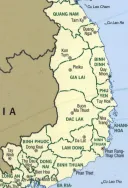




Everything written down about the old religion of our country was written by somebody else. French missionaries, French administrators, an American army analyst working from their books, and lately a team of researchers who state in print that they are not indigenous. We have looked for one published account by a Dega person describing a yang, or a ceremony they took part in, in their own words. We did not find one. The only rite a Dega person is recorded describing in the first person anywhere in the accessible record is a fake one, staged by the police in 2001. That is the shape of this page, and we put it at the top rather than at the bottom.

What yang is, and why “spirit” is a poor word for it
The English word arrived with the translators and it has never fitted. A recent study of the Bahnar puts the difficulty plainly: yang has been rendered as god, spirit and deity by turns, and what the word actually names is person-like beings who have a will, an intention and a life of their own, and who are in social relations with us. They are not forces. They are neighbors, and the relations with them are the kind you can get wrong.
What they govern, among the Jarai, is everything: the turn of the seasons, the movement of the stars, rainfall, the fertility of the ground, the growth of the plants, wealth and poverty, and whether the herds increase.
The names, kept apart
These are different peoples with different pantheons, and the habit of running them together into one highland religion is the habit this library exists to break.
| People | Who is at the head | Some of the others |
|---|---|---|
| Bahnar | a pair: Bok Kei Dei and Yă Kuh Keh, grandfather and grandmother | Yang Măt Nar the sun, Yang Măt Khei the moon, yang Dak the water, yang Krong the river, yang Kong the mountain, yang Bri the forest, yang Teh the earth, yang T’mo the rock, yang Sri the rice, who is female, yang Unh the fire; Bok Glaih the thunder; Bok Hoch, a giant bird who controls the wild animals; yang dong, the ancestors, literally the house spirits |
| Rhade | Aê Diê, Master of the Sky, ruler of the universe and of all the other spirits | H’Bia Dung Dai, who oversees the rice and the field, fertility, birth and the early years of a child; Aê Du, who governs harvests and rain, and the cold, heat, wind, storms and night so far as those are kind |
| Koho | Ndu, the supreme being | Yang Tongai the sun, Yang Konghai the moon, Yang Tioh the earth, Yang Truu the sky, Yang Dong Rong the thunder; and against the yang, who are good, the caa, who bring accident, illness and death |
| Ma | N’duh, who made all things — the same name as the Koho Ndu | the country of the Ma is also the country of the yaang; Jean Boulbet took the doublet for his title |
| Mnong | Nduu, soul of the rice and the founder of the human race; Tum Nduu to the Gar, Prah Ba to other Mnong | statues of Prah Ba are set up in front of the houses to claim a village site |
| Raglai | Nhang — plainly the same word as yang, used here as a name | no temples, no religious buildings; the spirit of Bumong has something close to a cult of its own |
| Jeh | Ra, the Heavenly Being, the most abstract and remote | and the Spirit of the Hearth, of the house |
The Bahnar creator is two people, an old man and an old woman. The Rhade head of the pantheon is one lord of the sky. These are not versions of each other. In the Rhade telling the head of the dark side is Yang Lie, who commands the dreaded spirits and the lesser imps, and who is shown in human form with his neck under a yoke, his feet in a wooden block and his head split by a saber. If Aê Diê forgets him for a moment he is at mischief again.
Three worlds, and the one that runs ahead
The Bahnar divide the universe in three: the earth with its plants, animals, people and stars; the world of the kiak, the ancestors, which also holds the objects and the sacrificed animals placed on a tomb; and the world of the spirits. A sleeping man’s essence, his po’hngol, goes into the second world and meets the ancestors there, who may help him or harm him. The grave goods are not symbols of the other world. They are already in it.
The Rengao count three as well, and their third world explains everything else:
“The first world is the earth, inhabited by living man and his soul. The second world, inhabited by the dead, is the world of dreams. The third world, heaven, is inhabited by great spirits; there events destined for the other two worlds occur first — 6 months in advance.”
Heaven runs half a year ahead of us. That is not a belief about divination bolted onto a cosmology. It is the reason divination works, stated from the inside. A dream, an omen or a reading is a look at something that has already happened up there and has not reached here yet.
The specialist, and the limit of the art
Among the Rhade the practitioner is the mjao. A mjao may be a man or a woman, though in practice few are women. The office is not chosen: a mjao is somebody who in youth was favored by the spirit of the python and whose gift for healing showed itself in signs. The gift is then confirmed by dreams, and fed daily by lessons from an experienced mjao who knows magic, sacrifice and healing. A mjao intervenes constantly in the life of the village, is a powerful person in it and is usually wealthy. When called to a sick person, the mjao sucks the sickness out.
And then there is a wall, and it is the most honest thing in the whole record:
“Against yang brieng, on the other hand, the mjao are powerless; their only recourse is prayer and sacrifice.”
The yang hrieng are the spirits of accident and sudden death, commanded by Yang Brieng Pong, the most dreaded of all. His partner, Hong Klang, whose name means wasp of the bone, goes into the body of anyone killed by accident and sits in the bones in the shape of a wasp; people are afraid to be near such a grave after sunset. And the ceremonies held afterward are not like other ceremonies: “They are marked by a deep anguish which grips all participants; they feel his invisible presence still prowling around them.”
A religion with a named grief in it, and a specialist who says out loud where his art stops. That answers “what did we actually believe” better than any definition of yang can.
Elsewhere the office has different shapes. Among the Bahnar the bơjâu or po’jâu is sorted into four kinds by how the illness is found: with a lamp, with a hand-span, with an arm’s length, or with a chicken egg. Becoming one is generally not anybody’s intention; it is what the ancestral spirits decide, and the capacity is given rather than sought. Among the Koho, Sre, Nop and Kil the bojou may be either male or female, and usually one serves a group of villages. The Raglai bojau works in trance, naming the illness, the spirit and the sacrifice — and unusually the Raglai diviners are loosely organized, under a bojau in the village of Choah near Bumong, in what looks like an attachment to the spirit of Bumong itself.
The woman who holds the rice, and can lose the job
The clearest case of a woman holding a religious office in our country is Sedang, and she is not a shaman. Sedang fields depend on the strength of the rice soul, the mahua phae, of the household that farms them. The rice soul lives in the cooking hearth of the house chief’s wife, the tyin, and she is therefore a religious leader. She performs the sacrifices for clearing, for planting and for harvest, and the whole household takes part under her.
And the office is answerable. If the crops fail, the rice soul has weakened; and if her sacrifices do not strengthen it, the house chooses another tyin. The rice soul lives in a woman’s fire, and the harvest is her performance review.
What was done
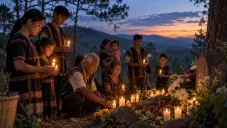
The soul travels and can be lost. When somebody falls ill because their soul has wandered off, the Bahnar family may go to the edge of the forest and call it back by name — do not stay here any longer, do not get lost any more, follow us and come home.
Illness is a matter between people and yang, and the reading of it is technical. The Jarai question the spirit of a stick, Topa Gai, and the Sedang do the same thing by measuring a stick against the arm; the intermediary falls into trance and cannot stretch the arm out. A sorcerer calls out the names of the spirits over an egg, and a certain movement of it names the one responsible. There are dice and there are snails.
The omens are read in the forest, and the Bahnar case is exact. There are auspicious birds, xem lơng, and birds of bad omen, xem kơni, that you may meet while traveling. What is listened to is not only which bird sings but where it sings from — the left of the path or the right — and that is what tells you whether the journey will go well. The omen is a bird in a place, not a bird.
Break a rule and you owe. The Bahnar name the resulting liability: xỏnoh, a debt contracted toward the spirits by a violation or an omission. The dictionary that supplies the gloss calls the thing violated a superstitious practice, which is the dictionary’s word and not ours, and is a small exact example of the problem this whole page is about. The debt is real enough to be inherited: one of the few Bahnar prayers ever printed is spoken by somebody discharging a promise that a grandparent made and could not keep.
What the spirits are given is the liver. Across peoples and across language families the liver and the blood of the sacrificed animal are the spirits’ portion, and the Bahnar say so to their faces: you can eat chicken liver and drink wine. The Koho say the same thing about rice — rice wine is the liver of the paddy, cooked rice is its flesh. One idea, two families of language, and it runs from the jar to the buffalo post. See Jars, rice wine and the buffalo feast.
Every Koho village keeps a stand of sacred trees, the yang bri, and to cut even a twig from them brings sickness and death on everyone. In Rhade country parts of the forest are sacred and cutting there is forbidden until the shaman has been brought to settle it with the spirits. Among the Bahnar no tree comes down until its spirit has had a sacrifice. That, and not a policy document, is our oldest forest law.
One small thing, because it says how consent was done. Among the Jarai a girl’s mother gives the go-between a bracelet, the kong, and the go-between holds it out and asks whether the girl agrees to his approaching the boy. She gives her consent by not touching the bracelet. If the match is agreed the bracelet goes to the boy’s mother, who puts it on his wrist; if the engagement is broken, the bracelet goes back to her family. See The bracelet.
The prayers
We set out to find the words. We did not find a single recorded highland prayer printed in its own language beside a translation in any source we could reach. The works that do print the originals — Kemlin on the Rengao agrarian rites of 1909, Maurice on three Rhade agrarian feasts of 1951, Guilleminet’s commentary on both, Condominas on the Mnong Gar, Boulbet on the Ma, Dournes on the Jarai — were closed to us by robots files, by access restrictions and by lending rules. That is a gap in access, not a gap in the record, and it is retrievable by anybody with a library card and a browser.
What we do have is four Bahnar texts, in English only, from the 2026 study. The sowing prayer, said over chicken and wine on the first day, asks the yang of thunder, of the field, of rice, of the mountains and of the trees to eat the chicken liver and drink the wine, and to “please love us and give us lots of rice so we can play gongs and buy xatok” — jars of rice wine. The soul-calling at the edge of the forest is above. The third is the paying of a spirit-debt, the tơl: in the past I, or my grandparents, promised you a sacrifice and could not give it in time, so here it is; please stop asking, and stop punishing me, and give me good health. The fourth is not a prayer at all but the thing the other three become: at Kon K’tu the Bahnar build a gâng, the carved sacrificial pole, and offer it to Ba Yang at Christmas.
There are prayers the sources describe and decline to print. At the New Year the Koho household heads say long invocations calling on the spirits of named features of their own landscape. If one unquoted prayer in the whole literature is worth hunting down, it is that one: a list of the places of a particular valley, spoken by the man of the house. The Ma open a lawsuit with a ritual invocation before the two sides sit down on a bamboo trunk to argue. Nobody printed those either.
Death, and the rite that lets you go on
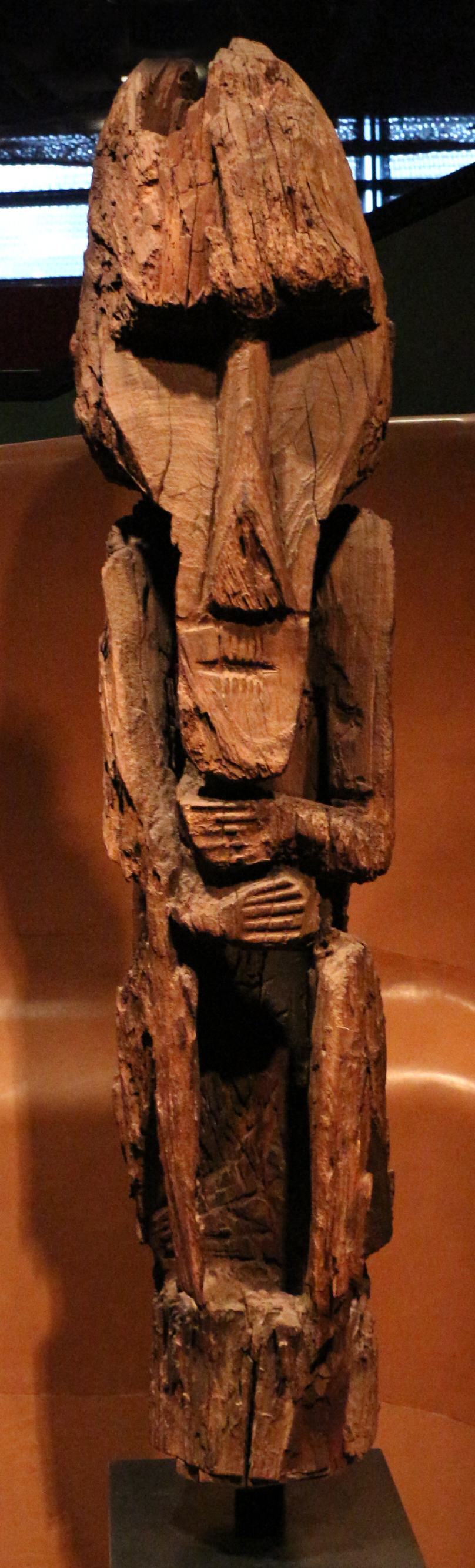
Before a Bahnar funeral the gongs are played at the house and the body is wrapped in mats; burial is at nightfall, twenty to thirty hours after the death, the family in white; the tomb may carry carved wooden figures two to five feet high. Among the Halang the frame is covered with statuettes of buffalo and with funeral figures, the rum, representing mourners. A buffalo, a pig or a chicken has to be killed to finish the rite, and the meat is shared out among the mourners.
What frees the survivor is a separate ceremony, the gai adro. A widow or widower cannot remarry until it is done; among the western Bahnar a widower gathers his dead wife’s unmarried sisters around a jar of wine. Until then the property is not divided either — the dead spouse’s own goods, the to’mam ko’dih, go first to pay for the burial and the closing of the tomb, and only the death itself allows the common property, the to’mam atum, to be apportioned. The long cycle of care that ends with leaving the tomb is on The tomb house.
What is said over the dead, in any of our languages, we do not have. Not one formula, for any of our peoples, in any source we could reach.
The new religion came in through the old religion’s door
The clearest case is Raglai, and it is one sentence in a 1966 handbook:
“The missionaries reached the Raglai through the conversion of a Raglai bojau named La Yoan, who himself conducted missionary activity in the region.”
The diviner converted, and then became the evangelist. That is not an anecdote, it is an argument about how the change actually happened. Set beside it the Hroi, a few hundred pages earlier in the same book, who had their own way of filing the arrivals: “The Hroi consider missionaries to be Western sorcerers.” They put the missionary into the category they already had — a bojau from a long way off.
The vocabulary went the same way. Every name the missions reached for was already the name of a high god in one of our languages before any missionary used it: Ndu among the Koho, N’duh among the Ma, Aê Diê among the Rhade, Nhang among the Raglai, Ra among the Jeh. Jacques Dournes’s use of Ndu for God, which brought him into conflict with his bishop, sits in that series and did not begin it.
The Bahnar answer at Kon Tum was not to replace the word but to add a term of respect to it — Ba Yang, for Christ. The church did not abolish the agricultural rites either. It rewrote them into a Bahnar prayer book, the Hlabar Khop, and kept the ritual system running inside itself. At Kon K’tu the sacrificial pole goes up at Christmas, and the bơjâu were still practicing when researchers were there between 2022 and 2024.
Elsewhere the break was hard. Many converts would not play gongs or even own them, calling them instruments of the devil; Bahnar Catholic congregations, which brought gongs into church, were the exception. Among the Jarai the cost of refusing was not private: a convert who would not join the ceremonies and the sacrifices was held to anger the spirits and bring disaster on the whole village, not only on himself. See The Bahnar, The highland Catholic church and The church they closed.
- From about 1850 — Catholic missionaries settle among the Bahnar around Kon Tum. In 1861 they devise a written Bahnar in Latin letters.
- About 1930 — The Christian and Missionary Alliance begins work in the highlands, above all among the Rhade.
- Early 1950s — La Yoan converts, and the Alliance reaches the Raglai through him.
- 1946–68 — Jacques Dournes uses Ndu for God and argues for taking faith from within rather than sticking it on from outside.
- 1975 — About 70,000 highland Protestants, by one count that appears to rest on official figures. Churches are closed and pastors imprisoned.
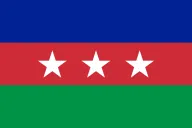
- Late 1980s–1990s — As the armed struggle ends, conversion accelerates. “In 1988 the ethnic minorities started to become Christians,” a Mnong man told Human Rights Watch. “Jesus changed our idea” — from armed to peaceful struggle.
- 2002 — Between 229,000 and 400,000 evangelical Protestants among highlanders, and about a quarter of us Christian.
The state, and the counterfeit
The state handles the old religion with two hands. With one it stages it: UNESCO proclaimed the Space of Gong Culture a masterpiece of the world’s intangible heritage in 2005, and the provinces have run gong festivals ever since, one of which an anthropologist who knows the music called a mockery of it. With the other it counterfeits it.
In Ea H’leo district in Dak Lak, from May to mid-August 2001, in at least two dozen villages including Buon Dang and Buon Treng, people who had taken part in the February demonstrations were summoned to ceremonies. A banner was hung. Officials, military commanders and police attended. Soldiers ringed the area so that nobody could leave. Each person identified as a demonstrator read out a prepared confession renouncing their religion and pledging loyalty, and then drank rice wine mixed with goat’s blood, while other villagers beat the ceremonial gongs. The signed pledges were distributed afterward.
Four things the people there said, to Human Rights Watch in October 2001:
- “We were afraid [the wine] had poison in it and that they wanted to kill off all of the demonstrators.”
- “The police told me that drinking blood with wine would cleanse my sins and wrongdoings.”
- “They asked us to drink goat’s blood, but we never saw any goat. We wondered where the blood was from.”
- “I wanted to kill myself, slit my own throat because of the pressure.”
Christians among them objected that it was a sin to receive or give blood that was not the blood of Jesus. Jarai villagers said they had never heard of such a ceremony in their lives.
The state did not revive our religion. It faked it, and used other villagers’ hands on the gongs to do it — the same gongs UNESCO would proclaim a masterpiece four years later.
The practice was then institutionalized. Officials in the highlands are instructed to eradicate all illegal religious organizations and to run official “Swearing Brotherhood” ceremonies, lễ kết nghĩa, in which we must publicly pledge loyalty to the government and the party and renounce Dega Protestantism. One such ceremony in Ia Suom district, Gia Lai, on September 24, 2010, at which 24 people “voluntarily” gave up Dega Protestantism and FULRO, was reported in the army newspaper — it was publicized, not hidden. Officials worked through village chiefs, elders and families to turn people around, which is the same move as putting the gongs into other villagers’ hands. The instruments have names and dates: a party directive of October 2002 on eliminating Dega Protestantism; Instruction No. 1 of February 2005; Decree 22 of March 2005, which prohibits forced renunciations of faith; Directive No. 5 of 2006.
And there is a category in the law for what we are told we have. Official media has made it clear that these actions belong to a policy of eliminating “evil way” religions, tà đạo — Dega Protestantism and Ha Mon Catholicism among them. The point for this page is the slot itself: the state’s legal grammar has a place for “not a religion at all,” and both our churches and our old rites have been put in it at different times. See Ha Mon and The law on belief and religion.
The reverse move exists too. In December 2012, officials in Tua Chua district beat members of a house church, fined them heavily and threatened to put them off their land unless they renounced their faith and returned to their family altars — that is, to traditional animist practice. A 2006 handbook instructed officials to persuade new converts back to traditional practices. Tua Chua is in Điện Biên province, in the northwestern highlands: those were Hmong people, not us. We name the province because the case is not ours. What it establishes is the pattern — that the state has, as policy, pushed converts back toward practices it elsewhere condemns as superstition — and Ea H’leo is what that pattern looks like in our country.
Whether any of it is coming back
We found no evidence of a revival of the old religion. The one documented living continuity is inside Christianity: the Bahnar prayer book at Kon Tum, the pole raised at Christmas, the bơjâu still working at Kon K’tu in the 2020s. That is continuity, and it is real, and it is not a revival. The gong festivals are heritage staged by provinces. Nothing we could reach shows the old rites being taken up again as religion.
What we do not know
We have no prayer in any of our languages with its translation beside it. We have no funeral formula at all. We have no rite of the village water place, though every village has one. We have found no account of chicken-bone augury for any of our peoples, despite how common it is said to be in this region. The claim that the Mnong called their shamans njau is one we cannot source — the word is real in Mnong, but the handbook does not have it and we have not read Condominas directly; treat it as unverified until we can. The Jarai pơjâo is still unchecked against Dournes. And we have found no source, outside Vietnamese state material that we do not use, for a campaign against the buffalo sacrifice or the pơthi as superstition, nor any legal text drawing the line between belief and superstition as it is applied to us.
Above all: no Dega person, anywhere in print, describing a yang or a ceremony they were part of. If you can tell us the names of the yang and the rites as your family kept them, in your own language, that is the thing this page is missing and nothing else will replace it. See How to record an elder.
See also: The rice year, Gongs and epics, The Kings of Fire and Water.
Sources
- Minority Groups in the Republic of Vietnam, Department of the Army Pamphlet 550-105, Cultural Information Analysis Center, Center for Research in Social Systems, The American University, 1966 — at the Internet Archive. A counterinsurgency briefing book, not an ethnography, compiled from French and American studies; we quote its evaluative words and do not adopt them. Checked against its own page images: the Jarai yang at p. 302, the Rhade pantheon and Yang Lie at p. 705, Hong Klang and the deep anguish at p. 706, the mjao at pp. 707–708, the Koho pantheon at p. 428, the yang bri at p. 426, the Koho bojou at p. 429, the Bahnar three worlds at p. 45, the Rengao three worlds at p. 645, the Sedang tyin at pp. 761–762, La Yoan at p. 608, the Hroi at p. 254, the Raglai Nhang and Bumong at p. 607, the Jeh at p. 341, the Ma N’duh at p. 473, the Mnong Nduu at pp. 500 and 503, the bracelet at pp. 290–291, and the gai adro and the property terms at p. 36
- Hoài Trần, K. David Harrison, Phước Lâm Huy Trần and Sơn Thanh Khuất, “Yang, forest animism, and environmental perception among the Bahnar in the Central Highlands of Vietnam,” PLOS One 21 (2026) — fieldwork at Kon K’tu, Kon Tum. The definition of yang as person-like beings with agency, the named Bahnar yang, the four kinds of bơjâu, the birds and where on the path they sing, xỏnoh the spirit-debt, the four prayers, the Hlabar Khop and the Christmas gâng. The authors state in the paper that they are not indigenous researchers
- Gerald C. Hickey, The Major Ethnic Groups of the South Vietnamese Highlands, RAND (1964)
- Georges Condominas, We Have Eaten the Forest, and “From the rice-field to the miir,” Social Science Information (1972). The Mnong Gar year named for the forest cleared. The book is lending-restricted and we could not search inside it, which is why the njau question above is left open
- Human Rights Watch, Repression of Montagnards, chapter XVI (2002) — the goat’s blood ceremonies at Ea H’leo: the dates, the two dozen villages, the soldiers around the perimeter, the prepared confessions, the gongs, and the four statements by people who were there, interviewed in October 2001
- Human Rights Watch, Montagnard Christians in Vietnam (2011) — the Swearing Brotherhood ceremonies, the Ia Suom ceremony of September 24, 2010 as the army newspaper reported it, and the directives and decrees by number and date; and Persecuting “Evil Way” Religion (2015) — the tà đạo category
- USCIRF, Annual Report 2013, Vietnam chapter, via Refworld — the December 2012 case in Tua Chua district, Điện Biên, and the 2006 handbook instructing officials to persuade converts back to traditional practices. That case concerns Hmong people in the northwest, not us
- Oscar Salemink, “Described, Inscribed, Written Off: Heritagisation as (Dis)connection,” ANU Press (2016) — the converts who would not own gongs, and the Pleiku festival
- UNESCO, Space of Gong Culture (2005)
- Chung Van Hoang, “The Rise of Protestantism and the State’s Response,” ISEAS Perspective 2017/34 — the 1975 figure, which appears to rest on official counts
- IRFA, Jacques Dournes, ethnologue en forêt and ethnologue évangélique
- Not read, and worth reading: Émile Kemlin, “Les rites agraires des Reungao,” BEFEO 9 (1909); Albert Maurice, “Trois fêtes agraires rhadé,” BEFEO 45 (1951); Paul Guilleminet’s commentary on both in the same volume; Jean Boulbet, Pays des Maa’, domaine des génies (1967); Donoghue, Whitney and Ishina, People in the Middle: The Rhade of South Vietnam (1962), which is the source behind nearly all the Rhade material above. These print the prayers in the original. They were closed to this research by robots files, by HTTP refusals and by lending restrictions
Compiled September 2026. Every quotation from the 1966 handbook has been checked against the scanned page. The peoples are kept apart on purpose: where a practice is recorded for one people we say which, and we do not extend it to the rest.