






















In 1899 the tribute our villages had paid every three years in wax, horn and ivory was abolished and replaced by a tax in cash, on people who did not use cash. Three years later came the days: ten a year of unpaid work on the roads, rising to fifteen, and eight to ten more spent walking to the worksite and back. A man who could not find the money worked fifteen days extra instead, at seventeen centimes a day — below the rate at which a Cambodian could buy a day off. The roads those days built are the roads the plantations came up, and the army after them. More than once the work itself started a war.

Before: a tribute nobody paid in money
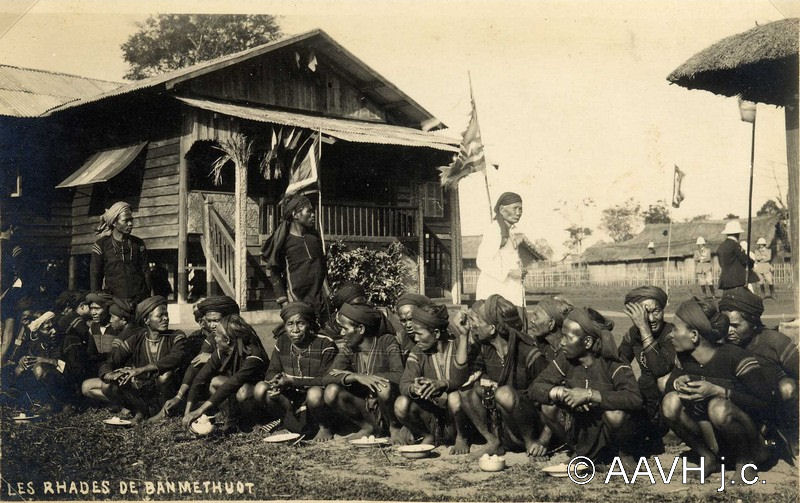
The highland villages the Cambodian court counted as tributary paid every three years, in forest goods — wax, lacquer, horn, ivory — collected by Khmer agents. The whole tribute of all the tributary villages came to a little under three thousand piastres every three years: the value of sixty tonnes of paddy a year, about a hundred and fifty kilograms per family, roughly a tenth of a normal harvest. The historian who reconstructed it adds the sentence that decides everything after: “Les aborigènes ne fournissent ni paddy, ni argent.” The highlanders supplied neither paddy nor money.
1899: a tax in cash
In January 1899 the Council of Ministers at Phnom Penh resolved to abolish the tribute and impose the head tax instead. By the order of April 26, 1899 the Mnong and Stieng were assimilated to Cambodians and made liable to the impôt personnel.
- 2.5 piastres for every able-bodied man aged twenty-one to fifty.
- 0.8 piastre for old men aged fifty-one to sixty.
- Plus 2.5 percent paid over to the mékhum, the Khmer sub-district chief who collected it.
- Village headmen exempt — because, as the record says plainly, the collectors needed them as go-betweens and collection was hard. From 1909 the exemption was formalized, to reward the intermediaries for their difficult task.
The French said the highlanders had asked for the change. The historian does not believe it: the Resident of Kratie “may have manipulated the aborigines into asking for what he wanted to impose on them.”
Two years later the new tax was dressed as an old one. The royal ordinance of August 21, 1901 provided that “according to the regulations and the usage of all time” the head tax was to be collected once a year from all Cambodian inhabitants and from the Siamese, Cham, Malay, Lao, Stieng and Pnong domiciled in the kingdom and assimilated to Cambodians. On which:
“L’expression « selon les règlements et l’usage de tout temps » ne doit pas faire illusion. Il s’agit de légitimer un nouvel impôt en le drapant de l’apparence de la coutume.”
The phrase “according to the regulations and the usage of all time” should fool nobody. The point was to legitimize a new tax by draping it in the appearance of custom.
What the administration expected from it was set out by an official who thought he was being humane:
“Dès maintenant, je crois pouvoir affirmer que l’impôt des pnongs et Stiengs sera dans l’ensemble quintuplé, peut-être même sextuplé, de six cents piastres par an, atteindra près de trois mille cinq cent piastres… La charge de l’impôt personnel remplaçant le tribut est déjà assez lourde pour ces populations misérables — une sorte de végétation humaine plaquée contre le sol ! Leurs chamcars de paddy sont péniblement gagnés sur la forêt.”
A kind of human vegetation pressed flat against the soil. That is a French official arguing on our behalf.
And it worked. In 1902 the value of the taxes the treasury took from highland villages was at least four times what it had been in 1870. By about 1910, at Stung Treng, nearly thirty thousand piastres a year were being demanded of highlanders, even though not all of them paid and some worked their tax off in kind.
The 1904 reshuffle
By the order of November 22, 1904 Darlac was attached to Annam and Stung Treng to Cambodia. For the people of Stung Treng that was a straight downgrade: the head tax went from two piastres under the Lao system, and one piastre for those classed as Kha, to two and a half for every man aged twenty-one to fifty, plus the additional hundredths, the land taxes on gardens, and the paddy tax. The buy-out of the corvée went from two to three piastres.
And the gun license went from one piastre to twenty-five. Many men owned old muskets, which they thought indispensable against the tigers — then very common in that country — and against thieves. Almost none could find twenty-five piastres. From the same year an elephant exported carried a duty of two hundred and fifty piastres, with a further fixed charge from 1908; the elephant trade, which was one of the few ways a highland family earned coin at all, collapsed after 1910. See The elephants of Buon Don.
The days
The corvée had lapsed in Cambodia after 1897. It was restored in 1902 and applied to us from the start: ten days of work a year owed to the administration.
Ten days is not the number that matters. This is:
“Il faut entre huit et dix jours de trajet aller-retour aux habitants de Bu Gler pour aller accomplir leurs dix jours de prestation. Ceux qui n’ont pas d’argent pour payer les 2,5 piastres, travaillent quinze jours de plus sur les routes du protectorat.”
It takes the people of Bu Gler between eight and ten days’ walking, there and back, to go and perform their ten days of service. Those who have no money to pay the 2.5 piastres work fifteen days more on the roads of the protectorate.
So for a man of Bu Gler the real figure is up to thirty-five days away from his fields: ten days of corvée, fifteen worked off in place of the cash tax, and eight to ten walking. More than a month, in the dry season — which is the season for clearing new swidden.
The arithmetic of that substitution is the sharpest number in the whole record. A day of corvée could be bought off at two-tenths, later three-tenths, of a piastre, which was already reckoned below the value of a day’s labor. But a highlander was not buying days off; he was paying his tax in days. Fifteen days demanded for two and a half piastres works out at 0.17 piastre a day — less than the rate at which a Cambodian could redeem one. And the ten days of corvée proper were still owed on top.
Nor did money help on the site itself: “Sur les chantiers de corvée, ceux qui ont de l’argent, exclusivement des Khmers, payent les gardes pour pouvoir en faire moins, les autres devant travailler plus pour tenir les objectifs fixés.” Those with money — exclusively Khmers — paid the guards to do less. The quota did not move, so the men without money did more.
The buy-out did improve, once. After the great grievance movement of 1916 a commission sat for months and the Council of Ministers conceded that men classed as Kha might redeem ten of their fifteen days for four piastres, the other five remaining compulsory for road maintenance; then it accepted a total redemption at four and a half. The aboriginal representatives on that commission had asked for something simpler: a single flat tax of four piastres a registered man, and the replacement of several officials at Moulapoumok including the governor. That is a highland tax petition, from 1916, and it deserves to be remembered as one.
Fifteen days, as a token of submission
On the plateau the French had just subdued, the corvée was not a revenue measure at all. From April 1934 the people of the Yok Laych, now the territory of the Haut-Chhlong, owed fifteen days a year of track maintenance and no cash tax whatever. The historian’s phrase for it: “cette corvée recognitive de leur soumission est vite détestée.” A corvée in recognition of their submission, and quickly hated. That is the cleanest statement anywhere of what the unpaid days were for.
The register is the other half of it. At Bu Gler, now too close to the post named after a dead French delegate, every man was quickly counted and could no longer escape his fifteen days. In December 1935 the chief of Bu Gler had authority over two hundred and thirty-one registered men. Across the whole delegation of the Haut-Chhlong, the number on the rolls went from fifteen hundred in June 1934 to more than two thousand six hundred in December 1935.
The register nearly doubled in eighteen months. That is what the road was for.
And the days were worked under guard: “Les hommes inscrits sur les rôles doivent effectuer quinze jours de corvée annuelle sur les chantiers encadrés par des tirailleurs ou des miliciens.”
Corvée as a sentence
Three times in the record the days are imposed as punishment:
- April 1935 — the men of Bu Gler surrender after the rising. They must hand over their weapons and give their names, and are sent to Le Rolland for fifteen days of corvée.
- July 1935 — Bedeugne, a Mnong chief who had been made a balat and then joined the revolt, is publicly stripped of his insignia, made to deliver two buffalo to the families of partisans killed the year before and a young man of his family as hostage, and to do fifteen days of compulsory work on the track with his whole village.
- January 15, 1936 — at Bu Dak Duk a drunken scuffle at a harvest feast ends with a Khmer sergeant firing: three people killed including the village koragn, three wounded, the survivors taken prisoner and the village burned. The survivors are then sentenced to fifteen days’ extra corvée.
The record of that last day also contains a sentence that says everything about what the worksites did to people: “Les Cambodgiens retrouvant les Pnongs qu’ils avaient connus sur les chantiers de prestataires sympathisaient avec eux, buvant la jarre et s’essayant sur les gongs” — the Cambodians, meeting again the Pnongs they had known on the corvée sites, got on well with them, drinking from the jar and trying their hand at the gongs. Minutes later a man came up behind the French lieutenant with a knife.
Collected in famine
This is where the paper system meets the ground.
After the drought of 1898 people were living almost entirely on tubers and deaths were being reported; the paddy tax owed by the Mnong from 1899 was remitted at once, because the harvest had failed and no Cambodian official dared go up into the Yok Laych to assess it. In 1901 the acting Resident of Kratie asked that the Mnong and Stieng be exempted from the head tax altogether, on the ground that they could not pay it and that in any case he could not verify that they had. He was not heeded. After the floods of 1907, with paddy at ten piastres the picul in the interior — ten times the normal price — the Resident offered the villagers road work to extinguish their debt to the state, and in the end granted a remission of 1,256 piastres for services not performed in 1906. Road work as debt service, stated as such.
And then 1913, at Stung Treng:
“Des dizaines d’aborigènes sont morts de faim ou sont partis louer leurs bras au Laos. On remarque que les opérations de recouvrement ne sont pas suspendues pendant la famine de 1913. Même si les percepteurs se montrent plus conciliants, ils vont dans les villages réclamer leur impôt à des gens qui meurent de faim, au sens propre.”
Dozens of highlanders died of hunger or left to hire out their arms in Laos. Collection operations were not suspended during the famine of 1913. Even if the collectors were more accommodating, they went into the villages to demand their tax from people who were dying of hunger, in the literal sense.
A picul of rice reached nine piastres that year: a month’s wages for sixty kilograms.
Refusal was the ordinary defense, and it often worked, because the country was large and the officials were few. “Les hommes qui refusent d’aller faire leurs prestations ou de payer leur capitation malgré les pressions et les intimidations finissent toujours par en être exemptés” — men who refused, despite pressure and intimidation, always ended up exempted in the end. Distance was our best protection. The road took it away.
In 1908 the Minister of the Palace at Phnom Penh proposed that the Mnong and Stieng simply be taxed like everyone else. The Resident of Kratie and the Resident Superior opposed it, and he had to give way to their “compassion.” In 1915 the governor of Stung Treng denounced the highlanders’ separate fiscal regime and his own subordinate declared himself ready to use force to make the Jarai do the corvée. The Resident Superior counselled patience in terms worth reading twice:
“Le protectorat ne peut que temporiser, ménager les chefs khas encore en apparence soumis à son autorité, paraître leur faire crédit et leur accorder sa confiance et ajourner à plus tard des mesures radicales qui s’imposeront nécessairement pour soumettre les Khas aux lois communes du royaume.”
The protectorate can only temporize, handle carefully the Kha chiefs still apparently submitted to its authority, appear to extend them credit and grant them its confidence, and put off to later the radical measures that will necessarily be required to subject the Kha to the common laws of the kingdom.
Everything that follows is the “later.”
Six hundred kilometers and twenty-five thousand men
On the Annam side, the evidence comes from an unlikely place: the floor of the French Chamber of Deputies, on March 18, 1927, in the debate on Indochina. The deputy Ernest Outrey — himself a former administrator of Thủ Dầu Một who in 1893 had surveyed a road through Stieng and Mnong country, and who therefore knew exactly how such roads got built — rose to attack the résident of Darlac, Léopold Sabatier. He began by conceding the achievement.
“M. le ministre a fait remarquer à la commission qu’il avait notamment construit 600 kilomètres de routes. C’est exact. Il a incontestablement rendu un très grand service. Mais, monsieur le ministre, puisque vous allez vous renseigner en Indochine sur la gestion de M. Sabatier, demandez donc comment ont été construits ces 600 kilomètres de routes.”
Then he did the arithmetic out loud, as a man who had built roads himself.
“Une route coûte environ 4.000 à 5.000 piastres le kilomètre, mettons 4.000 piastres.”
“600 kilomètres font 2.400.000 piastres, c’est-à-dire près de 36 à 40 millions de francs.”
That money had never existed. No province could raise it; neither the government general nor the Resident Superior of Annam had provided it. From which:
“Ces routes n’ont donc pu être construites qu’en demandant à la population des efforts excessifs, en leur imposant des journées de corvée innombrables. Il y a, en effet, 25.000 inscrits au Darlac.”
These roads can therefore only have been built by demanding excessive efforts of the population, by imposing on them innumerable days of corvée. There are, in fact, 25,000 registered men in Darlac.
Six hundred kilometers, twenty-five thousand men. Our own arithmetic, offered as arithmetic and not as anything Outrey said: that is about twenty-four meters of finished road for every registered man in the province, and at his own figure of four thousand piastres the kilometer, labor to the value of roughly ninety-six piastres a head — against a head tax of a few piastres a year.
The same debate holds the two halves of the colonial argument, side by side. The Minister of the Colonies, Léon Perrier: “C’était un pays absolument sauvage, traversé par quelques pistes que l’on ne pouvait parcourir qu’à dos d’éléphant” — an absolutely savage country, crossed by a few tracks passable only on elephant-back. And the communist deputy Marcel Cachin, quoting Sabatier’s own reports on what would happen if the companies were let in: “Ces gens-là vivent à peine sur leurs terres ; ils ont besoin de 1.300 kilogr. de vivres par an.” These people barely live on their land; they need thirteen hundred kilograms of food a year.
An empty country crossed by elephant tracks, against a people with barely enough ground to eat from. The whole colonial argument about the highlands is in those two sentences, spoken in the same room on the same afternoon. See Sabatier, the oath of 1926 and the Rhade law code.
July 22, 1914: the day the work gang rose
The post at Bu Gler was itself the provocation. A new balat named Neang arrived in January 1914 charged with building a militia post in the village itself.
“L’accord des habitants n’est pas demandé ; ils sont considérés comme soumis. Les hommes sont réquisitionnés comme prestataires. Il s’agit donc d’un travail forcé, exécuté au titre de la corvée.”
The inhabitants’ agreement is not asked for; they are regarded as having submitted. The men are requisitioned as corvée laborers. This is therefore forced labor, carried out in the name of the corvée.
At midday on July 22, 1914 the hundred or so men of the Bu Gler worksite rose. We know what happened because Neang’s cook, a seventeen-year-old Khmer named Choeu from Sre Khtum, watched it, escaped, and gave his deposition to the governor of Kratie. It was Pagnouk, the koragn of Bu Gler, who led the attack: he ran at Neang and struck him in the face; the balat got his rifle up before he was run through with bamboo spears by men of Bu Kes. Four militiamen were killed the same way. The bodies went into a hole in the ground, and three days later there was a sacrifice and drinking to mark it. The haul was three Lebel rifles, a case of cartridges, a seven-shot rifle with its ammunition, and a female elephant. Fifty men under Pagnouk went off to the valley of the Hoyt.
The act bound every village around into the revolt together, which was the point of it.
Two things should be said carefully. This was not the beginning of the Mnong revolt: that had started in May 1912 with the burning of the post at Ban Bu Sra, and between then and July 1914 there were some fifteen engagements. What July 22, 1914 was, was the day the corvée gang itself rose. See N’Trang Long.
And the French knew what had caused it. In September 1914 the Mnong who had stayed submitted were exempted from the corvée, to counter the popularity of the revolt.
Méra, and Henri Maitre in his own words
The post at Méra had been sited in February 1914, three days southeast of Bu Gler, in Bunong country, “despite the more or less apparent hostility of the hamlets of the sector.” Henri Maitre came back at the end of July to check on the progress of the works at Méra and Bu Gler. He died on a tour of inspection of construction work.
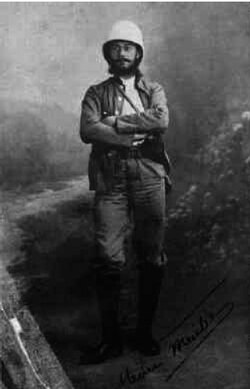
How he died is in Choeu’s deposition. Maitre let his militiamen put down their weapons so that the carbines and his own revolver could be anointed with rice beer and the blood of a sacrificed pig — a rite to conciliate the yang and make the weapons work. It was then easy for the Mnong to kill the disarmed men with knives and bamboo spears. Maitre was beheaded and his body put in the ground. In a few hours the delegate of Méra, twenty-three Rhade, Khmer and Vietnamese militiamen, Maitre’s servant and four mahouts were killed; three men got away, one of them Maitre’s Rhade interpreter. Three weeks earlier, on July 7, he had written to the Resident of Kompong Cham that the political situation was as good as it could be.
Maitre is usually cited for his ethnography. Here he is describing, in the first person, how he made a village submit. The place is Bu Sra and the old chief is Ndjrak-Ot.
“Aussi, dès l’arrivée du chef, un vieux bonhomme ridé, les cheveux blancs, je lui expose mes projets. Mais, aux premiers mots, il m’arrête ; fort tranquillement, il me répond que c’est impossible ; son village est pauvre… d’ailleurs, il ne veut pas se soumettre… A toutes mes remontrances, à toutes mes offres de conciliation, le vieux, accroupi sur le long lit de camp en bambous tressés qui court d’un bout à l’autre de la hutte, se borne à secouer négativement la tête… tranquillement obstiné, exaspérant, bourrant méthodiquement sa pipette de bambou, le chef, les yeux clignotant dans les rides de la face, refuse en mots secs et décidés.”
“Il est inadmissible qu’à huit jours de Kratiè, à quatre du Darlac, l’on rencontre encore des populations qui nous ignorent, se soustrayant tranquillement à notre domination comme si la région moï ne faisait pas partie intégrante de nos possessions indochinoises.”
“En un clin d’œil, les miliciens, préalablement stylés, sont debout… Ndjrak-Ot et ses gens sont prisonniers. Je leur explique alors qu’ils resteront ainsi jusqu’à soumission complète.”
An old man refusing politely and repeatedly; a Frenchman who finds the refusal “inadmissible”; and an ambush inside our own longhouse. The French put up a monument to Maitre in 1943.
The road as a weapon, 1918–1934
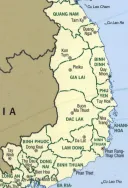
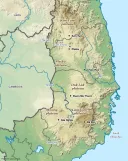
From 1918 Cochinchina began pushing the future Route Coloniale 14 north out of the rubber country. By 1925 it had crossed the Cambodian frontier by several kilometers and there was a gendarmerie post at La Palkei on Cambodian soil. In March 1926 four Europeans and about forty militiamen crossed the plateau for the first time in twelve years; among them was the public works inspecting engineer Rigal, whose job was to find the line of a future road of penetration. A few months later a military aircraft overflew the southwestern flank of the plateau to continue the survey.
In 1929 the Resident Superior asked Gatille, then delegate at Budop among the Stieng, to relaunch it. Gatille was against the use of force, which he thought ineffective, and with Rigal proposed a line that would climb straight onto the plateau, going round the villages most compromised in the revolt of 1914–15 while cutting the dissident zone in two. He was relieved of supervising the plantations so as to devote himself entirely to “la route de pénétration” that would let the civil authority recover its grip on the plateau.
On May 26, 1931, with the track reaching the foothills, Gatille was killed in an ambush by Mnong of Bu Than. Arrested in November, the men who did it explained their reasoning exactly: they had hoped the death of the white man would make the French pull back and the worksite stop.
It had the opposite effect. A punitive column went out a month later, two Mnong were killed, the car was recovered, and work resumed under a hundred militiamen stationed twenty kilometers behind the head of the works. In February 1932 the militia were replaced by soldiers. The Resident Superior explained why:
“Démontrer aux Phnongs que les temps sont passés où le meurtre d’un Européen entraînait de notre part des reculs et des abandons.”
To demonstrate to the Phnongs that the days are over when the murder of a European brought retreats and abandonments on our part.
With the army the pace changed, and the worksite was run as a military column: navvies and clearers never more than five or six hundred meters apart so the site could be defended; cars driving up behind the workers on track that was usable the moment it was cut; and a strict prohibition on anyone from the worksite entering a village, even to buy food. Everything — workers, provisions, materials — came up from the rear.
August 1932, kilometer 26. A month later a post at kilometer 41 on the Plateau des Herbes. February 1933, a permanent camp at kilometer 71, named camp Le Rolland after a French lieutenant who had died of malaria guarding the works — the same Camp le Rolland that FULRO would make its headquarters thirty-five years later. And:
“Le tronçon reliant les routes du Cambodge et de l’Annam est achevé en mars 1934. La route coloniale 14, voie de pénétration vers les hautes terres des Mnong, est devenue une réalité sans que ceux-ci aient pu réagir.”
On the Annam side the same thing was being done to us by us: in April 1933, near Méra where Maitre had been killed, Frenchmen from Ban Me Thuot commanding a Rhade detachment opened a fortified post and built their own track toward the plateau.
Who actually dug
The labor on Route Coloniale 14 in the Haut-Chhlong came in a sequence, and the record states it plainly: tirailleurs and militiamen first, helped by Mnong and Stieng workers who were properly paid; then, because that was not fast enough, a hundred and fifty prisoners under heavy sentence, working there in February 1933; and then, from April 1934, once the soldiers were firmly established, the local people requisitioned onto the worksites through the prestations system.
What killed them was not accident. In eight months of 1932 one French officer and forty tirailleurs died of malaria, and five officers, ten non-commissioned officers and two hundred tirailleurs had to be evacuated, some of them to die in hospital at Thủ Dầu Một or Saigon. Nineteen deaths in 1934, twenty-one in 1935. Between 1932 and 1935 every officer who commanded the poste Gatille in turn died of malaria or had to be evacuated. The captain commanding in 1933 put it in three words: “L’ennemi, c’est le moustique.” A medical report records what that meant at Pou-Plok on November 20: on one bamboo bed-shelf, a tirailleur, his wife and their three children, all five in a terminal coma.
And the men who did not get counted:
“Les prisonniers khmers qui travaillent sur les chantiers n’apparaissent pas toujours dans les statistiques. Sous-alimentés, mal protégés, ils sont particulièrement touchés. En novembre 1935, 91% des prisonniers sont impaludés.”
Ninety-one percent of the prisoners on the road had malaria.
“No submission, no work on the track”
In January 1933 the captain commanding in the Haut-Chhlong was told by the plateau people what would happen:
“Ils veulent rester libres. Ils ne peuvent pas empêcher les reconnaissances de passer. Mais si la piste avance, ils se battront pour empêcher sa construction.”
They want to stay free. They cannot stop the patrols from passing. But if the track advances, they will fight to stop it being built.
They did. Once the harvest was in there were palavers in the villages to prepare for war; those with privileged access to the yang were asked to intercede; an ointment of bark and animal dung was left to steep for a week and the warriors anointed themselves with it so that French bullets would not enter their flesh. On January 6, 1933 the advance post of the worksite, then at kilometer 65, was cut off from its base and attacked by two hundred and fifty to three hundred warriors, who tried to burn it after making propitiatory sacrifices in front of the encircled detachment. Machine-gun fire and grenades drove them off by late afternoon when the French relief arrived. The French had two men lightly wounded.
Two years later, after the harvest of January 1935, the villages of the upper dak Deur conspired again, and a watchword went round the hamlets:
“Pas de soumission, pas de travaux sur la piste, nous voulons être libres sur nos terres.”
No submission, no work on the track, we want to be free on our own land.
Between forty-five and fifty villages were involved. The leaders are named: N’Deur, Tching and Bling of Bu Dole; Mang and Touich of Bu Mesi; B’Tcheu and N’Glae of Bu Drou; Kleuk of Bu Rnet, who came originally from Méra; M’Broye of Bu Dak Hoyt; Niang of Bu Chop. N’Trang Long, too old to fight, was represented by his son and his son-in-law. They came at the poste Gatille at four in the morning, took the prison in under five minutes and freed the four Mnong held in it, fighting with knives and bayonets while the gongs were beaten, before the tirailleurs drove them off.
The reprisals used aircraft. Bombers had first been used in the Yok Laych in 1931 after Gatille’s death, and the Mnong of Bu Than had shot arrows at them. In 1935 Potez 25 aircraft bombed Bu Dole, Bu Drou, Bu Chveng and Bu Rmot in the upper dak Deur with ten-kilogram bombs and machine guns. On the ground, in five days the detachments covered five hundred kilometers — two hundred and fifty hours of marching — and Bu Gler was passed through four times in March and April. Abandoned villages were looted, the cattle killed, the food stores destroyed. Six months of operations: nearly two hundred days of patrolling and a score of raids.
One image from those months deserves keeping. The unsubmitted Pnongs of Pouthan watched the aircraft circling and hoped the French really would drop their bombs — so that they could pick them up and use them as cartridges for their rifles.
The general commanding the division pronounced on us afterwards: “Cette race comprend les plus sauvages, les plus braves et les plus irréductibles des Moïs.” And then the men of Bu Gler were sent to Le Rolland for fifteen days on the road.
1937: ten days for two cents
In June 1937 Vietnamese district chiefs reported to the Resident of Pleiku that something strange was happening around Cheo Reo, in the Jarai country: villages closing their entrances, buffalo being sacrificed, fields left unworked, and people trying by any means to obtain one-sou coins. A man called Sam Bram was selling magic water — la lun in Jarai — said to carry the spirit of the Python God, in exchange for coins, piglets and rice wine. It spread through Pleiku, Kon Tum, Darlac, Quảng Ngãi and Quảng Nam and across into Cambodia and Laos. Between the Srepok and the Mekong the prophecy was carried by a Mnong woman named Médreng, who was arrested with him.
People stopped doing the corvée, believing the water protected them from the administration. And French administrators, reading their own files, identified the cause of the whole thing as the “dissatisfaction of the Montagnards with the colonial regime, symbolised by taxes, corvee labour and appointed chiefs.” That is the thesis of this page, written down by the people who imposed it.
Sam Bram was arrested in July 1937 and sentenced on September 2, 1938 to ten years and a fine of five hundred piastres for sorcery with intent to defraud, halved on appeal. In Haut-Donnai fourteen people charged with sorcery, secret meetings and conspiracy got between eight and twenty years.
What happened to everybody else is recorded by an American missionary living at Ban Me Thuot, who watched it from his window:
“Each village chief who had obeyed Sam Bram had to pay a fine of twenty piastres. Each man who had paid the two cents tribute had to spend ten days working on the road or in jail.”
Ten days on the road for two cents, imposed on an entire province at once. The same writer records the rest of it: villages had pulled up their newly grown rice because they were told the spirits would feed them, the harvest failed, and the authorities had to ship in rice by the ton from the coast to stop people starving.
He also set down, without meaning anything much by it, the three sentences that sum this page up.
“The idea of paying taxes or working on new roads through their territory is not received joyfully by these children of the forest, and there are periodic outbreaks against it.”
“The tribesmen have been obliged to bend to the white man’s yoke and pay taxes for the privilege of living in a land their own by every right from time immemorial.”
“Now that taxes are being imposed or road work demanded, life appears to wear more heavily upon these children of the wilds.”
And he recorded what the road had done to distance, and what the résident of Darlac did with the road once it existed. The hundred and twenty miles from the coast to Ban Me Thuot had taken six days by elephant a few years earlier; by the late 1930s it was three hours in a good car. And the résident told him: “You may use this main road to the coast, but all other roads are strictly prohibited. Travel is not free in this province for anyone except on government duty. No one may go into the interior more than ten kilometres from either side of any road.”
A road our fathers built with unpaid days, which we were then forbidden to leave.
What it was all for
The historian who has read the Cambodian files closest gives the balance sheet in one sentence:
“Certes, des routes, des écoles, des dispensaires sont construits. Mais les routes sont l’œuvre des corvéables et seule une toute petite minorité a accès à l’enseignement et aux soins…”
Roads, schools and dispensaries were indeed built. But the roads are the work of the corvée-liable, and only a very small minority had access to the teaching and the care.
By 1938 and 1939 all the prestations in the Haut-Chhlong had been performed and the political situation was judged satisfactory. The register was full, the road was metalled, and the plantations were coming. See Rubber and How we got pushed off our land.
What we do not know
We have day counts for the Cambodian side in detail and for Darlac only through Outrey’s speech. For Kon Tum, Pleiku and Haut-Donnai we have no figure at all for days owed per man per year, and we would like one. We have not been able to read Henri Maitre’s Les Jungles Moï itself; the passages above reach us through a historian who quotes him, and the page references should be established. We cannot date the founding of Route Coloniale 19, 20 or 21, or say how many of us were on the plantations by 1940. And for N’Trang Gưh, who rose among the Rhade and Mnong in the same years, everything reachable online comes from Vietnamese state publications, which we do not use. That is why he has no page here yet, and it is a fact about what the state publishes rather than about him. If your family in the Krong Ana country carries what was handed down about him, that is the source we are waiting on. See How to record an elder.
See also: N’Trang Long, The outsiders we welcomed, Sabatier and the Rhade code, Rubber.
Sources
- Mathieu Guérin, Paysans de la forêt à l’époque coloniale: la pacification des aborigènes des hautes terres du Cambodge, 1863–1940, and the doctoral thesis behind it — the spine of this page. The tribute before 1899 (p. 107); the capitation of April 26, 1899 and the exemption of village chiefs (pp. 44, 151, 153); the ordinance of August 21, 1901 and “un nouvel impôt en le drapant de l’apparence de la coutume” (p. 151); the forecast quintupling and “une sorte de végétation humaine plaquée contre le sol” (p. 151); the fourfold rise on 1870 (p. 155) and the thirty thousand piastres at Stung Treng about 1910 (p. 156); the 1904 transfer, the gun license and the elephant duties (pp. 152–153); the restoration of the corvée in 1902 (p. 152); the eight-to-ten-day walk, the buy-out at 0.2 then 0.3, and the 0.17 piastre a day (pp. 44, 153); the bribing of the guards (p. 53); the 1916 commission and the four-and-a-half-piastre redemption (p. 182); the fifteen recognitive days of April 1934 (p. 70); the register going from 1,500 to 2,600 (p. 81); the corvée as sentence at Bu Gler, Bedeugne and Bu Dak Duk (pp. 77, 78, 86); the 1913 famine (p. 156); the grievance movement and the Resident Superior on temporizing (pp. 182–185); Bu Gler on July 22, 1914 and Choeu’s deposition (pp. 56–57); Méra and Maitre’s death (pp. 59–60); Maitre quoted at Bu Sra (p. 54); Rigal, Gatille and the road (pp. 68–69, 190–191); the worksite run as a column and the junction of March 1934 (pp. 69–70); the labor sequence and the 150 convicts (p. 194); malaria and the 91 percent (pp. 192–193); Brunet’s warning and the attack at kilometer 65 (p. 71); the watchword of 1935 and the named leaders (p. 73); the bombing (p. 195); the bombs wanted for cartridges (p. 75); Médreng and the Python God on the Cambodian side (p. 86); and the balance sheet at p. 132
- Débat sur l’Indochine à la Chambre des députés, sitting of March 18, 1927, Journal officiel de la République française — the record. Ernest Outrey on the six hundred kilometers, the cost per kilometer, the 25,000 inscrits and “des journées de corvée innombrables”; Léon Perrier on the “pays absolument sauvage”; Marcel Cachin on the thirteen hundred kilograms. Every sentence above checked against the document
- Gordon Hedderly Smith, The Blood Hunters: A Narrative of Pioneer Missionary Work among the Savages of French Indo-China (Chicago, 1942) — Sam Bram and the two cents; the twenty-piastre fines and the ten days on the road or in jail; the pulled-up rice and the imported relief; the three sentences on taxes and road work at pp. 40, 56 and 64; the résident’s travel rules at p. 51; the six days by elephant become three hours by car at p. 48; and an independent, non-French account of the aerial reprisal after Gatille’s death at p. 39. A missionary’s book, written in the language of its time, and quoted here for what he saw rather than for what he thought of us
- Oscar Salemink, “The Return of the Python God: Multiple Interpretations of a Millenarian Movement in Colonial Vietnam,” History and Anthropology 8 (1994), pp. 129–164 — the movement surfacing in June 1937 near Cheo Reo; the magic water and the one-sou coins; the refusal of corvée; the French administrators’ own diagnosis of taxes, corvée and appointed chiefs; the sentences of September 2, 1938 and the Haut-Donnai terms of eight to twenty years
- Gerald C. Hickey, The Major Ethnic Groups of the South Vietnamese Highlands, RAND RM-4041-ARPA (1964), pp. 29–30 — which dates the Python God episode to 1935 and puts its origin in Phú Yên. We follow Salemink, who worked from the archives, and note Hickey’s date as the alternative
- Mathieu Guérin and Jonathan Padwe, “Pénétration coloniale et résistance chez les Jaraï,” Outre-Mers, revue d’histoire 98:370–371 (2011), pp. 245–272 — the Cambodian rates seen from the Jarai side, 2.65 piastres plus ten cents for the mékhum plus ten days. Read only as rendered text, and the figures should be confirmed from the printed article
- Henri Maitre, Les Jungles Moï (Larose, Paris, 1912) — quoted here at second hand, from Guérin. We have not read it
- Albert Sarraut, La mise en valeur des colonies françaises (Payot, Paris, 1923), p. 493 — the minister’s own defense of the Route Coloniale 14 project as both a road of penetration and an instrument of economic development. Cited from Guérin; the passage should be recovered in full
Compiled September 2026. French is quoted as printed, with an English rendering beside it; where a phrase is the evidence, the phrase is kept in French. Figures for the Cambodian side come from the colonial archives as read by one historian and are cited to his pages so that they can be checked. Place names in our own country are written plainly; Vietnamese place names outside the highlands, and the titles of cited works, stand as printed. No Vietnamese state source is used on this page.