

























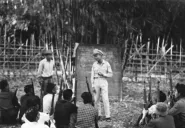
On New Year’s Day 1926 the French résident of Darlac stood in front of the assembled chiefs at Buon Ma Thuot and told them, among other things, that the peoples around us who had let strangers into their country had lost their law and were themselves lost. Ten times he told them to touch the bracelet. Six months later he was quietly relieved of his post, and a fortnight after that eight thousand hectares of the plateau went out on a ninety-nine-year lease at ten cents a hectare. We have now read the book he printed of that day. We are also obliged to report something we did not expect: no Dega document we can find, from 1958 to now, appeals to it.
The palabre of January 1, 1926
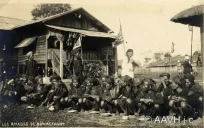
Sabatier printed his own record of the assembly four years later, in Hanoi, as Palabre du serment au Darlac — ninety-four pages, in French. A copy has been digitized by a French university library and is public domain, which is how we are able to describe it here rather than repeat what others have said about it.
It opens with the new year and a roll of who was in the room:
“AUJOURD’HUI commence l’année nouvelle; c’est pourquoi je vous ai tous appelés, chefs de villages des tribus: Rhadé kpa, Adhams, Krungs des terres rouges, Blos noirs, Bihs des marais, Djarays des terres pierreuses…”
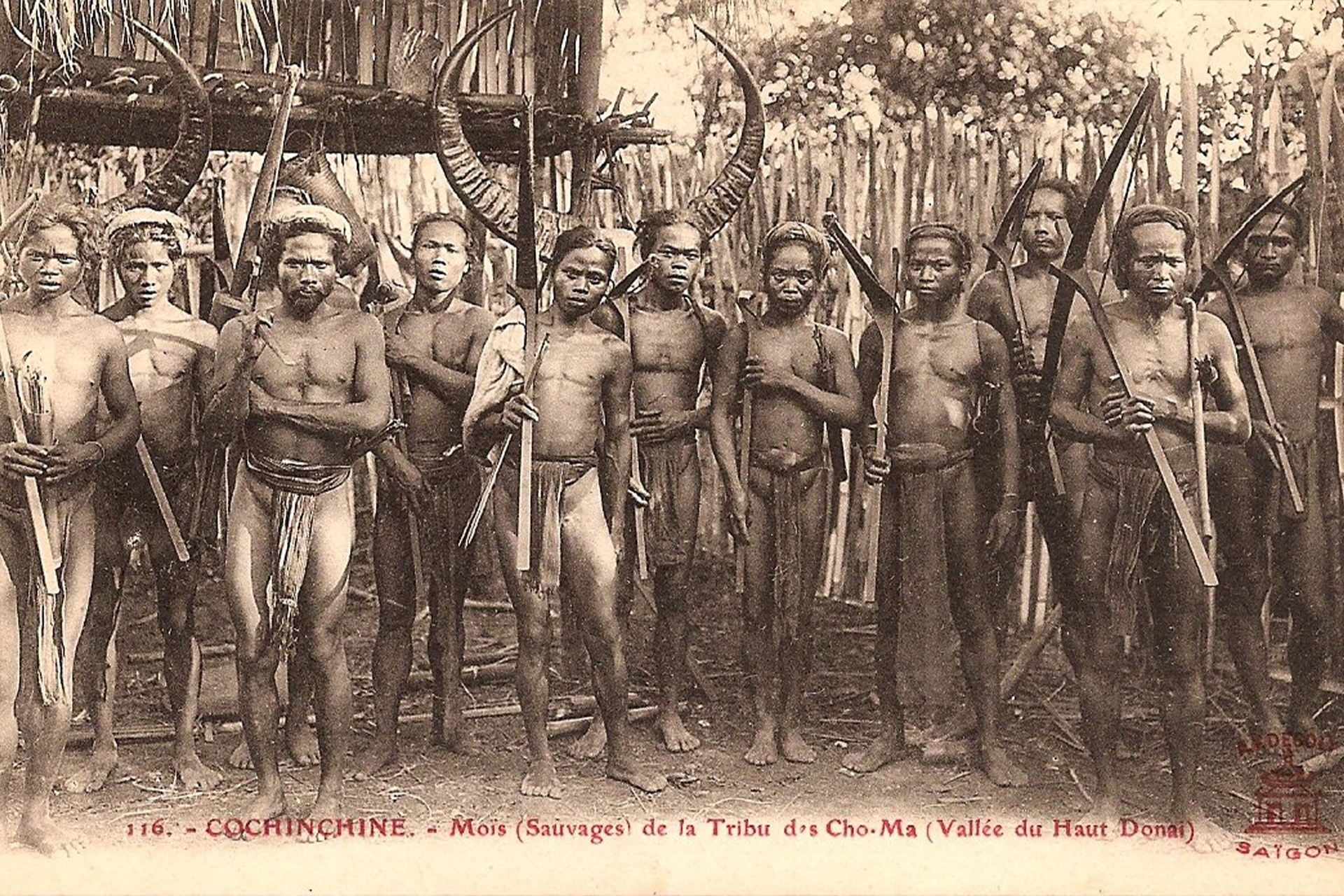
— today the new year begins; that is why I have called you all, village chiefs of the tribes: Rhade Kpa, Adham, Krung of the red earth, black Blo, Bih of the marshes, Jarai of the stony ground. The Mnong Rlam, Mnong Gar, Mnong Nong and Mnong Lat are named after them. It is a list of peoples, by their own subgroup names and by their country, spoken to their faces.
The address is built around five laws, presented as the five fingers of the right hand, and given in Rhade: the indissolubility of the union; the obligation to replace a dead spouse; that chiefs must protect the people of their village; that the people of the village must heed their chief; and the law of the land. Then the image that holds them together:
“Désobéir aux deux premières, c’est trancher la racine femelle de l’arbre smuk; ne pas suivre les deux autres, c’est en couper les branches; méconnaître la dernière, c’est en abattre le tronc.”
Disobey the first two and you cut the female root of the smuk tree; fail to follow the next two and you cut its branches; ignore the last and you fell the trunk. The marriage laws are the root, and the root is female. A French administrator explaining Rhade law to Rhade chiefs put matriliny at the bottom of the tree, where it holds everything else up. See Customary law and the village court and Dega women.
What he warns them about is what happens to peoples who let outsiders in. Of the country along the Annamese, Cambodian, Laotian and Siamese borders he says those who allowed it ont perdu la loi et qu’ils sont perdus eux-mêmes — they have lost the law and are themselves lost: the country deserted, the people poor and open to the slave merchants. He names the trade in front of them, with names in it: K’Chay, and the Annamese Pham Quyên, taking Mdhur women and children to sell at Buon Bal. This was not a metaphor in that room. See The slave raids.
And there is an undertaking on the other side. The French had come, he tells them, pour assurer la paix dans le pays, la sécurité dans les villages — to secure peace in the country and safety in the villages.
Touch the bracelet
The book is not a speech with an oath at the end. There is no sworn formula printed in it. What there is, about ten times over, is an instruction: Touchez le bracelet. Each one comes after a specific undertaking — to keep foreigners out and hold to the law of the ancestors; to stop the slave merchants, the killers and the thieves; to keep the roads and guard the bridges; to give sound and honest young men to the militia; and the commanders to command them properly.
That is not a French ceremony. The bracelet is ours. Among the Jarai a girl gives her consent to a marriage by not touching the bracelet the go-between holds out; it passes to the boy’s mother, who puts it on his wrist, and an engagement is broken by returning it. Among the Rhade the bracelet settles and seals. The résident of Darlac did not invent an oath for the chiefs. He reached for the object our own law already used to make a thing binding, and used it ten times in one morning. See The bracelet and Yang, the spirits.
The child in the frontispiece
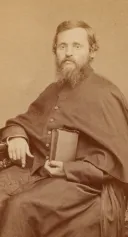
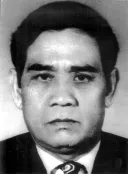
Every account of Sabatier we had read was silent on whether he had a family here. The book answers it on its own opening pages. The frontispiece is a portrait of Léopold Sabatier and his daughter H’Ni, born in 1923, whose mother was a highland woman named H’Nhuôn Niê. The dedication is to the child, as both the past and the future of Darlac.
Her name is out of the Dam San epic — the epic Sabatier himself collected and published in Paris in 1927 as La Chanson de Damsan. He gave his daughter the name of the heroine of the song he had taken down from our singers. See Gongs and epics.
What he built
He took Darlac around 1913 and held it until 1926 — a minister told the Chamber the following year that he had been fourteen years alone among these men. He learned Rhade and worked out a way of writing it, about 1916 by the reckoning of the American survey of 1966, which also records, fifty years on, that few people except missionaries ever used it.
- A Franco-Rhade school at Buon Ma Thuot, teaching in both languages, which educated the generation that made BAJARAKA. Y Thih Eban, born 1932, went to the Franco-Jarai school at Pleiku and then to the Collège Sabatier. See The Franco-Rhade school and the Collège Sabatier.
- A customary law court from 1923 — the Tribunal Coutumier, sitting at Buon Ma Thuot in the first seven days of every month, where the chief judge decided by our own law and custom, with village and district levels below it.
- Medical posts and a highland guard recruited from among ourselves.
- A closed door. Vietnamese and Chinese traders, planters and even missionaries were kept out of Darlac, and the land held for shifting cultivation was kept back from concession.
Forty years later there were two accounts of the same man. The Rhade spoke of a man at Ban Don known as the King of the Rhade. A US Army handbook compiled in 1966 for officers working among us answers: “Actually, he was the head of the Tribunal Coutumier which was held monthly in Ban Me Thuot and, while he was well known among the Rhade, he apparently had no political function.” Keep the handbook’s own apparently. An army manual had its reasons for finding no political function in a highland office, and the people who called him king had lived under his judgments. What would settle it is the court’s own rolls, and we have not found them.
How he was removed
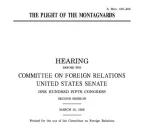
The whole thing was fought out in the French Chamber of Deputies on March 18, 1927, and the record of that debate is the best source on his fall that exists.
The attack was led by Ernest Outrey, deputy for Cochinchina, and it was not about land. It was about how the roads had been built — six hundred kilometers of them, which Outrey conceded was a very great service, from a population of twenty-five thousand registered inhabitants, by innumerable days of corvée. And it was about a series of specific and ugly allegations: that a militiaman called Y-Diap was punished for failing to salute, punished again for laughing, threatened with strangling, and sentenced to five years by the native tribunal of Darlac sur l’ordre du résident; that in 1922 a militiaman was told to kill a prisoner, Y-D’jou, on the road and report it as an escape, and that the official report of February 25, 1922 duly says the prisoner attempted to escape and was shot; that on January 19, 1926 — eighteen days after the oath — two prisoners, Y-Tu and Y-Plok, were blindfolded, noosed and hanged, and Y-Tu shot when his rope broke; and that a school inspection found twelve children with the cangue around their necks.
These are allegations, made in a political debate by a man who wanted Sabatier gone, and they were never tested. We print them because they are in the parliamentary record with names and dates in them, and because a page about a colonial protector that leaves them out is not telling the truth about the file.
The inquiry was conducted by an official named d’Eloy. Outrey’s description of it: d’Eloy came to Buon Ma Thuot, lodged with the résident, ate at his table, and questioned the witnesses in his presence. The inquiry cleared him. He was relieved of his post three days later, quietly, with no proceedings and no announcement. The exoneration and the removal were the same operation.
Against Outrey stood Marcel Cachin, who read out what Sabatier had been writing to his superiors:
“Je ne permettrai pas, tant que je serai là, qu’on leur vole leurs terres.”
I will not permit, as long as I am here, that their lands be stolen from them. And from the other side of the chamber, Outrey conceded the motive in one sentence: “Je dois dire que M. l’administrateur Sabatier avait toujours refusé toute concession et toute aliénation des terres au profit des colons” — I must say that the administrator Sabatier had always refused every concession and every alienation of land for the benefit of the colonists.
Then the date that answers both of them. July 14, 1926: eight thousand hectares to a M. Mailhot, on an emphyteutic lease of ninety-nine years, at ten cents the hectare. As long as I am here. He had been gone a matter of weeks.
What followed on the plateau over the next years was rubber and coffee on the red basalt, which is where this library’s land pages begin. See Rubber and Land taken for coffee.
The code
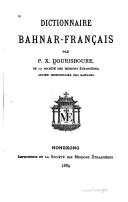
The collection of Rhade customary law he made was published fourteen years after he left, in Hanoi in 1940, as Recueil des coutumes rhadées du Darlac — in Rhade, Hdruôm hră klei duê klei bhiăn đum — translated and annotated by Dominique Antomarchi, as number 4 in the series Textes et documents sur l’Indochine. It is bilingual, and it is out of print.
Antomarchi was born in 1901 and died in 1941, the year after it appeared, at about forty. He had worked alongside Sabatier on the schools and the medical service. He was at most twenty-five when Sabatier was removed, and the book came out in the middle of the war, under an administration Sabatier never saw.
Here is what we have to admit. We have not read a single article of the code. We cannot confirm how many articles it contains — the figure of 236 in general circulation has no source we can trace. We do not know who declaimed the sayings, which judges, over what period, or whether Antomarchi collected independently after 1926 or worked up Sabatier’s notes. There has never been an English translation. For a document routinely called the most complete written statement of any of our peoples’ law, that is a remarkable state of affairs, and it is ours to fix.
What can be said is that the law in it is declaimed law — rhythmic, paired sayings recited from memory by the judges — and that the 1926 palabre gives a sample of how it sounds, because the five laws and the smuk tree in that address are the same kind of speech.
What we actually appeal to
The oath of 1926 is sometimes described as a mutual undertaking, and as the understanding the highland leaders of 1946 and 1958 would appeal to. We went looking for that appeal and could not find it.
We have found no Dega text — no memoir, no petition, no FULRO document, no diaspora history — that mentions Sabatier, the palabre, or the code. Our own organizations’ account of where highland autonomy came from names the French in general, dates the romanizing of our languages to 1892 and the first school to 1901, and does not credit him at all. The BAJARAKA petition of 1958 went to the ambassadors of France, the United States and the United Nations, and asked for outside intervention; it did not argue from 1926. Where the customary law is actually demanded back is at the Pleiku conference of October 1964, among the FULRO demands: Bao Dai’s statut particulier, development programs, and the reinstatement of customary highland law. The line of appeal in our own documents runs 1951, 1958, 1964 — through the Crown Domain and the emperor’s guarantee, not through the résident’s bracelet.
So the honest version is this. The oath of 1926 is a charter we are reading now, not one we carried. Whether that is because it was never ours to carry, or because a French book in ninety-four pages of French was never going to reach the villages it was about, we cannot say. Both are possible and the second is likelier. See The BAJARAKA movement and What we ask for.
A colonial official, not a saint
He governed us for France. His protection was paternal and his purpose was to keep us as he thought we had always been — a friend who admired him wrote afterward that Sabatier had vowed to save the Moï race and that Darlac had become his field of experiment. The court, the school and the code were real, and so were six hundred kilometers of road built on forced labor and the allegations Outrey put to the Chamber. Both things are in the same file and we do not get to keep only one.
What we have not read
The 1940 code itself, in any form. Oscar Salemink’s chapter on Sabatier, which is the fullest scholarly account and which we know only by its title and one sentence. The 1952 memorial notice on Sabatier and the obituary of Antomarchi, both in the Bulletin of the French school at Hanoi and both closed to us. Maillot’s contemporary pamphlet Autour d’un scandale colonial: le Darlac of 1927, which is on the French national library’s site and which we could not open — and which, given that the concessionaire of July 1926 is named Mailhot in the parliamentary record, may not be a disinterested account. Sabatier’s two reports of 1927 on land tenure, whose whereabouts we do not know. And anything at all about what became of H’Ni. She was born at Buon Ma Thuot and her family was ours; if your people there remember her, or remember the household she was born into, that is the one gap on this list we are not going to close out of a library. See How to record an elder.
See also: Roads, taxes and forced labor, The outsiders we welcomed, The Rhade.
Sources
- Léopold Sabatier, Palabre du serment au Darlac: assemblée des chefs de tribus, 1er janvier 1926 (Hanoi, 1930), 94 pp. — digitized and public domain at Université Côte d’Azur (ark:/17103/g0q1, Fonds ASEMI). The roll of the tribes, the five laws as the five fingers of the right hand, the smuk tree, the ten touchings of the bracelet, the warning about the neighboring countries, the slave traders named, the French undertaking, and the frontispiece portrait of Sabatier with his daughter H’Ni
- Journal officiel de la République française, debate on Indochina in the Chamber of Deputies, March 18, 1927 — the record. Outrey on the roads and the corvée, the Y-Diap sentence “sur l’ordre du résident”, the allegations concerning Y-D’jou, Y-Tu and Y-Plok, the twelve children in the cangue, the d’Eloy inquiry and the relief three days later, the concession of July 14, 1926 to Mailhot, and Cachin quoting Sabatier’s own reports
- Léopold Sabatier, La Chanson de Damsan: légende radé du XVIe siècle (Leblanc et Trautmann, Paris, 1927) — digitized at Université Côte d’Azur (ark:/17103/d38b), with Pierre Pasquier’s preface. Also published in the Bulletin de l’École française d’Extrême-Orient 33 (1933), pp. 143–302
- Léopold Sabatier and Dominique Antomarchi, Recueil des coutumes rhadées du Darlac = Hdruôm hră klei duê klei bhiăn đum, Textes et documents sur l’Indochine no. 4 (Imprimerie d’Extrême-Orient, Hanoi, 1940) — the publisher’s record. Bilingual, out of print, and unread by us
- Bibliothèque nationale de France, authority record for Léopold Sabatier (1877–1936) — the dates, which correct the “died about 1929” that circulates elsewhere
- Minority Groups in the Republic of Vietnam, Department of the Army Pamphlet 550-105, 1966 — at the Internet Archive. The courts at village, district and provincial level and the Tribunal Coutumier sitting the first seven days of each month (p. 52); the written Rhade developed by Sabatier and used by few but missionaries (p. 675); Antomarchi aiding him on the schools and the medical service (p. 677); and the King of the Rhade at Ban Don (p. 716)
- Human Rights Watch, Repression of Montagnards (2002) — Y Thih Eban at the Franco-Jarai school and the Collège Sabatier (p. 21 n.27); Bao Dai’s guarantee of native landed property (p. 19); and the Pleiku demands of October 1964 including the reinstatement of customary highland law (p. 23)
- Our own “History” — our account of where highland autonomy came from, in which Sabatier does not appear
- Oscar Salemink, The Ethnography of Vietnam’s Central Highlanders: A Historical Contextualization 1850–1990 (University of Hawai‘i Press, 2003), chapter 3, “Léopold Sabatier: Colonial Administration and Cultural Relativism” — the fullest account there is, and one we have not been able to read. His argument, from the dissertation behind the book, is that administrative ethnography of Sabatier’s kind created the ground for cultural relativism in the academy: the protecting and the describing were the same act
- Rie Nakamura, “A Man of the Central Highlands,” JATI 19 (2014), pp. 190–191 — cited here only for the 1913 start date. The article is about the writer Nguyễn Ngọc, not about Sabatier
Compiled September 2026, after reading the 1926 palabre itself. The 1927 allegations are set down as allegations. French is quoted as printed.