

















Our children start school in a language they do not speak, under a rule that is written in no decree: Vietnamese only in the classroom. Primary school nearly works. By fifteen the system has lost half of them. A Rhade teacher will pretend not to understand a Rhade child who asks him a question, because that is what he has been told to do, and a child whose father fled the country can be expelled in the middle of grade six because the commune took the family’s papers.
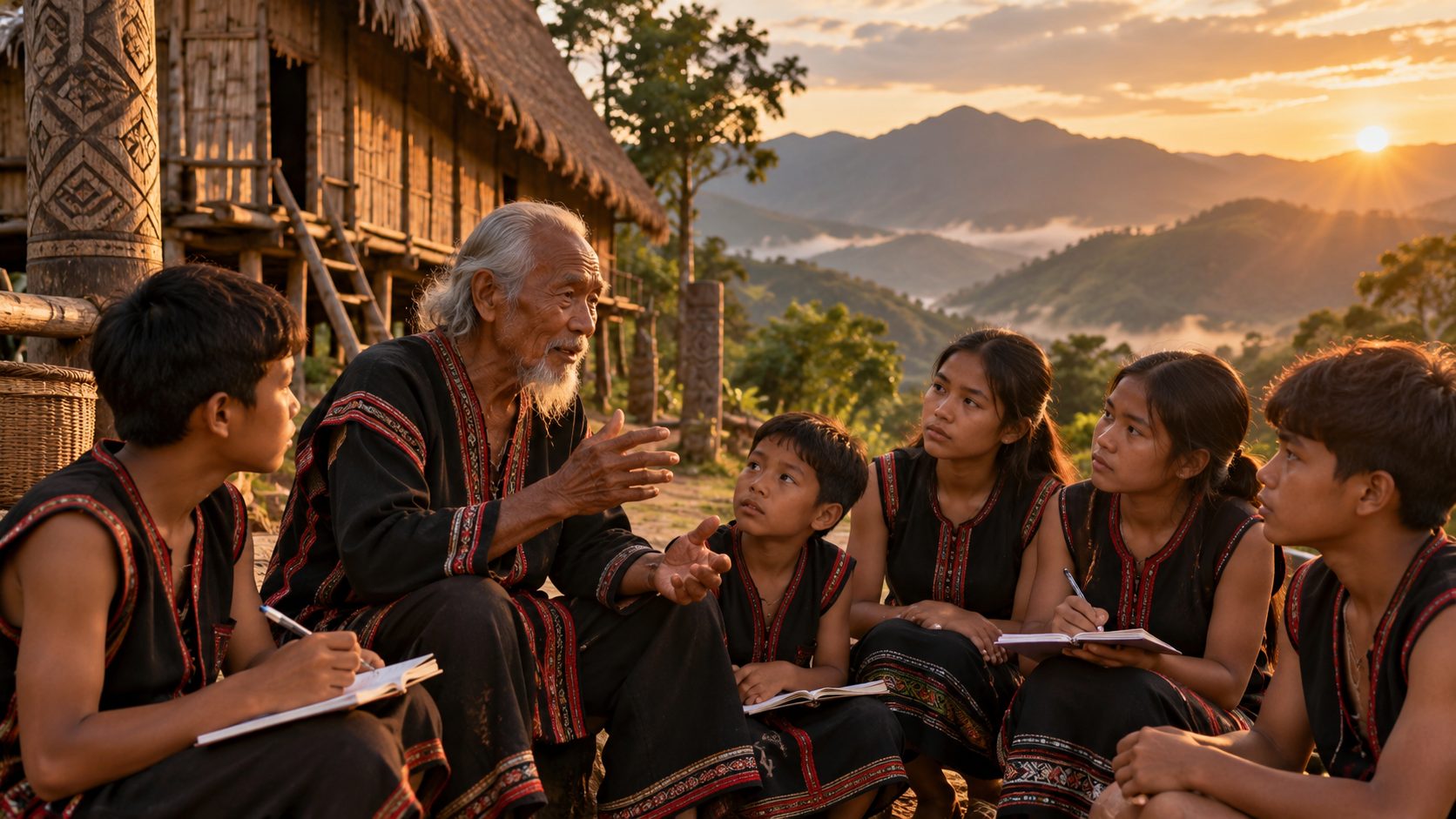
The rule that is not written down
Vietnam’s constitution provides for instruction in minority languages. The vast majority of primary schools in the Central Highlands teach in Vietnamese. That gap between the paper and the room is the whole subject of this page, and it repeats in every section below.
Researchers who interviewed sixteen education officials, school leaders and teachers across two secondary schools in Gia Lai and two in Dak Lak found the governing rule to be “Vietnamese only” — not formally documented by any department, and operating as standard practice all the same. An officer of the Department of Education explained the reasoning to them: if Vietnamese only is not strictly mandated, minority students will use their own languages, and then their attainment will not improve.
So the teachers enforce it. A mathematics teacher noticed that weaker Jarai students ask the stronger ones for help in Jarai, and told the strong ones to stop. A physics teacher reported that his class cooperated with the rule and grasped very little of his teaching. A biology teacher put it in a sentence: some of them are in grade six or seven, and their Vietnamese is below that of a Kinh child in grade three.
The hardest of these accounts is a chemistry teacher who is himself Rhade. Rhade students ask him things in class, a lot of it about the lesson. He pretends not to understand, or answers in Vietnamese. He uses Rhade only when something is urgent.
Others quietly break the rule. A Jarai biology teacher explains tropical vegetation by reminding children of things they have seen, and uses a little Jarai to carry half the class. An English teacher who went round the villages in his early years picked up enough Rhade to speak to his students in it, and found they came closer and listened harder. A mathematics teacher lets the strongest Jarai students translate when something matters. And a history teacher said the thing that should be nailed above the door of every education ministry in the world: their faces showed their happiness and comfort, not like what they had to undergo in the classroom.
The principal explains why none of it can change. The school must align with the national curriculum, the national textbooks, the national pedagogy and the national assessments, so everything must be in the national language.
What the law actually says, and how it weakened
The instruments are not hard to read, and they move in one direction.
| Instrument | What it grants |
|---|---|
| Law on Universalization of Primary Education, 1991 | Primary education is in Vietnamese; ethnic minorities have the right to use their languages and scripts along with it |
| Education Law, 1998 | The State creates conditions for ethnic minorities to study their languages and writing systems |
| Education Law, 2005 | The State creates conditions for them to learn their languages and scripts, to preserve cultural identity |
| Education Law, 2019 | The State encourages and creates favorable conditions for ethnic minorities to learn their language and to write |
A right became an encouragement in twenty-eight years. And note what the verb governs even at its strongest: learning the minority language as a subject. None of these provisions is a promise to teach our children in our languages. We have taken this sequence from a secondary study of poor quality because it is the only place we have found the four texts set side by side; the direction of travel is clear, the exact English wording should be checked against the statutes, and we would be glad of a better source.
How much of our language is taught
In 2007–08, seven minority languages — among them Ede, Bahnar and Jarai — were taught across seventeen provinces and cities to 107,905 pupils in all. In the following year the number of schools offering any minority language fell 11.4 percent and the number of pupils fell 14.2 percent. Of the five highland provinces, one ran a bilingual experiment, in one language: Gia Lai, in Jarai. A mother-tongue bilingual pilot ran with UNICEF from 2008 to 2015 in three provinces, Gia Lai among them, from preschool to grade five. We have found no independent account of what replaced it when it ended.
For Ede in Dak Lak there is one set of provincial figures, and we give it with a warning: it comes from a pay-to-publish journal and the numbers almost certainly originate with the provincial department of education. In 2004–05 there were 185 teachers of Ede for 7,856 pupils. In 2021–22 there were 128 teachers for 10,271 pupils. Thirty-one percent more children, thirty-one percent fewer teachers, and about half the remaining teachers working part-time. Between a quarter and a third of the pupils had an Ede textbook. Half of those who started in grade three were gone by grade five. If the figures are wrong, we would like the right ones; nobody publishes them.
Where the children go
The shape of the loss is the important thing, and it is consistent across every dataset we could reach.
| Level | Ethnic minority | National or Kinh | Source |
|---|---|---|---|
| Primary attendance, 2024 | 96.3% | 98.3% | GSO and the Ministry of Ethnic and Religious Affairs, published by UNICEF Viet Nam |
| Lower secondary attendance, 2024 | 87.0% | 95.2% | As above |
| Upper secondary attendance, 2024 | 51.7% | 79.4% | As above |
| Literacy, 15 and over, 2024 | 84.9% | 96.6% | As above |
| Upper secondary attendance, 2013–14 | 29% | 74% | World Bank, 2019 |
| Post-secondary attendance, 2013–14 | 4.7% | 12% | World Bank, 2019 |
| Upper secondary net enrollment, rural Central Highlands, 2006 | under 20% | almost 60% | Baulch and others, World Bank |
| Illiteracy among the Bahnar and Jarai, around 2000 | 70–72% of men, 88% of women | — | UNDP, cited by Human Rights Watch, 2002 |
Two points below the national average at primary. Eight at lower secondary. Twenty-eight at upper secondary. The system does not fail our children at the start. It fails them at fifteen. Ethnic minority pupils are more than seven times as likely to drop out as Kinh pupils, and in the Central Highlands the dropping-out peaks between grades six and seven, especially among girls.
Be careful with the headline numbers, because they are contested in public. In November 2023 a member of the UN Committee on the Elimination of Racial Discrimination told Vietnam that 63 percent of Kinh children reached upper secondary school against 31 percent of ethnic minority children. In the same session Vietnam’s delegation said the proportion of ethnic minorities enrolled in upper secondary education had risen to 59 percent. The two numbers are not the same measure — reached, versus enrolled — and that is exactly the point: the gap between 31 and 59 is mostly a choice of definition, and the state chose the one that flatters. The 51.7 percent above sits between them and is the best current figure.
The boarding schools
There are 315 ethnic minority boarding schools in forty-nine provinces, with more than 109,000 students. Fifty-nine are run at provincial level, 256 at district level. Only 40 percent of them meet the national standards. The UN agency that commissioned research into them wrote, in its own terms of reference, that facilities and equipment are limited, that staff have not been regularly trained in inclusive education, that some school regulations for ethnic minority students are culturally inappropriate, and that numerous cases of violence and sexual abuse are reported in boarding schools.
What are they for? Vietnam answered that question itself, to a UN treaty body in November 2023: boarding schools were established in the 1950s to develop ethnic minority cadres. The Committee’s experts asked why the boarding schools were segregated, whether anyone had assessed the effect of boarding education on the children, and why satellite schools in remote areas had been closed. The delegation replied that some satellite schools had closed because access to better schools had improved.
Fourteen months earlier, the UN Committee on the Rights of the Child had told Vietnam to do the opposite: to ensure quality satellite schools in remote areas “with a view to phasing out boarding and semi-boarding schools.” One UN body asked Vietnam to keep the village school and wind down the boarding school; Vietnam told another UN body it had closed village schools because the big ones were better. Both statements are in UN documents.
A study of the wellbeing of children in these schools, funded by UNICEF, collected data in Lào Cai, Kon Tum and Ninh Thuận in 2023 and was expected to be published that December. We have not been able to find it.
What school costs
In theory our children are exempt from school fees. In 2002 Human Rights Watch set out what was actually charged: 300,000 to 500,000 dong a year for a primary pupil, a million for lower secondary, one and a half million for high school — roughly 23 to 100 US dollars a year, per child — with books, pens and paper on top, and private tutoring beyond that. Twenty years later the US State Department was still recording the same arrangement: by law education is free and compulsory to fourteen, ethnic minority students are exempt from fees under a subsidy program, and school fees were common.
It is worth stopping on that. The exemption is not a dead letter from long ago. It has been on the books, and not honored, for the whole of a child’s school career, twice over.
We do not have a figure for what school costs a highland family in any year since 2002, and we have looked. We also have no measure of the work a highland child does instead of going to school, and no study connecting the loss of a family’s land to a child leaving school — although the UN Committee on the Rights of the Child has put the eviction and displacement of indigenous children and their families on Vietnam’s record. The land pages are Land taken for coffee and Pushed off our land.
Faith, papers and the gate at grade eight
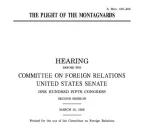
The clearest account of how a Dega child is removed from school came from a Montagnard woman to Human Rights Watch. When a student gets to eighth or ninth grade, she said, there is always difficulty getting to a higher level; if you are of a different religion, or your father was in FULRO, you are not allowed to go further, because they do not want you to know anything. Then the mechanism: “They line the kids up and ask them what religion they are.” They find a way to drop the child — by taxing the family more, by making them pay more money. The families are already very poor, so the children leave.
The gate is money and the key is faith. The same report records an Ede woman saying that even with twelve years of school our people cannot work as doctors or government employees, because we are said to follow an American religion and not real Christianity; an Ede girl told she was no longer welcome at school after she joined the February 2001 demonstration in Buon Ma Thuot; and a decision by the commune committee of Ea H’leo district that a school could hire a Jarai woman as a teacher if she undertook in writing to abandon Protestantism. See The church they closed.
Papers are the other gate. The US State Department records that the government sometimes denied education to children of families not registered in their locality, and to the children of some political and religious activists; that a birth certificate is required to reach public services including school; and that local authorities have prevented some parents from registering children. A World Bank study of the household registration system found that children with only temporary registration are substantially less likely to be enrolled at lower and upper secondary level, even after everything else is accounted for, and that many schools give permanent registrants priority.
Both accounts were given by name, with dates, villages and communes in them, to a United Nations treaty body in 2023, by the families themselves through their own organizations. Nobody has been able to check them against Vietnamese records, because Vietnam does not open the files on whose papers it takes. What is established from other sources is the pattern they belong to: a child’s schooling is used as leverage against an adult.
After school, for the few who get there
Preferential admission to university exists and is largely captured by other people. Of fifty-three minority students surveyed in the preparatory schools that feed the universities, 88.6 percent came from the northern minorities near Hanoi — the Tày, the Nùng, the Mường — who are close to the Kinh geographically and culturally. The peoples counted as distant get the residue. We are the distant ones.
And a diploma does not buy a job. The one serious ethnography of education in the Central Highlands, done in Dak Nong in 2005, found that Mnong graduates could not get the work that the industrializing local economy was creating, despite the centralized examinations and the diploma-based recruiting rules that were supposed to make it possible. Its author called schooling there a system that reproduces the existing divisions between indigenous people and migrants rather than a ladder out of them. Its title came from what highland parents are told about themselves: that they do not value schooling.
What we have not found
There is no published, independent, per-people education table for the Ê Đê, Gia Rai, Ba Na, Cơ Ho, Mnông or Xơ Đăng. The UN and World Bank publications either aggregate us into “ethnic minorities,” or into “others,” or into size bands. Only one Central Highlands people, the Xơ Đăng of Kon Tum, has ever been studied individually in a World Bank report on minority development. And one of the research teams whose figures this page relies on recorded that it could not obtain permission to work in the Central Highlands at all, and went to Lạng Sơn, Sơn La and Trà Vinh instead.
So the honest summary is this: the best numbers about our children’s schooling are produced by the state that runs the schools, are not broken down by our peoples, and the outsiders who wanted to come and count were not let in. If you have taught in a highland school, studied at one, or been kept out of one, you know something the published record does not. See How to record an elder and Language resources.
See also: Growing up Dega, Schools and language, The Franco-Rhade school and the Collège Sabatier.
Sources
- Human Rights Watch, Repression of Montagnards (2002), chapter VIII — Article 5 of the constitution against the practice of the classroom, the fee schedule, the lining up of children by religion, the Ede woman on doctors and government work, the girl expelled after the 2001 demonstration, and the Ea H’leo commune decision
- Chinh Duc Nguyen and Thanh Nguyen Thao Tran, “Languages and Ethnic Minority Students’ Access to Education in Vietnam,” in Vietnamese Language, Education and Change In and Outside Vietnam (Springer, 2024) — the “Vietnamese only” rule and the teachers’ and parents’ own words, from fieldwork in Gia Lai and Đắk Lắk
- Trương Huyền Chi, “‘They Think We Don’t Value Schooling’: Paradoxes of Education in the Multi-Ethnic Central Highlands of Vietnam,” in J. London (ed.), Education in Vietnam (ISEAS, 2011) — the Đắk Nông fieldwork of 2005 and the Mnong graduates
- Trương Huyền Chi, Eliminating Inter-Ethnic Inequalities?, Young Lives Working Paper 69 (Oxford, 2011) — the 107,905 pupils across seventeen provinces, the decline the following year, Gia Lai as the only bilingual experiment, the dropout ratio and the boarding-school stipends. Ministry figures, reported and assessed in an Oxford working paper
- General Statistics Office and Ministry of Ethnic and Religious Affairs, published by UNICEF Viet Nam, Disparities and Multidimensional Child Poverty among Ethnic Minority Populations in Viet Nam (December 2025) — the 2024 attendance and literacy figures. A Vietnamese state statistical product, published by a UN agency, and given here as that
- World Bank, Vietnam’s Human Capital: Education Success and Future Challenges (2019) — the 2013–14 attendance figures by level
- Bob Baulch and others, Ethnic Minority Poverty in Vietnam (World Bank, 2009), and the team’s full research report (2008) — the 2006 enrollment figures, the grade six to seven dropout peak, and the refusal of permission to work in the Central Highlands
- World Bank, Drivers of Socio-Economic Development Among Ethnic Minority Groups in Vietnam (2019) — the Xơ Đăng as the one Central Highlands people studied individually
- World Bank, From the Last Mile to the Next Mile: 2022 Vietnam Poverty and Equity Assessment (2023) — minorities as 79 percent of the remaining poor, and Kinh families spending seven times more on extra classes
- OHCHR, summary of the CERD dialogue with Viet Nam, November 30, 2023 — the 63 and 31 percent from a Committee expert, the 59 percent from the delegation, the purpose of the boarding schools, and the experts’ questions
- UN Committee on the Rights of the Child, concluding observations on Viet Nam, CRC/C/VNM/CO/5-6 (September 2022) — satellite schools and the phasing out of boarding schools, violence in schools, household registration, and eviction and displacement
- UNICEF Viet Nam and the UN in Viet Nam, terms of reference for research on ethnic minority boarding and semi-boarding schools (2022) — the 315 schools, the 109,000 students, the 40 percent meeting national standards, and the reports of violence and sexual abuse
- UNICEF Viet Nam, “Bringing mother tongues into the classroom” — the 2008–2015 bilingual pilot in Lào Cai, Gia Lai and Trà Vinh
- US Department of State, 2022 Country Report on Human Rights Practices: Vietnam — fees charged despite the exemption, education denied to unregistered families and to children of activists, and birth certificates as the gate to public services
- Gabriel Demombynes and Linh Hoang Vu, Vietnam’s Household Registration System (World Bank, 2016) — temporary registration and secondary enrollment
- Ito Miho, “Affirmative Action for Minorities to Go to Higher Education in Vietnam under Doi Moi,” Southeast Asian Studies 49(2) (2011) — the 88.6 percent of preparatory-school places held by the northern minorities
- UN Human Rights Committee, concluding observations on Viet Nam, CCPR/C/VNM/CO/3 (2019), paragraphs 55–56
- Nguyen Thu Huyen and Nguyen Thi Thuy, “Vietnam’s Language Policy for Ethnic Minority Languages from 1975 to Now” (2022), and Nguyen Minh Hoat and Nguyen Thi Thanh Huyen, “Vietnamese–Ede Bilingual Education in Primary Schools in Dak Lak Province” (2023) — the sequence of statutes and the Đắk Lắk teacher figures. Both are low-quality venues carrying figures that originate with Vietnamese authorities, and both are flagged as such in the text
Compiled September 2026. Where an official figure and an independent one conflict, both are given with the body that produced each.