




















Our languages were spoken for thousands of years before any of them was written. Between the middle of the nineteenth century and the 1970s, French missionaries, a French administrator and his teachers, American missionaries and linguists, and our own people put them into the Latin alphabet, one language at a time, each for its own reasons and each in its own spelling. Governments have banned, changed and replaced those spellings more than once since. This page tells how each of the main languages came to be written, who did the work, what the letters are, and what has happened to them since 1975.
Before writing
What our peoples had instead of writing was memory, and a great deal of it: the long recited epics that the Rhade call klei khan, the rhythmic sayings of customary law, and the memory of the elders. See Gongs and epics and Customary law.
We also have stories about why we did not write. The Rhade tell that their creator, Ida, called the peoples to come and receive their languages. The other peoples brought something plain to write on; the Rhade, wishing to make a good impression, brought a buffalo skin, which was finer and more costly, and on the way home a dog ran off with it and took the only copy of their writing. The Mnong tell almost the same story: their language was written on a buffalo hide, they hung it on the porch of a house when they got home, and in the night the dogs came and ate it. The oldest printed versions we have found are in an American army handbook of 1966, but the stories are older than the book and belong to the people who tell them. If your family tells them differently, we would like the other version.
The colonial government had a story of its own. Its report on schooling in 1934 claimed that French teaching had given intellectual life back to a people who “no longer even knew how to write its language.” We know of no Rhade writing older than the French one. The claim tells us more about how the administration saw its own work than about our past.
Bahnar: the Kon Tum mission
Bahnar was the first of our languages to be written, by the French Catholic priests of the Missions Étrangères who settled among the Bahnar at Kon Tum in the middle of the nineteenth century. The American army handbook of 1966 gives the dates: a written Bahnar devised at Kon Tum in 1861, in Latin letters resembling the romanized script of the Vietnamese; teaching interrupted by movements against the French; resumed in 1883, the year Father Guerlach arrived at the mission; and officially adopted in 1935. It does not say by whom, and we have not found the act. See The Kon Tum mission.
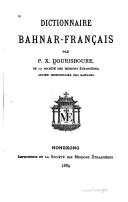
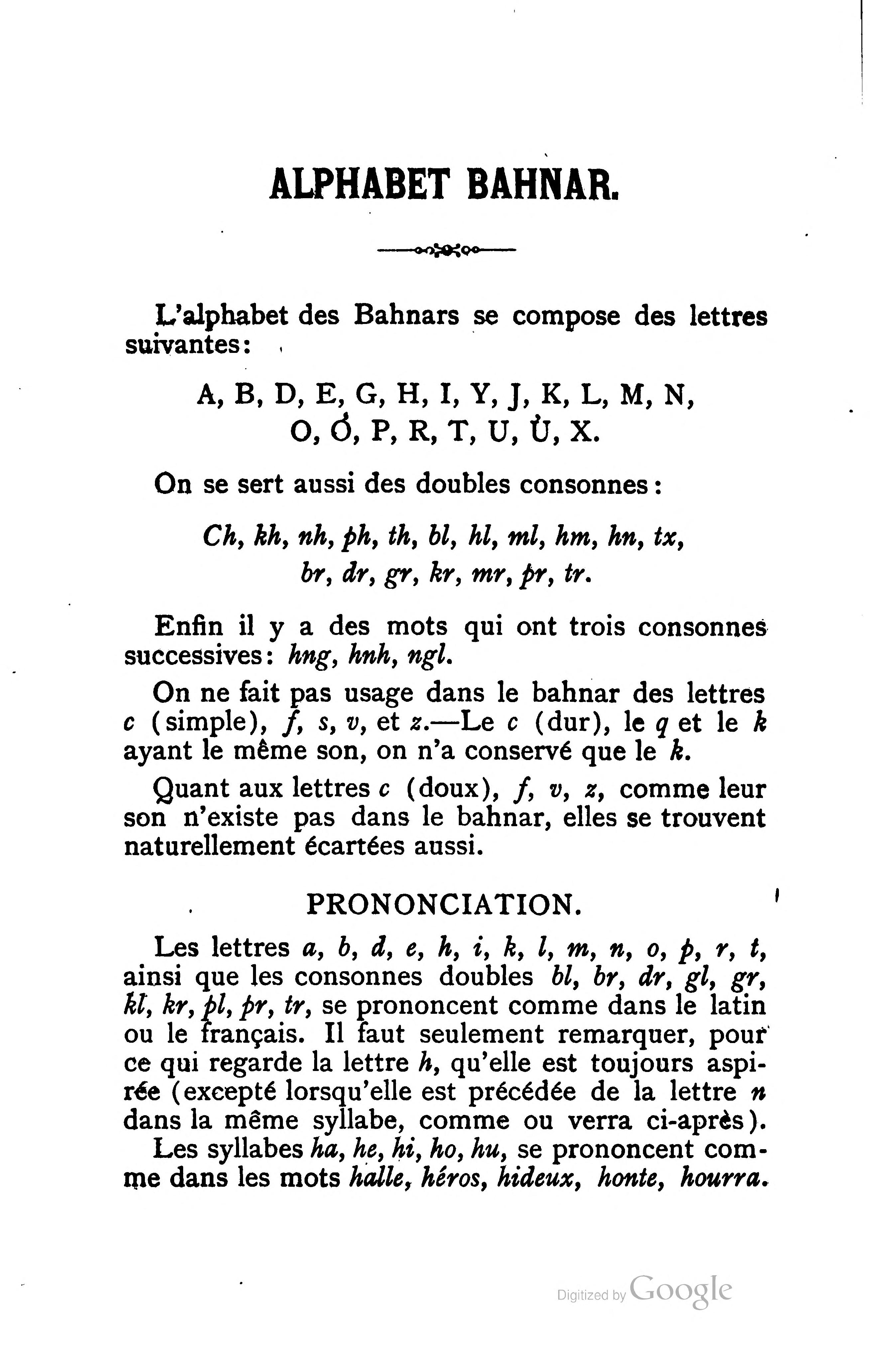
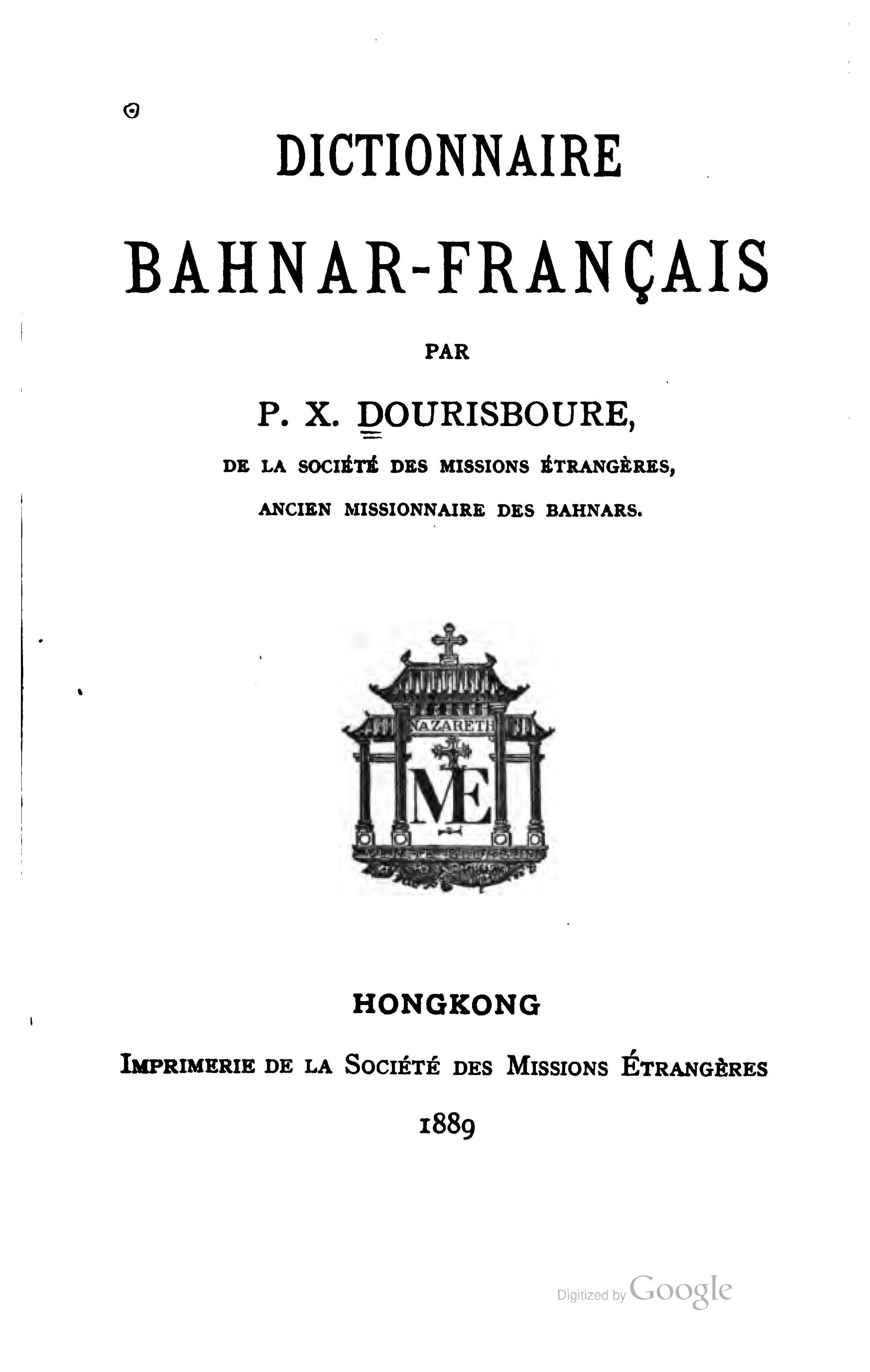
The oldest book in our library in any of our languages is Father Pierre-Xavier Dourisboure’s Dictionnaire bahnar-français, printed by the mission press in Hong Kong in 1889. Its alphabet has twenty-one letters: A, B, D, E, G, H, I, Y, J, K, L, M, N, O, Ô, P, R, T, U, Ù and X. It uses no c, f, s, v or z, writes the hard k-sound as kh, and borrows x and ch from the Vietnamese romanization with their Vietnamese values, as the author says in so many words. It writes clusters that French cannot, tx, hng, hnh, ngl, and tells the reader to pronounce them as they are written. By 1894 the same press had also printed a Bahnar primer and a catechism with prayers. The work went on in the twentieth century: Paul Guilleminet, with Father Jules Alberty, published a two-volume Bahnar–French dictionary of some ten thousand words through the École française d’Extrême-Orient in 1959 and 1963, and the American linguists John and Elizabeth Banker published a Bahnar dictionary in 1979 in which the preglottalized consonants are marked with an apostrophe, ’b, ’j, ’m, a letter the 1889 alphabet does not have. In 1966 the Rengao, neighbors of the Bahnar, were said to have no written language of their own; the few who could read had learned in Bahnar at the mission schools.
Rhade: the school at Ban Me Thuot
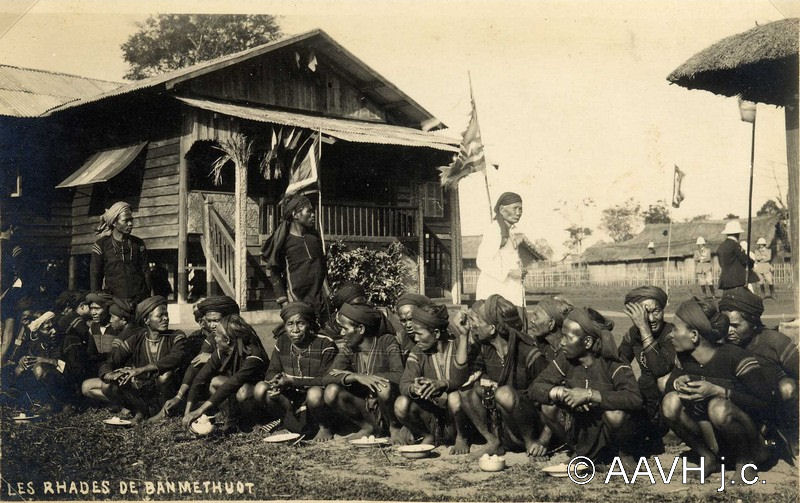
Rhade was written for a school. Léopold Sabatier, the French Resident of Darlac in the first quarter of the twentieth century, opened the Franco-Rhade school at Ban Me Thuot in 1915 with thirty pupils, and encouraged two educated Rhade men to begin devising an alphabet for their language. Their names have not come down to us. The American handbook of 1966 gives the whole credit to Sabatier, and so do most later books, but the letters were worked out by Rhade speakers. If anyone knows who those two men were, that is a name this library wants more than most. See The Franco-Rhade school and Sabatier and the Rhade code.
In 1921 the government press in Hanoi printed Sabatier’s Recueil de mots rangés d’après le sens, a collection of words arranged by meaning, for the pupils of the school. The real building of a written Rhade came after 1929, when a young teacher, Dominique Antomarchi, arrived in Darlac. He reorganized the school, spread a network of village schools across the province, and made teachers of the oldest and ablest pupils; with a team of Rhade teachers he wrote the school books, tried them in class and had them printed. The first examinations in Rhade were held in 1930. That September a section to train Rhade teachers opened at the Collège Quốc Học in Huế. Between 1925 and 1930, by the government’s own count, five thousand copies of school books were printed in Rhade and one thousand in Jarai. Every Rhade child’s first reader carried Antomarchi’s name, and the judges of the Rhade courts held the customary code he had translated. He died in 1941 with a Rhade–French dictionary three-quarters finished. When the Japanese took over Indochina in March 1945, the manuscript was given to two Rhade teachers, his closest collaborators, to hide; they were denounced and had to hand it back. Their names are not recorded either.

The Rhade letters are those of the central plateau: short vowels marked with a breve, long vowels left unmarked, and for the preglottalized consonants a barred ƀ, a barred đ and dj. Rhade dictionaries were compiled after Antomarchi’s by Louison and by Davias-Baudrit, and there was a short Raday vocabulary of 1957, but the first published Rhade dictionary, in its authors’ words, is the Rhade–English one of 1980, made by the American James Tharp with a Rhade scholar, Y-Bham Buon-ya. It is free to read and download from the Australian National University; see Language resources.
Jarai
Jarai was written by the French in the same years and in the same way, following the Vietnamese system; the thousand school books of the late 1920s are the earliest printed Jarai we know of, and a French–Jarai lexicon followed in 1940. Writing spread slowly. In 1964 a visitor reported that only about five hundred Jarai could read their own language, most of them taught by missionaries, in government schools, or in the army. From 1960 the Protestant missionaries worked to change that. The Jarai New Testament and Psalms, translated by Charles Long, were dedicated and presented to the Jarai people at the Evangelical church in Pleiku on February 16, 1975, weeks before the highlands fell. Long had sworn not to shave until it was finished; his wife was finishing a Jarai hymnal at the next table.
Koho: many spellings
Koho shows how unsettled a written language can be. A Sre alphabet based on the Vietnamese letters was made by French administrators and missionaries in 1935 or 1936, and the Catholic priest Jean Cassaigne produced Koho work of his own in 1936. In 1949 an orthography commission met at Đà Lạt to replace it, and Father Jacques Dournes published his Sre–French dictionary in the new spelling in 1950. More proposals followed in 1953 and in the 1960s. The Protestants split over a single vowel: one church kept î for the sound e, the other used ê, the spelling of the Christian and Missionary Alliance and the Summer Institute of Linguistics. The second spelling was used for the Koho New Testament, dedicated in March 1967, for the Psalms in 1993, for the complete Bible in 2010, and for the South Vietnamese government’s school books. In North Carolina today, which spelling a family uses depends on which church it belongs to.
The missionaries and the Bible
The Christian and Missionary Alliance came to Ban Me Thuot under French rule. Laura Smith, whose account of the mission was published in 1943, found that the French had already made a vocabulary of the Raday language, and within eight months her husband, Gordon Smith, had translated and printed a Gospel summary in Rhade, followed by Mark. She called it the first book the Rhade had ever had in their language. It was not: the school books of the 1920s came first, and so did Sabatier’s word book. At the Bible school at Ban Me Thuot, the first two Rhade students to finish the course, Y Suai and Y Ham, received their diplomas on Christmas Eve 1955; they had begun in 1947. By April 1956 the whole New Testament existed in Rhade: the Gospels and Acts in print, the rest in mimeographed sheets. The date of the first complete printed Rhade New Testament depends on whom you read. Kenneth Swain, who led the team that finished it with the Psalms for the British and Foreign Bible Society, gives 1964; a mission magazine of 1971 dates it to 1965. In 1966 the Mnong had parts of the Bible and fifty or sixty hymns in one of their dialects.
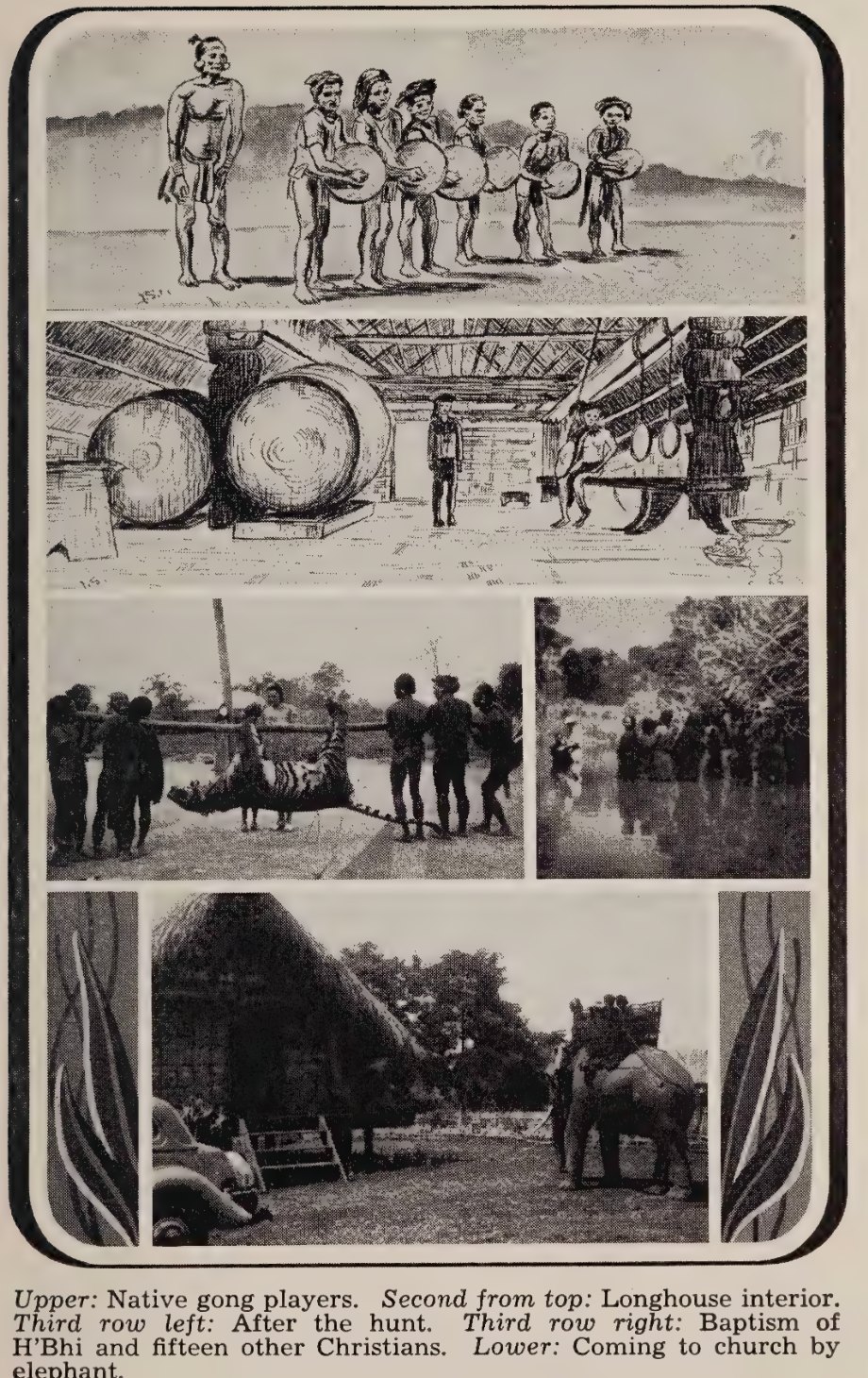
Complete Bibles are now in print in Rhade, the Klei Aê Diê Blŭ of 2015, in Jarai in two versions, of 2014 and 2016, and in Koho. There is a Bahnar Bible from a Bahnar Bible Association, and New Testaments or Bibles in Central and Eastern Mnong, Chru, Hre, Stieng, Chrau and Pacoh. For many of our families the Bible and the hymnbook were the first books they owned in their own language, and for many young people in America they are still the way in. See Missions and doctors and The Evangelical Church and registration.
Banned, then taught
Under Ngô Đình Diệm, instruction in our languages was banned; highland place names were replaced with Vietnamese ones, and highland soldiers had to take Vietnamese names. At the Pleiku conference of October 1964, after the rising, the Darlac delegation asked for our languages to be taught in the primary schools beside Vietnamese. On October 28, 1964, the Ministry of Education issued a decree allowing highland pupils to learn their own languages through the elementary grades, in parallel with Vietnamese. Little was done to carry it out. A presidential decree of August 29, 1967, repeated the promise: regional languages were to be taught along with Vietnamese, and the programs were to teach the customs and traditions of each people.
This time there was money behind it. In 1966 a joint commission of the Ministry of Education, the commissariat for the minorities and the American aid mission asked the Summer Institute of Linguistics to write the textbooks and train the teachers, and in 1967 the contract was signed. In the spring of 1967 a team of language specialists, working with the linguist Sarah Gudschinsky, who started the project, spent two months at the linguistic research center in Kon Tum preparing primers and textbooks in four languages: Bahnar, Jarai, Koho and Rhade. The children spent a first year learning to read and write their own language and to speak some Vietnamese; in the first grade they learned to read Vietnamese while studying from books in their own language; in the second grade every book was in both languages; from the third grade the curriculum was Vietnamese, with classes in their own language and culture. Enrollment rose, especially among girls, and fewer children repeated a year. The project was extended to Cham, Bru, Central Mnong and Hre, and then to Jeh, Sedang, Chrau, Chru and Northern Raglai; it was strongest in the Rhade, Bahnar and Koho country. A decree of 1972 added adult literacy, three months in the mother tongue and one month of transition to Vietnamese. By 1967 the Summer Institute had already printed primers in Bahnar, Bru, Chrau, Pacoh, Northern Roglai, Sedang and Stieng. See Schools, language and the university gap.
After 1975
After 1976, all the South Vietnamese teaching materials were discarded. In 1983 the new government introduced its own spelling for Koho, based on the Vietnamese alphabet; Koho families in North Carolina have not taken it up. Vietnam’s constitution provided for teaching in minority languages, but in 2002 most primary schools in the highlands were still teaching in Vietnamese. What the police did with our writing in those years is recorded by the people it was done to. An Ede church leader near Buon Ma Thuot described the fine for a first offense of worship, one million dong, with the confiscation of all documents and Bibles; an Ede woman remembered hiding the books and hymnals. From 2008 to 2015 UNICEF supported a pilot of mother-tongue teaching in three provinces, one of them Gia Lai, for Jarai children. We do not know whether it continued. See Schools and language.
A timeline
- 1861 — Bahnar. A written Bahnar is devised at the Kon Tum mission, according to the 1966 US Army handbook; teaching resumes in 1883.
- 1889 — Bahnar. Dourisboure’s Dictionnaire bahnar-français, with its twenty-one-letter alphabet, is printed in Hong Kong.
- 1915 — Rhade. The Franco-Rhade school opens at Ban Me Thuot with thirty pupils; two Rhade men begin an alphabet.
- 1921 — Rhade. Sabatier’s word book for the pupils is printed in Hanoi.
- 1925–30 — Rhade, Jarai. Five thousand school books printed in Rhade and one thousand in Jarai.
- 1929–30 — Rhade. Antomarchi reorganizes the schools; the first examinations in Rhade; a Rhade teachers’ section opens at Huế.
- 1935–36 — Koho, Bahnar. A Sre alphabet on the Vietnamese model; Bahnar writing officially adopted.
- 1949–50 — Koho. The Đà Lạt orthography commission; Dournes’s Sre–French dictionary.
- 1956 — Rhade. The whole New Testament exists in Rhade, partly in print and partly mimeographed.
- 1964 — All. After the ban under Diệm, the decree of October 28 allows our languages in the elementary schools.
- 1964–65 — Rhade. The printed Rhade New Testament and Psalms.
- 1967 — Bahnar, Jarai, Koho, Rhade. Primers for the Highlander Education Project prepared at Kon Tum; the Koho New Testament dedicated in March.
- 1975 — Jarai. The Jarai New Testament and Psalms dedicated at Pleiku on February 16.
- 1980 — Rhade. Tharp and Y-Bham Buon-ya’s Rhade–English dictionary, the first Rhade dictionary in print.
- 1983 — Koho. A new government spelling for Koho, not taken up in North Carolina.
- 2010–18 — Koho, Jarai, Rhade. Complete Bibles in print.
Typing our letters
Our spellings use letters that keyboards and fonts handle badly. The barred ƀ of Rhade and Jarai is a character of its own in Unicode, as is its capital; Rhade uses č and ñ; the short vowels carry a breve, as in ă, ĕ, ĭ, ŏ and ŭ. Where the breve sits on a letter that already carries a Vietnamese mark, as in ơ̆, ư̆, ê̆ and ô̆, no single character exists, and the two marks have to be stacked; many typists give up and write a Vietnamese letter instead, Ờ for Ơ̆ or Ē for Ê̆. When you write our names and words, check that the marks survived. The spellings of names on this site are discussed on Names and words.
What we do not know
The names of the two Rhade men who began the Rhade alphabet in 1915, of Antomarchi’s Rhade teachers, and of the two who hid his dictionary in 1945. Who adopted the Bahnar script in 1935, and by what act. When the first New Testaments in Bahnar and Mnong were printed. How the spellings taught in Vietnam today differ, letter by letter, from those our families brought to America. Our elders know some of these answers. If your family kept old primers, school books, hymn books or Bibles in our languages, or remembers a teacher’s name, we would like to photograph and record them.
Sources
- Department of the Army, Minority Groups in the Republic of Vietnam, Pamphlet 550-105 (1966), Internet Archive, in our library — the Bahnar dates, the Rhade and Mnong legends, the Jarai readers of 1964, the Rengao, the Mnong hymns
- P. X. Dourisboure, Dictionnaire bahnar-français (Hong Kong, 1889), Internet Archive, in our library — the title, dedication and alphabet; T’oung Pao 5, supplement (1894) — the Bahnar primer and catechism
- Paul Guilleminet and Jules Alberty, Dictionnaire bahnar-français, 2 vols. (EFEO, 1959–63); John and Elizabeth Banker, Bahnar Dictionary: Plei Bong–Mang Yang Dialect (SIL, 1979)
- Gerald C. Hickey, Kingdom in the Morning Mist (University of Pennsylvania Press, 1988), Internet Archive — the school of 1915 and the two Rhade men, after Antomarchi; The Major Ethnic Groups of the South Vietnamese Highlands, RAND RM-4041 (1964), RAND, text copy — Sabatier as Resident; The Highland People of South Vietnam, RAND RM-5281 (1967), Internet Archive, in our library — the ban under Diệm, the Pleiku conference, the Summer Institute primers
- Bulletin de l’École française d’Extrême-Orient 22 (1922) — Sabatier’s Recueil de mots, 1921; F.-P. Antoine, “Dominique Antomarchi (1901–1941),” BEFEO 47 (1955) — Antomarchi’s schools, the first reader, the dictionary hidden in 1945; Georges Condominas on the klei khan, BEFEO 47 (1955), in our library
- “L’enseignement en Indochine,” La Documentation catholique, November 3, 1934 — the examinations of 1930, the Huế teachers’ section, the school books of 1925–30, the claim about a people who could no longer write
- James A. Tharp and Y-Bham Buon-ya, A Rhade–English Dictionary (Pacific Linguistics, 1980) — the earlier Rhade dictionaries; Nguyễn Đăng Liêm, “The National Language Policy and the Minority Groups in the Republic of Vietnam,” in Papers from the Conference on the Standardisation of Asian Languages (Pacific Linguistics, 1978) — the decrees of 1964, 1967 and 1972, the letters of the central plateau, the stages of the Highlander Education Project
- Laura Irene Smith, Gongs in the Night (Zondervan, 1943), Internet Archive, in our library — the French vocabulary and the first Gospel printing; Gordon H. Smith, Farther into the Night (1954)
- N. R. Ziemer, “Alliance Missions on the March,” The Alliance Weekly, April 18, 1956 — the Bible school graduates and the New Testament of 1956; Kenneth Swain, in To the Glory of God (1994) — the New Testament and Psalms of 1964; World Vision Magazine, May 1971 — the Koho New Testament of March 1967 and the Rhade of 1965
- Dale Amend, A Duck Looking for Hunters (2009), and Charles E. Long, To Vietnam with Love (1995) — the Jarai New Testament and Psalms of February 16, 1975
- Neil H. Olsen, A Descriptive Grammar of Kơho-Sre (University of Utah, 2014), section 2.5 — the Koho spellings from 1935 to 1983 and the Bibles of 1967 and 2010; A Dictionary of Asian Christianity (2001) — Cassaigne, 1936; Timothy M. Manley, Outline of Sre Structure (1972)
- “Montagnards begin language studies,” World Vision Magazine, June 1967 — the primers at Kon Tum; Sarah C. Gudschinsky, Literacy in the Mother Tongue and Second Language Learning (1971), in our library — how the program worked and what it did for enrollment
- Human Rights Watch, Repression of Montagnards (2002), chapter VII and chapter VIII — the schools in 2002, the fines and the hidden hymnals; UNICEF Viet Nam, Bringing mother tongues into the classroom — the pilot of 2008–2015
- Raleigh Bailey, Montagnards: Their History and Culture (Center for Applied Linguistics, 2002), in our library
- Omniglot, Jarai and Rade — the letters and the typists’ substitutes; Bible.com — the Bibles in print today
Compiled September 2026. Where two sources give different years for the same book, both are given. Names of our peoples and places are given in the spellings of the sources for each period; the Vietnamese forms of names outside the highlands keep their diacritics.