








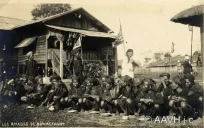
Thirty boys from the villages around Buon Ma Thuot were put into a French school in 1915. Attendance was not voluntary; within a few years some of them walked home, and the paramount chief who defended them was accused of inciting disobedience. Out of that school came a written Rhade language, a class of clerks and teachers, and, a generation later, the men who founded BAJARAKA. In 1955 the Republic of Vietnam renamed the school, banned teaching in our languages, and closed the civil service college to us for six years.
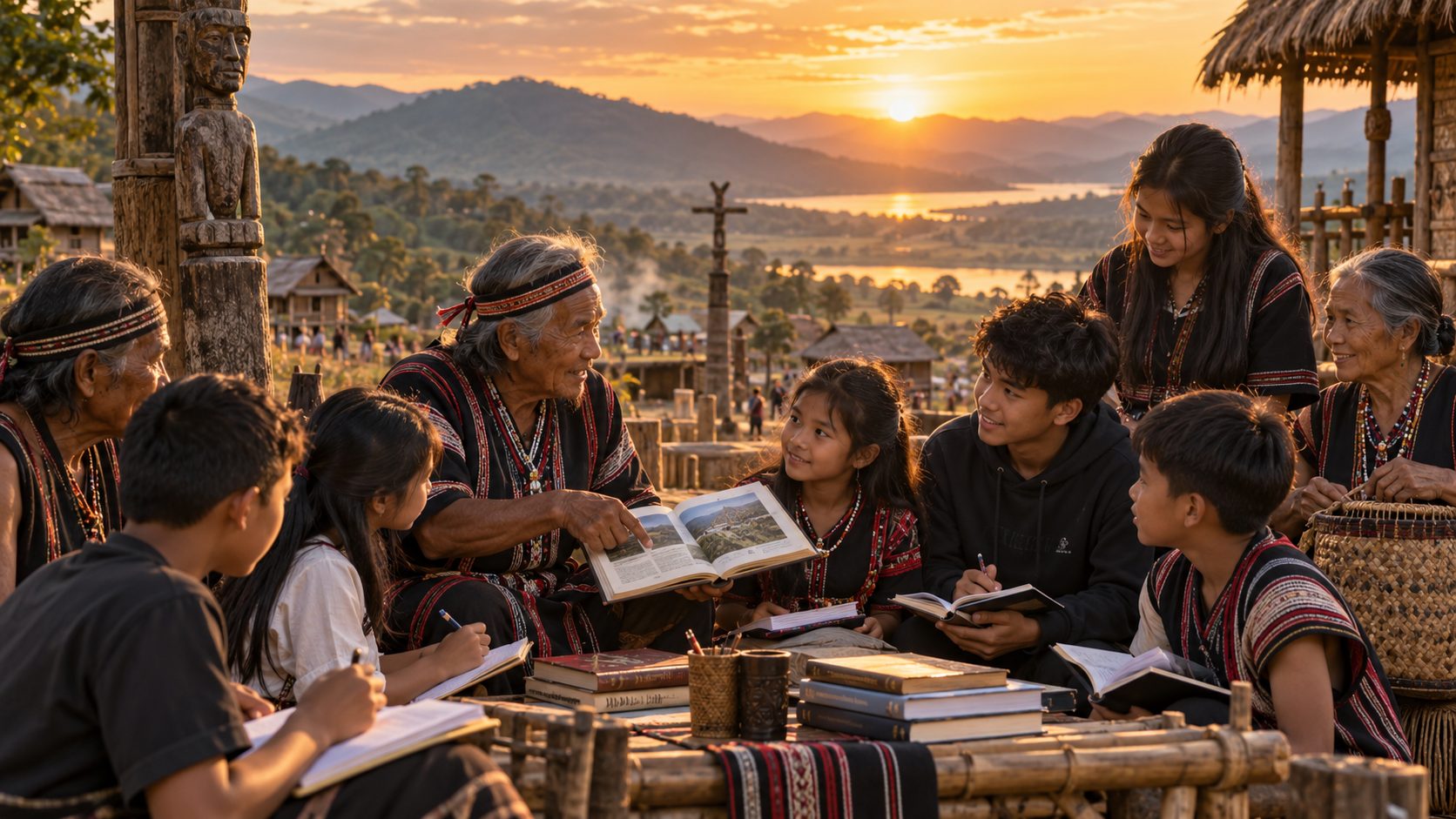
Thirty boys, 1915
Léopold Sabatier had been at Buon Ma Thuot a year when he opened the school. He was the French Resident of Darlac, and the plan he had for our country is set out on Sabatier, the oath of 1926 and the Rhade law code: write down the Rhade law, write down the Rhade language, keep the Vietnamese and the planters out, and raise a small class of Rhade who could run the province for him. The school was the fourth of those instruments and the one that outlived him.
It opened in 1915 with thirty pupils, all from the villages around the town. They were taught French, history and geography, with some teaching in our own customs, and the sons of chiefs and notables were taken first. The lessons were in French and, later, in Rhade. They were not in Vietnamese — in a province that was legally part of the protectorate of Annam, no Vietnamese was taught in the school at all. That one decision shaped everything that came after it. It gave us a written language of our own, and it left the generation that grew up under it unable to read the language of the state that took the highlands over in 1954.
Attendance was compulsory for village boys. A village was told how many boys to send, and it sent them. In 1922 the first examinations for the primary certificate were held in the town: four candidates sat, and three passed.
The boys who walked home
The school and the resistance to it are the same story from the beginning.
Some of the boys left the school without permission and went back to their villages. The man who took their side was Y Ut Buon Rit, the foremost Rhade chief of the province. It was not the only quarrel between him and Sabatier — there was another over villagers punished for the way they had taken honey — and Sabatier answered by accusing Y Ut and a group of Rhade civil servants of goading the villages into disobedience. Y Ut’s reply was that Sabatier treated the Rhade harshly. Rhade civil servants were arrested and put in the stocks. Y Ut and the chief Khunjanob pressed until a French representative was sent to look into it.
That was not the end of it either. Families stopped sending their children to the school, and in 1929 there were a few armed attacks. The anger over compulsory school attendance for our boys sits in the same account as the anger over the road corvée and the tax — see Roads, taxes and forced labor. In 1926 Sabatier assembled the chiefs at Buon Ma Thuot to swear the oath. In the same year the planters and the administration moved against him, and he was ordered out of Darlac.
What our villages objected to was not reading. It was being ordered. The school that our leaders later defended, and that Diệm later took away from us, began as something done to us.
Making the alphabet
Rhade had to be written before it could be taught, and in 1915 it had never been written. Sabatier put two educated Rhade to work on an alphabet. The script that came out of that work was built by Dominique Antomarchi, the schoolmaster, on the pattern of quốc ngữ, the romanized script of Vietnamese — so our alphabet was modeled on the written form of the one language the school refused to teach.
The first book was a schoolbook. In 1921 Sabatier published it at Hanoi under a title that says exactly what it was for: Dak-lak. Recueil de mots rangés d’après le sens, à l’usage des élèves de l’École franco-rhadée du Darlac — a collection of words arranged by sense, for the use of the pupils of the Franco-Rhade school of Darlac. The alphabet and the classroom were made together; neither came first.
The missionaries were working on the same problem at the same time, and the written Rhade taught in our schools later owed a great deal to them. Forty-five years after the word book, a US Army handbook still summed the whole thing up as Sabatier “developing the written form of the Rhade language and codifying the traditional Rhade laws” — the two Rhade at the table having gone unnamed, as usual. Who else did the work is on Writing our languages, and what the words themselves carry is on Names and words.
Antomarchi and what the school was like inside
Sabatier left Darlac in 1926. Dominique Antomarchi stayed for the rest of his working life, and he is the reason the school became an institution rather than an experiment. French accounts call him the founder of the Groupe Scolaire Franco-Rhadé de Ban-Mé-Thuôt and later its director; by 1940 he was Inspector of Primary Education for the Ethnic Minorities. He wrote the course in the Rhade language. He wrote the schoolbooks, and he wrote them to carry our own culture rather than replace it. In 1940 he brought out the posthumous translation of Sabatier’s collection of Rhade customary law, the Recueil des coutumes rhadées du Darlac, which is the text discussed on Customary law.
The one person who wrote down what the classrooms looked like from the inside is the French traveler Gabrielle Bertrand, who sat in on several of Antomarchi’s lessons in order to tell the tribes of Darlac apart. What she saw was not a room of pupils in uniform. The children kept the dress of their own clans in class, and their own speech with it; the school, she wrote, was “a microcosm of the villages.” A boarder at Buon Ma Thuot was still visibly a boy of his own village.
The school fed itself. It held land and cattle, and the meat and vegetables the boarders ate came off them; the rice did not, so Antomarchi went out to the villages himself and collected what he needed to feed both the pupils and the herd. Whatever else that was, it meant the director of the school was in our villages, on our terms, asking. It is also the plainest measure of how small the thing was: a boarding school for the future leadership of a people, provisioned by its headmaster going door to door for rice.
One of the pupils has a name in her book. I’Doat, a Rhade boy of Darlac, was picked out of the school to travel with her as guide and interpreter, and she described him as wise and full of humor. That is as close as any surviving account gets to a pupil of the Franco-Rhade school as a person.
The system, and how small it was
By the 1930s this was no longer one schoolhouse. There was a complete Franco-Rhade course of education — its own teaching methods, its own staff, its own separate examinations — sitting alongside the French and Franco-Vietnamese systems and leading nowhere near as far. A Rhade teacher-training section had been opened, and in September 1930 a class to train Rhade teachers opened at the Collège Quốc Học in Huế.
The numbers are the argument. In 1930 two pupils passed the Franco-Rhade elementary certificate and seven the Franco-Rhade primary certificate. The colonial statistical yearbook for 1929–30 counts differently — five Franco-Rhade primary certificates and fourteen elementary — and we cannot reconcile the two; either way the figure is single or low double digits for a province of tens of thousands of people. The printing tells the same story. Of the schoolbooks printed for the languages of Indochina in that period, 50,000 copies were in Lao, 5,000 in Rhade and 1,000 in Jarai.
It grew slowly and then it stopped. By 1949 the school register of the Pays Montagnards du Sud Indochinois carried 3,522 highland pupils — for every people of the highlands together, after thirty-four years. That is the whole educational inheritance the French left us, and the reason the gap described on Schools, language and the university gap starts where it does.
The Collège Sabatier
During the war of 1946–54 the French wanted highland support badly enough to pay for it, and in the early 1950s they opened a lower secondary school at Buon Ma Thuot and named it after the man who had opened the first one. Boys came to it from every part of the highlands — Bahnar and Jarai from Kon Tum and Pleiku, Rhade from Darlac, Chru and Koho from the south — and for many of them it was the first time they had sat in a room with the other peoples of our country and found out how much of the same thing had been done to all of them. The best of them went on with scholarships, granted under Bảo Đại, to the Lycée Yersin at Da Lat, the school of emperors. Most of the boys who got those scholarships were sons of chiefs and notables.
The ladder was short and it was the only one: Franco-Rhade at Buon Ma Thuot or Franco-Bahnar at Kon Tum, then the Collège Sabatier, then the Lycée Yersin. Perhaps a few hundred men in total went up it.
The school was still on the French state’s books three months before the French left Indochina for good. In the budget published on July 13, 1954, the Collège Sabatier at Buon Ma Thuot appears among the grants to French establishments abroad, at 100,000 francs, on the line below the Lycée Pavie at Vientiane.
We know remarkably little else about it. We have not found its opening date, the name of a single one of its directors, its curriculum, its enrollment, or any description of life inside it. For the school that formed our national leadership, that is a poor record, and it is one of the reasons this library exists.
Who studied there
| Name | Where he was taught |
|---|---|
| Y Bham Enuol (born 1913) | The Franco-Rhade school, then the mission Bible school and the national agriculture school. He was too old for the Collège Sabatier. |
| Y Thih Eban (born 1933) | The Franco-Jarai school at Pleiku, then the Collège Sabatier as a teenager, then work as a translator |
| Nay Luett | The Franco-Bahnar school at Kon Tum and the Collège Sabatier, then the Lycée Yersin |
| Toplui Pierre K’briuh | Later deputy director of the Highland Normal School at Buon Ma Thuot, the first highlander to hold the post |
In 1958 Y Bham Enuol, Y Thih Eban and Nay Luett were arrested together, with Paul Nur, Y Ju Eban, Touneh Yoh and Siu Sipp, for BAJARAKA — a name made from the first letters of Bahnar, Jarai, Rhade and Koho, which is to say from the four peoples whose schoolboys had met in the same classrooms. The schools were built to make us useful to the administration. What they made instead were men who could petition it, in its own language, on its own paper, with their own alphabet. Christopher Goscha puts it in one line: the school produced highland nationalists, equipped with their own romanized languages.
The committee came first and the movement second. Early in 1957, highland students at the lycée in Da Lat formed a committee among themselves. BAJARAKA was announced the following year.
The name on the gate
After 1955 the Republic of Vietnam set out to make the highlands part of Vietnam, and it began with the schools. The colonial textbooks were thrown out and a single Vietnamese curriculum put in their place, with Vietnamese as the common language. The Collège Sabatier became the Nguyễn Du School, named for the poet of the Tale of Kiều. The whole policy is in that one change of sign.
Teaching in highland languages was banned. Our place names were replaced with Vietnamese ones. Highland soldiers had to take Vietnamese names. In Darlac, Rhade were forbidden to enter Buon Ma Thuot in a loincloth. What had been taken from us in the space of a few years was not only a school: it was the written language the school had made, the right to be called by our own names in our own country, and the clothes we stood in.
The civil service went the same way. The Highland Students’ Section of the National Institute of Administration, the school that trains young citizens for government service, had produced four small classes between 1954 and 1958 — men who came out of it as district chiefs, judges and officials. Diệm ordered the section abolished, and from 1958 to 1964 not one highlander was admitted to the institute. The Bureau for Highland Affairs was moved from Da Lat to Huế, and highland civil servants were reassigned to posts in the lowlands, away from their own people.
A Highland Normal School opened at Buon Ma Thuot in 1957 to train teachers, under a government that would not let them teach in our languages. In the same year the state began broadcasting in four highland dialects. Our languages were fit for the radio and not for the classroom.
What came back, and what did not
It took the rising of September 1964 to get any of it returned. At the conference at Pleiku that October our delegates asked for highland law courts, for scholarships and places for highland students in secondary schools and universities, and for the highland languages to be taught in the primary schools alongside Vietnamese. The following year the Diệm decree was formally abrogated and teaching and writing in highland languages in primary schools was permitted again.
Permitted, and then not provided. The law changed and the implementation lagged, which is the pattern of every concession made to us before and since. The primers that made teaching possible again were largely prepared by foreign linguists of the Summer Institute of Linguistics — fifty of them — and by missionaries who knew our languages; the state that had banned them supplied very little. The teachers were not there: the shortage of teachers was the central problem of highland education, and as the war spread, teachers left the villages for the safety of the provincial towns. In the 1966–67 course at the National Institute of Administration there were four highlanders, two Jarai and two Rhade. Four men in a year, against four whole classes in the four years before Diệm closed the door.
A school opened in 1915 by a French official who wanted clerks had, within two generations, given us an alphabet, a first generation of leaders, and a long education in what happens to a concession once it has been granted.
What is missing
We have not found a single first-person account by a Dega of being a pupil at the Franco-Rhade school, the Groupe Scolaire Franco-Rhadé or the Collège Sabatier. Everything above about the inside of a classroom comes from a French visitor. We have no roll of pupils for either school, no name for any Rhade monitor or teacher of the early years, and no director of the Collège Sabatier. Gerald Hickey’s Free in the Forest (1982) and Sons of the Mountains (1982) almost certainly hold more, and his papers are at Texas Tech; we have not yet been able to consult either.
If you, your father or your grandfather sat in those classrooms, we want to record it — the year, the teachers’ names, what was taught, what it cost the family to send a boy. See How to record an elder.
See also: Writing our languages and Schools and language.
Sources
- Gerald C. Hickey, Kingdom in the Morning Mist: Mayréna in the Highlands of Vietnam (University of Pennsylvania Press, 1988) — the opening of the school in 1915 and its thirty pupils, the 1922 examinations, compulsory attendance for village boys, and the quarrel with Y Ut Buon Rit
- Gerald C. Hickey, Window on a War: An Anthropologist in the Vietnam Conflict (Texas Tech University Press, 2002) — Antomarchi, the founding of the Collège Sabatier, the Lycée Yersin scholarships and the school ladder
- Gerald C. Hickey, The Highland People of South Vietnam: Social and Economic Development, RAND RM-5281/1 (1967) — the ban on teaching in our languages, the loincloth order, the National Institute of Administration between 1958 and 1964 and its four earlier classes, the Highland Normal School of 1957, the Pleiku demands of October 1964, the 1965 legislation and its implementation, and the fifty primers
- Gerald C. Hickey, The Major Ethnic Groups of the South Vietnamese Highlands, RAND RM-4041 (1964) — text copy — Sabatier’s school system and medical service
- Oscar Salemink, “Mois and Maquis: The Invention and Appropriation of Vietnam’s Montagnards from Sabatier to the CIA,” in G. W. Stocking (ed.), Colonial Situations (University of Wisconsin Press, 1991), pp. 243–284 — the romanized script built after quốc ngữ and the absence of Vietnamese from the curriculum, the school’s graduates as administrators, the withdrawal of children and the armed attacks of 1929
- Frédéric Bourdier (ed.), Development and Dominion: Indigenous Peoples of Cambodia, Vietnam and Laos (White Lotus, 2011) — Salemink’s chapter: the school as a training ground for the children of local elites, and Antomarchi as director and translator of the Recueil
- Gabrielle Bertrand, The Jungle People: Men, Beasts and Legends of the Moï Country (English translation, Robert Hale, 1959) — the classrooms, the clan dress, the school’s land and cattle, the rice collected from the villages, Antomarchi as founder and teacher, and the pupil I’Doat
- Christopher Goscha, Vietnam: A New History (Basic Books, 2016) — the Franco-Rhade schools as a system, teaching in highland languages and French but not Vietnamese, the classrooms of the Collège Sabatier, the quoted line on highland nationalists, and the renaming of the school as the Nguyễn Du School
- Jacques Dournes, Minorities of Central Vietnam (Minority Rights Group, Report No. 18, 1980) — the 3,522 highland pupils on the P.M.S.I. register in 1949, Antomarchi as Inspector of Primary Education for the Ethnic Minorities in 1940, and the 1927 publication of the Recueil
- La Documentation catholique, November 3, 1934 — the complete Franco-Rhade system with its own methods, staff and examinations, the certificates of 1930, the Rhade teacher-training section, and the print runs of 5,000 Rhade and 1,000 Jarai schoolbooks (our translation)
- Annuaire statistique de l’Indochine, 1930–1931 — the differing count of Franco-Rhade certificates for 1929–30
- Léopold Sabatier, Dak-lak. Recueil de mots rangés d’après le sens, à l’usage des élèves de l’École franco-rhadée du Darlac (Hanoi: Imprimerie d’Extrême-Orient, 1921), cited in Franklin E. Huffman, Bibliographies of Mon-Khmer and Tai Linguistics and in the Bulletin de l’École française d’Extrême-Orient, vol. 22 (1922)
- Journal officiel de la République française, July 13, 1954 — the grant of 100,000 francs to the Collège Sabatier
- Department of the Army, Minority Groups in the Republic of Vietnam, Pamphlet 550-105 (1966) — the credit given to Sabatier for the written language and the law code
- Central Intelligence Agency, “The Highlanders of South Vietnam: A Review of Political Developments and Forces” — the committee formed by highland students at the lycée in Đà Lạt in early 1957, and the missionary written language taught in the Rhade schools
- Human Rights Watch, Repression of Montagnards (2002), chapter III — the schooling of Y Bham Enuol and Y Thih Eban, and the measures against highland civil servants after 1958
- RAND, Accommodation and Coalition in South Vietnam, DTIC AD0699558 — Toplui K’briu as deputy director of the Highland Normal School
Compiled September 2026. Hickey dated the founding of the Darlac school system to the 1920s in 1967 but the opening of the Franco-Rhade school to 1915 in 1988, and we follow the later account. The 1930 certificate counts in La Documentation catholique and in the colonial statistical yearbook do not agree, and we give both.