
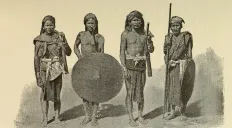


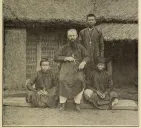















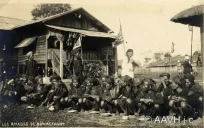

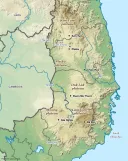
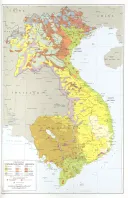
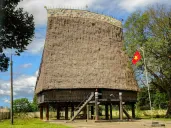






The Rhade are the people of the Darlac plateau, the red basalt shelf around Buon Ma Thuot where the Krong Ana, the female river, joins the Krong No, the male river, and becomes the Srepok. They speak a Chamic language, cousin to Cham and more distantly to Malay. They count descent through women: a house belongs to its women, land belongs to a woman, and a man marries out of his mother’s house into his wife’s. Their law is in verse and was sung by judges before it was ever printed. And the word Dega, which names this organization and every page on this site, is a Rhade word.
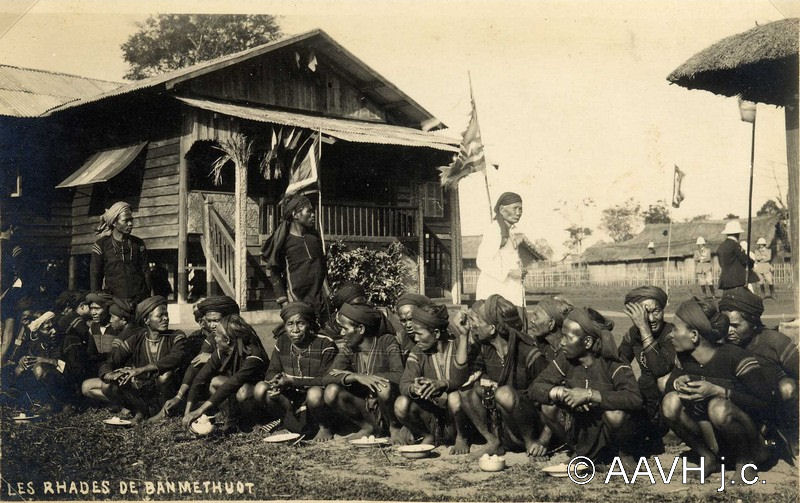

The word that names this library
Start here, because it is not widely known even among us. Raleigh Bailey, writing in 2002 for the American agencies that were about to resettle nine hundred of our people, explained where the word came from:
“Dega comes from the Rhade language and refers to a creation myth in which the first two Montagnards were named De and Ga.”
And why that word and not another:
“A Rhade term was chosen because among the first group of Montagnard refugees in the United States the Rhade were in the majority, and their language had been the lingua franca among the resistance fighters.”
So the name of this organization is a Rhade word, chosen because Rhade was the language the men in the forest used to talk to each other across five peoples. Keep that in view through what follows. See Who are the Dega and Names and words.
The country
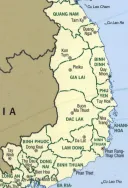
The Darlac plateau runs between about four hundred and eight hundred meters, and it is made of old basalt, which is why it grows coffee and why everybody has wanted it. Its water runs west and north-west to the Mekong. Two head-streams come together below Buon Ma Thuot to make the Srepok: the Krong Ana, the female river, and the Krong No, the male river.
Read the district names on any map of Dak Lak and you are reading Rhade. Krong is river and ea is water: Krong Buk, Krong Pac, Krong Bong, Krong Nang, Krong Ana, Ea H’leo, Ea Sup, Ea Kar. Buon is village, and Buon Ma Thuot is named for a headman, Ama Y Thuot, the father of Y Thuot. The French made it the capital of Darlac province in 1904 and the name stayed. See Four highland towns.
The Rhade are not one undivided people and never were. The sub-groups, as the French administrators mapped them and as later scholarship repeats:
- Kpa around Buon Ma Thuot — the largest, and the group whose speech became the written standard
- Adham north of the town, around Buon Ho
- Ktul in the valleys of the Krong Buk and the Krong Pac
- Mdhur east and north toward the Ayun Pa and into what is now Gia Lai and Phú Yên
- Krung in Ea H’leo and Krong Nang
- Epan, Blo, Kah, Kdrao, Hwing, small groups on the southern and eastern edges
- Bih in the south, in Krong Ana — counted Rhade by some, a people of their own by most
One detail from that list explains something a reader of this library will otherwise trip over. The northern and north-eastern groups — Krung, Adham, Mdhur — are thoroughly mixed with Jarai, and Henri Maitre was already reporting in 1909 that Krung, Mdhur and Blo speech was made of elements of both languages. That is why our own prisoner lists from Ea H’leo and Ea Sup carry Jarai clan names — Ksor, Rocom, Rmah, Siu — standing next to Rhade ones. The border between the two peoples is not a line; it is a gradient, and it runs through families.
What grows there is upland rice on swidden, called hma; wet rice wherever water could be led onto flat ground; maize; and, since Sabatier planted the first bushes and then in earnest after 1975, coffee. One nineteenth-century observation is worth carrying: the plateau, and the Kpa country above all, gave not bare subsistence but a high standard of living, because roughly a third of the rice harvest could be turned into ritual rice wine. A people who can afford to ferment a third of the crop is a people with a surplus. See The rice year and Land taken for coffee.
The name
Êđê is ours. Rhadé is theirs. As an umbrella term covering all the sub-groups, Rhadé dates from the colonial period; before that it was only the Kpa’s name for themselves. One of the first French residents of Darlac wrote it I-dê in 1907.
The earliest witness to the word is our own literature: the name Ede is already used as the Kpa’s self-designation inside the Dam San epic, which is older than any Frenchman in the highlands.
And the etymology, reported on colonial authority rather than from a Rhade source, and given here as reported: the word denotes a particular species of bamboo, the one used as the load-bearing cross-tie in building a house. If that is right, then the people are named for the piece of bamboo that holds the longhouse together — which, for a people whose law and property and descent all run through the house, would be exactly the right name.
One more, with its edge left on. Kpa is said to mean pure, and the Kpa were called Rhadé tout droits, the straight Rhade, because they were held to have kept the old speech and the old custom most exactly — and they themselves, by the accounts of the people who asked them, regarded the other sub-groups and the Jarai as bastards. That is an internal hierarchy. Nobody imported it.
What we wrote ourselves
Almost everything published about the Rhade was written by outsiders. That is true, and it is not the whole truth, and the part that is usually left out belongs at the front of this page rather than in a footnote.
Y Bih Nie Kdam, schoolteacher, Saigon, 1949
The German scholarship on Rhade society calls him, over and over, der Rhadé-Lehrer — the Rhade teacher — and leans on him for clans, phratries, marriage, trade, farming and history. He published in French, in the highlands number of the Saigon journal Education in 1949.
Here is a Rhade man explaining Rhade marriage law, in 1949, in his own words:
“Le mariage légitime doit être légalisé et consolidé par des engagements très forts, dont la valeur dépend de la somme que la femme donne aux parents de l’homme comme prix. Si le prix est d’une valeur égale à un jeu de gongs, les engagements que doivent prendre les époux seront portés à trois jeux de gongs de même espèce; cela veut dire que celui qui provoque ou prononce le premier le divorce devra payer à l’autre trois jeux de gongs sans protestation.”
The mechanism is exact and worth stating plainly. The bride-gift the woman’s family pays sets the unit. The undertaking each spouse gives is three times that unit. Whoever breaks the marriage first pays the other three sets of gongs, sans protestation — without argument. A marriage is a contract with a fixed penalty clause, and the penalty is denominated in music.
He also wrote this about a Rhade husband:
“Puisqu’il est en quelque sorte acheté par la femme, il vient habiter chez elle pour travailler au bien-être de la famille et pour accroître le patrimoine de son épouse.”
Since he is in a manner of speaking bought by the woman, he comes to live in her house, to work for the family’s wellbeing and to increase his wife’s estate. A German anthropologist writing thirty years later thought that overstated the husband’s powerlessness, and argued from the inheritance rules that a husband’s matriline does very well out of the arrangement. We print the disagreement rather than settling it. A Rhade schoolmaster in 1949 and a European academic in 1979 did not agree about what a Rhade husband is, and the reader is entitled to both.
He was not sentimental about his own country either. Swidden farming, he wrote, was still une vraie calamité pour le pays, a real calamity for the country, destroying the forest essences that fed the French perfume trade and washing the soil away.
Y Chang Nie Sieng, and a Rhade civics textbook
Between 1967 and 1981 one man’s name appears on at least a dozen books in the Rade language: primers, readers, a vocabulary, a set of language lessons, texts on health and on conduct. Some were made for the Republic of Vietnam’s Department of Education with the linguists of the Summer Institute of Linguistics. Two were published in Huntington Beach, California, after 1975 — which is to say, in exile, by a man who had lost the country the books were for and went on making them.
Look at what the titles are made of: hdruôm hră, book; klei hriăm, lesson; boh blŭ, word; adŭ, class; nai, teacher; knuih jăk, good conduct; klei suaih pral, health.
And one of them, from 1971, is called Klei bhiăn leh anăn klei dhar-kreh — custom and civics. Three Rhade men wrote it: Y Tlung Ayun, Y San Nie and Y Chang Nie Sieng. A civics textbook, in Rhade, by Rhade authors, for Rhade schoolchildren, four years before the schools closed.
The standard dictionary of the language, published by the Australian National University in 1980, carries a Rhade name on its title page beside the American linguist’s: Y Bham Buon Ya.
And in Greensboro, North Carolina, in 2020, the city government published its emergency public health notices in Rhade: stay at home, what to do if you get sick, what the rules are about your housing. An American city translating a pandemic into a highland language, because enough of its residents needed it in that language. See Writing our languages.
Klei khan: the epic

Klei khan is the sung epic. Klei is word, matter, affair — it heads dozens of Rhade compounds, including the name of the law and the title of the Bible — and khan is the chanted narrative. The singer is a pô khan. It is performed through the night, at the fire, in the front room of a longhouse, to people who already know how it ends.
Nine Rhade khan are named in the collections: Dam San; Dam San’s childhood; Chang M’hieng; M’Drong Dam; Dam Di goes hunting; Khinh Du; Dam Kteh Mlan; the girl H’Bia Jao; and Dam bang Mlan.
What Dam San is actually about
It is usually described as a hero story. It is better described as a poem about the law of replacement, and told that way it makes sense of everything else on this page.
H’Nhi first replaces her own grandmother H’Klu as the wife of the chief Y Kla — her grandfather. When Y Kla dies, Dam San replaces him, and is married to H’Nhi and to her sister H’Bhi. He is one of the great rich chiefs, a sah prŏng mđrong. He wears the double turban and the hunting bag that mark the rank. His longhouse is the longest in the village — and the phrase everyone repeats, that a Rhade house is as long as the echo of a gong, comes from this poem. The 1933 French text gives it as la longueur de l’onde sonore du gong renflé, the length of the sound-wave of the bossed gong.
A hundred of his servants draw the seed-furrows on his fields and two thousand sow them. They follow him as infantry against other chiefs, whose villages he plunders and whose people he sells or keeps in his house. He calls them children; they call him grandfather.
And he fails. He takes no interest in the household he married into. He wanders. He does not trade and does not increase his wife’s wealth. He neglects the defense of the village. He keeps going back to his sisters. This angers his wives’ kin, and it angers Aê Diê, the highest god, who is the keeper of the norms. The village is raided again and again and his wife carried off, and each time his relatives make him win her back. Then he commits the offense that cannot be forgiven: he tries to take the Sun, a female spirit, the daughter of the spirits of sky and earth, as his lover — a place that only a successor of H’Nhi could hold. Aê Diê abandons him to the black wax, to permanent night.
And then the poem does not end. H’Nhi sends her brothers out to take up the broken alliance again. Her brother negotiates with Dam San’s elder sister, and the sister says to her newborn son — the new Dam San — that he is to go and receive the goods of his dead uncle.
So the epic ends exactly where the law book begins: with a nephew replacing an uncle. Dam San is a poem about the duty to replace the dead, and the hero is punished not for cruelty — he keeps slaves and sells people and the poem does not blink at it — but for failing his wife’s house.
How it got into print, and whose name is on it
It was published in Paris in 1927 as La Chanson de Damsan, recorded and transcribed into French by Léopold Sabatier, the French resident at Ban Me Thuot, with prefaces by two Frenchmen and sixteen compositions by the illustrator Maurice de Becque, in an edition of two hundred and twenty-five copies. Six years later Sabatier published the bilingual text — Rhade with a word-for-word French translation — in the journal of the French School of the Far East. He dated the material to the sixteenth century on his title page and to the seventeenth in his commentary. Both are guesses by a colonial administrator about a poem nobody had dated.
There are Rhade names in the later recording of the khan, and they should be said: Y Wang Mlo Duon Du, who collected a version of Dam San after 1975; Linh Nga Nie Kdam, an Rhade woman who has spent a career on highland music and culture, working with Y Khem Nie; and the singer Aê Wưu. We give these as names to follow rather than as settled record, and we have to say why: every reachable source about Linh Nga Nie Kdam is Vietnamese state or provincial media, which this library does not cite. The best-known living Rhade woman writing about Rhade culture cannot be sourced on this page under our own rules. That is a real cost and we are not going to hide it.
Klei duê: the law that is sung
The Rhade code is called Hdruôm hră klei duê klei bhiăn đưm — the book of the linked sayings, the custom of old.
Take that title apart, because it settles an argument before it starts. Hdruôm hră is book. Klei duê is the name of a Rhade genre: rhymed, linked, formulaic speech, the thing a judge declaims. Klei bhiăn is custom, law. Đưm is of old. The law is not a text that happens to have been put into verse. Its own name says it is verse. The judges who spoke it were called khoa phat kdi, and kdi — case, dispute — runs through the whole code.
Some of its articles, in the French in which they were printed in 1940:
On what a marriage is. “Le mariage lie non seulement l’homme à la femme, mais le clan de l’homme à celui de la femme. Une fois qu’il a été scellé, plus rien ne doit pouvoir en briser les liens, même pas la mort.” Not even death.
On replacement, with the Rhade preserved:
djiê aduôn lŏ cuê hŏng čô — when the grandmother dies she is replaced by the granddaughter
djiê amiêt lŏ cuê hŏng amuôn — when the uncle dies he is replaced by the nephew
On daughters and the ground, which is the best line in the code:
“Les filles (anak mniê) sont comme la semence du riz … elles veillent sur les vans et les tamis à riz, elles veillent sur le dos des ancêtres.”
The back of the ancestors is the cultivated earth. Daughters watch over the winnowing baskets and the rice sieves, and they watch over the ground the dead are in. And in the same article: the rolls of copper wire and the loads of gourds, a man may not take for himself.
On the village and its chief, which addresses the villagers as kin rather than as subjects: all the sparrowhawk brothers, adei tlang, and the nephews and nieces, those from here and those from there, must help the chief — build his house and his field hut, repair the house, fetch firewood and water; and every villager owes the chief’s wife cotton thread when her dress is torn. The chief in the code’s own metaphor is the fig tree and the banyan.
On old quarrels, the code reaches back past any French memory: “L’affaire remonte à la dispersion des Chams, à la défaite des Annamites.” And a companion formula warns the man who goes alone into another’s house to rob it just as the Cham are breaking into the village.
On incest, the code distinguishes hlăm, between close kin, from agăm, between distant kin, condemns both in the same metaphorical formulas and sets the same penalty — and treats the offense as against the natural order as much as the social one: it brings drought or flood, failed harvests, epidemics.
The land title that is a genealogy of women
And then this, which is the single most important sentence in the code for everything else this library is about. It concerns the pô lăn, the woman who holds the land:
“Le pô lăn (ou plus exactement le clan de la femme pô lăn, par descendance utérine) doit prouver qu’il est propriétaire du sol depuis toujours, par droit du premier occupant. Pour cela, il récite les différents points géographiques (montagnes, sources, confluents, mares…) qui en sont les limites, et la généalogie complète par voie utérine de toutes les femmes pô lăn qui se sont succédé depuis les origines.”
Read what that is. To prove she owns the land, a woman recites the mountains, the springs, the river junctions and the pools that bound it, and then recites every woman who has held it before her, mother to mother, back to the beginning. The title deed is a poem, and it is a list of rivers and a list of women.
And it is generous. The code provides that the pô lăn takes nothing from the people who live on and use her territory; another village could move onto it and use the land, the forest and the water without asking her. A title that is real, recited, and free.
Now set that beside the present. The United Kingdom’s government, in its December 2024 assessment of Vietnam, records that highland land “is a particularly sensitive issue,” that traditional inheritance is, in its words, “not recognised by the state,” and that land grabbing and development have displaced many Montagnards from their homelands. A registry that will only write one name on a certificate, and will not write a matriline, has abolished the pô lăn with a form. Nothing had to be confiscated. See The land law, Customary law and Dega women.
Sabatier, both halves
Léopold Sabatier was the French resident at Ban Me Thuot from about 1914 to 1926, and he is the reason a great deal of this page can be written at all. He shut the plateau against Vietnamese traders and French settlers alike. He built a boarding school where Rhade children learned French, a trade, and their own language in writing. He recorded the epic. He codified the law and made it the basis of the native tribunal. He was the first administrator in Vietnam to write down an indigenous people’s norms and give them force. The Rhade code became the model for all the others — the Bahnar code, the Sre, the Maa, the Jarai were all collected after it and on its pattern.
And here is Sabatier in 1930, in his own preface, explaining what the code was for:
“Le Coutumier qu’il a fait imprimer et répandu sera sa Charte et son Appui. Tous les travaux, tous les changements qu’il demande, il les demande en montrant qu’il ne fait rien d’autre qu’appliquer ‘la Loi des Ancêtres’. Ce faisant, il se concilie les Génies de qui vient cette loi; on peut donc obéir sans avoir à redouter leur colère.”
The code he had printed and circulated would be his Charter and his Support. Every piece of work and every change he asked for, he would ask by showing that he was doing nothing but applying the Law of the Ancestors. In doing so he made his peace with the spirits the law came from, so that one could obey without fearing their anger.
He wrote that down himself. A code he controlled was easier to administer than a council of elders he did not, and the norms canonized in it as laws of the ancestors now included ones that suited the administration. Once a year the village heads were assembled and held to it.
There is a third half. The code was also an instrument of restoration. The replacement-marriage rule had fallen out of use, and Sabatier revived it and made it binding, with this reasoning:
“[Les règles de remariage] assurent la continuité de la souche et l’agrandissement du patrimoine familial. Leur inobservation pendant environ 25 ans a été l’une des causes principales de la déchéance des tribus malayo-polynésiennes du Darlac.”
A Frenchman diagnosing the decline of the Rhade and prescribing, as the cure, a Rhade marriage rule that he had put in a book. All three of those things are true at once, and a page that gives only the first or only the second is not describing Sabatier. See Sabatier and the Rhade code.
The clans
How many Rhade clans there are has three answers from three tellers, and we are not going to reconcile them.
Fourteen, in two halves of seven — Y Bih Nie Kdam, the Rhade schoolteacher, in 1949. On one side Eban, Ayun, Hdok, Mlo, Buon Krong, Ecam and Knul; on the other Nie Kdam, Nie Hra, Nie Krieng, Nie Sieng, Buon Drieng, Buon Ya and Enuol. Marriage inside a half is forbidden, because the clans of one half stand to each other as brothers, and brothers and sisters come from the same belly.
About twenty — Gerald Hickey, in the RAND memorandum he wrote in 1964 under contract to the US military. He gives a number and not one name. That is worth a sentence on its own: the standard English reference on our peoples, prepared for the American government on the eve of a war fought across our country, counts our clans and names none of them.
Twenty-nine — a European field researcher publishing in 1973, who could confirm the fourteen-clan scheme only in small part. On her material the one prohibition that reliably held was that Mlo might not marry Eban, Adrong or Knong.
Her survey turned up something more useful than the count. In seven Mdhur villages she found only two clan names; in two more, a few members of a third; in the rest, up to six. A Rhade village was very often a village of two clans who married each other — which is what the two-halves scheme is the ghost of.
Older lists add names and a hierarchy. Henri Maitre in 1909 divided them into noble — Hdok, Eban, Ayun — and inferior. And several Rhade clans are the same clans as the Jarai’s under different spellings: Jarai Siu, Rahlan and Rocom answer to Rhade Ecam, Ksor to Ksor, Rmah to Rmo, Kpa to Kpa, and Jarai Nei to Rhade Nie. Of the Ecam or Rocham, the French noted that the name indicates the clan’s Cham origin, which its members assert.
Two origin stories survive. In one, bang Adrênh, the first clans came up out of a hole in the earth, and the Eban and the Ayun came out first. In the other, a mother and son travel together after he has killed his father in the shape of a black dog, and at every place they lie together a clan comes into being and takes the name of the place.
How to read a name
This is the practical part, and it will change how you read every other page in this library.
A woman’s personal name takes the prefix H’. A man’s takes Y. The clan name comes after the personal name, not before it as in Vietnamese. And the clan name descends from the mother.
So: H’Lo Kbuor was born into the Kbuor. Y Bham Enuol was born into the Enuol. Y Quynh Buondap was born into the Bdap. The clan names that recur through our prisoner records for Dak Lak and through the memorial register are Eban, Nie, Nie Kdam, Buon Ya, Enuol, Knul, Mlo, Buon Krong, Adrong, Hdok, Bya, Ayun, Kbuor, Bdap, Buon To, Nai and Kpa — with Ksor, Rocom, Rmah and Siu appearing wherever the lists reach into Ea H’leo and Ea Sup and the Jarai country begins.
Every name in those lists is a piece of kinship information. Read the second word and you know which house a man was born in, which women he could not marry, and who was obliged to replace him when he died. See Prisoners: Dak Lak and The memorial register.
The longhouse
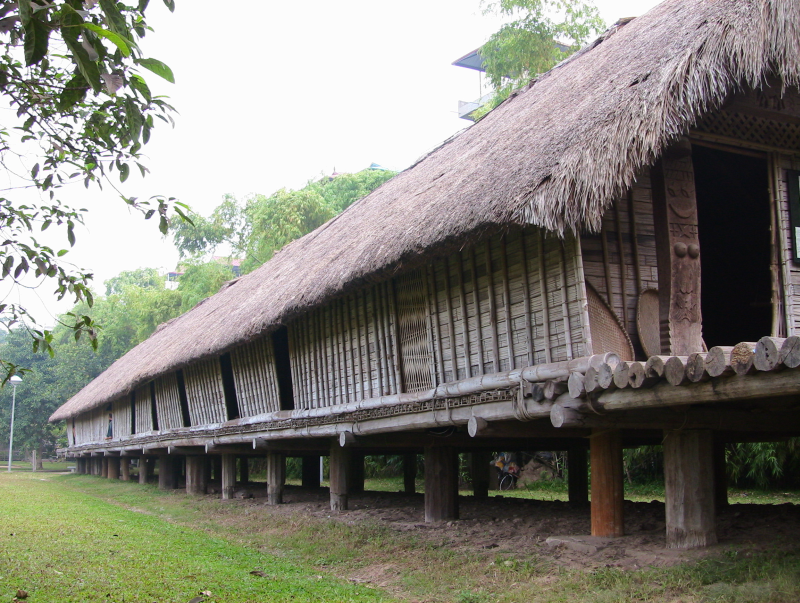

The house is sang; the village is buôn. The front, public third is the gah; the living part behind it is the ok. The mistress of the house is the pô sang; the man who heads it is the khŏa sang; the village head is the khŏa buôn; a chief is a mtao.
A village is ten to twenty longhouses on rising ground near water. North of the Srepok the houses are laid out north to south, and the reason given for it is practical and has a second half that is not: the prevailing winds run east to west and would carry the hearth fires down a row of houses lying that way — and the living should be set apart from the dead, who are buried east to west.
The rich lived at the east end of the village and the poor at the west. We print that because a page which presents the old village as an undifferentiated idyll is not telling the truth, and it is our own record that says so.
The house stands on piles and is reached by notched logs leaning against a wide verandah. It is extended by one compartment every time a daughter marries and her husband moves in, and its length is counted in collar beams, đê. While it is unfinished, food taboos hold and sexual relations are forbidden until the householder has moved in.
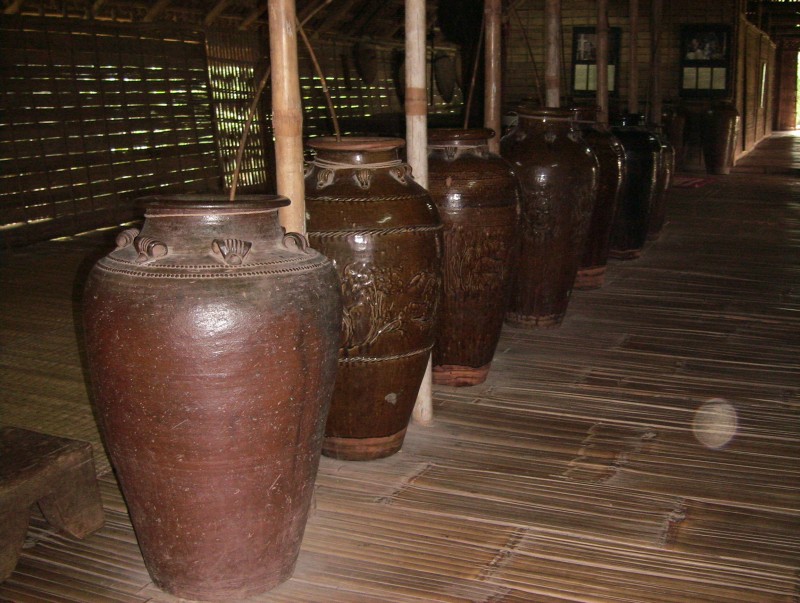
Inside, the colonial accounts describe three parts. The gah, the first third, is the communal and guest room; in rich houses a massive bench cut from a single tree stood along the east side, and the gong players sat on it at festivals, with the great wine jars and the weapons beside them. Behind a bamboo wall came small rooms along the side walls for the people the French called of inferior condition — the house slaves — and it was the absence of a bamboo curtain across their doorways that marked their lesser standing. Behind that again came the closed, larger, better-furnished rooms of the householder’s own families.
Not every source describes that class division; Maitre and Sabatier say only that the householder’s rooms were somewhat larger and better supplied with mats and blankets. Both accounts stand here.
Each nuclear family had its own hearth, and a taboo forbade cooking at any hearth but your own. The number of hearths in a house was the unit by which its contribution to the land-holder’s ceremonies was reckoned. Each house had its own granary nearby, with great bamboo cylinders for the rice.
A stranger was fed and housed for twelve days without being asked where he came from or where he was going, and the mistress of the house, if he had secured her goodwill with small gifts, would equip him for the rest of his journey. The Frenchman who recorded that noted drily that Vietnamese travelers were said to have made ample use of it.
Who actually lives in a longhouse is precise: a three-generation matrilineal group, living where the women live, extended sideways, with the line traceable over four generations. As one French account put it, every house is the dwelling of all its daughters and granddaughters, because the young men must marry into other families.
One caution, and it is an odd one to have to give. The two doors, the men’s stair and the women’s stair, and the pair of breasts and the crescent moon carved on the women’s stair, are famous, and we believe they are right, and we could not find a single source for them that this library is permitted to cite. Everything reachable is Vietnamese state media or tourism copy. If you have photographed a carved Rhade stair, or can name the carver, or know the words for the two stairs, we would like to hear from you.
Nobody is allowed to be a widow
This is the institution that ties the epic, the code, the clans and the house into one thing, and it is strange enough that you will remember the page for it.
Nuê is the replacement spouse. The word means the shoot that grows from the root of a felled tree and takes its place. The related verb, bi cuê, means to join back together the threads of a broken band.
The rule: when a husband dies, his matriline must supply a man of the same clan to take his place. When a wife dies, her matriline must supply a woman. The grandmother is replaced by her granddaughter; the uncle by his nephew. A generation is skipped, so the aging household is made young again and the alliance between the two matrilines is never broken. If the dead man has no sisters or sisters’ children in the village, they are sought in another village; it is enough that the replacement carry the same clan name.
If an old woman receives a young replacement, she is to give him one of her granddaughters — preferably from the same house — as a second wife, because she can no longer bear children, so that the stock may increase and so that the girl may carry him water and rice and weave him his skirt and his jacket. One French commentator proposed calling that girl not a concubine but an anticipated replacement, which is a colder and more accurate phrase.
Refusal has a price, and the price falls on children. If a dead wife’s family will not supply a replacement, a large part of the goods goes to the dead husband’s nieces and her own children inherit almost nothing. The obligatory share owed to a dead spouse’s kin for what he or she contributed to the household ran to about a third of what the couple had earned together, and in a rich house it could run from clothes and mats up through gongs and jars and buffaloes to elephants.
Sabatier recorded one standing alliance of whole clans, in a note to the epic: the Nie Kdam will supply the replacements for the widows of the Eban, and it is always an Eban woman who is given as replacement to a Nie Kdam widower. Set that beside the schoolteacher’s list, in which Eban and Nie Kdam sit in opposite halves, and the whole system clicks into place.
Who was it for? The earliest French account, from 1907, says it was imposed on the widows of chiefs and of well-off free people so that an estate would stay whole in the dead man’s family — and that among the poor and the enslaved it was not done at all.
So: a practice of the rich, made compulsory for everybody by a code a foreigner printed. That is the cleanest example in this whole library of what writing a law down does to it.
The language
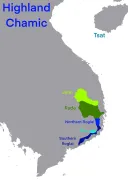
Rade is Austronesian, in the Chamic branch, with the code rad; Bih has its own code, ibh. The dialects run Kpa around Buon Ma Thuot, which became the written standard; Krung in Ea H’leo and Krong Nang; Adham in Krong Buk; Ktul in Krong Bong; Drao, Blo and Epan in M’Drak; Mdhur east into Phú Yên; and Bih in Krong Ana. Most sit at eighty to eighty-five percent lexical similarity with Kpa. Bih sits at seventy-three, and is nearly gone — by one count about ten speakers remained in 2015, out of an ethnic population of some four hundred.
Now the number that matters most on this page. The ethnic count at the 2019 census is 398,671. The speaker count is about 180,000. More than half the people counted as Rhade are not counted as speakers of Rhade. That is a language shift happening now, in the middle of a generation, and no amount of festival footage changes it.
Who made the alphabet
The Latin orthography was made for the Franco-Rhade school at Buon Ma Thuot, which opened in 1915. Who made it depends on who is telling you.
Y Jut Hwing was born in 1888 at Buon Kram in Krong Ana, went through the Franco-Rhade primary school and then to the lycée at Huế, and came back to teach at the school he had attended. He spoke French, Rhade, Lao, Thai and Vietnamese. He worked out the fit between the Latin alphabet and the Rhade sound system with his contemporaries, among them Y Ut, called Ama Puk, and Y Blul. In 1920 the French — Antomarchi the missionary and Sabatier the resident — refined it. Official recognition followed in 1935. Y Jut was poisoned and died at Ban Me Thuot in 1934.
Hickey’s version is that Sabatier “encouraged two educated Rhade to begin devising an alphabet.” Another account credits Sabatier with providing a romanized Rhade script. A third says the pupils learned their mother tongue transcribed together with the missionary Antomarchi.
The honest sentence is this: two Rhade men did the work, and three foreigners took the credit in three different ways, and all four names belong in it. See The Franco-Rhade school.
What exists in it
The complete Bible in Rade — Hdruôm hră Klei Aê Diê Blŭ, the book of the Word of the Lord of Heaven — in a revised edition of 2015, with audio and a translated film. Note the first two words: the same hdruôm hră that opens the title of the law code. Before it, Genesis in Rade, printed at Saigon in 1968 and titled the first book that Moses wrote. A Rhade–English dictionary from the Australian National University in 1980. A Rhade vocabulary published in California in 1979. A Rhade–Vietnamese–Japanese glossary from Tokyo in 1981. And the schoolbooks.
The spirits, and then the churches
The yang are the spirits, and they are ranked. The most powerful is Aê Diê, the Lord of Heaven. His sister Dung Dai protects the paddy, and her husband Aê Du is Aê Diê’s assistant; below them come Mtao Kla and his wife H’Bea Kly, usually shown in human form.
Notice the shape of that. The Rhade pantheon is a kin group with a brother, a sister and an in-law at the top of it. It is organized the way a longhouse is organized.
A person has three souls, and the one that stands for him on earth and in the land of the dead is the mngat — which is also the word for the soul of the rice. The dead are atao, and the funeral invocation sorts them by rank: shades of grandfather rank, of grandmother rank, brother-shades, nephew-shades.
Break a norm and the spirits are angered, and you owe — depending on the gravity — the wăt offering, a hen or a cock, or the kpih offering, a pig or a buffalo. The feasts in order of expense were the death feasts first, and the three greatest of them would exhaust a household’s entire reserve of rice, wine and livestock; up to three hundred jars were set out at the closing feast, when the tomb is abandoned. Then birth feasts, then marriage and harvest, then sacrifices for a named person’s health.
And one sentence that re-frames every photograph of a Rhade wine jar ever taken: among the Rhade, rice wine was never drunk for a secular reason. See Yang, the spirits, The tomb house and Jars and the buffalo feast.
The Christian and Missionary Alliance came to the Rhade around 1929 and built a mission, a school and a leprosarium near Ban Me Thuot; six Americans were killed at that mission during Tet 1968. Today most Rhade Protestants are either in the registered Evangelical Church of Vietnam (South) or in unregistered house churches, and the second category is the one that gets people arrested. The United Kingdom’s December 2024 country assessment records that Montagnards are majority evangelical Protestant, that many worship in unregistered house churches and have been subject to surveillance, discrimination and pressure to join state-approved bodies, and that as of that month thirty-nine Montagnards were recorded as detained across the various databases, almost all of them charged with undermining national unity. See The church they closed, The Evangelical Church and registration and Missions and doctors.
What has happened to us
Before the French, Rhade society was stratified and our own sources say so. There were free people and unfree, rich and poor, house slaves and debt-bondsmen. One French estimate put two-thirds of the population in slavery or debt-bondage, which is probably too high, but nobody who looked thought the number small. Debt usually came not from hunger but from having to borrow sacrificial animals for ceremonies and fines. A man who could not pay put his body in pledge — tuich asei — until his family paid. The rich held goods of power: gongs, copper cauldrons, jars and buffaloes. One family in M’Drak was remembered as owning more than a thousand head of cattle; the richest household in Ban Me Thuot had five hundred buffaloes, where most had two to ten.
The French. Darlac province created in 1904, dissolved in 1913, re-established in 1923. Sabatier from about 1914 to 1926: the school, the tribunal, the code, the closed door, and the oath sworn on January 1, 1926. Then his removal, and the rubber concessions. See Rubber.
1948. With the Viet Minh in the country, the colonial authorities assembled 3,371 highland notables and told them the mountain peoples would have a special legal status providing for the free development of their populations in respect of their traditions and customs. The highlands became a Crown Domain under Bảo Đại the same year. The promise has a long afterlife on What we ask for.
1958. Bajaraka. Of the leaders arrested at Ban Me Thuot on September 15, 1958, at least four were Rhade: Y Bham Enuol, Y Thih Eban, Y Ju Eban, and Y Bham’s circle from Buon Ale A. See The Bajaraka movement.
1964 to 1975. FULRO, with Y Bham Enuol as president. Y Dhon Adrong, whom a South Vietnamese general believed was the real leader of the September 1964 revolt. Y Kdruin Mlo, called Philippe Drouin and Cowboy, born 1936, an interpreter to the Americans who became a FULRO colonel commanding a division in Darlac and was killed in 1968 — one of very few Dega people with a book written about him. See FULRO and The men of FULRO.
And the other side. Y Bih Aleo, a Rhade and a Bajaraka leader, went to the National Liberation Front, headed its Highland Autonomy Movement from 1961 and became a vice-president of the Front. Y Ngong Nie Kdam joined the Viet Minh in 1945 and went north in 1954; of the roughly ten thousand highlanders who went north, about half were Rhade. From prison, Y Bham Enuol was made to write letters urging Y Bih Aleo to surrender — two Rhade men, two movements, one clan system between them. See Highlanders on the other side.
The land, under the Republic. The figures are worth having because they are so small. In December 1965, at a ceremony attended by Nguyễn Cao Kỳ, exactly thirty-eight land titles were handed to Montagnards in Darlac and Tuyên Đức, thirty-seven percent of them for under one hectare. Thiệu proclaimed a new land law at Ban Me Thuot on August 29, 1967. By November 1970 the director-general of land reform claimed registers covering some forty thousand hectares of Montagnard land — out of more than five million cultivable hectares in the highlands. The missionary who supplied those figures said the living-space law was never put into practice although the Montagnards celebrate its anniversary, and that land was the chief tragedy of the Montagnards. See How we got pushed off.
Since 1975 is told elsewhere on this site and not repeated here: 1975, The great migration, February 2001, Easter Week 2004, The 2002 resettlement, Cu Kuin, June 2023 and North Carolina. The clan names in the indictment of the hundred tried in January 2024 are the clan names in this article.
The people of this people
| Name | What they did |
|---|---|
| Y Thu Knul | The elephant hunter of Buon Don; photographed at Darlac in 1933 under a French caption calling him chief of the Rhade at a hundred and seventeen. See Elephants of Ban Don |
| Y Jut Hwing (1888–1934) | Teacher at the Franco-Rhade school; fitted the Latin alphabet to Rhade; died by poisoning at Ban Me Thuot |
| Y Ut (Ama Puk) and Y Blul | His collaborators on the alphabet |
| Y Bih Nie Kdam | Schoolteacher; published in French on Rhade clans, marriage, trade and farming, Saigon, 1949 |
| Y Chang Nie Sieng | At least a dozen Rade-language schoolbooks and a vocabulary, 1967–1981, in Saigon and then in Huntington Beach, California |
| Y Tlung Ayun and Y San Nie | His co-authors on the 1971 Rhade civics and customary-law reader |
| Y Bham Buon Ya | Co-author of the standard Rhade–English dictionary, 1980 |
| Y Diêng (b. 1928, Sông Hinh) | The first Rhade writer of written literature; fiction and folktale collections in Rhade and Vietnamese from 1959. His whole career ran inside the Vietnamese state’s literary institutions, and that is part of the record too |
| Y Bham Enuol (c. 1913–1975) | Bajaraka 1958; president of FULRO; killed at Phnom Penh in 1975. See Y Bham Enuol |
| Y Bih Aleo | Bajaraka leader who went to the NLF and became a vice-president of the Front |
| Y Kdruin Mlo (1936–1968) | Interpreter, then FULRO colonel in Darlac; killed 1968 |
| Linh Nga Nie Kdam | Rhade musician, teacher and writer on highland culture; a collector of the khan. Every source we can reach about her is one this library does not cite |
| Y Ngo Adrong (d. 2006) | Died in police custody |
| Y Ben Hdok (1979–2008) | Arrested April 28, 2008, aged twenty-nine; police told his family on May 1 that he had hanged himself; his family said his head, his ribs and a leg were broken and his teeth knocked out |
| H’Lo Kbuor | A blind woman of Cu Mgar, killed on the road outside Buon Ma Thuot on April 10, 2004 |
| Y Pum Buonya (d. 2024) | Preacher; found dead after a police summons. Fourteen UN experts said he died in custody after being tortured |
| Y Quynh Buondap | Co-founder of Montagnards Stand for Justice; ten years in absentia; extradited from Thailand on November 28, 2025. See Y Quynh Buondap |
How many
| Figure | Year | Who counted |
|---|---|---|
| about 120,000 | early 1960s | Gerald Hickey, RAND memorandum RM-4041, under US military contract |
| 194,710 | 1985 | Vietnamese census, via the Encyclopedia of World Cultures |
| 258,000 | late 1990s | Raleigh Bailey, writing for US resettlement agencies, and UNDP via Human Rights Watch |
| about 180,000 speakers | 2007 | Ethnologue |
| 398,671 — 44,310 urban, 354,361 rural | 2019 | Vietnamese census, reported by the UK Home Office, December 2024 |
We do not re-argue the national totals here; that is done at How many Dega there are.
But one correction belongs on this page. The Rhade are not the largest Dega people. On every count we can reach, the Jarai are more numerous — Bailey in 2002 ranks the Jarai at 320,000 against the Rhade at 258,000, and the 2019 census figures point the same way. What is true is that the Rhade are the largest people of Dak Lak, the people of the plateau’s one city, the people whose language served as the movement’s common tongue, and the people who supplied most of its leadership. That is almost certainly where the belief comes from, and it is a better claim than the one it replaced.
What we do not have
The bilingual Dam San. Sabatier’s 1933 edition, Rhade text facing a word-for-word French translation, is free to read online and nobody in this organization has read it through. It is the largest body of old Rhade in print anywhere. Somebody should.
The stair. The two doors, the two stairs, and the breasts and the crescent moon carved on the women’s stair. We cannot cite a word of it. If you have a photograph, or know what the two stairs are called in Rhade, write to us.
The clans, settled. Fourteen, twenty, or twenty-nine — and one full modern ethnography of Rhade kinship exists, published in Paris in 1987, which would probably settle it, and which we have not been able to read.
Ourselves, in our own words. One 1949 journal article, a dozen schoolbooks, a dictionary, a novelist, and a woman whose work we are not allowed to quote. That is the published Rhade record of the Rhade. The elders in Dak Lak and in Greensboro hold the rest of it, and nobody has asked them systematically. See How to record an elder.
Terms
- klei duê
- The linked, rhymed, formulaic speech in which Rhade law is spoken. The code’s own title says the law is in this form.
- pô lăn
- The woman who holds the land — the senior woman of a subclan’s elder line. She proves her title by reciting the boundaries of the ground and the full line of women who have held it before her.
- nuê
- The replacement spouse. The word means the shoot that grows from the root of a felled tree.
- gah
- The front third of the longhouse, the public and guest room, where the gong players sit and the wine jars stand.
- đê
- The collar beam. A longhouse’s length is counted in them, and one compartment is added each time a daughter marries.
- Aê Diê
- The Lord of Heaven, the highest of the yang, and the keeper of the norms. It is Aê Diê who destroys Dam San, and not for cruelty.
See also: The Jarai, Sabatier and the Rhade code, Customary law, The Franco-Rhade school, Dega women.
Sources
- Y Bih Nie Kdam, in Education (nouvelle série) no. 16, Saigon, 1949 — a Rhade schoolteacher on Rhade clans, phratries, marriage, agriculture, trade and history, quoted here through Jörg Schaeffer’s 1979 Freiburg dissertation on Rhade society, which uses him throughout as an authority
- L. Sabatier (collected) and D. Antomarchi (translated and annotated), Recueil des coutumes rhadées du Darlac = Hdruôm hră klei duê klei bhiăn đưm, Hanoi, 1940 — the code, in 236 articles, in Rhade and French. Quoted here through Schaeffer’s citations
- Léopold Sabatier, La Chanson de Damsan, Paris, 1927, and “La chanson de Damsan: texte et traduction,” Bulletin de l’École française d’Extrême-Orient 33 (1933), pp. 143–302 — the epic. The 1933 version is the bilingual one and is freely readable
- Gerald C. Hickey, The Major Ethnic Groups of the South Vietnamese Highlands, RAND Corporation memorandum RM-4041, 1964 — the pantheon, the pô lăn, the village layout and the 120,000 figure. Written under contract to the United States military during a war fought across the country it describes, which does not make it wrong and does need saying
- Raleigh Bailey, The Montagnards: Their History and Culture, Center for Applied Linguistics, 2002 — the origin of the word Dega, the ranking of the peoples by size, and the Rhade as the lingua franca of the resistance
- United Kingdom Home Office, Country Policy and Information Note: Vietnam — Ethnic and religious groups, December 2024 — the 2019 census figures, the non-recognition of traditional inheritance, and the detention count
- James A. Tharp and Y Bham Buon Ya, A Rhade–English Dictionary with English–Rhade Finderlist, Australian National University, 1980; and the Rade-language schoolbooks of Y Chang Nie Sieng, 1967–1981, listed in the Open Language Archives for the language code rad
- Hdruôm hră Klei Aê Diê Blŭ, the Bible in Rade, revised edition 2015, Bible Society in Vietnam
Compiled September 2026. No Vietnamese government or state media source is used. That rule costs this page two specific things and we would rather name them than pretend: the living Rhade woman who has done most to record the klei khan cannot be cited here, and the carved women’s stair of the longhouse — the breasts and the crescent moon — is known to everyone and sourced by nobody we may quote. Several things here are unsettled and printed unsettled: whether there are fourteen, twenty or twenty-nine clans; whether the name Êđê really comes from a bamboo; and whether a Rhade New Testament existed by 1956, which is often said and which we could not confirm. The French of the code and the epic is given as it was printed in 1927, 1933 and 1940; the Rhade words are spelled as our sources spell them, and our sources do not always agree. If you can correct a word, a clan name or a date on this page, we want it.