












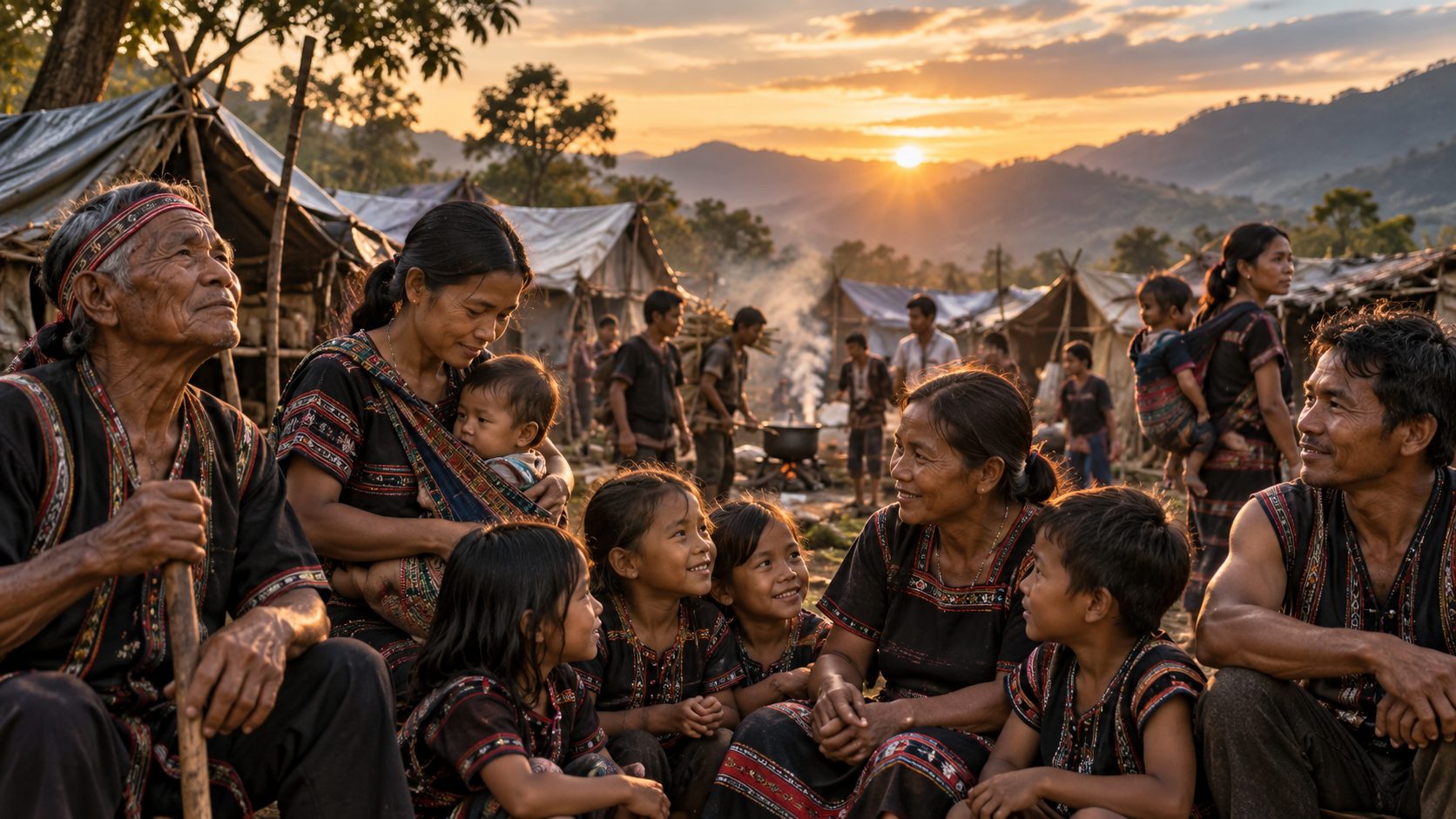
In the summer of 2002 about nine hundred of our people were flown from a disused factory in Phnom Penh to airports in North Carolina, fifty at a time, three or four times a week, on ordinary commercial flights. Most had been in the forest or in a camp for a year. Three quarters of them were men, and most of those men had left a wife and children behind in a village that was now being watched. They were given a three-day course on what a lease was, a four-hundred-dollar grant, and an apartment furnished by retired Green Berets. And the same decision that put them on those aircraft closed the border behind them, so that for everyone still in the highlands that summer, the road the nine hundred had taken no longer existed.
Who got on the plane
Start with one man, because the summaries do not carry it.
Glun Siu came from Plei Grak in Gia Lai. He began going to church in the late 1990s, drawn to what he described as living a pure life — no smoking, no drinking. That was what brought him to the attention of the police. They picked him up and questioned him, and put a gun on the table while they did it. In 2001 a friend told him his name was on a list of people due to go to jail the following month.
“I didn’t want to go to jail because I didn’t do anything wrong.”
He went into the forest with ninety-nine other people who were also on lists. For twelve days they lived on leaves off the jungle floor. He reached a camp in Cambodia and stayed eight months. He came to North Carolina in 2002. He had never learned to read or write in his own language. He got a job as a custodian at a high school. Somebody took him to the coast and he saw the ocean for the first time, and he was stunned by how much water there was.
In 2005 he was told his wife and five children were coming. He could not sleep. He is a United States citizen now; his eldest daughter is married to a man born in North Carolina and they have a small son.
When he calls his village, he says, the people there are always upset and crying. “The Vietnamese don’t care about our village.” What they say to him on the telephone is “Help us” and “You must come back.” What he answers is “I’m scared to come back.”
That is the 2002 group in one life: a church member, not a soldier; on a list, not at a barricade; four years apart from his family; illiterate in his own language on arrival; and still, two decades later, taking calls from home that he does not know how to answer.
The people who left had said why, before they went. A Jarai man, in February 2001:
“In my heart I didn’t want to run to Cambodia and abandon my family…All I want is a place that’s safe. If the Vietnamese catch me, they will chop me up like chopped fish.”
A Rhade man from Dak Lak who had been tortured and imprisoned, in July 2001:
“I fled to Cambodia to meet the upper levels…to solve the problem of land…We just want our land. We want our own country.”
A Jarai church leader from Gia Lai who had not been at any demonstration, in June 2001:
“After the demonstrations there was no peace or freedom in my village. When I woke up one morning, the place was full of soldiers.”
Nobody in that group was emigrating. They had run, and they were about to find out that running had been permanent. See The Cambodian camps.
How the decision was made
Nobody chose North Carolina for these people. What happened is that a repatriation scheme collapsed in public and the United States was the only exit left.
On January 21, 2002, Cambodia, Vietnam and UNHCR signed a tripartite agreement to send everyone home. It fell apart in eight weeks. On February 21 the two governments agreed between themselves to finish the returns by April 30, with or without UNHCR. On February 22, Cambodian police in white helmets went into the Mondulkiri site during an official visit and one officer beat people with an electric truncheon; he had hit five before he was physically removed. On March 2, sixty-three people were forced back from Ratanakiri; on March 16, thirty-five more. On March 21, a delegation of more than four hundred people arrived at the Mondulkiri site in twelve tour buses from Vietnam, as many as a hundred of them Vietnamese officials by UNHCR’s estimate, and searched the refugees’ huts. On March 22, UNHCR withdrew from the agreement.
Nine days later, on Sunday, March 31, 2002, Hun Sen announced that Cambodia would allow the nine hundred and five Montagnards then under UN protection to seek asylum in the United States, and that anyone who refused third-country resettlement would have to go back to Vietnam within a few weeks.
“They cannot choose to live in Cambodia forever.”
The American ambassador in Phnom Penh, Kent Wiedemann, called the decision a solid indication of Cambodia’s determination to stand by international humanitarian standards, and said of the caseload: “Our focus was really on these particular people; that was what we had on the immediate plate.”
Put those two sentences next to each other and you have the shape of it. A prime minister saying they cannot live here forever, and an ambassador saying these particular people were what was on the immediate plate. It was not a rescue. It was the acceptance of a referral, at the end of a process in which every other option had been closed by somebody.
The legal category
The US government’s own account of what it did is in the State Department’s annual report to Congress on refugee admissions — the Bureau of Population, Refugees and Migration describing, in September 2002, a program the Bureau itself had just run:
“During 2001, 1,100 Montagnard refugees fled from Vietnam to Cambodia, fearing reprisals by the Vietnamese Government over their involvement in demonstrations in the Central Highlands over land-use and religious freedom issues in early-February 2001. In early 2002, some 150 of these asylum seekers voluntarily returned to Vietnam. The remaining 950 were processed for U.S. resettlement and began to arrive in the U.S. in June.”
And on the timetable:
“the U.S. conducted expedited processing during May and June of FY 2002, and the majority of the group arrived in the U.S. during the summer of 2002.”
They came in as refugees under the US Refugee Admissions Program, in the category the same report defines this way:
“Priority 1 (P-1) is reserved for compelling protection cases or refugees for whom no other durable solution exists who are referred to the program by UNHCR or a U.S. Embassy.”
Two things follow from that definition. The first is that the people the United States took were the people UNHCR had already recognized and had nowhere to put; the American decision was to accept a referral, not to go looking. The second is scale. For the following year the proposed ceiling for the whole East Asia region was four thousand, of which four hundred were for first-asylum referrals of exactly this kind. The 2002 Montagnard caseload, taken in a single summer, was more than twice the normal annual allocation for the entire region.
Note also the word voluntarily in the first quotation, applied to the hundred and fifty who went home in early 2002. That was the period of the April 30 deadline, the electric truncheon at the camp gate, and the twelve tour buses. We quote the word because it is what the document says, and we say what the conditions were.
The Immigration and Naturalization Service adjudicated the applications from its Bangkok office. The International Organization for Migration did the medical examinations, the cultural orientation and the travel arrangements.
How many
The existing figure of about nine hundred hides a spread of fifty people, and the spread is worth showing, because each number is a different body counting a different thing at a different moment.
| Figure | Published by | What it counted |
|---|---|---|
| 1,100 | US State Department, Bureau of Population, Refugees and Migration | People who fled to Cambodia during 2001 |
| 950 | the same report | Those processed for US resettlement, after 150 returned |
| 932 | the 2006 report for UNHCR | People transferred from the two camps to Phnom Penh in April 2002 |
| 915 | US Committee for Refugees | People transferred to Phnom Penh |
| 907 | a contemporaneous Greensboro account | Refugees who began flying to North Carolina that summer |
| 905 | Hun Sen, March 31, 2002; and the 2006 report for UNHCR | Those permitted to seek US asylum; and those actually resettled |
| about 900 | Raleigh Bailey, Center for Applied Linguistics, 2002 | “close to 900 Montagnard villagers” resettled in four North Carolina sites |
| 791 | US Committee for Refugees | Actually admitted to the United States by December 31, 2002 |
| 124 | US Committee for Refugees | The remainder, expected in 2003 |
A camp population, a transfer list, an offer, an adjudication and an arrival count, taken at five different moments by five different bodies, none of them counting the same thing. The honest statement is that about seven hundred and ninety people arrived in 2002 and about nine hundred and five came in the whole movement, and that the difference is a hundred and twenty-four people who spent longer in Phnom Penh than their neighbors did. See below for why.
Three men for every woman
This is the fact about the 2002 resettlement that decided the next twenty years, and it is set out in one sentence in a report written for UNHCR’s protection division in 2006:
“of the 905 people resettled in the US from the 2002 group, 76 per cent were male”
Seventy-six percent of nine hundred and five is about six hundred and eighty-eight men and about two hundred and seventeen women and children. The report’s next sentences say what that meant: many of those men had wives and children still in Vietnam who might be eligible for US resettlement under what are called I-730 petitions, and advocates were pressing Vietnam to speed up assistance and grant those families access to US authorities, and pressing the US consulate in Ho Chi Minh City to open a permanent office in the Central Highlands for interviews.
For comparison: the group of 1992 was two hundred and sixty-nine men, twenty-four women and eighty children. As a proportion, 2002 was slightly less lopsided. In absolute numbers it was more than twice as large, so the number of split households was far greater.
Follow that imbalance through and you get most of this page.
In the highlands, every one of those men left a house standing, and the police knew exactly whose house it was. The women who stayed carried the farm, the children and the surveillance. See Dega women, and the accounts of the wives in The Cambodian camps: the remittances confiscated, the interrogations about how much and how often, the woman refused permission to buy a telephone because the police were afraid she would help the movement.
In North Carolina, a community formed out of a three-to-one male intake is a community of men in apartments waiting for paperwork. The most accurate contemporaneous description of them is Raleigh Bailey’s: predominantly male, many having left wives and children behind in their haste to escape, and with the expectation that they could return to their villages. The expectation of return is the part not to leave out.
And the paperwork became the community’s principal occupation. The I-730 petition is how a resettled refugee brings a spouse and unmarried children under twenty-one. Between October 2003 and January 2009, our own organization in Raleigh processed two hundred and two I-730 petitions, four hundred and fifty-five applications for permanent residence, forty-eight naturalization applications and a number of others — and reunited a hundred and thirty-six families with five hundred and sixty children. That is our own organization’s own count of the work, and it is the measure of the separation better than any estimate. We also recorded the obstacle the families kept hitting: local provincial officials in Vietnam either withheld the necessary documents or demanded bribes for them.
A hundred and thirty-six families and five hundred and sixty children, over six years, one form at a time.
The journey
The factory
After the two camps closed in mid-April 2002, everyone was moved to a disused factory in Phnom Penh. On April 15, about five hundred and fifty people left Mondulkiri in eighteen trucks. Witnesses said that Cambodian police and Vietnamese officials set fire to the camp soon after the last truck pulled out. The Interior Ministry denied it, saying local residents had taken the materials and the police had been burning garbage. A UNHCR officer contradicted the government: “The camp was burned down when it was in its original shape. There was no warning that it was to be burned down that day.”
That is where the processing happened: the medical examinations, the interviews, and the course.
The three days
The cultural orientation was a three-day course, taught in the factory by an instructor working for the International Organization for Migration, through a Cambodian translator. The material she had to cover reads like this:
“This is a couch. This is a bathtub. This is an escalator. This is a lease. This is a ‘help wanted’ ad.”
She also had to tell them that their house in America would have doors and windows that lock, and that Americans usually sleep on squishy mattresses. A reporter who sat in on the class recorded that the most incredulous looks came when she explained that they would go into a small room, shut the door, take off all their clothes, and lie down in a tub of water. Asked whether they would rather sleep on mats, the class answered vehemently and in unison.
The questions they asked are the part worth keeping. One asked how many tribes there are in the United States. One asked about America’s indigenous people. And one asked how to go about getting permission to leave the state of North Carolina and travel to another state.
That last question is not funny. A man who asks whether he will need permission to leave a province is reasoning correctly from every government he has ever dealt with. He had spent his adult life in a place where travel inside the highlands was restricted, where gatherings of more than two people were banned, and where a summons cost a day in the fields. He was applying what he knew. What he did not know was that this time the answer was no.
Raleigh Bailey, writing about the same course from the receiving end that year: this group had relatively little overseas cultural orientation to prepare them for life in the United States, and brought with them a great deal of confusion and fear of persecution. Three days, in a factory, through two layers of translation, for people going to Guilford County.
The flights
Not charters. Ordinary scheduled aircraft, in groups of about fifty, three or four times a week.
The first arrivals came in June. On June 7, about thirty people arrived in the New Bern area. On June 13, national radio reported that more than nine hundred refugees had begun arriving in North Carolina, and that American veterans were meeting them. On June 24, Ykhiem Ayun landed. By the first week of July, five hundred and fifty-eight had gone and the rest were expected by the end of the month. On September 3, another nineteen left Phnom Penh, leaving about a hundred and twenty-two behind. By the end of the year, seven hundred and ninety-one had been admitted.
At the Lutheran Family Services refugee office in Raleigh, the arrivals were a list read off a page — “I have a list that had them on a Northwest flight arriving at 10 o’clock”; another on a US Air flight arriving at 11:24. Six people went to Seattle rather than North Carolina. See Beyond North Carolina.
Who was left out
Four groups did not fly, for four different reasons, and they should not be collapsed into one.
The hundred and fifty who went home first. The State Department calls it voluntary. It happened during the weeks of the deadline, the truncheon and the buses.
The ones sent back. About two hundred and fifty forcibly returned during 2001 on UNHCR’s own confirmation; sixty-three on March 2 and thirty-five on March 16, 2002; and more than four hundred deported between March and September 2002 under a Cambodian policy, from early March, of not accepting any new Montagnard refugees but deporting them.
The hundred in the forest. As many as a hundred people were hiding in the border forests through 2002, outside every count, reachable by nobody. There is no figure for them and there never will be.
And the hundred and twenty-two who waited. This is the least-known part of the story and it should be told carefully.
In September 2002, about a hundred and twenty-two people were still in Phnom Penh waiting on the outcome of applications sitting with the INS office in Bangkok. A US Embassy official blamed a worldwide backlog. The IOM officer who ran the program said only that it had always been expected that some would take time finalizing papers. But the reason reported at the time was different. Montagnard supporters in the United States had said the previous month that they suspected the delay came out of long-standing animosity between Montagnard support groups in America — and that accusations had been made claiming some of the remaining refugees were Vietnamese government agents, a charge that had led to intense INS scrutiny of the last of them.
What is established is this. A hundred and twenty-odd people sat in a factory for months after their neighbors had flown, and the reason given at the time was an accusation made by Dega people in America about other Dega people. So far as the published record goes, none of them was finally refused; all hundred and twenty-four were expected to be admitted in 2003. We set that down because it happened and because pretending our own quarrels did not reach into that building would be a lie. The people who waited those extra months are alive and most of them are here, and they are the only source that can say what those months were.
And the wives and children. Six hundred and eighty-eight men flew. A hundred and thirty-six families were reunited over the following six years, one petition at a time.
The landing
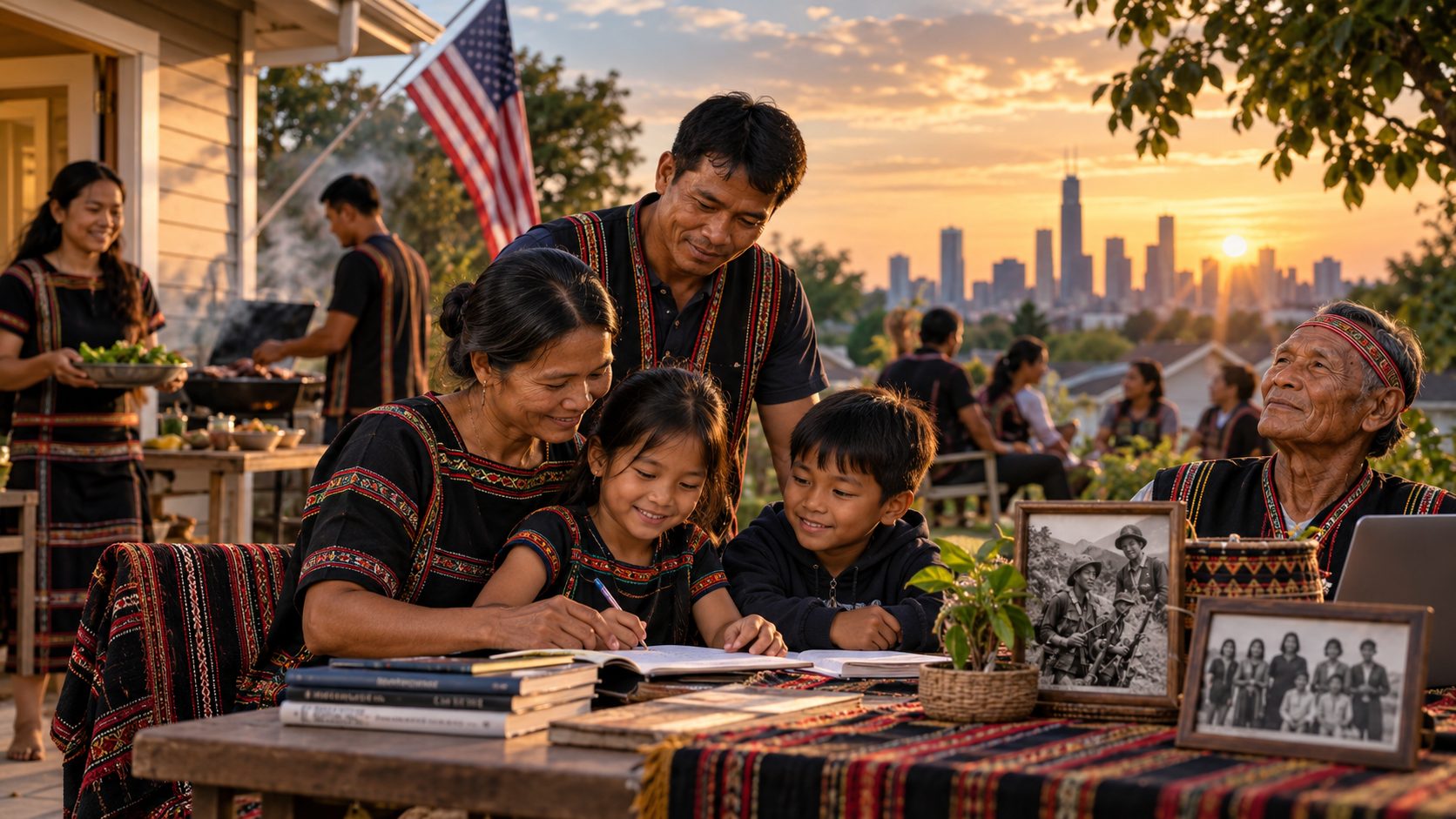
They went to four places. Raleigh, Greensboro and Charlotte, which had taken the earlier waves, and New Bern, which had not. Bailey’s explanation of why North Carolina at all:
“The refugees were resettled in Raleigh, Greensboro, and Charlotte, North Carolina, because of the number of Special Forces veterans living in the area, the supportive business climate with numerous entry-level job opportunities, and a terrain and climate similar to what the refugees had known in their home environment.”
New Bern was added because the three existing sites could not absorb nine hundred people in one summer and eastern North Carolina had an agency with capacity — Interfaith Refugee Ministry, a program of the Episcopal Diocese of East Carolina, which has resettled more than twenty-eight hundred refugees across the east since 1992. Its director described the reach and the first hour: they resettle people as far away as Elizabeth City and as far south as Southport; someone meets them at the airport, and once they arrive, the first thing is clothing. English instruction came through Craven Community College.
Anui Rmah was in the group of about thirty who reached New Bern on June 7, 2002. Speaking years later through his son Anem, he explained what the protests had been about — “the north took over their lands, their church, religion, they don’t want them to go to church or have their own” — and what they had turned into: “When there are protest till midnight they are fighting, hitting each other, throwing rocks.” On arriving he said only: “It was really different compared to Vietnam. Here it was really different.” Asked what would happen if he went back, his son answered for him: they will take him to the jails. He went to work at a poultry plant in Kinston. After nearly five years apart, his wife and six children joined him.
Who did the work
Three sets of people met the aircraft, and the third is the one usually left out.
The agencies. Lutheran Family Services in the Carolinas ran most of it, arranging housing, hiring Montagnard caseworkers and setting up English classes; Catholic Social Services and Interfaith Refugee Ministry took the rest. The reception and placement grant the State Department paid the agencies was nine hundred dollars per refugee at the time. What a family was actually handed was four hundred. After that came eight months of refugee cash and medical assistance, or enrollment in the matching grant program, in which a voluntary agency puts up one dollar for every two federal dollars.
The veterans and the churches. Churches found housing and paid rent and electricity; by July the appeal had sharpened and sponsors were being asked to give more, for longer. And the Special Forces Association provided much of the manpower for setting up apartments — retired Green Berets carrying donated sofas up apartment stairs in Guilford County in June 2002. See The veterans in America.
And our own people. This is the part that is documented and is nonetheless usually missed. The 1986 and 1992 arrivals were the reception committee for 2002. The International Montagnard Bible Church in Greensboro — Rev. Y Hin Nie’s congregation, in the former Crusade Baptist building since 1998, with pews for two hundred and fifty and a membership speaking six languages — was helping forty-one of the nine hundred and seven that summer. Lutheran Family Services’ own reception program manager put it plainly: “It was a huge undertaking” and “Y Hin was one of our major, major volunteers.” When a family’s food stamps took two weeks to come through, Montagnards brought food to the church.
Y Hin Nie on what the church is for:
“This church we can keep own language. We want to keep our heritage.”
And on the newcomers:
“We not come here to get rich in America.”
And on the hardest thing in the summer of 2002:
“Right now is big shock is job placement.”
He was right, and the reason was the calendar.
The first year
They arrived into a labor market that had just closed. North Carolina’s economy had not come back from the recession of the previous year. At Southern Foods in Greensboro, a meat packaging and distribution company where about fifty Montagnards already worked — one of them, Jic Jic, who had arrived in 1992, was making over eleven dollars an hour as a meat cutter and explained why his people were there: “A whole lot of my people work here because they work enough hours and they work, … they need money” — a decline in sales meant that none of the new group would find work there at all.
The place where fifty Montagnards already worked could not take one more. That is the concrete reason the first year was hard, and it is worth more than any general sentence about adjustment.
The work that did exist was, in Bailey’s words, factory and warehouse work, landscaping, maintenance, or other tasks that are physically challenging but require little English. Ama Kse of the Montagnard Dega Association gave the list from the inside: furniture companies, K-Mart, textile companies. He also explained what the real adjustment was — being on time, and workplace discipline, neither of which is part of farm life in the highlands. And on why any of them were there at all:
“The problem is the Vietnamese government took the ancestral land from the Montagnards. And they use Montagnard land to build up plantations.”
Look at one apartment four months in. Y Djret Eban, a Mnong, a former soldier, arrested and beaten in 1976 and then put to work on a collective farm where he was paid one bag of rice for harvesting two hectares, until he got away during a protest at the farm in 1991. In Vietnam he could not get work unless he renounced Christianity, and he remembers what he was told: “they say to me, ‘because you are soldier to America…’” In Greensboro, at about fifty, he said:
“I can do everything if they give me job.”
His wife H’Biok, who has a heart condition:
“I can cook, because my health problem that’s all I can do.”
“I am here, happy. My people back home they make many difficulties.”
Their son-in-law Y Gor Eban:
“If we don’t have our community, then we won’t have our culture.”
“Right now I’m homesick.”
“I had no choice, I couldn’t go back home.”
The apartment held two faded and unmatched sofas and a video recorder, and the heat was not working; a caseworker visiting noted that every apartment has heat but theirs appeared not to. Six people, two mismatched sofas, a broken thermostat, and a man of fifty saying he can do any work at all if somebody will give him work.
The agency’s own aim, in its Raleigh director’s words, was “to create a situation of independence for the refugees as quickly as possible” — and he added something worth recording about the summer after September 2001: “I think people were anticipating that there would be kind of a backlash against foreigners.” There was not.
What was said about them, and what they said
Two claims were made about the 2002 group by outsiders at the time, and both should be printed with their authors named.
The first, from the report written for UNHCR’s protection division, attributed to American social workers: that on the whole the 2001 and 2002 refugees had few marriage or relational ties to the former FULRO community already in North Carolina. Set beside that what our own record shows: Y Hin Nie’s church took forty-one families; Montagnards carried food to the church when the food stamps were late; and Ykhiem Ayun’s first sentence about America was about his friends from the war. The two accounts are not the same and we are not going to pretend they reconcile.
The second, from Raleigh Bailey, writing in 2002 for a publisher funded to prepare orientation materials: “Many did not plan to come as refugees; some had been misled into believing that they were coming to the United States to be part of a resistance movement.” He names nobody who was misled and nobody who did the misleading, and gives no instance. What is documented is different and more ordinary: an instructor in Phnom Penh found people who did not know what a lease was and thought they might need permission to leave the state. Both sentences describe people who did not know what they were going to. Only one of them supplies a motive, and it is the one written by somebody who was not there.
Bailey also wrote the most honest sentence anybody wrote about that summer, and it is about us:
“Many long-term Montagnard residents have opened their homes and limited resources to the new group. However, trust, mutual respect, and the willingness to accept different opinions must be reinforced as the earlier arrivals attempt to incorporate these frightened and unprepared newcomers into their community.”
That is true and it was not easy, and the hundred and twenty-two who waited in Phnom Penh are the sharpest instance of it.
The line between soldier and villager
The usual account says 1986 and 1992 were soldiers and 2002 was villagers. It is roughly right and it should not be pushed.
| 1986 | December 1992 | Summer 2002 | |
|---|---|---|---|
| Number | about 200, mostly men | 402: 269 men, 24 women, 80 children | about 905 offered; 791 admitted in 2002 |
| Who | FULRO soldiers out of Thailand | the last FULRO fighters and their families, found in Mondulkiri and Ratanakiri | villagers and church members, and some former soldiers |
| Notice | months | very little advance notice | expedited processing over about ninety days |
| Orientation | — | almost none | a three-day course |
| Cities | Raleigh, Greensboro, Charlotte | the same three | the same three, plus New Bern |
Now the exceptions, which matter more than the rule.
Ykhiem Ayun arrived on June 24, 2002. He had taken up arms at fourteen, in 1967, because his parents were poor: “The Vietnamese came for us and I ran.” At sixteen he joined B-23 Mike Force. He was wounded four times. He served under a captain he remembered as a good man who loved the Montagnards. From 1969 to 1975 he hid; then he was captured at Pleiku and imprisoned. He was released in 1992 and went back to his village until 2001, when the interrogations started again. He reached a UN camp in Cambodia. The first thing he says about arriving in America is this:
“I was very happy when I arrived here. So happy to see my friends I fought alongside.”
And Y Djret Eban, in the Greensboro apartment above, was refused work in Vietnam because, as he was told, he was a soldier to America.
So the line between soldier and villager is a line drawn by resettlement paperwork, not by lives. See Mondulkiri, 1992.
There is one more thing about Ykhiem Ayun that belongs on this page. A stroke in 2014 left him unable to work. Because he had not naturalized, he was ineligible for assistance. He was living on ninety-seven dollars a month for food. A man who fought in an American unit, brought to the United States on an American program, on ninety-seven dollars a month, because the citizenship test is in English and he could not take it. That is not a footnote to this story. It is where a good deal of it ends up.
What it built
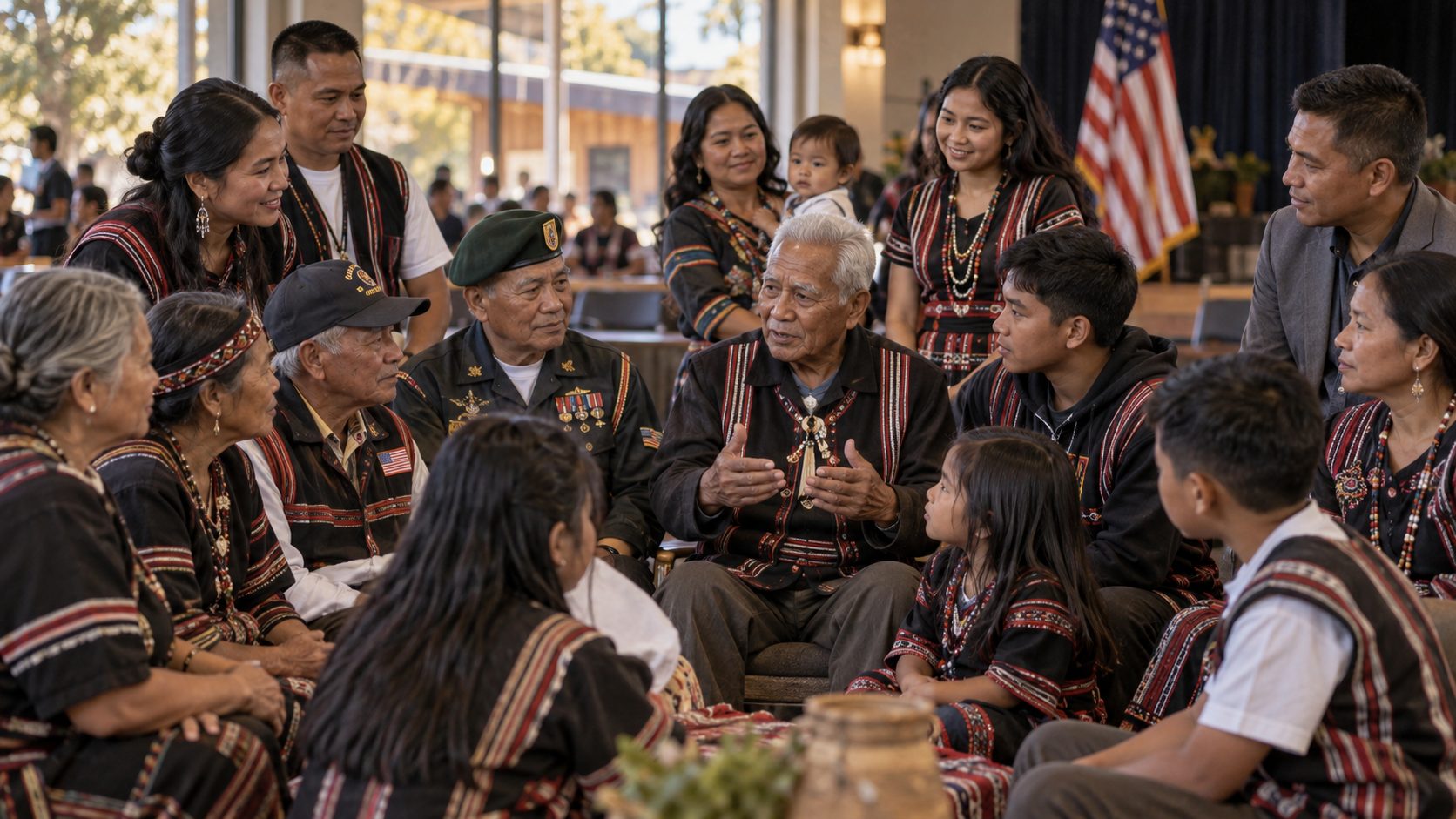
Look at the churches and you can read the 2002 wave straight off the map. When eleven Montagnard men were ordained together at Greensboro in November 2013, they came from eleven congregations: the Bunong Christian Church, the Montagnard Christian Bible Church and the United Montagnard Christian Church in Greensboro; Kroi Kong Plei Ku Church, Oyadao Baptist Church, Dega Christian Church, Sang Oi A Dai Mathio Anih and Ana Jarai Baptist Church in Charlotte; the Montagnard Baptist Church in Raleigh; the Jarai Baptist Church in New Bern; and Highland Christian Church in Asheboro.
A Jarai Baptist church in New Bern exists because of 2002. So does the Asheboro congregation, near the land the veterans bought. Alongside them: the International Montagnard Bible Church in Greensboro, the International Montagnard Church in Charlotte, the Greensboro Evangelical Church and the Seventh-day Adventist mission group. See The Evangelical Church and registration.
The associations were mostly older than this wave and were remade by it. The Montagnard Dega Association was formed in 1987 by the first elders to arrive, to help with resettlement, keep the traditions and handle communication; it is today a designated refugee service provider. Our own organization did the immigration work described above. The Montagnard American Organization is the youth branch. And Save the Montagnard People, founded by American veterans in 1986, had raised the money for a hundred acres near Asheboro by 2003, with a replica longhouse and a traditional cemetery on it; a donation of three hundred thousand dollars paid off the mortgage in 2006. See Our organizations.
And then the children who came on those flights grew up.
Sel Mpang arrived in Greensboro in 2002 when she was about five or six. She now teaches two traditional dance classes, one for fifth to eighth grade and one from high school up.
“My parents had always spoken our language, and kept our culture in our household.”
Sachi Dely arrived at four, studied art at Guilford College, and paints:
“It had to do with my culture and trying to figure my identity. I was confused about what it meant to be Montagnard.”
“A culture can be reinvented without forgetting its heritage.”
Liana Adrong, of the Montagnard Dega Association:
“Cultural preservation is so important to us.”
“We see a lot of disconnect between us and our parents.”
And, on what her parents did and what has come of it:
“My father served seven years in a Vietnamese jail, and my mom struggled so much to raise her kids.”
“Some have been here since 1986 but haven’t been naturalized due to the language barrier.”
A girl of five off an aircraft in 2002, teaching Dega dance to Dega children born in Greensboro. That is what the 2002 resettlement built, and it is a better measure of it than any figure on this page.
How many of us are in North Carolina now is a separate question with a long and disputed answer, and it is set out with its sources at How many Dega there are. Before this wave, the community was about three thousand people. See also North Carolina.
What we do not have
The months in the factory. Nine hundred people lived in one building in Phnom Penh from April to September 2002. Nobody wrote down what it was like. The three-day course is documented because a reporter sat in on one session; the rest of those five months is not documented at all.
The hundred and twenty-two. Who they were, what they were told, how long they actually waited, and whether anybody ever apologized. The accusation is on the record. Nothing else about it is.
The arrival, from the inside. There are recorded interviews with American veterans about Montagnards in several archives. There is very little the other way round: very few recordings in which a Dega person who got off one of those aircraft in June 2002 describes the first week. The people are here, in Greensboro and Charlotte and Raleigh and New Bern, and they are in their fifties and sixties now.
If you came in 2002, or met someone who did, that first week is the thing we most want written down. See How to record an elder.
Terms
- Priority 1 (P-1)
- The category of the US Refugee Admissions Program reserved for compelling protection cases, or refugees for whom no other durable solution exists, who are referred to the program by UNHCR or a US embassy. The 2002 group came in under P-1.
- I-730 petition
- The Refugee/Asylee Relative Petition, by which a resettled refugee applies to bring a spouse and unmarried children under twenty-one. It is the form on which the separated households of 2002 depended.
- Reception and placement grant
- A per-refugee payment from the State Department to the resettlement agency, nine hundred dollars at the time, covering reception at the airport, housing, furnishings, food and clothing for at least thirty days, and referrals. Families themselves received a four-hundred-dollar cash grant.
- Matching grant program
- An alternative to state-administered refugee cash assistance, in which the voluntary agency provides one dollar in cash or services for every two federal dollars.
See also: The Cambodian camps, 2001–2005, North Carolina, Mondulkiri, 1992, The veterans in America, How many Dega there are.
Sources
- US Department of State, Bureau of Population, Refugees and Migration, Proposed Refugee Admissions for Fiscal Year 2003: Report to the Congress, September 2002 — the 1,100, the 150 and the 950; the expedited processing; and the definition of Priority 1. A bureau reporting to Congress on a program it ran itself, in the year after it ran it
- Vietnam: Situation of Indigenous Minority Groups in the Central Highlands, a Writenet report commissioned by UNHCR’s Status Determination and Protection Information Section, June 2006, page 15 — the 905 and the 76 percent, and the I-730 paragraph. The published PDF names no author, so we cite it by title
- Raleigh Bailey, The Montagnards: Their History and Culture, Center for Applied Linguistics, 2002 — the four resettlement sites, the 1992 composition, the job types, the community at about 3,000 in 2000, and the passages quoted here about the reception of the new arrivals
- US Committee for Refugees, World Refugee Survey 2003, Cambodia — the 791 admitted and the 124 to follow, the forced returns of March 2002, and the hundred hiding in the forests
- Human Rights Watch, Cambodia: Protect Montagnard Refugees Fleeing Vietnam, September 25, 2002, and Repression of Montagnards, chapter XIII — the deportations after March 2002, the closing of the border, and the accounts of people who fled in 2001
- The Cambodia Daily, April 1, April 22, July 4 and September 10, 2002 — Hun Sen’s announcement and the ambassador’s reply; the burning of the Mondulkiri camp; the three-day orientation course; and the hundred and twenty-two held back in Phnom Penh
- Voice of America, June 4 and July 1, 2002 — Ama Kse, Jic Jic and Hlinh Nay, the commercial flights, and the recession. VOA is the external broadcasting service of the United States government, reporting on a resettlement its own government had just decided to carry out
- Public Radio East, Montagnards in Eastern North Carolina, August 29, 2012 — Anui Rmah, through his son Anem; and Interfaith Refugee Ministry in New Bern
- Janie Dyhouse, Montagnards Find Home in North Carolina, VFW Magazine, April 2019 — Ykhiem Ayun, Y’Siu Hlong, Y Monah and Vung Ksor
- Erica Hellerstein, INDY Week, March 22, 2017 — Glun Siu and Rong Nay
- A contemporaneous Greensboro feature on the arrival, autumn 2002, hosted in the Redefining Home project — Rev. Y Hin Nie, the Eban family, Shirley Thoms, and the Special Forces Association. The page carries no byline or date; we date it from its own contents and say so
- Our own record of our immigration and family reunification work — the 202 I-730 petitions, the 136 families and the 560 children, October 2003 to January 2009. Our own organization’s count of its own work
- YES! Weekly, January 9, 2019 and 2022 — Sel Mpang, Sachi Dely and Liana Adrong; and Michael McEwen, 11 Montagnard men ordained, Biblical Recorder, December 2, 2013 for the eleven congregations
Compiled September 2026. No Vietnamese government or state media source is used. The figures for the size of this movement disagree by about fifty people and are printed disagreeing, each with its publisher; the best single statement is that about 790 people arrived in 2002 and about 905 in the whole movement. Two claims made about our people by outsiders — that the 2002 arrivals had few ties to the earlier community, and that some had been misled into thinking they were joining a resistance movement — are reported here with their authors named and without an instance attached, because no instance was given. The largest gap on this page is the five months in the Phnom Penh factory and the first week in North Carolina, neither of which anybody wrote down. The people who lived both are here and in their fifties and sixties.