
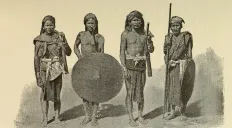


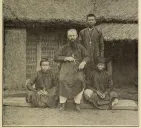













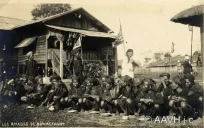

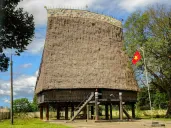



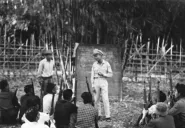
The Bahnar are the people of Kon Tum and eastern Gia Lai, with a wing that spills over the Annamite crest into the hills of Bình Định. They are the counterweight to the Rhade and the Jarai in any honest account of who we are: they speak a Mon-Khmer language, not an Austronesian one; they count descent through both parents rather than through women; and they are the largest Mon-Khmer-speaking people of the Central Highlands. The rong — the tall communal house with the incurved roof that stands for the highlands in every photograph ever taken of them — is theirs. Theirs was the first of our languages ever written down. And the first letter of Bajaraka is the B.
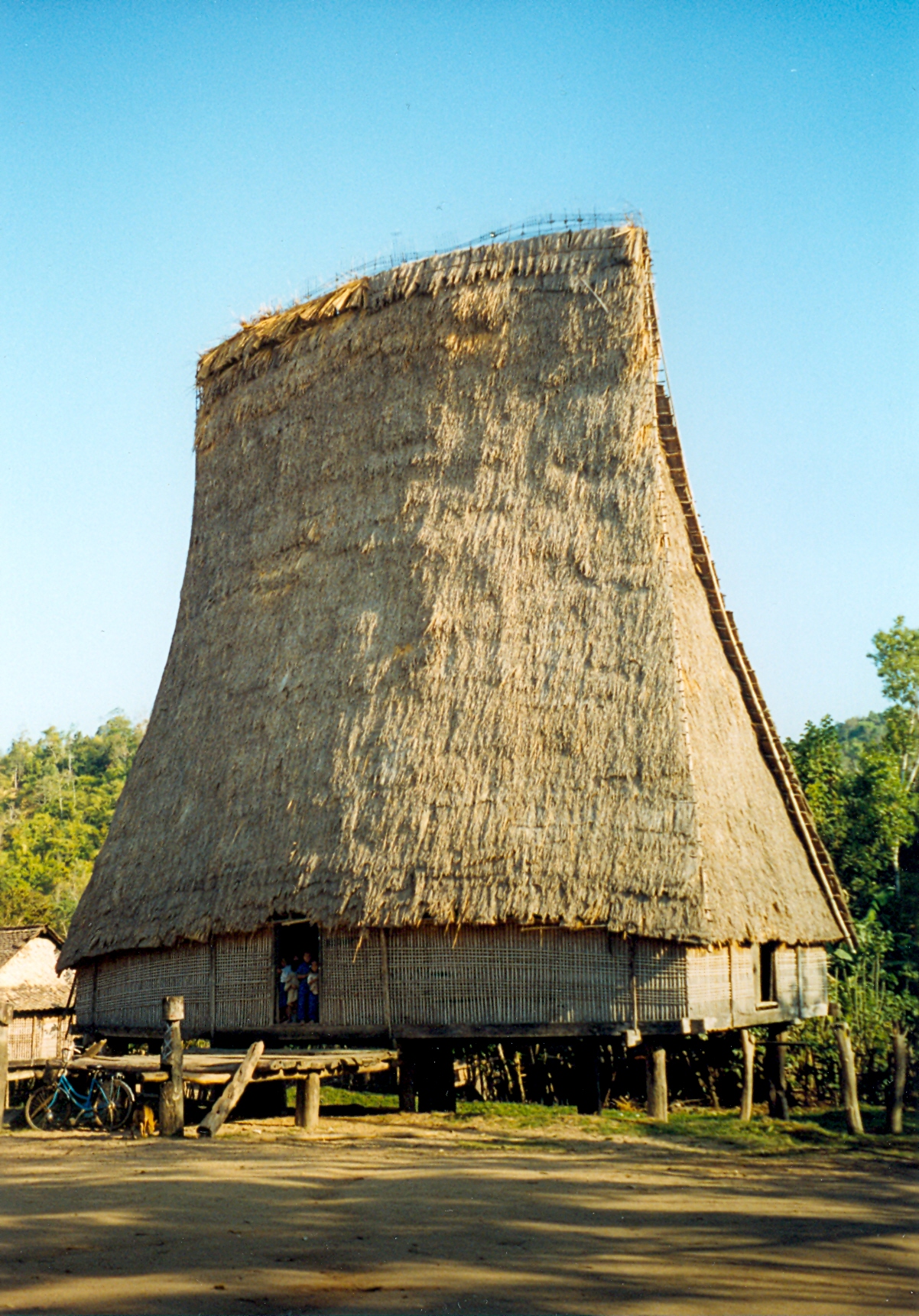

The country
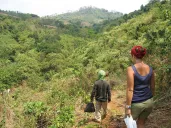
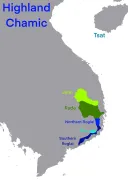
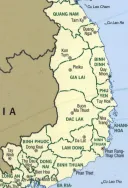
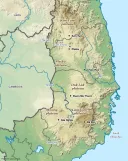
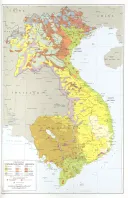
The Bahnar hold the northern end of the plateau. The Dak Bla runs through Kon Tum town; the Pô Kô comes down from the north; where they meet they become the Se San and run west into the Mekong. The eastern Bahnar sit on the headwaters of the Ba.
Districts to put on a map: Kon Tum city, Dak Ha, Kon Ray and Sa Thay in Kon Tum; Dak Doa, Mang Yang, Kbang, Kong Chro, Dak Po and An Khe in Gia Lai; and, over the crest, Vĩnh Thạnh and Vân Canh in Bình Định where the Bahnar Kriem live.
Villages that will recur on this page, each because something happened there: Kon Phar, where the mission arrived on January 1, 1851. Kon Kơ Xâm, the principal Bahnar center, which the mission took over in 1857. Jơ Ri Krong, the first village made entirely of Christians, in December 1866. Kon K’tu, a village of about a thousand people where the Bahnar language has been documented from 2016 onward, with Bahnar men named on the resulting papers. Kon Klor, whose rong stands on the Dak Bla. Bre in Dak Doa, the village of an epic singer. Plei Grak in Sa Thay, from which every one of the eleven people in our Kon Tum prisoner record came.
A Bahnar village moved about every three years, because a swidden supports three or four crops and then has to be let go. Traditionally it held about two hundred people; the number of houses ran from twenty to a hundred. Villages were once fortified, and then the stockades were replaced by fences to keep cattle out of the fields — and then, as a 1966 American handbook put it, “now, to satisfy military needs, they are again sometimes fortified.”
That is the whole twentieth century in one clause.
The name, and names
We are going to be honest about this, because the alternative is to make something up. The best answer available is the one the 1966 handbook gives at page 17:
“The meaning and origin of the name Bahnar is unknown.”
A guess circulates that it is related to Khmer phnom, mountain. We could not find a linguist who says so, and it is not a plausible regular derivation. It is a folk etymology and we are not going to repeat it as a fact.
The spellings tell you who was writing. Ba-hnar is Dourisboure’s, on the title page of his 1873 memoir. Bahnar is the standard in French and American scholarship and in the language code. Bơhnar is the internal spelling. Ba Na is the Vietnamese state’s, and we take it from a non-Vietnamese source that reports it.
The long lists of “other names” in reference works are mostly subgroup names, because a Tơlô man asked who he is may reasonably answer Tơlô.
What a Bahnar name is made of
Bahnar personal names are ordinary nouns, and one nineteenth-century priest found that so trying that he complained about it in print. Writing from his district in 1900, Father Guerlach:
« L’un s’appelle Michel Marmite (Go), l’autre Marie Boucle d’oreille (Gop), le troisième Thomas Forêt (Bri). J’en ai baptisé un que ses parents voulaient appeler Crotte de chien (Ik Kô). — Mais j’ai ordonné de chercher un nom plus convenable pour un honnête homme et on l’appelle Ding (Tube). »
One is called Michael Cooking-pot. Another Mary Earring. A third Thomas Forest. He baptized one whose parents wanted to call him Dog-dirt — but he ordered them to find a name more suitable for an honest man, and the child was called Ding, which means Tube.
Read that again for what it is. It is a Frenchman, in print, describing the exact moment at which a Bahnar name was overruled. It is also one of the very few places where nineteenth-century Bahnar words survive attached to particular people: Go, Gop, Bri, Ik Kô, Ding. The priest meant it as a joke against the parents. It has outlived him as a record of them.
Today a Bahnar man’s name in Kon Tum usually begins with A and a woman’s with Y — A Bên, A Banh, A Xơm, Y Bê, and in our own prisoner record A Chie, A Groh, A Phuc, A Yiu, A Brih, A Nhuih, A Thuh. In Gia Lai and Bình Định the registered surname Đinh is very widely used. Bok is grandfather, elder, sir; Yă is grandmother. Hence Bok Pơnh the epic singer, bok kara the village chief, and Bok Glaih the god of thunder. See Names and words.
The first alphabet in the highlands
No language of the Central Highlands had ever been written before the Bahnar’s was, and the sequence is documented.
Father Combes wrote first. At the end of 1850 Dourisboure, at Kon Trang among the Sedang, translated into Sedang the prayers Father Combes had composed in Bahnar. So the first Bahnar text was a set of Catholic prayers, and the first use anyone made of written Bahnar was to turn it into Sedang.
1861: the script. Missionaries at Kon Tum devised a written language for the Bahnar — Latin letters with Bahnar variations — and taught it to Bahnar children until, in the handbook’s phrase, anti-French movements within the tribe interrupted their education. Teaching resumed in 1883. It was officially adopted in 1935 — seventy-four years after it was made. Our people were writing their language for three generations before any state agreed that they were.
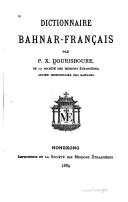
1889: the dictionary. Dourisboure’s Dictionnaire bahnar-français, printed at Hong Kong, opens with a grammar and an alphabet of twenty-one letters:
A, B, D, E, G, H, I, Y, J, K, L, M, N, O, Ô, P, R, T, U, Ù, X
No C, no F, no Q, no S, no V, no W, no Z. X does the work of s. Y is a vowel as well as a glide. That one line is the first alphabet ever made for a language of the Central Highlands, and it was the model for the ones that followed. The dictionary holds a little over four thousand headwords, and it is dedicated to the bishop who ordered the mission and died in a Vietnamese prison in 1861.
One of its entries is worth having on its own: CHƠRO XEM — consult the birds, go and listen to their song to know what they announce. Hold on to that; it comes back below.
The chain, and the two Bahnar names in it
From Combes’s prayers to the present is a hundred and seventy-five years of dictionaries: Dourisboure’s alphabet and catechism in 1888 and the dictionary in 1889; Guilleminet’s customary law and his 169-page monograph in 1952, and his dictionary with Father Alberty from 1959, about ten thousand entries; a Yale doctorate on the structure of Bahnar in 1964; the Summer Institute of Linguistics dictionary of the Plei Bong dialect in 1979; a bilingual Bahnar–Vietnamese New Testament in 2008; and a talking dictionary online now.
Two names on that list are Bahnar, and they are the point of this section. Siu Mo’ is credited as an author of the 1979 dictionary alongside the two American linguists. Hơ L.T.T. is credited on the talking dictionary and on the current online Bahnar–English dictionary.
And a third, from a different field. Xơm A, of the Bahnar community of Kon K’tu, is a named co-author of a peer-reviewed, open-access article on documenting environmental knowledge in the Bahnar language, published in 2026. He appears elsewhere in the same team’s work as the culture expert A Xơm. A Bahnar man from a Bahnar village, on the byline of a linguistics paper about his own language. That outranks everything else in this article and we say so. See Writing our languages.
The rong
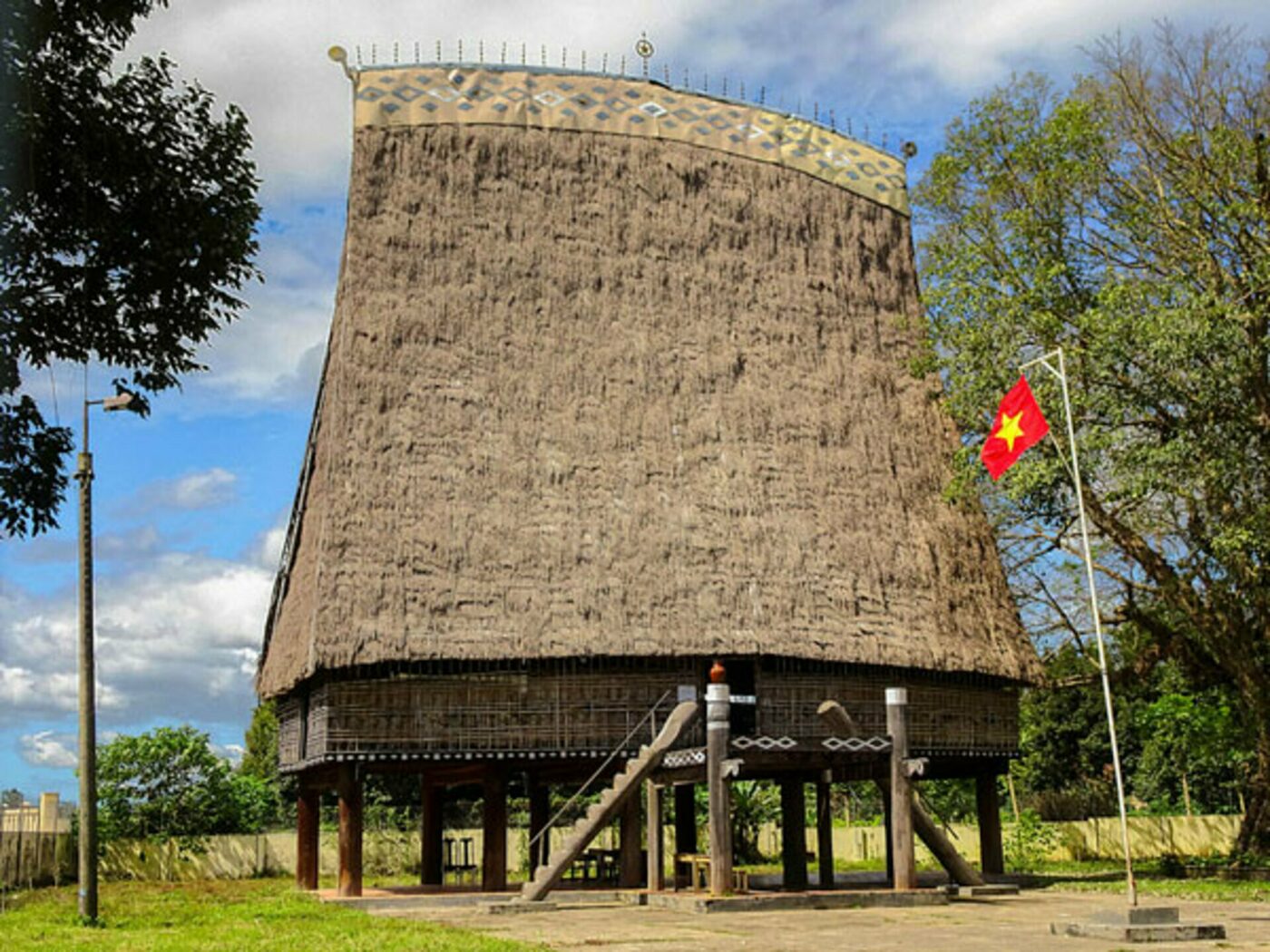

Everybody knows what a rong looks like. Very few accounts say what it is for, and the 1966 handbook — written to make our villages legible to American soldiers — says it in one clause that no tourist brochure will print:
“The floor of the communal house is made of crushed bamboo planking supported by four large beams and is designed to prevent lance thrusts from below.”
A rong is not a village hall with a dramatic roof. It is a keep. The same source is explicit: the communal house is normally where the village’s bachelors sleep, and it is also a stronghold for defense in warfare conducted with lances, knives and crossbows, from which the warriors can defend the village.
Across the subgroups it is called rong, hnam rong — literally rong-house, hnam being the ordinary word for house — and also horojig, wal or jong. It faces north-east to south-west.
What happens inside it. The village assembles there. Disputes are heard there. A guest from an allied village is welcomed there and given wine — the rong is the place where a stranger is turned into a guest. (The same passage notes, with no explanation offered, that visitors with large beards have special appeal to the Bahnar because they fit the tribal ideal of masculine power.) The gongs and the bronze drums are stored there. And the unmarried young men who sleep there make things: tools, traps, nets, pipes, baskets, and bamboo tubes for water, salt and tobacco — some of which, the handbook notes, only women may use.
How tall. Reported heights vary so much that we are not going to commit to one. Eighteen meters is given for a neighboring people’s communal house on eight columns. Thirty meters appears in travel writing and should be read as travel writing.
How it is built. No iron anywhere in the frame; columns joined by smooth mortise and tenon; grass thatch under large woven rattan mats; a decorative ridge strip about a meter and a half tall, sometimes carved with a bird; and a scaffold of poles driven in diagonally and lashed horizontally, which lets crews work at several heights at once and can be extended by ropes from the summit.
And the thing that matters most about it. A rong is rebuilt by the whole village, communally, out of materials cut fresh. It is not a monument; it is a recurring act. Which is why a village losing its rong is not a heritage question. A village that no longer assembles no longer rebuilds.
Bilateral: how the family works
This is where the Bahnar page has to part company with the Rhade and the Jarai, and the difference should be named rather than fudged.
Bahnar kinship is bilateral. Descent is reckoned on both the father’s and the mother’s side, with neither dominant. There are no exogamous matriclans — no Niê and Êban, no Ksor and Siu, no bride who owns the house and no husband who marries into it. Village headship tended to pass from father to son or to a close kinsman, so residence and office lean patrilateral, but that does not make it a patrilineal clan system either. It is bilateral, and the honest word for it is bilateral, not “not matrilineal.”
Inside the house, the hearth to the right of the door is kept for guests; the other hearths at the far end are the family’s.
The tơring
And here is the Bahnar land institution, which has no equivalent on the other pages of this library and ought to.
Land is held by tơring associations: the territory of several villages administered collectively by those villages together, controlling the farming, hunting and fishing rights across the whole of it. Not a village boundary and not a clan estate — a standing association of neighboring villages over a shared country.
Under the French, Bahnar functionaries were picked from the influential families of a tơring. A district chief was often a Bahnar; the resident province chief was usually French. And the handbook records the consequence in a sentence that is the fault line of the next hundred years:
“The Bahnar continue to draw a sharp distinction between traditional headmen and those functionaries who emerged under the French rule.”
See Customary law and The land law.
Three worlds, and the birds
The Bahnar universe has three worlds. The first is the earth, the plants, the animals, people and the stars. The second is the world of the kiak, the ancestors — and it includes the objects and the sacrificed animals that have been set on a tomb. The third is the world of the spirits.
A person reaches the second world asleep. When a man dreams, his essence, his po’hngol, goes into the second world and meets the kiak directly, who may help him or harm him. Dreams therefore matter enormously.
Notice what that does to the tomb house. The things left on a tomb are not memorial objects. They are in the second world already. See The tomb house and Yang, the spirits.
The yang
The best living record of Bahnar religious vocabulary comes from eight field expeditions to Kon K’tu between 2022 and 2024, with about a hundred interviews and twenty expert consultants from the village. Its framing sentence is worth quoting because it is a description of method as much as of belief:
“Understanding about the spirit world’s relations to the local environment and people is encoded in the Bahnar language through the lexicon — especially the emic concept yang which denotes spirits or deities — and is transmitted via metaphors, wise sayings, songs, stories, placenames, gong music, and epic tales by people who occupy diverse social roles.”
The yang are everywhere and they are specific: yang dak of water, yang kong of the hills, yang bri of the forest, yang phe of the rice, yang Măt Nar of the sun, yang Măt Khei of the moon, yang Unh of fire, yang Teh of the earth, yang T’mo of the rock, yang Krong of the river, and yang h’long, the trees taken together, invoked when a field is cleared and again when it is harvested. Above them, Bok Glaih the thunder god, Yă Kung Keh and Kok Kei Dei, named as the highest of the traditional deities, and Bok Hoch, a giant bird with a wide wingspan.
Below them a populated middle distance: hri, the spirit that makes rice grow; hodrĕ, an evil spirit; hui-hai, miniature invisible people of the forest; kơnŏk, a mythical woman who plays with living children; gơhlŏu, an imaginary sweet-smelling thing that lives in trees.
And then three verbs, which between them are a complete theology. Tơl: to answer — that is, to promise the spirits a buffalo. Ming yang: to placate the spirits. Sơnoh: to pay the spirits what was promised. Promise, appeasement, payment. See Jars and the buffalo feast.
Asking the birds
This is unlike anything on the other pages in this series and it should be told at length.
Some birds are xem lơng, auspicious. Some are xem kơni, birds of bad omen. The birds whose songs are read are bơlang; a song may be bơlang lơng, favorable, or bơlang kơni, sinister. The act of consulting them is chơro bơlang or chơro xem.
And there is a word for what you do about the answer: uâl — turning back; abandoning a journey into the forest because of the omens.
A Bahnar setting out listens, and if the wrong bird calls he goes home, and the language has a verb for that.
Now put the dates together. Uâl and chơro bơlang were recorded at Kon K’tu between 2022 and 2024. CHƠRO XEM is an entry in a dictionary printed at Hong Kong in 1889. The practice is attested, continuously, for a hundred and thirty-seven years.
The rice year
In order: rơih teh, choosing the ground; kăl long, cutting the trees; xoh muih, burning; choi, planting, with et pôm choi, the sowing ceremony; khop apinh dak mi, prayers for rain, and khop apinh kơ prăng, prayers to stop it; xum nao, making the new rice store; and kech ba, the harvest ritual. See The rice year.
Two passages from 1966, and what they are
These come from the same American handbook, and they should be read as what they are: a briefing prepared for the United States Army about people its soldiers were about to live among.
“Initially, the Bahnar were extremely reluctant to seek medical aid at government clinics: they feared dying outside the village because they believed their souls would have no homes — the worst fate that could befall them.”
“Once they feared the helicopter and performed sacrifices at its wheels to ward off harm to the village. Reportedly the Bahnar have overcome this fear; the helicopter has become associated with the arrival of food and medical supplies.”
The first is a serious piece of ethnography and explains a great deal about why people would not go to clinics. The second is an army telling its own officers that the locals have got used to the aircraft. Both are useful. Neither was written for us.
Hơamon
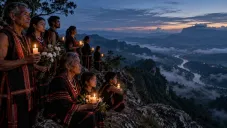
The Bahnar epic is the hơamon, also written h’mon or hơmon — glossed by the Kon K’tu documentation simply as old-time stories; epic tales. It is a long narrative in prose, in verse, or in paired symmetrical prose, performed as sung recitation with varied tone and inflection.
It is performed at festivals, at night, when the sounds of the day do not intrude. The audience is not passive; the listeners share the emotion with the singer.
And afterward, listeners report dreaming of the characters — which is taken as a good omen and as evidence of real contact with the ancestral spirits.
Set that beside the po’hngol, the dream-soul that goes into the second world and meets the kiak. A hơamon is not entertainment. It is a way of arranging for the dead to visit you in the night. Only a page that carries both facts can say that, and this page carries both.
The singers have names. A Lưu of Kon Tum, a performer of more than a hundred Dăm Giông epics, among them Giông hunts the wild buffalo. Bok Pơnh of the village of Bre in Dak Doa, who recited Atâu So Hle, Kơne Gơseng, recorded and translated with Siu Pêt and published in 2006.
The epics have names. Đăm Noi. Xing Chi On. Atâu So Hle, Kơne Gơseng. And the great Giông cycle, whose recurring hero is Giông and whose recurring subjects are the kidnapped beauty and the battle fought for her.
Nineteen h’mon were collected from 1985 onward by one researcher who learned the language and lived with the singers, and published in Hanoi in 2006. That work fed into a sixty-two-volume collection of Central Highlands epics published between 2004 and 2007 — and here the double accounting this library tries to do applies exactly. A state that classifies its nationalities also collected and printed their epics, in bilingual editions, at a scale nobody else has attempted. Those volumes are the largest body of Dega literature in print anywhere, and they exist because a government paid for them. Both halves are true.
We could not obtain lines in Bahnar. What we have is a fragment at one remove, in Vietnamese translation, from Atâu So Hle, Kơne Gơseng, describing a country beyond the sea:
“beyond the blue sea is the land of Atâu So Hle, where the rong house touches the sky.”
When a Bahnar epic reaches for an image of paradise, it reaches for a rong so tall it touches the sky. That line explains the building better than the architecture does.
And the present tense is not good. The people who can memorize and tell the epics are becoming rarer, and preservation by printing and by classroom has not worked. Both of the scholars who have said so use the same image: to take a h’mon out of performance is to take a fish out of water. See Gongs and epics.
The mission
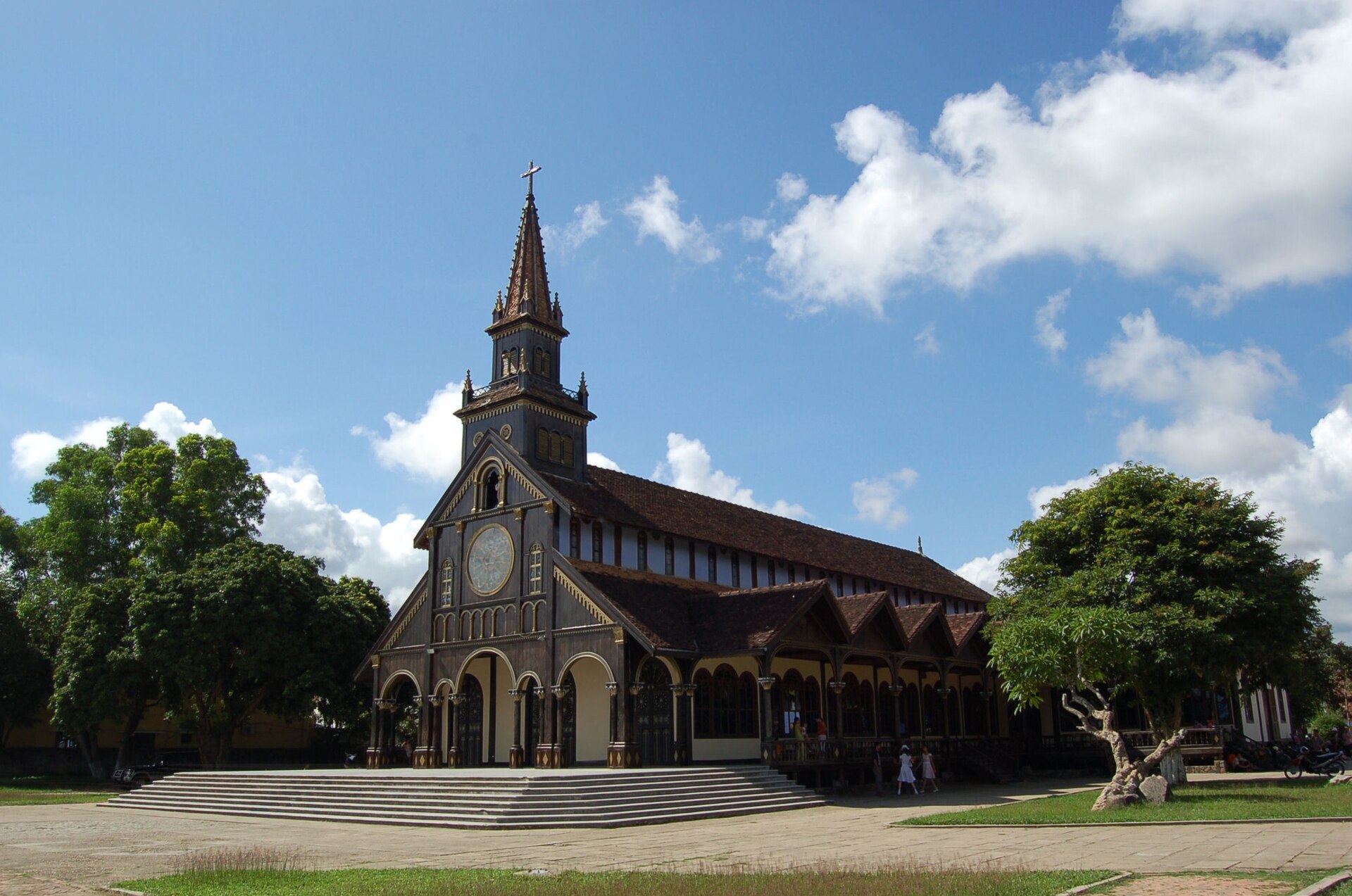
The institutional story is at The Kon Tum mission. What belongs here is the Bahnar part, and the double accounting.
What it was and what it wanted. The Missions Étrangères de Paris wanted the highlands because the court had closed the lowlands to them and because the peoples of the plateau were unevangelized. The expedition left the coast on November 11, 1850. Father Pierre Dourisboure, aged twenty-five, reached the Bahnar village of Kon Phar on January 1, 1851. He stayed thirty-five years.
The sequence: the first infant baptism on January 1, 1852; two adult baptisms on October 16, 1853 — Ngui and Pat, who were probably Sedang of Kon Trang rather than Bahnar, and we say probably because the mission’s own notices place him among the Sedang at that date. Combes died in 1857 and Dourisboure took over at Kon Kơ Xâm. In 1865 the method changed: instead of converting individuals inside existing villages, found villages made only of Christians. The first was Jơ Ri Krong, in December 1866. By 1883 there were four villages of baptized Bahnar and Guerlach’s own estimate of fifteen hundred Bahnar and Rơngao converted. Dourisboure went home in 1870, published his memoir, was recalled to compile the dictionary, and died at Marseille in 1890 with his health gone.
What the mission was living through. A letter Dourisboure wrote from Bahnar country on December 12, 1871 describes swarms of locusts stretching across the sky, crops destroyed everywhere, and the missionaries accused of having released them; then five young Christians carried off into servitude, seven people killed and about forty wounded, and months of sentries posted.
One Sunday, 1900
Guerlach published an account of an ordinary Sunday in his district, and it is the most usable scene in anything written about the Bahnar in the nineteenth century, because it is not trying to be evidence of anything.
He had a Vietnamese colony and five Bahnar villages. He could not get the Bahnar of the further villages to come on Saturday night — especially the women, who said the housework kept them and that they were afraid of meeting the tiger on the road. Guerlach adds: « Cette crainte n’est pas chimérique », this fear is not imaginary; the tiger regularly took horses, cows and oxen thereabouts.
So he said two Masses. The Vietnamese were called by drum at four in the morning; then, in his own words, the Annamites gave up their places to the sauvages, who were called by the bell, the drum and the tam-tam with a first-class noise, and he preached the second sermon in Bahnar. Latecomers sat under the church floor.
And then the bugle. A friend had given him a clairon, and he blew it twice a day as the signal for the sick to come, because otherwise they came one at a time all day and all night. He records one exchange:
— « Pourquoi n’es-tu pas venu plus tôt ? »
— « Mais, Père, il est encore tôt, il n’y a pas longtemps que j’ai mangé le riz. »
… « Oh ! Père, ce n’est pas pour moi, c’est pour ma femme, hier soir, elle a mangé du chien, elle ne peut pas digérer, elle a été malade toute la nuit. »
Why did you not come earlier? — But Father, it is still early, I ate the rice not long ago. … Oh, Father, it is not for me, it is for my wife; last night she ate dog, she cannot digest it, she has been ill all night.
The three priests
In 1932, three Bahnar men from the Christian village of Kon Tum were ordained priests: Father Châu, Father Hiâu and Father Den. They had entered the Cuénot school between 1911 and 1913, gone on to the seminary at Làng Sông, and spent six years in philosophy and theology at the college on Penang. Twenty years of study. They were ordained on June 29 and reached Kon Tum on July 4; the village formed a procession, and the European missionaries and the laity knelt to receive their first blessing. On July 5 all three said their first Mass at once, at three decorated altars.
The priest who wrote that up opened by noting that twenty-five years earlier, the idea of priestly vocations among the indigenous population would have seemed absurd.
In 1933 Kon Tum became a vicariate in its own right — officially, the mission of the Bahnar savages — with twenty-three thousand Christians, twelve missionaries and fifteen indigenous priests. By 1940 there were about twenty-five thousand Catholic Bahnar who had, in the handbook’s phrase, modified but not abandoned their traditional rites.
Bahnar Catholicism has its own vocabulary: Bă Yang, the God of Heaven, used in Christian speech for Christ; Hlabar Khop, the prayer songs; hơ mắt, meaning satanic. And one thing that happened nowhere else. Highland Christians and Vietnamese officials were generally too suspicious of one another to let gong music into church — with, as one scholar puts it, some Bahnar Catholic groups the proverbial exception, because they took the gongs into the liturgy.
The people whose gongs went into the Mass. See The highland Catholic church.
What has happened to us
Before the French. In 1827 the Siamese conquered Laos and took over Laotian claims to the highlands; outposts were set up in Bahnar country and taxes collected nearby. The 1966 handbook says that in this period intertribal warfare became widespread and — its words — the Bahnar were almost eliminated by the warlike Jarai and Sedang. That sentence is unsourced, and “warlike” is doing colonial work in it, and we quote it labelled. What is corroborated, by Dourisboure’s own letter of 1871, is that the nineteenth century was a period of raiding in which Bahnar villages were badly hit.
Which is part of why the mission became a refuge. The Christian villages founded from 1866 were defensible and stood under the protection of Frenchmen that raiders had reason to avoid. When Vietnamese troops came to seize the missionaries in 1854, the handbook records, the tribesmen refused to guide the soldiers.
1888. A French adventurer crowned himself King of the Sedang, and among the offices he handed out was that of Krui, a Bahnar chief made “President of the Bahnar Republic.” See The Kingdom of the Sedang.
1897. Guerlach raised twelve hundred Bahnar warriors — the largest force of highlanders ever assembled under a single command, raised by a priest.
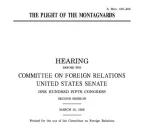
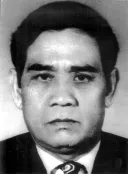
1958. Bajaraka. The name is made of four peoples and the B is first: Bahnar, Jarai, Rade, Kaho. The demonstrations of August and September 1958 were held at Kon Tum, Pleiku and Buon Ma Thuot — our town first. Paul Nur, the Bahnar among the founders, was one of the leaders arrested; he served five and a half years, was released in February 1964, became assistant province chief of Kon Tum, signed the Republic’s treaty with FULRO on February 1, 1969, served as minister for the development of ethnic minorities, and died in a prison in Hanoi. See The Bajaraka movement and Paul Nur and Nay Luett.
The American war. Read these three sentences from the 1966 handbook together, and then read what they were for:
“The territory inhabited by the Bahnar is one of the most strategic in the Republic of Vietnam. Viet Cong supply lines run through the Bahnar area…”
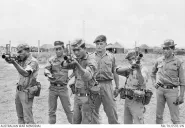
“The Bahnar have a reputation as skilled and capable fighters… if given intensive modern training, support, and leadership, they could become exceptionally effective in jungle combat.”
“Unless given Government training and support, the isolated Bahnar do not have the means and backing to withstand Viet Cong hostility.”
That is a recruitment case, written by a university research center under contract to the Department of the Army, about whether our people would be useful. It is accurate about the ground and about the fighting, and its subject is not the Bahnar. Its subject is what the Bahnar could be made to do. See Mike Force and SOG and Battles on our land.
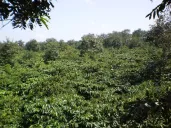
After 1975 is told elsewhere and not repeated: 1975, Land taken for coffee, Ha Mon — which is a Bahnar Catholic movement and has its own page — and The highland Catholic church. Our own prisoner record for Kon Tum holds eleven people, every one of them from Plei Grak in Sa Thay. See Prisoners: Kon Tum.
The people of this people
| Name | What they did |
|---|---|
| Ngui and Pat | Dourisboure’s first two adult baptisms, October 16, 1853 — probably Sedang rather than Bahnar |
| Krui | The Bahnar chief made “President of the Bahnar Republic” by Marie-David de Mayréna in 1888 |
| The twelve hundred | Unnamed, and they belong here as a body: the largest force of highlanders ever assembled under one command, raised by Guerlach in 1897 |
| Father Châu, Father Hiâu, Father Den | The first three Bahnar priests, ordained June 29, 1932, after twenty years of study by way of Làng Sông and Penang |
| Paul Nur | Bajaraka founder, 1958; five and a half years in prison; assistant province chief of Kon Tum; minister for ethnic minority development; died in a prison in Hanoi |
| Siu Mo’ | Co-author of the 1979 Bahnar dictionary |
| A Lưu | Teller of more than a hundred Dăm Giông epics, Kon Tum |
| Bok Pơnh | Reciter of Atâu So Hle, Kơne Gơseng, of Bre in Dak Doa; recorded 2006 with Siu Pêt |
| Xơm A | Culture and forest expert of Kon K’tu; named co-author of a 2026 peer-reviewed paper on the Bahnar language |
| A Bên, A Banh, Y Bê | Village chief, former chief and forest expert of Kon K’tu; named consultants on the same work |
| Y Yich | Bahnar pastor in Gia Lai; twelve years; released May 2025 |
| Đinh Núp (1914–1999) | A Bahnar of Gia Lai, a resistance fighter of the French war, later a deputy of the National Assembly, and the most heavily mythologized highlander in Vietnamese state culture. Every account of him we can reach comes from the state that made him a hero. We would like a Bahnar account of him |
How many
| Figure | Year | Who counted |
|---|---|---|
| 80,000–200,000 | 1966 | US Army handbook — a range wide enough to be an admission |
| 136,859 | 1985 | Vietnamese census, via the Encyclopedia of World Cultures |
| 160,000 speakers | 1999 | Ethnologue, on the 1999 census |
| 181,000 | late 1990s | UNDP, via Human Rights Watch |
| 286,910 | 2019 | Vietnamese census, reported by non-Vietnamese sources |
| about 300,000 | 2019 | Harrison and colleagues, 2026 |
And the sentence those numbers earn: the Bahnar are the largest Mon-Khmer-speaking people of the Central Highlands. National totals are argued at How many Dega there are.
For the diaspora we have seen figures of about ten thousand in the United States and five thousand in France, and we could not find a source for either that we would put our name to. We do not know.
What we do not have
Lines of hơamon in Bahnar. Nineteen epics were collected and sixty-two volumes were printed, and this page carries one line, at one remove, in translation. The singers are old.
What “Bahnar” means. Nobody knows, and the honest answer is that nobody knows.
What the anti-French movements of the 1860s and 1870s were that interrupted the teaching of the alphabet for twenty years. One clause in an American handbook is all we have.
A Bahnar account of Đinh Núp.
And the rong houses. How many survive, and what has happened to the programs that rebuild them in concrete and corrugated iron, is reported almost entirely by sources this library does not cite. If your village has a rong, or had one, we would like to know when it was last rebuilt and by whom. See How to record an elder.
Terms
- rong / hnam rong
- The communal house. Assembly hall, courtroom, guest house, boys’ dormitory, gong store — and a stronghold, with a floor built to stop a lance coming up through it.
- tơring
- An association of neighboring villages holding and administering a territory together, with collective farming, hunting and fishing rights over the whole of it.
- po’hngol
- The dream-soul. When a person dreams, this is what goes into the second world and meets the ancestors.
- kiak
- The ancestors, who occupy the second of the three worlds — along with the objects and sacrificed animals set on a tomb.
- hơamon
- The sung epic, performed at night. Listeners who dream of the characters afterward take it as a good omen.
- uâl
- Turning back — abandoning a journey into the forest because the birds gave the wrong answer.
See also: The Kon Tum mission, The Sedang, Ha Mon, Gongs and epics, Paul Nur and Nay Luett.
Sources
- Xơm A and colleagues, “Documenting Environmental Knowledge in the Bahnar Language of Vietnam,” Languages 11 (2026), article 141 — open access, with a Bahnar man from Kon K’tu named on the byline; and the companion paper on yang and forest animism in PLOS ONE (2026). Eight field expeditions between 2022 and 2024, about a hundred interviews, twenty named consultants from one village. This is the best record of living Bahnar vocabulary that exists
- Pierre Dourisboure, Dictionnaire bahnar-français, Hong Kong, 1889 — the twenty-one-letter alphabet, four thousand headwords, and the entry chơro xem; and Les Sauvages Ba-Hnars, Paris, 1873. A missionary’s memoir and a missionary’s dictionary, made to convert us, which are also the first writing our language ever had
- J.-B. Guerlach, “Chez les sauvages Bahnar: Le dimanche du missionnaire à Reu-haï,” Annales de la Société des Missions Étrangères, 1900, and M. Jannin, “Un grand jour chez les Bahnars,” the same Annales, 1933 — the Sunday, the tiger, the bugle, the overruled name, and the ordination of the first three Bahnar priests
- American University, Minority Groups in the Republic of Vietnam, 1966 — the rong as a stronghold, the tơring, the three worlds and the po’hngol, the village sizes, and the passages about training the Bahnar for jungle combat. Prepared for the Department of the Army on the eve of a war fought across this country
- Paul Guilleminet, Coutumier de la tribu Bahnar, des Sedang et des Jarai de la province de Kontum and “La Tribu bahnar du Kontum,” both 1952; and the Dictionnaire bahnar-français with Father Jules Alberty, from 1959. He was the French resident at Kon Tum, which is to say he wrote down the customary law he then administered
- John and Elizabeth Banker with Siu Mo’, Bahnar Dictionary, Plei Bong–Mang Yang Dialect, Summer Institute of Linguistics, 1979; and the bilingual Bahnar–Vietnamese New Testament, United Bible Societies, 2008
- Phan Thị Hồng’s collection of nineteen h’mon, published Hanoi 2006, and the sixty-two-volume Kho tàng sử thi Tây Nguyên, 2004–2007 — the largest body of Dega literature in print, collected and paid for by the state that classifies us
Compiled September 2026. No Vietnamese government or state media source is used as a source. That rule costs this page the modern figures on surviving rong houses and any independent account of Đinh Núp, and we say so rather than filling the gaps. Several things here are printed unsettled: whether Ngui and Pat were Bahnar or Sedang; what the name Bahnar means, which nobody knows; and what the anti-French movements were that stopped the teaching of the alphabet for twenty years. The French of Guerlach and Dourisboure is given as printed, including the word sauvages, which they used descriptively and which we are not going to tidy away. Bahnar words are spelled as our sources spell them, and the nineteenth-century sources and the 2020s fieldwork do not always agree. If you can correct a word, a village or a date here, we want it.