








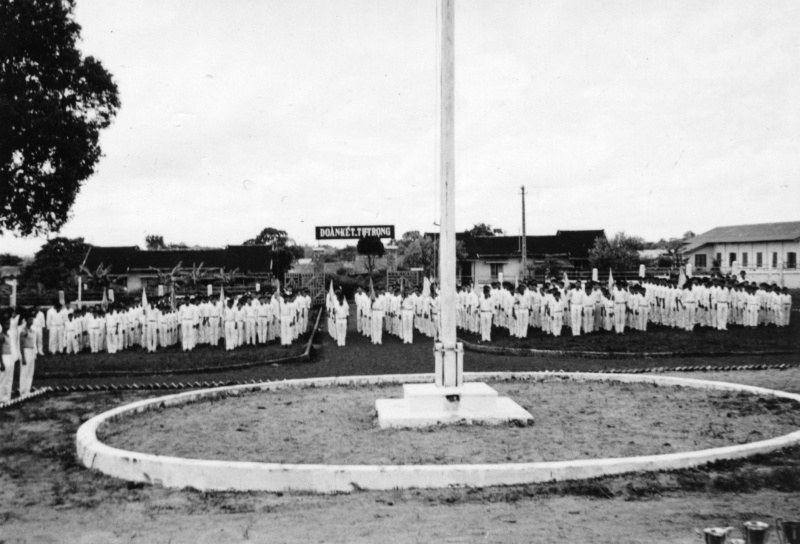
In a century and a half our children have been taught in our languages for only a few short stretches: by the Kon Tum missionaries, in the French schools of Darlac, in the Protestant mission schools, and in a bilingual program the Republic of Vietnam ran with American money in its last years. Every government since 1955 has in the end made the classroom Vietnamese, and today a Rhade teacher in a Rhade district will pretend not to understand a Rhade pupil. The result is measured: thirty-one percent of ethnic minority children in Vietnam reach upper secondary school, against sixty-three percent of Kinh children. This page sets out what the schools taught, in which language, under whom, and what it has cost.

The figures
| Measure | Ethnic minorities | Kinh | Source |
|---|---|---|---|
| Children reaching upper secondary school | 31% | 63% | CERD member, 2023 |
| Grade 5 pupils independent in Vietnamese, 2011–12 | 72% (non-Kinh) | 87% (all pupils) | World Bank |
| Grade 5 pupils meeting the standard in Vietnamese and mathematics, 2013–14 | under 50% (non-Kinh) | 89% | World Bank |
| Completed upper secondary school or higher, 2009 census | 9.0% (all non-Kinh peoples) | 22.7% | UNFPA, 2011 |
| Literacy, 2009 census | 37.7% (Hmong, the lowest) | 95.9% | UNFPA, 2011 |
Every published series treats the fifty-three recognized minorities of Vietnam as one block, or singles out the largest groups, so none of these figures is ours alone. No series for the Central Highlands, or for the Rhade, Jarai, Bahnar, Sedang, Koho or Mnong, is published. That absence is itself a finding. The fuller picture of the present, with attendance level by level, is in The education gap.
The mission and the French schools
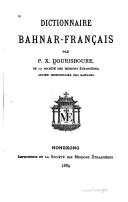
Our languages were first written to be taught. In 1861 the Catholic missionaries of Kon Tum devised a Latin script for Bahnar and taught it to Bahnar children; the teaching was broken off by anti-French movements among the Bahnar, resumed in 1883, and the script was adopted officially in 1935. Pierre Dourisboure’s Bahnar dictionary of 1889 is in our library. See The Kon Tum mission and Writing our languages.
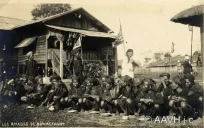
In Darlac the school came with the administration. The Franco-Rhade School at Ban Me Thuot opened in 1915 with thirty pupils; our own records date the first school in the town to 1901. In the 1920s the administrator Léopold Sabatier and the teacher Dominique Antomarchi built a school system for the province, which was then extended to Pleiku, Kon Tum and the Haut-Donnaï, while the Protestant mission spread schooling in the south of the highlands. Scripts were made for Bahnar, Rengao, Jarai, Rhade and the Koho-speaking peoples.
When Antomarchi arrived in Ban Me Thuot on September 10, 1929, as primary inspector for the highland provinces, he found one schoolbook in Rhade and every teacher still to be trained. He trained the best of the older pupils as teachers, wrote textbooks with Rhade teachers, set up a network of village schools across Darlac, and held the first examinations adapted to highland pupils in 1930. That year seven pupils passed the Franco-Rhade primary certificate, and in September a Rhade teacher-training section opened at the Quốc Học college in Huế. Between 1925 and 1930 the colonial education service printed 5,000 copies of schoolbooks in Rhade and 1,000 in Jarai. Antomarchi’s Rhade primer was printed in 1939 and his Jarai primer in 1940, both written with highland teachers. Cochinchina, Cambodia and Laos drew on the system for their own mountain peoples. The men who founded BAJARAKA were its pupils: Y Bham Enuol at the Franco-Rhade School, Y Thih Eban at the Franco-Jarai school in Pleiku and the Collège Sabatier. See The Franco-Rhade school and Sabatier and the Rhade code.
1955 to 1963: the ban
The Republic of Vietnam under Ngo Dinh Diem set out to assimilate us. Instruction in highland languages was banned. Highland place names were replaced by Vietnamese ones, and highlanders in the army had to take Vietnamese names. A province chief in Darlac forbade Rhade men to enter Ban Me Thuot in loincloths. The schools taught the national curriculum in Vietnamese, without any change for minority pupils. Our own records say that documents written in our languages were destroyed in those years. The Collège Sabatier, its own curriculum given up for a common Vietnamese one, was renamed the Nguyen Du school.
The higher schools closed to us as well. The National Institute of Administration trained seventy-one students in a highland section between 1954 and 1958, thirteen of them highlanders; Diem abolished the section in 1958, and from then until 1964 not one highlander studied there. In 1957 the government founded a Highland Normal School at Ban Me Thuot to train teachers. It served mainly the Rhade, Jarai and Koho peoples who lived near it: at the entrance examination of 1965, 21 of 54 Rhade candidates passed, 8 of 19 Jarai, and none of the 6 Sedang. See The BAJARAKA movement.
1964 to 1975: the bilingual years
At the Pleiku conference of October 1964, after the FULRO rising, our leaders asked for our languages to be taught in the primary schools alongside Vietnamese, and for scholarships and special consideration in secondary schools and universities. On October 28, 1964, a decree allowed highland pupils to learn their languages throughout primary school, alongside Vietnamese. The government gave highlanders ten extra points in a hundred at the entrance examination for secondary school and a twenty percent bonus at the two baccalaureate examinations, and doubled its secondary scholarships to three hundred. Much of this stayed on paper; the government lacked the will to carry out the new laws, and the political turmoil of those years did the rest. By 1967 only two highlanders were known to hold the second baccalaureate, and none held a university degree. At a second conference in Pleiku in 1966 the delegates asked again:
“The right to speak our own languages and have our people learn to read and write these languages.”
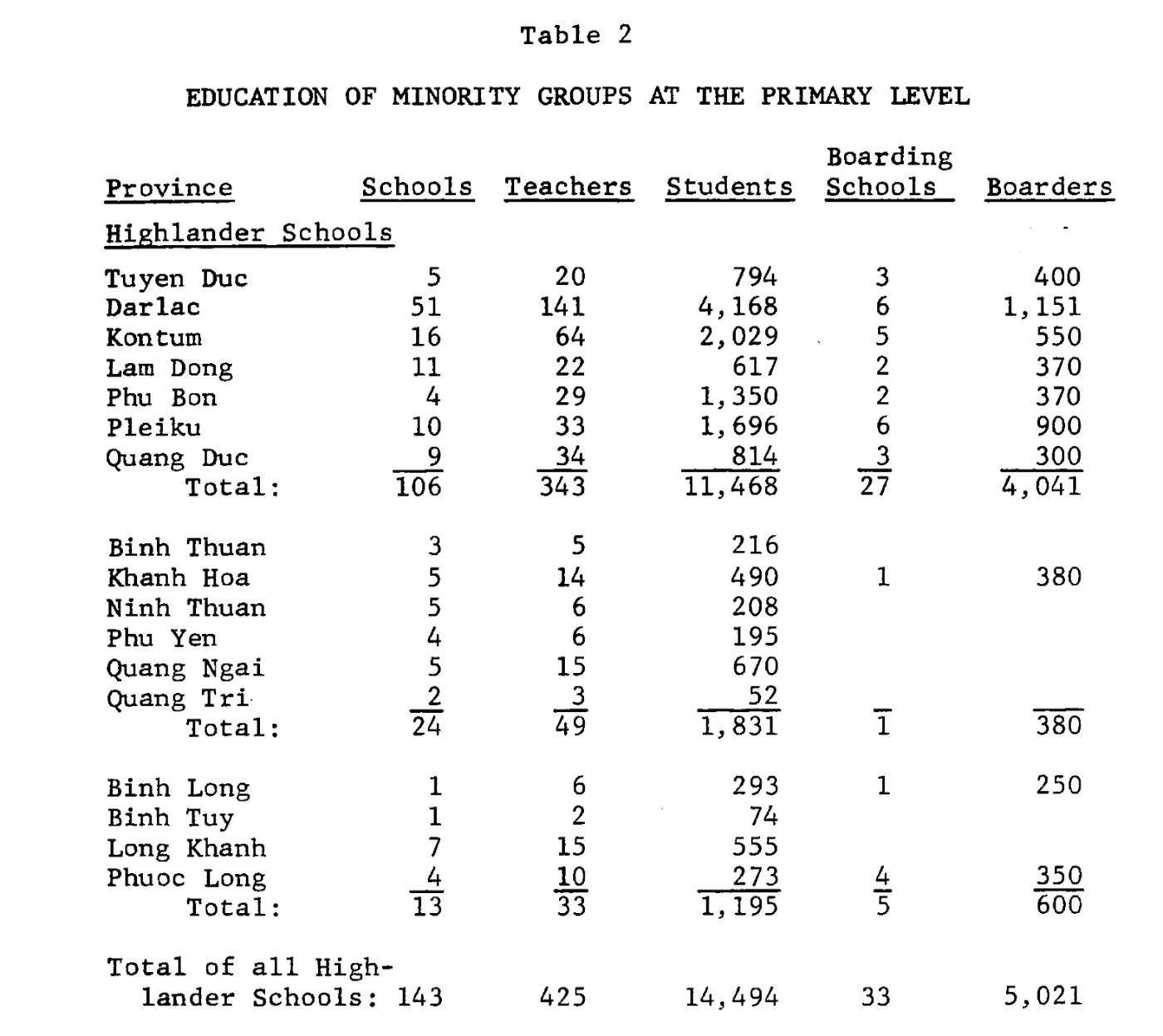
In the school year 1966–67 there were 143 highland primary schools, with 425 teachers and 14,494 pupils; Darlac had 51 of the schools and more than 4,000 of the pupils. That year a joint commission of the Ministry of Education, the commissariat for ethnic minorities and USAID asked the Summer Institute of Linguistics to write textbooks and train teachers for a Highlander Education Project, and the first books came off the press in 1967. It began with Bahnar, Jarai, Rhade and Koho, added Cham, Bru, Central Mnong and Hre, and then Jeh, Sedang, Chrau Jro, Chru and North Raglai. A child spent a first year learning to read in the mother tongue while learning spoken Vietnamese, and the following grades moved step by step into Vietnamese by the end of primary school. Decrees of 1967, 1968 and 1972 required regional languages to be taught in primary school, created the primer year, and authorized bilingual first and second grades.
Before the project, the teachers who spoke our languages had often been posted away from home, so that a child who spoke only Rhade or Jarai rarely had a teacher who could talk to him. The early results were more children enrolled, girls above all, and fewer held back; by scattered early reports, children entering the first grade from the mother-tongue year already knew more Vietnamese than children usually knew at the end of a first grade taught in Vietnamese. The program was strongest, by one account, among the Rhade, Bahnar and Koho, and was growing among the Bru, Cham, Jarai and Chrau.
After 1975
Our own records say that after 1975 our languages were barred from the schools again, that higher education was in effect closed to Dega students, and that districts away from the towns had no schools at all. An American culture profile written in 2002 for those receiving our refugees states that the government outlawed the use of our languages in schools. The written record of the first decades is thin, because the state published nothing about what it did in the highlands and admitted no outside observers.
At the turn of the century most Bahnar and Jarai could not read: illiteracy was put at 70 to 72 percent of men and 88 percent of women. The constitution provided for instruction in minority languages, but the vast majority of primary schools in the Central Highlands taught in Vietnamese. Minority pupils were in theory exempt from fees, but fees were charged, from 300,000 dong a year for primary school to 1.5 million for high school, in families that often earned less than 200 dollars a year, and very few of our children went past the seventh grade.
By one account given to Human Rights Watch, a child from an unregistered church, or whose father had been in FULRO, was stopped at the eighth or ninth grade. An Ede girl who reached the tenth grade was told not to come back after she joined the demonstration of February 2001 in Buon Ma Thuot, and a Jarai woman trained as a teacher in Ea H’leo was told she could have a post if she renounced Protestantism in writing. See The protests of 2001.
Today
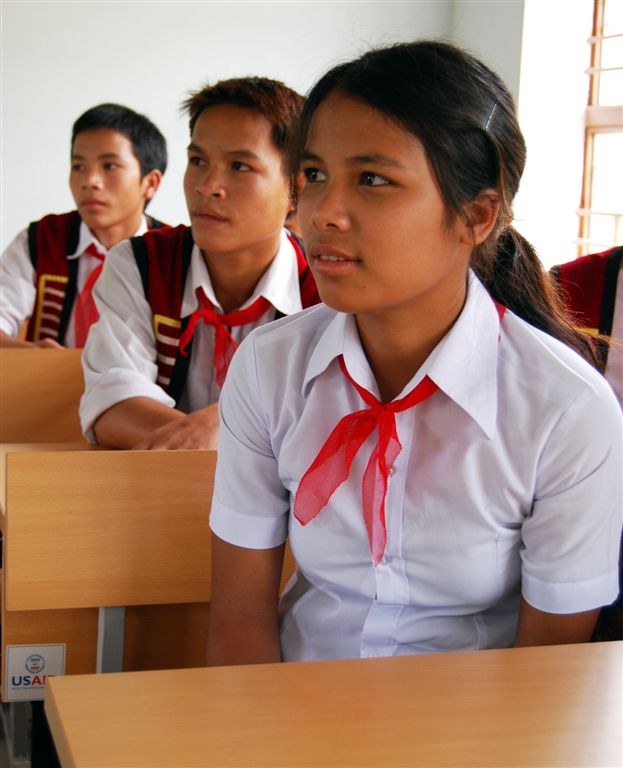
Vietnamese is the language of instruction at every level, including in districts where almost no one speaks it at home. Our languages are taught, where they are taught at all, as a subject, up to a fifth of the primary curriculum in some places. The Education Law of 2019 says the state encourages minorities to learn their languages; it does not promise to teach our children in them. From 2008 to 2015 a mother-tongue bilingual pilot run by the ministry with UNICEF taught Jarai children in Gia Lai in Jarai and Vietnamese from preschool through primary school, with better results and more confident pupils. We have found no account of what happened in Gia Lai after the pilot ended.
In the classroom the rule is Vietnamese only. Researchers who interviewed sixteen officials, principals and teachers at two secondary schools in Gia Lai and Dak Lak found that the teachers and principals all insisted it was necessary, and all said that no written order from the education department required it. A Rhade chemistry teacher told them:
“Rhade students often ask me this or that in the classroom… But I always pretend not to understand.”
A Jarai teacher of civic education told them that Jarai–Vietnamese bilingual teaching stops at primary school. None of our languages is a language of administration anywhere in Vietnam. See The education gap for the full account.
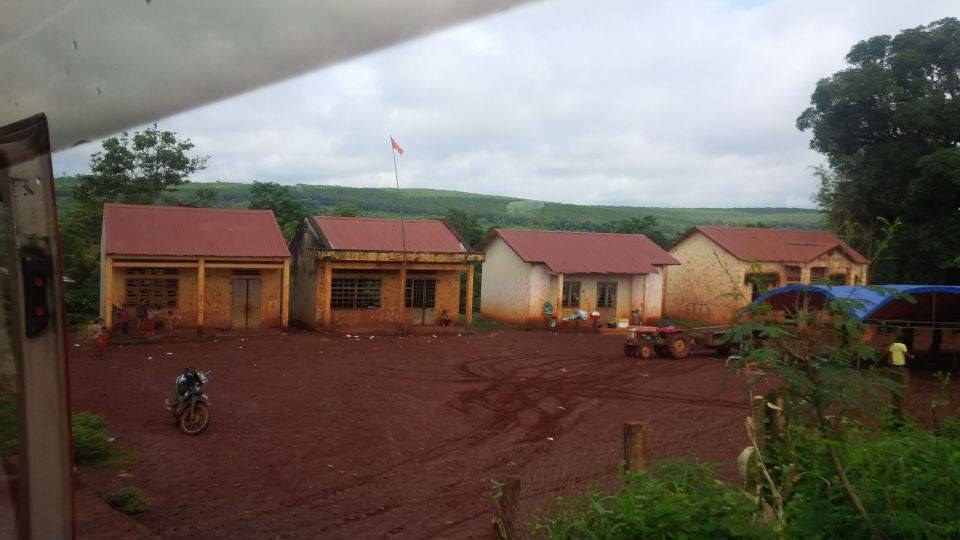

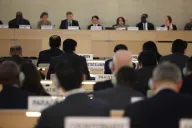
The state’s answer is the boarding school. There were 315 ethnic minority boarding schools in 49 provinces by 2022, with more than 109,000 pupils, and only four in ten met the national standard; UNICEF recorded cases of violence and sexual abuse in boarding schools in several provinces outside the highlands. At Vietnam’s review in November 2023 members of CERD asked why the boarding schools were segregated and why satellite schools in remote villages were being closed. The delegation answered that the boarding schools were founded in the 1950s to train ethnic minority cadres, take the best pupils and have the best teachers, that satellite schools were closed where better schools could be reached, and that minority students can enter university directly from high school. The committee members also commended the number of minority deputies in the National Assembly. A year earlier the Committee on the Rights of the Child had told Vietnam to keep the village schools open and to phase the boarding schools out.
.jpg)
Why the school is the quietest instrument
A confiscated field produces a complaint. A closed church produces a congregation meeting somewhere else. A school produces nothing that anyone can point to, because its effect arrives twenty years later and lands on people who cannot describe what was done to them. They only know that they read Vietnamese better than Rhade, and that their grandmother is hard to talk to.
A child who starts school at six in a language no one at home speaks is being asked to learn to read in a second language, from teachers who may not speak the first, in a curriculum in which the child’s own people appear as a colorful minority rather than as the people of the place where the school stands. The child falls behind and is recorded as falling behind, and the record then explains the outcome by the child. A boarding school takes the child out of the village for the very years in which a village is learned. Preferential admission to university works on the pupils who are left by upper secondary school, and two-thirds are already gone. A remedy applied at the end of a pipeline does not fix the pipeline.
What the United Nations has asked
In 2012 the Committee on the Elimination of Racial Discrimination asked Vietnam to increase bilingual education for minority children, to teach the Kinh teachers in minority areas the local languages, to recruit minority teachers, and to allow minority languages to be taught and used as the medium of instruction in schools. In 2022 the Committee on the Rights of the Child asked it to expand multilingual education and phase out the boarding schools. In 2025 the Human Rights Committee told Vietnam to give ethnic and religious minorities and Indigenous Peoples access to education in their own language. See The UN record.
Our children in America
The first two hundred of our people came to North Carolina in 1986 and were settled in Charlotte, Raleigh and Greensboro; more came between 1992 and 1996 and in 2002. Many of the adults who came after 1975 had had little or no schooling; among the men in the villages a fifth-grade education was typical, and there were few with college degrees. One Mnong boy who arrived in 2002 had grown up in a longhouse near the Cambodian border and had never been able to go to school in Vietnam, because, his teachers wrote, of the government’s discrimination. Most of our children arrived with little schooling and little English, and their teachers found that none of them spoke Vietnamese, though most of their parents did. A guide for school leaders in Charlotte, written in 2007, is in our library. See North Carolina.
What is lost when a language goes
Our customary law was oral and recited in verse. The Rhade code survives on paper because Sabatier collected it in the 1920s and Antomarchi translated it; it was printed in 1940. Most of the other codes were never written down. Song cycles, the vocabulary of the gong ensembles, the plant and animal knowledge of a forest economy, and the names of places that appear on no map are carried in speech, and speech lasts only as long as someone is taught it. For the smallest of our peoples, the Brau and the Ro Mam, a language taught in no school is one generation from ending. See Customary law and Gongs and epics.
What we do not know. The education figures for the Central Highlands, or for any of our peoples by name; nobody publishes them. What the bilingual pilot in Gia Lai became after 2015. What CERD recommended on education in December 2023. What is taught about the Dega in the provincial curricula of the highlands. The written orders, if any, by which our languages left the classroom after 1975. We would like all of these, and so would every parent who reads this page.
See also
- The education gap — the classroom today, in detail
- The Franco-Rhade school — the first school at Ban Me Thuot
- Writing our languages — the alphabets
- Language resources — primers, dictionaries and recordings
- Growing up Dega
Sources
- Office of the UN High Commissioner for Human Rights, meeting summary of CERD’s dialogue with Viet Nam, November 30, 2023 — the 31 and 63 percent, cited by Sheikha Abdulla Ali Al-Misnad; the boarding schools and the delegation’s answers
- Sachiko Kataoka and others, Vietnam’s Human Capital: Education Success and Future Challenges (World Bank, 2019), in our library — the grade 5 results; UNFPA, Ethnic Groups in Viet Nam (2011) — the 2009 census
- Department of the Army, Minority Groups in the Republic of Vietnam (1966), in our library — the Bahnar script from 1861, government and mission schools; P. Dourisboure, Dictionnaire bahnar-français (1889), in our library
- Gerald C. Hickey, The Highland People of South Vietnam, RAND RM-5281 (1967), in our library — Sabatier and Antomarchi, the ban under Diem, the Institute of Administration, the Normal School, the Pleiku demands, the bonus, Table 2; Kingdom in the Morning Mist (1988) — the Franco-Rhade School of 1915
- F.-P. Antoine, notice on Dominique Antomarchi, Bulletin de l’École française d’Extrême-Orient 47 (1955) — Antomarchi’s arrival, the one schoolbook, the primers; “L’enseignement en Indochine,” La Documentation catholique, November 3, 1934 — the certificates of 1930, the Rhade section at Huế, the textbooks of 1925–30
- Human Rights Watch, Repression of Montagnards (2002), chapter VIII — illiteracy, fees, the language of the schools, the testimonies; Christopher Goscha, Vietnam: A New History (2016) — the Nguyen Du school
- Nguyễn Đặng Liêm, “The National Language Policy and the Minority Groups in the Republic of Vietnam,” Pacific Linguistics C-47 (1978) — the decrees of 1964–72, the Highlander Education Project; Sarah C. Gudschinsky, Literacy in the Mother Tongue and Second Language Learning (1971), in our library
- Kimmo Kosonen, “Education in Local Languages: Policy and Practice in South-East Asia,” in UNESCO, First Language First (2005), in our library; UNICEF Viet Nam, “Bringing mother tongues into the classroom” — the pilot of 2008–2015; UNICEF and UN Viet Nam, terms of reference for research on ethnic minority boarding schools (2022)
- Chinh Duc Nguyen and Thanh Nguyen Thao Tran, “Languages and Ethnic Minority Students’ Access to Education in Vietnam,” in Vietnamese Language, Education and Change In and Outside Vietnam (Springer, 2024) — the Vietnamese-only rule
- CERD, concluding observations CERD/C/VNM/CO/10-14 (2012), paragraph 14; Committee on the Rights of the Child, CRC/C/VNM/CO/5-6 (2022), paragraphs 43–44; Human Rights Committee, CCPR/C/VNM/CO/4 (2025), paragraphs 56–57
- Michael Jazzar and Carl Hamm, “A School Leader’s Guide to Improving the Achievement, Assimilation, and Involvement of Montagnard Children” (2007), in our library; Raleigh Bailey, Montagnards: Their History and Culture (2002), in our library
- Our own records — the first school at Ban Me Thuot, the destruction of documents under Diem, the years after 1975
Compiled September 2026. Figures are given with their year and the body that published them, and the measure is named each time, because the series measure different things. We would like education figures for the highland provinces, and any provincial curriculum showing what is taught about the Dega.