













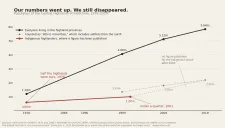



In 1921 there were twenty Vietnamese living in Darlac. By 1997 there were a million and a half people in the province that replaced it, and we were one in five of them. No war, epidemic or famine did that. It was done by migration: first planned by the state, family by family into New Economic Zones, and then, when coffee made the highlands rich, by hundreds of thousands who came on their own. This page gives the numbers we can trace, and what they did to the land and to us.

The numbers
Almost every figure on this page comes from one source, chapter V of Human Rights Watch’s 2002 report Repression of Montagnards, which drew them from Vietnamese government statistics, the World Bank, and the work of the geographers and anthropologists who have studied the highlands. We give only figures we can trace; others circulate, “three million” settlers or “six million,” and they measure different periods and areas, or cannot be traced at all. See How many Dega there are.
| When | Where | Figure |
|---|---|---|
| early 1900s | Central Highlands | about 240,000 people in the four provinces, almost all indigenous |
| 1921 | Darlac | twenty ethnic Vietnamese residents |
| 1943 | Darlac | 80,000 people, of whom 4,000 Kinh |
| 1940 to 1989 | Central Highlands | Kinh share of the population rises from 5 percent to 66 percent |
| by end of 1962 | Central Highlands | more than 100,000 lowlanders settled in 117 Land Development Centers under Ngô Đình Diệm |
| 1976 to 1979 | Dak Lak and Sông Bé | more than 55,000 people moved into New Economic Zones (Desbarats) |
| 1976 to 1996 | Dak Lak | 311,764 planned migrants and about 350,000 spontaneous migrants |
| 1976 to 1998 | Dak Lak | 623,000 new settlers |
| 1978 | Dak Lak | 61 percent Kinh |
| 1990 to 1994 | Dak Lak; Lâm Đồng | 110,000 and 90,000 spontaneous migrants |
| 1975 to 1997 | Dak Lak | indigenous share falls from 48 percent to about 20 percent; population about 1.5 million by 1997 |
| 1976 to 2001 | four highland provinces | 1.2 million to more than four million; indigenous about 600,000 to about one million (Salemink) |
Before 1975: the Land Development Centers
The idea was older than the Communist state. After 1954 President Ngô Đình Diệm settled northern Catholic refugees and lowland farmers in the highlands in what he called Land Development Centers, both to relieve the crowded coast and to plant loyal Vietnamese among a people he did not trust. By the end of 1962 more than 100,000 lowlanders had been placed in 117 centers. His government’s own briefing on the program is in our library, and the policy and our answer to it are on BAJARAKA and Land law and customary land. It was the war, not any change of heart, that stopped it.
After 1975: New Economic Zones
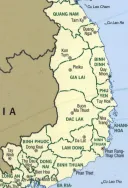
The model came from the North, which had used “New Economic Zones” to move lowlanders into its own mountains during its first five-year plan. After 1975 the new state applied it to the whole country. The geographer Jacqueline Desbarats, working from Vietnamese figures, found that in the years 1976 to 1979 alone more than 55,000 people were moved into New Economic Zones in Dak Lak and Sông Bé. Human Rights Watch records that in the early 1980s the government began transmigration programs to the highlands on a larger scale, and that between 1976 and 1998, 623,000 new settlers were brought into Dak Lak: 311,764 of them under plans, and about 350,000 spontaneously, people who followed relatives and rumors of land. Not all of them stayed, but those who did took land, and the state kept sending more: an average of 30,000 a year, so that Dak Lak went from ninety-six communes and wards in seven districts in 1975 to 192 in eighteen districts by 1997. The government’s plan, as Human Rights Watch reported it, was for the province to take another 260,000 people by 2010.
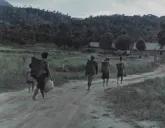
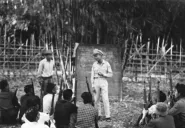
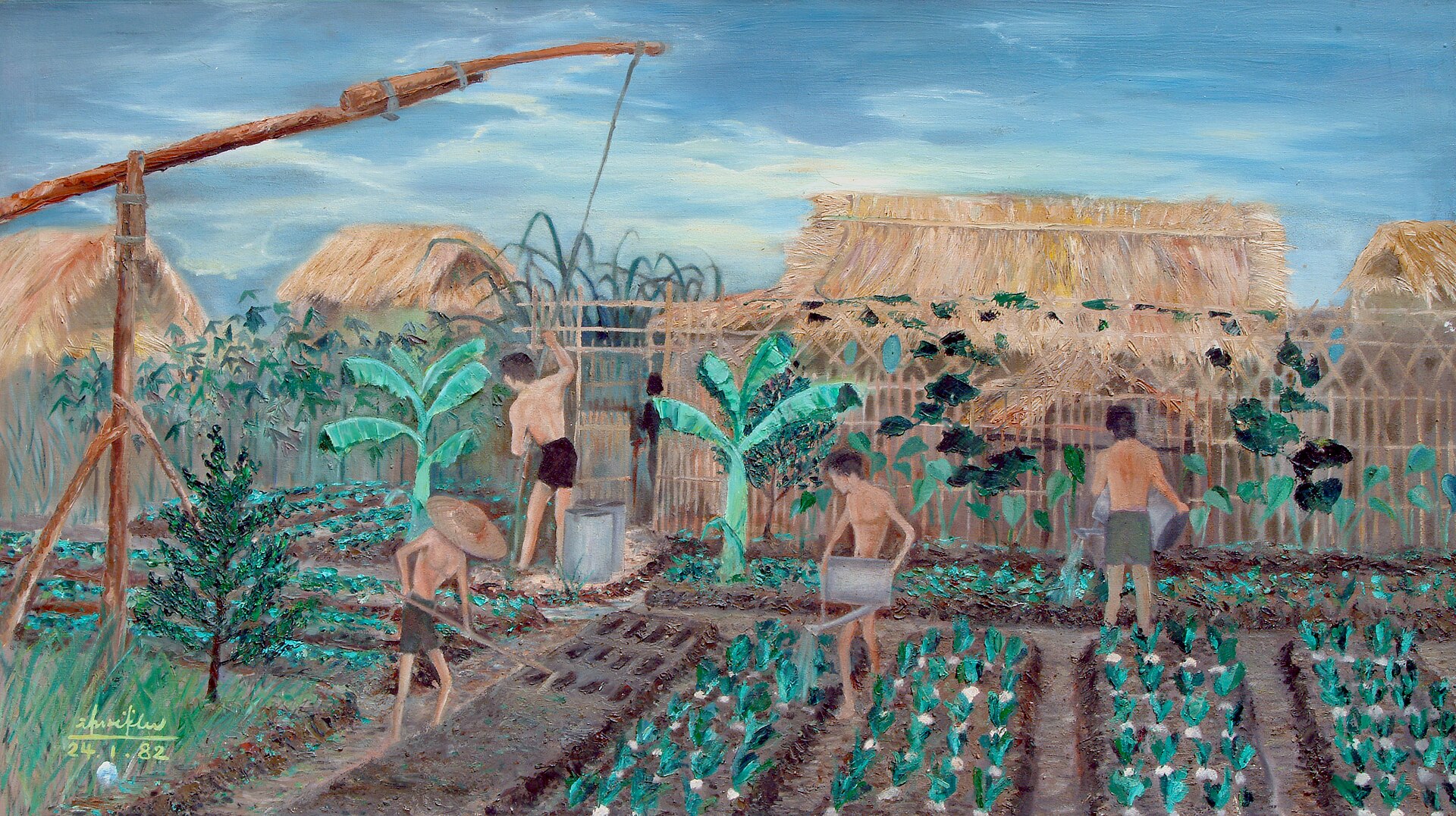
The settlers were not the enemy. They were poor people from the crowded provinces of the coast and the Red River delta, and later from the northern mountains: Tai, Nùng and Dao families, in Human Rights Watch’s account, who had lost their own land to the same state. The painting at the head of this page, of a New Economic Zone in the first years, shows what they were promised: rows of thatched houses, vegetable plots, a watchtower. What it does not show is whose forest it was.
State farms and forest enterprises
After 1975 all land belonged to the state. Farming was collectivized and the forests and plantations went to state enterprises. In Dak Lak, Human Rights Watch reports from the work of the anthropologist Neil Jamieson, sixty-four state farms and forty-two state forest enterprises came to control 86 percent of the land while holding about 20 percent of the people. The fallow land of the rice cycle was treated as empty and reallocated; a village that had farmed a hillside for a century found that the years it rested that hillside counted against it. See The rice year. A 1996 survey found that migrant households in Dak Lak occupied an average of 1.26 hectares each; at that rate, the provincial authorities themselves said, the newcomers could have destroyed as much as 100,000 hectares of forest.
Coffee
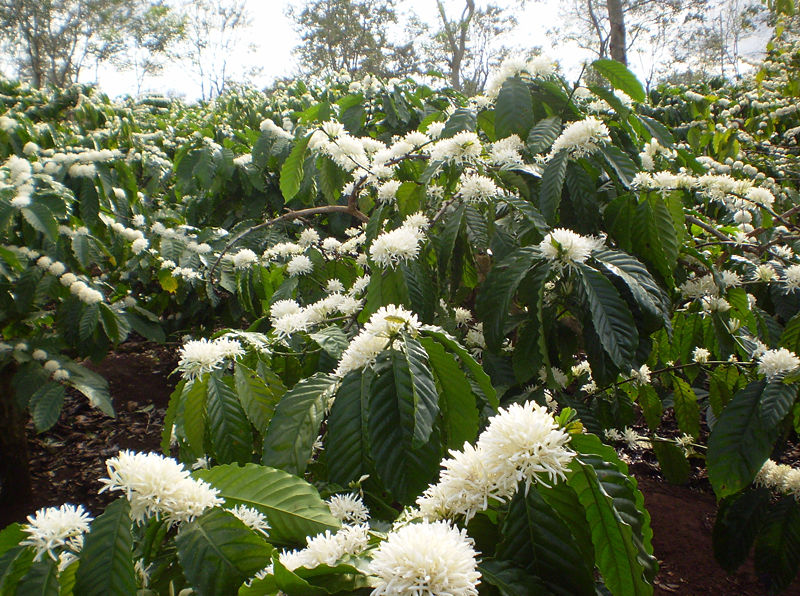

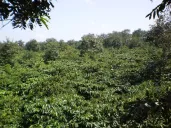
In the 1990s coffee turned planned migration into a rush. Vietnam became the world’s largest exporter of robusta, and Dak Lak grew about 60 percent of the country’s crop. Between 1990 and 1994 alone 110,000 spontaneous migrants came to Dak Lak and 90,000 to Lâm Đồng. Highland villages sold or rented land they could not defend under a law they had not been taught, or simply lost it. As much as 80 percent of the population of the highlands, settlers and highlanders alike, was thought to work in coffee. Our families, Human Rights Watch found, had turned to it on small plots as an alternative to the rotating rice fields, which need more land than they had left, and so had “virtually no risk margin” when the price fell. A man of Buon Cuor Knia in Dak Lak told its researchers about the commune people’s committee: “There’s only one Ede on the committee now.”
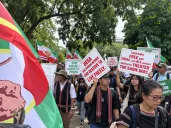
Then the price collapsed. A kilo of coffee that sold for 40,000 đồng in 1995 sold for 12,000 in February 2000 and 4,250 in January 2002. The families who had been left with a hectare of coffee and no rice field had nothing; the families who had been left with nothing at all had less. The protests of February 2001 came in the middle of that fall. See Land taken for coffee and The 2001 protests.
What it means
The state knew. In 1998 Huỳnh Thị Xuân, vice-chairwoman of the Dak Lak provincial people’s committee, told an international seminar on migration: “One of the most significant problems is land disputes, since the traditional living space of local groups is shrinking more and more because of migration. This is particularly true for spontaneous migrants, who arbitrarily occupy the fields and forest land of the indigenous peoples.” The migration went on. The indigenous peoples became a minority in most of the highland provinces and in every highland town. That is the demographic fact behind almost everything else in this library: the loss of land, the pressure on language and church, the new district town where the village was, and the state’s confidence that it can do as it likes in a region where the people it does it to are a quarter of the population, and falling.
We do not ask for the settlers to leave. Most of them were born there now. We ask that what happened be called what it was, that the land that was taken be accounted for, and that the people who were here first have a say in what is done with what is left; see What we ask for.
See also: How we got pushed off our land, Forests and logging, Rubber, Four highland towns.
Sources
- Human Rights Watch, Repression of Montagnards: Conflicts over Land and Religion in Vietnam’s Central Highlands, April 2002, chapter V, “Migration and Land Conflict” — nearly all the figures above, the Jamieson and Desbarats figures as cited there, the coffee prices, and the Buon Cuor Knia interview
- Republic of Vietnam, Briefing on Land Development (1958–59), DCHO library, and Briefing on the Central Highlands Land Development Area, DCHO library
- Oscar Salemink, The Ethnography of Vietnam’s Central Highlanders (University of Hawai‘i Press, 2003) — the 1976 to 2001 provincial totals
- Andrew Hardy, Red Hills: Migrants and the State in the Highlands of Vietnam (NIAS Press, 2003)
- Jacqueline Desbarats, “Population Redistribution in the Socialist Republic of Vietnam,” Population and Development Review 13:1 (1987)
- Gerard Clarke, “From ethnocide to ethnodevelopment? Ethnic minorities and indigenous peoples in Southeast Asia,” Third World Quarterly 22:3 (2001)
Compiled September 2026. Figures are given as the sources give them; where two sources differ we print both.