











Between the Easter protests of 2004 and the attacks at Cư Kuin in 2023 there were no mass demonstrations in the highlands, and the world mostly stopped looking. The pressure did not stop; it changed shape. Instead of breaking up crowds, the authorities went village by village: meetings at which families were made to renounce their church, arrests of the few who led it, and pressure on those who fled. People kept walking west to Cambodia, and Cambodia kept sending them back. This page records those years as far as independent sources let us.

The numbers
The fullest independent account of these years is Human Rights Watch’s report of March 2011, Montagnard Christians in Vietnam: A Case Study in Religious Repression. For the decade from 2001 it records:
- more than 350 highlanders sentenced on national security charges, and “At least 250 Montagnards currently remain in prison or are awaiting trial”;
- “At least 65 of the Montagnards imprisoned since 2001 were arrested trying to seek safety and political asylum in Cambodia”;
- “Since 2001, at least 25 Montagnards have died in prisons, jails, or police lock-ups after beatings or illnesses sustained while in custody.”
Those are the cases Human Rights Watch could verify. They are the floor, not the total. The names we hold are on The prisoner records, and the dead we can name on The memorial register.
2005–2008
The arrests went on after Easter 2004: of people linked to the protests of 2001 and 2004, of leaders of the house churches the authorities called “Dega Protestant,” and of people caught trying to reach Cambodia. See Easter Week 2004.
In April 2008 there was a smaller wave of protests. Y Ben Hdok, twenty-nine, was arrested on April 28. On May 1 the police told his family he had hanged himself. His family, who saw the body, told Human Rights Watch that his head, his ribs and a leg were broken and his teeth knocked out.
2010: village by village
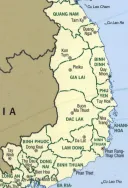
Human Rights Watch’s report gives the year 2010 in Gia Lai in detail. It is the clearest picture we have of how the method worked.
- January 2010. The Gia Lai provincial court sentenced Rmah Hlach and Siu Koch for “undermining national unity.” The 2021 list records Rmah Hlach’s sentence as twelve years.
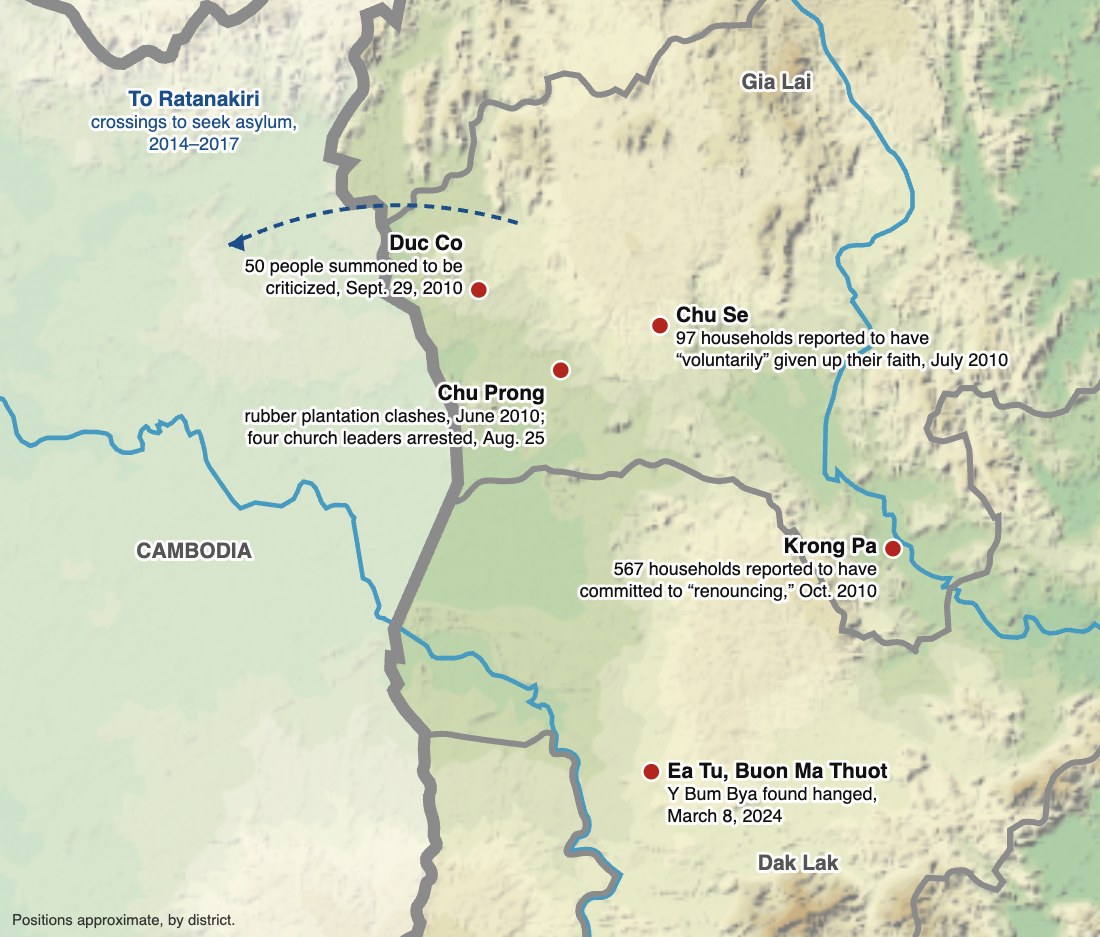
- June 10–22, 2010. Four clashes between villagers and the guards of a state rubber plantation in Chu Prong. See Rubber.
- July 12, 2010. Vietnamese state media, as Human Rights Watch reports it, announced that 97 households, 297 people, in the villages of Tok and Roh in Chu Se had “voluntarily” abandoned Dega Protestantism.
- August 25, 2010. Police in Chu Prong arrested four leaders of the Dega Protestant church: Ro Mah Hit, Kpuih Do, Kpa Thom and Ro Lah K’lanh.
- September 29, 2010. Fifty people from four villages in Duc Co were summoned to be formally criticized.
- October 2010. State media, again as Human Rights Watch reports it, said that 567 households in Krong Pa had committed to “renouncing” Dega Protestantism.
- November 2010. The Phú Yên provincial court sentenced Ksor Y Du and Kpa Y Co to six and four years.
In all, Human Rights Watch recorded, “more than 70 Montagnards arrested or detained during 2010 in Gia Lai alone.” Its report was published in March 2011.
What the pattern was
The years after 2004 were quieter because the method changed. Renunciation meetings, pressure on the families of people who had fled, identity papers taken, and prosecutions of the few who organized: it is harder to photograph a renunciation ceremony than a demonstration, and much harder to count one. That is why so much of what we know about these years comes from one report, and why they are thin in the news. The church’s side is on The church they closed.
2014–2017: the road to Ratanakiri
From late 2014 small groups began crossing into Ratanakiri again to ask the United Nations for asylum, as their parents had in 2001. Radio Free Asia reported in January 2015 that a group from Gia Lai had hidden in the forest there for weeks before coming out, ill, to ask for protection. The United Nations refugee agency and human rights office appealed to Cambodia to let them reach the people in hiding.
Cambodia treated them as illegal immigrants. On January 25, 2015, the Voice of America reported, seven were arrested and sent back across the border, while at least fourteen others stayed hidden in the forest. In early February a family of five was deported after being found in Ratanakiri. Human Rights Watch said at the time: “The government is putting these people’s lives and well-being at risk by forcing back those it arrests, and putting those who are forced into hiding at risk of starvation, disease, and exposure.” The groups kept coming. Many who reached Phnom Penh were refused refugee status, and in June 2017 Radio Free Asia reported that sixteen whose appeals had failed had been returned to Vietnam. See Asylum today and The Cambodian camps, 2001–2005.
2018: the law
On January 1, 2018 Vietnam’s Law on Belief and Religion came into force. Rights groups report that the house churches of our people remained unable to register and continued to be pressed to join the state-recognized church or give up their faith. See The Law on Belief and Religion (2018). The same year, the 2021 list records, police raided house churches in Dak Lak, beat the evangelists Y Pum Bya and Y Min Ksor and shocked them with electric batons under interrogation, and sentenced them to fourteen and nine years. See The camps and the prisons, 1975 to today.
What came next
In June 2023 armed men attacked two commune offices at Cư Kuin in Dak Lak, and the state’s response reached far beyond those responsible; see Cư Kuin, June 2023 and Y Quynh Buondap. On March 8, 2024, Christian Solidarity Worldwide reported, the body of Y Pum Buonya, a member of the Central Highlands Evangelical Church of Christ in Ea Tu commune near Buon Ma Thuot, was found hanging from a tree after he had been summoned to meet public security officers at a cemetery near his home. Villagers said his body showed signs of torture.
What we do not know
How many families were made to renounce, in how many villages. How many people crossed to Cambodia between 2005 and 2022, and how many were sent back. Most of the twenty-five who died in custody by 2011, and everyone who has died since. If you or your family were arrested, made to renounce, or crossed the border in these years, your account matters; please read Reporting safely from inside the highlands first.
Sources
- Human Rights Watch, Montagnard Christians in Vietnam: A Case Study in Religious Repression, March 30, 2011 — the numbers, Y Ben Hdok and the 2010 chronology. Where it draws on Vietnamese state media, we say so.
- Radio Free Asia, “Rights Group Tells Cambodia to Stop Treating Montagnards as ‘Illegal Aliens’”, February 9, 2015; and “Sixteen Montagnards returned to Vietnam from Cambodia After Failed Asylum Appeals”, June 8, 2017
- Voice of America, “Cambodia Deports 7 Montagnard Asylum Seekers to Vietnam, Others Still Hiding”, January 2015
- Christian Solidarity Worldwide, call for an investigation into the death of Y Pum Buonya, April 23, 2024
- US Commission on International Religious Freedom, State-Controlled Religion and Religious Freedom in Vietnam, September 2024
Compiled September 2026. This period is badly under-documented, and we are adding to it as accounts reach us.