












Since 1975 our people have been held in two generations of camps and prisons. The first held the men of the old order: our ministers and officials, the soldiers who had served with the Americans, and our pastors, taken without trial after the war. The second has held the people of the churches and the land protests since 2001, tried in groups and sentenced under the national security articles of the penal code. Some of the places are the same. The camp in Phú Yên that held our minister in the early 1980s held our pastors thirty years later. This page sets out the places we can name, the people we know were held in them, what was done there, and how much is still missing.

The first generation, 1975 and after
After the fall of Saigon on April 30, 1975, former officers, officials, police, teachers, religious figures and anyone associated with the Republic of Vietnam or with the Americans were ordered to register in May and to report for “re-education” in June. They were told how long it would take: ordinary soldiers three days, junior officers ten, senior officials a month. In fact people were held for anything from weeks to eighteen years. The legal basis was a 1961 resolution of the North Vietnamese National Assembly, carried south after the war, which allowed three years of detention by administrative order, renewable without limit. Nobody was tried. Between two hundred thousand and three hundred thousand people from the South were held, on the conservative estimates. Higher figures circulate; scholars regard them as inflated.
Nobody has counted how many of them were ours.
Why our people were taken
Because there were lists, and our names were on them. From 1961 Dega men were recruited, armed, trained and paid by American programs: the CIDG camps, the Mike Force, the Kit Carson Scouts, the Provincial Reconnaissance Units, the Truong Son cadre. Administered programs produce rosters, pay records, unit histories and discharge papers. So do a ministry, a provincial administration and a school.
Human Rights Watch, drawing on the anthropologist Gerald Hickey, records who was taken:
“Those who had worked with U.S. Special Forces or FULRO were sent to re-education camps.”
and of the leaders:
“At the same time all of the highland leaders from the ministry and those who had been active in provincial administrations and programs were captured and incarcerated either in jails or ‘reeducation camps.’”
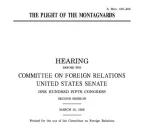
Rong Nay, who was one of them, told the US Senate Foreign Relations Committee on March 10, 1998: “All the Montagnard leaders and preachers have been arrested and jailed.” The years in the forest are on Re-education and the forest, 1975–1992.
It was not only the men who had fought. Paul Nưr and Nay Luett had spent 1964 to 1975 arguing our case inside the machinery of the Saigon state rather than fighting it, and neither had carried a weapon in eleven years. Both were imprisoned, and both died of it. And it reached the Dega who had chosen the other side: Y Bih Aleo and Y Ngong Nie Kdam had held office in the National Liberation Front, and some of its highland leaders kept a ceremonial position after 1975, but none of it produced autonomy, land, or schools in our languages. What was done to us after 1975 was not a punishment for having chosen wrongly in the war. See Highlanders on the other side.
The places
We can name four.
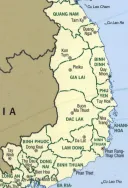
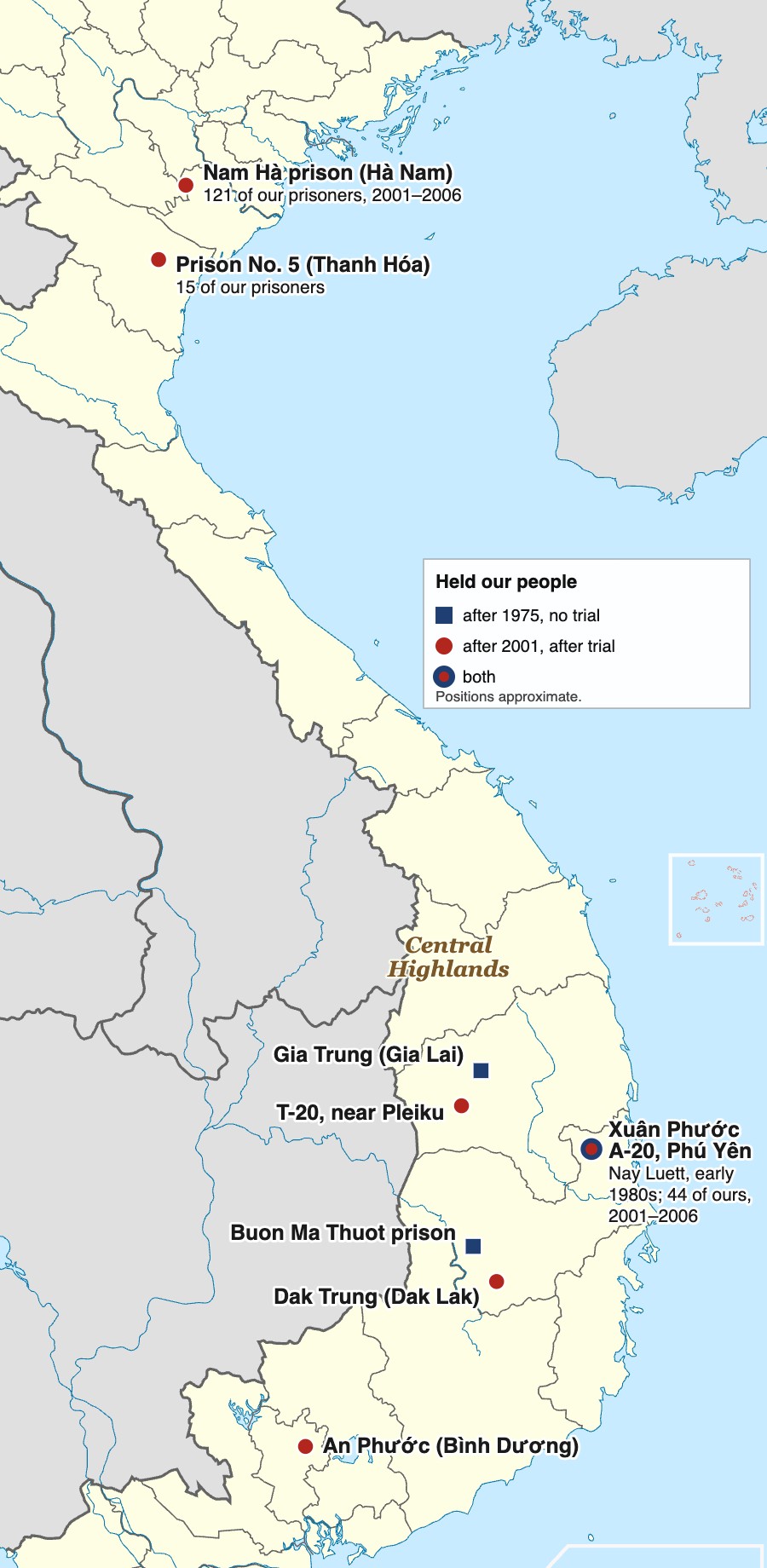
Gia Trung, in what was then Gia Lai–Kon Tum province. Amnesty International, in its report on Vietnam of February 1990, records that most of a group of southern intellectuals arrested in 1976 “were sent to a camp in Gia Trung in the central highland province of Gia Lai-Kontum.” The camp was built on our land, and it is still a prison.
Buon Ma Thuot prison, where Nay Luett was first held.
A plantation camp near Buon Ma Thuot, given in one account as Mewal, and not confirmed in any other.
Xuân Phước, in Phú Yên, the camp known as A-20, where Nay Luett was held last. Amnesty lists A-20 among Vietnam’s long-term political prisons independently of any account of him.
That is the whole list we have for those years. In the same 1990 report Amnesty noted that a number of highland pastors were reported to be in detention, “but information about this latter group is scarce.” The best-known human rights organization in the world, in 1990, could not see us.
What the camps were
Survivors from all over the South describe the same things: political indoctrination and written confessions; forced labor clearing jungle, cutting timber, planting corn and cassava, digging wells and sweeping minefields without equipment; beatings for small offenses; confinement in metal conex boxes; reduced rations and solitary confinement; and deaths from hunger, malaria, beriberi, dysentery and tuberculosis. From 1980 families were allowed to visit every three months, and for many prisoners those visits were the only extra food they had. The best descriptions that exist are by Vietnamese officers. We have not found a single first-person Dega account of the inside of a camp in those years, and that silence is part of what happened.
The people we know
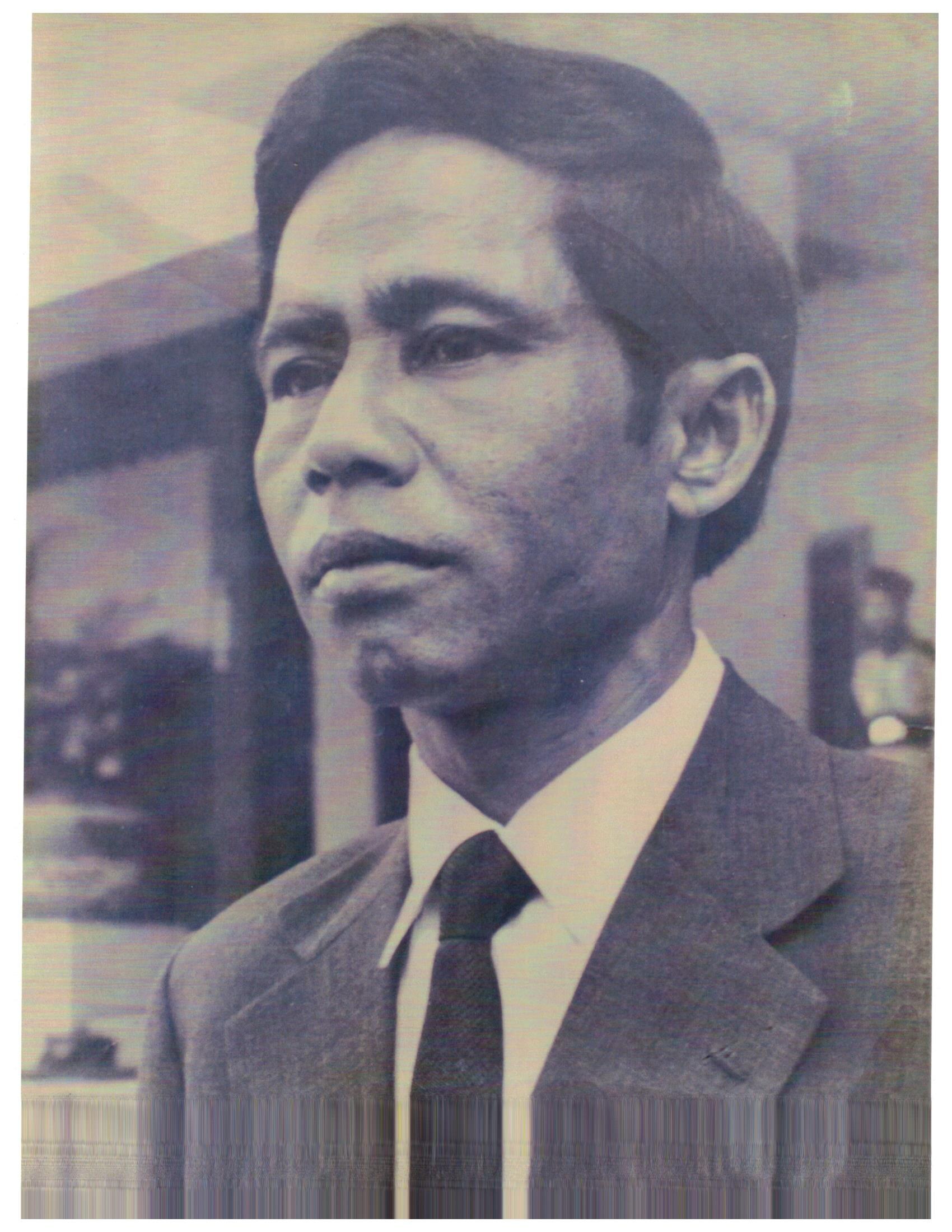
Nay Luett, the Jarai who had been Minister for the Development of Ethnic Minorities, went from Buon Ma Thuot prison to the plantation camp to Xuân Phước. He had tuberculosis. He was held eight, nine or ten years, depending on who tells it; he died either in captivity in February 1984 or at home in his village two months after he was let go. Paul Nưr, the Bahnar who had been minister before him, died in prison. Their lives are on Paul Nưr and Nay Luett: the ministry years.
The men who had served with the Americans were held as long. K’Sao Krajan, who had won an American Bronze Star, for four years. Y Monah, a border scout for the Green Berets, for five. Ykhiem Ayun, a Mike Force soldier captured at Pleiku, until 1992. See 1975, and what came after.
A woman’s account survives from a little later. An Ede church leader from a hamlet near Buon Ma Thuot told Human Rights Watch in April 2001 that she had been arrested in 1985 for FULRO activities and held in a dark cell for a year. When she came out she began to preach, and was arrested again, beaten at the provincial police station and put on probation.
What coming home meant
In December 2000 eight villagers of Krong Ana district in Dak Lak wrote down in Ede what had been done to our people and got the paper out of the country; Human Rights Watch obtained it in July 2001. It says the men who came back from detention lived a year or two and then died, and that our retired officials were paralyzed; the villagers believed they had been given poisoned injections. We cannot test the explanation. We can record that the people who buried them believed it, and that nobody has ever counted those deaths.
Release did not end the sentence for the families either. Land taken while a man was inside was not given back.
The second generation, 2001 to today
In February 2001, at Easter 2004 and in April 2008, our people marched in their thousands for their land and their churches. The arrests that followed were not reeducation. They were trials, often of several people at once, under the articles of the penal code on “undermining national unity,” “disrupting security” and fleeing abroad; see The laws used against us. Human Rights Watch counted more than 350 of our people sentenced between 2001 and 2011, at least 250 in prison or awaiting trial in 2011, and at least 25 who had died in prisons, jails or police lock-ups, or soon after being released early to a hospital or home. Amnesty International, in 2016:
“In 2001, 2004, and 2008, large numbers of ethnic minority Montagnards, Christians from the country’s Central Highlands, were arrested following demonstrations calling for freedom of religion and an end to confiscation of land owned by Montagnard groups.”
Where our records say they were sent
Our own prisoner records, compiled from families and congregations, name 337 of our people arrested between 2001 and 2006 in five provinces. Where the family knew where a prisoner had been sent, the record says so:
| Where held | People | What it is |
|---|---|---|
| Hà Nam | 121 | almost certainly Nam Hà prison, in the north, more than a thousand kilometers from the highlands |
| Phú Yên, or Tuy Hòa | 44 | the province of Xuân Phước, the camp A-20 |
| Thanh Hóa | 15 | the province of Prison No. 5, also in the north |
| Hà Tĩnh | 1 | in the north |
| Pleiku, including “T-20 in Pleiku area” | 9 | detention in the highlands |
| Binh Phuoc, Dak Nong, Dak Lak, Chu Se | 10 | provincial and district detention |
| not known to the family | 137 | — |
Two things stand out. Of the 200 whose prison is known, 137 were sent north, to Hà Nam, Thanh Hóa and Hà Tĩnh, where their families could rarely afford to visit and where the guards did not speak their language. Amnesty International has described the practice among Vietnam’s prisoners of conscience in general:
“A central component of Viet Nam’s systematic abuse of prisoners of conscience is subjecting them to repeated prison transfers: a deliberate practice that aims to further isolate them from their families, break their spirits and punish them for engaging in prison activism.”
And the second-largest group was sent to Phú Yên, to the camp that had held Nay Luett a generation earlier.
The dead
Our people have died in the hands of the police and in the prisons. Y Ben Hdok, twenty-nine, was arrested on April 28, 2008, over that month’s protests. On May 1 the police told his family he had hanged himself. His family, who saw the body, told Human Rights Watch that his head, his ribs and a leg were broken and his teeth knocked out. The names of the dead we know are on the memorial register. Most of the twenty-five that Human Rights Watch counted between 2001 and 2011 have never been named anywhere.
Where to find a person
The 337 names are on the five province pages of our prisoner records, with how to search them. The best-documented cases are profiled on Our defenders and prisoners. If somebody has just been taken, go to If a family member is detained.
What we do not know
How many of our people were in the camps after 1975, which camps, how long, and how many came back. The figure of two hundred thousand to three hundred thousand is for the whole South. No breakdown by people exists that we have found.
The dead of both generations. There is no roll of the men who died in the camps, or of those who came home to die in the 1980s. Vietnamese-American organizations have worked since 2006 to find graves from the camps; nothing like it exists for us.
Where the 137 are whose families were never told, and the names of the twenty-five and more who have died in custody since 2001.
The generation taken in 1975 was in its twenties and thirties then, and is in its seventies and eighties now, where it is alive at all. Everything else in this library can be rebuilt from documents later. This cannot.
If you were held, or someone in your family was, please record it: the name, the year, where they were told to report, which camp or prison, what the work was, when they came out, and whether they came home. A name and a year is already more than we have. Read Reporting safely first if you are in Vietnam, and then how to document.
See also: 1975, and what came after, Re-education and the forest, 1975–1992, Prisoner records, The laws used against us, Massacres of our people.
Sources
- Amnesty International, Viet Nam: “Renovation” (doi moi), the law and human rights in the 1980s (ASA 41/01/90, February 1990) — the 1961 resolution, Gia Trung, and the highland pastors
- Amnesty International, Viet Nam: Long-Term Political Prisoners (ASA 41/004/1991) — the camps, including Gia Trung and A-20 at Xuân Phước
- Amnesty International, Prisons within prisons: Torture and ill-treatment of prisoners of conscience in Viet Nam (ASA 41/4187/2016, July 2016), pp. 9 and 20 — transfers, and the arrests of 2001, 2004 and 2008
- Human Rights Watch, Repression of Montagnards: Conflicts over Land and Religion in Vietnam’s Central Highlands (April 2002) — who was taken after 1975, the Ede church leader, and the Krong Ana villagers’ paper
- Human Rights Watch, Montagnard Christians in Vietnam: A Case Study in Religious Repression (March 2011) — the numbers sentenced, held and dead, and Y Ben Hdok
- US Senate, Committee on Foreign Relations, The Plight of the Montagnards, March 10, 1998 — the testimony of Rong Nay
- Gerald C. Hickey, Free in the Forest: Ethnohistory of the Vietnamese Central Highlands, 1954–1976 (Yale University Press, 1982) — the highlands after 1975. Hickey worked for many years under RAND contracts funded by the US government.
- “Re-education camp (Vietnam)”, Wikipedia — the registration orders, the stated and actual periods of detention, conditions and the detainee estimates
- Our own prisoner records, compiled from families and congregations, 2001–2006; see Prisoner records
Compiled September 2026. The counts in the table are taken from our own records as the families gave them; many entries give only the province. We are adding the names of those held, and of those who died, as families send them.