






FULRO is usually told as the story of one man. It was never only his. This is a register of the others we can name — the Cham officer who invented the word for what we were supposed to be, the two men called Adrong whom the record keeps confusing, the interpreter who funded a liberation front out of an American payroll, the commander who walked out of the forest in 1992 and asked the first foreigner he had seen in seventeen years where his president was. It also records what we cannot establish, because on this page that matters as much as what we can.
Why naming is difficult
When Gerald Hickey published Free in the Forest in 1982 he appended a list: “One Hundred Highlander Leaders: ethnic affiliation, approximate birth date, and religion,” at pages 304 to 307. The anthropologist Oscar Salemink records what happened next: “After his books were published and arrived in Vietnam, Vietnamese security officials who were still fighting FULRO started to arrest every person mentioned in the book.”
That is one scholar’s sentence in one dissertation and we have not been able to corroborate it. But it states the problem this page has to live with. Naming our people is how some of them were found. Not naming them is how the rest are lost. We have chosen to name, because every man below is either dead, resettled abroad, or already in the published record many times over — and because a movement whose members cannot be listed has already been half erased.
Where a name in circulation cannot be sourced, we say so rather than inventing a career for it. For Y Bham Enuol himself, see his own page.
The three fronts
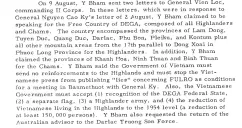
FULRO — the United Front for the Struggle of Oppressed Races — was proclaimed on August 1, 1964 as a coalition of three: a highland front, a Cham front, and a Khmer Krom front of the Mekong Delta. Who stood at the head of it has never been agreed, and the disagreement is not a detail. It is the movement.

| Account | Who was president |
|---|---|
| FULRO’s own founding proclamation, as reproduced by a scholar working from the 1965 printing | President Chau Dara, glossed “(Om Savuk)”; vice-presidents Po Nagar, the nom de guerre of Les Kosem, and Y Bham Enuol |
| Our own account, filed with the United Nations at Geneva in 1993 | The Cham and Khmer Krom “asked to join Mr. Y-Bham-Enuol and organized a new front called ‘Front Unifie De Lutte Des Races Opreemees’ (FULRO) on August 1, 1964” |
| Most American and anthropological accounts | Y Bham Enuol, president from the start |
| A Cham diaspora account of 2024 | Founded September 20, 1964, with Norodom Sihanouk as chairman and Y Bham Enuol chairman only of the Champa front |
The last of those is not consistent with anything else and we give it as a partisan account, not as history. The other three are the real disagreement: a coalition in which nobody’s version of who was in charge was ever accepted by the others.
Les Kosem (1927–1976)
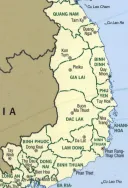
A Cham, born in 1927 — at Kompong Cham in Cambodia by one account, in Phan Rang in Ninh Thuận by another, and raised on Khmer soil either way. If the Phan Rang birth is right, he was a Cham of Vietnam who became a general of Cambodia, which is exactly the double loyalty that governs everything he did. He was a Muslim and carried the title Haji. He signed FULRO’s founding proclamation as Po Nagar, the name of the Cham mother goddess.
He had served with French colonial paratroops — he once gave an American officer a French colonial paratroop camouflage jacket — and rose to be the most senior Cham officer in the Royal Cambodian Army, an airborne colonel and an intelligence officer of Cambodia’s 12th Bureau. He founded the Front for the Liberation of Champa somewhere between 1960 and 1962; the sources give all three years.
His one lasting invention was a word. Austrien: a merger of Austronesian and Austroasiatic, coined to name a single dispossessed people of the peninsula, taking in the Cham, who speak an Austronesian language, and the Khmer and most of us, who do not. It is the intellectual core of FULRO’s plural name, and it is his.
What he did on December 30, 1968 is contested, and the contest is instructive. Hickey, writing within months, says only that “a force of FULRO dissidents… accompanied by a group of Cambodian-Cham… captured Y Bham’s headquarters.” Later accounts put Kosem personally at the head of several battalions of the Royal Cambodian Army. The escalation happened somewhere between 1969 and now. We give Hickey’s wording as the earliest and note what grew on top of it. See Y Bham Enuol in Phnom Penh.
After the coup of March 1970 he became a brigadier general of the Khmer Republic and commanded the 5th Special Brigade, which one historian’s note records as about eighty percent Cham, and in which Bunong and other highland soldiers served. He was made a roving ambassador in 1974. He escaped Phnom Penh when the Khmer Rouge took it in April 1975 and died in Malaysia. How is disputed: of natural causes about a year later; of cancer; or, in the Cham community’s own memory, by poison at a dinner party in Kuala Lumpur on December 7, 1976, aged forty-nine, his wife’s brother having died the same month in similar circumstances. We give all three, including the last, because a community’s suspicion about how its general died is itself part of the record.
One correction. Kosem is often said to have trained at the French military academy of Saint-Cyr. We looked for that and found nothing behind it. What is attested is service with French colonial paratroops. Until someone produces a source, treat Saint-Cyr as tradition rather than fact.
Chau Dara — and whether he is Um Savuth
These two names are often printed as one man. We do not think they are, and the reason is worth setting out because it shows how this kind of record decays.
Chau Dara led the Front for the Liberation of Kampuchea Krom, representing the Khmer of the Mekong Delta, and was a former monk. He signed the August 1964 proclamation as president, and the proclamation itself glosses his name “(Om Savuk).” That gloss, in a primary document, is the whole basis for the identification.
Um Savuth was a serving officer of the Cambodian army, the son of a government chauffeur, who rose to brigadier general of the Khmer Republic, commanded Military Region 5, and led Operation Chenla I in 1971, which was a disaster. He was paralyzed down one side and walked with a cane, the result of a drunken order in which he had a subordinate shoot a live cat off his head; the shot missed and took away part of his skull. He reportedly drank continuously against the pain. It is at his residence in Phnom Penh, most accounts say, that Y Bham Enuol was held from December 1968.
And here is the problem: Um Savuth died in November 1972, in a car crash. If Y Bham Enuol was held at Um Savuth’s house “for the next six years” from December 1968, then either the house outlived its owner by two and a half years, or the house is misidentified, or the death date is wrong. We cannot resolve it. We print it because a contradiction that is visible is worth more than a smooth sentence that is wrong.
The two Adrongs
Both are on the list of those arrested after the BAJARAKA demonstrations of 1958: Y Bhăm Êñuôl, Y Dhơn Adrong, Y Dhê Adrong, Y Nuin Hmok, Y Wick Buôn Ya, Y Het Kpor, Y Tluốp Kpor, Y Sênh Niê, Y Bun Sor, Y Yu Êban, Y Thih Êban, Touneh Yoh, Siu Síp, Paul Nưr, and Nay Luet. Fifteen names, two of them Adrong, and the literature has been mixing them up ever since. See The BAJARAKA movement.
Y Dhon Adrong was a Rhade former teacher who led the faction of the highland front that argued for armed resistance, and who is credited with making contact with Kosem’s Cham front and with the Khmer Krom — that is, with building the three-front coalition. He is named as the signatory, opposite Paul Nur, of the final treaty with the Republic of Vietnam on February 1, 1969. Of his death there is a single sentence, in one American writer’s summary of another’s book: his ego ran away with him, he opposed Y Bham Enuol directly, and he offended enough rivals that he was arrested and executed. By whom, where and when is not said, and there is no second source. See Paul Nur and Nay Luett.
Y Dhe Adrong is the man Hickey put at the center of both 1964 and 1968, writing in 1969 within months of the events:
“Y Dhe Adrong, a Rhade civil servant, met with representatives of the Struggle Front of the Khmer of Lower Cambodia and the Front for the Liberation of Champa… to plot a revolt involving five Special Forces Camps.”
“Y Dhe and Y Bling and the government representatives signed an agreement on December 19, 1968. It concerned a flag for the Highlanders, an important role for Y Bham, an increased number of Highlander administators, and integration of FULRO military units into the Regional Forces.”
Two things follow. First, the date of the 1968 agreement is December 19 on the authority of the earliest and best-placed source, and we correct our own library accordingly. Second, one Adrong is said to have signed the December agreement and the other the February treaty. Both can be true. They can also be one event that has been split in two and given to two men with the same clan name. We leave the question open.
The first sentence has a further consequence for how the September 1964 rising is told. If Hickey’s FULRO sources were right, the revolt was planned by Y Dhe Adrong with the two lowland fronts, and Y Bham Enuol joined a rising he had not called. An American who was in the highlands says the same from the other direction: that Kosem and the Khmer Krom colonel planned the revolts “with the aid of a Rhadé and a Jarai leader, but not Y-Bham.”
Y Bling Buon Krong Pang
The man who signed FULRO’s peace and then chaired what was supposed to replace it. Hickey again:
“On February 11, 1969, a delegation of former FULRO leaders met with President Thieu… they declared that they intended to form a political party… The Movement for Unity of the Southern Highland Ethnic Minorities… The chairman is Y Bling Buon Krong Pang.”
An armed front dissolving itself into a legal party, agreed with the president of the Republic in person. More than thirteen hundred FULRO soldiers and their families came back into South Vietnam in January 1969 and were received at an official ceremony at Buon Ma Thuot.
A name to be careful with. The form “Y Bling Nie Buondap” circulates. We could find no source for it. Buon Krong and Nie Buon Dap are different Rhade clan names, so that is more likely to be a second man than a second spelling of this one.
The soldiers
Kpa Doh
Chief interpreter and, in practice, the Montagnard commander of the II Corps Mike Force, and its FULRO political officer. The Mike Force was close to a hundred percent FULRO with no Vietnamese in it, which meant Kpa Doh could and did collect a tenth of the men’s pay in FULRO dues. A national liberation front funded by a payroll deduction from an American-paid strike force is the single strangest fact on this page, and it is well attested.
On November 8, 1966, about a hundred and sixty Jarai of the Pleiku Mike Force with six American Green Berets were put into the Plei Trap valley as bait. Of that day an American officer who was there remembered Kpa Doh walking upright through the smoke, tapping his men’s boots as he passed, barely able to speak, letting them know he was still there. He had been hit in the neck by a rifle bullet. “It didn’t even knock him down. It just looked like it pissed him off.” Fourteen Jarai were killed and forty wounded; all six Americans lived. He carried a rasp in his voice afterwards.
He was later dismissed as chief interpreter and de facto commander. When an American writer met him again in Phnom Penh in 1973 he was a major in the Cambodian army. In April 1975 he and his family were among those who took refuge in the French embassy; the Khmer Rouge threatened to storm the building unless they were handed out, and they were handed out, and those people were executed. A second account, which the same writer could not settle, has him making a deal to go on fighting the Vietnamese and dying in battle later.
One note. The description of him as “half-Jarai” we could not source. What the record shows is a Jarai unit whose message to the enemy that day was: we dare you to attack, we are Jarai.
Y Kdruin Mlo — “Philippe Drouin,” “Cowboy” (1936–1968)
Took the name Philippe Drouin at a French colonial school; was nicknamed Cowboy by American soldiers after he learned their culture from John Wayne films and adopted the swagger. He served in the French colonial army and became an interpreter for the Green Berets, at Buon Beng among other places. One American called him “handsome, flamboyant, courageous, clever, and cruel.” A Special Forces captain who used him said “you’ve got to take the bad with the good, and Cowboy is a good interpreter,” and then fired him, because prisoners did not fare well when Cowboy was around.
Inside FULRO he was Colonel Drouin, commanding the Dam Y Division in Darlac province by 1967, a private army that could be rented out to government forces needing combat support. He was murdered by his own side in 1968. The proximate cause, on one account, was a fight with a Vietnamese Special Forces sergeant over a bar girl in Buon Ma Thuot; he had enemies inside FULRO, and they killed him for the Vietnamese. The two accounts — killed by FULRO rivals, killed on the authorities’ behalf — are the same account.
Y Bun Sur (1939–1975)
Mnong Rlam. A French bibliographic note gives his dates as September 10, 1939 to April 21, 1975, which if right makes him nineteen at the time of the BAJARAKA arrests — and a “Y Bun Sor” is indeed on that list. He was described by an American who knew the leadership as the best-educated of them.
By 1964 he was a lieutenant colonel of the Royal Khmer Army, province chief of Mondulkiri, and, like Kosem, an agent of Cambodia’s 12th Bureau. He commanded the former Buon Sar Pa strike force as a Cambodian army battalion. After the revolt he left Vietnam and left his family behind; they were all executed when the Khmer Rouge took Phnom Penh. He himself was with Y Bham Enuol and some hundred and fifty of the militant faction who went into the French embassy in April 1975 and were handed out.
Y Tlur Eban
The most under-told man in this register, and the one with the fullest life.
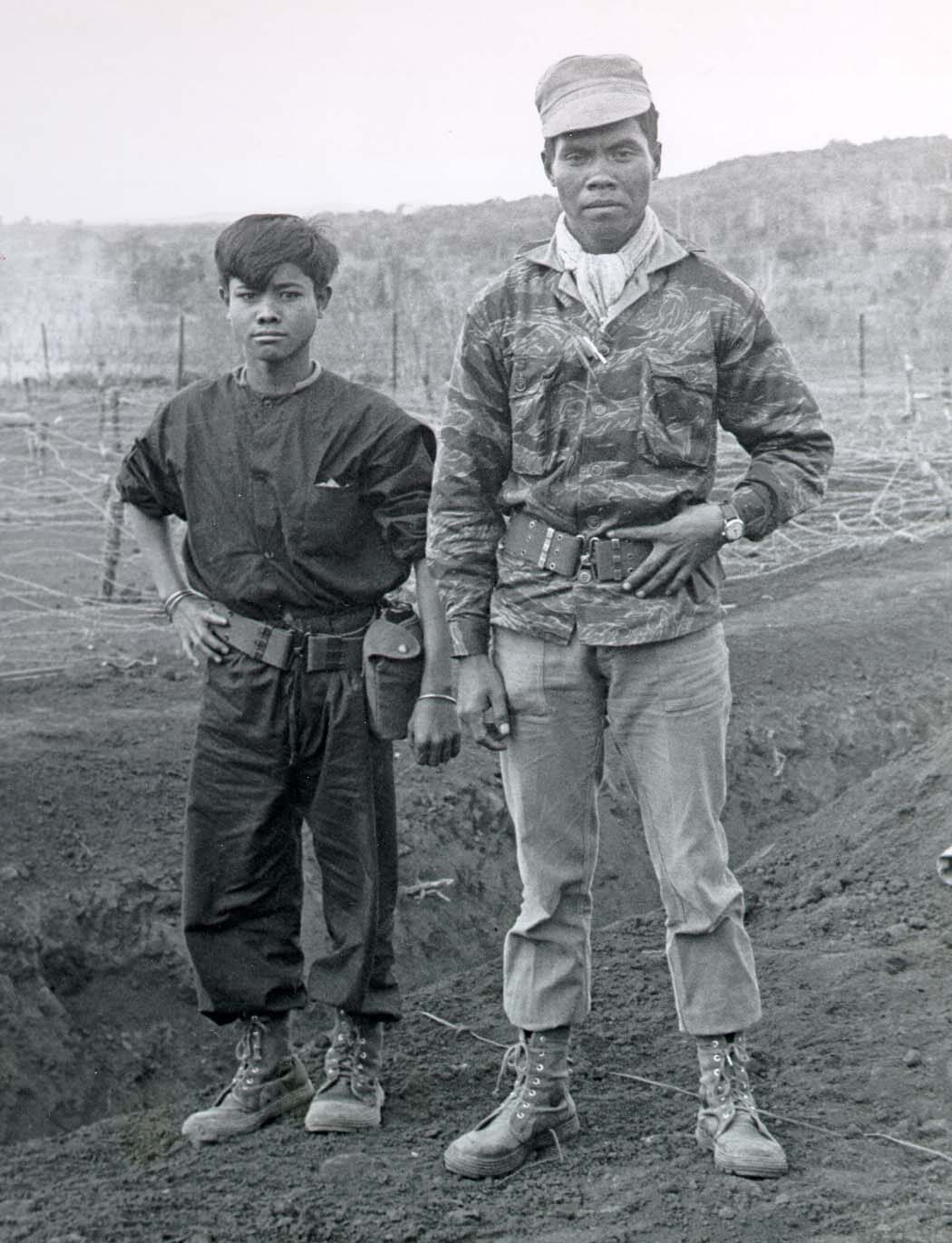

He was an interpreter for United States Special Forces. Our own organization’s history names him as acting military commander during the September 1964 uprising. After 1975, on the account of the historian Ben Kiernan, the Pentagon and the CIA aided the anti-communist wing of FULRO “under former US Special Forces interpreter Y Tlur Eban” in renewing the movement against the reunified state. He walked across Cambodia to Thailand and reached Greensboro, North Carolina in 1986, where a magazine profile calls him Thomas Y Tlur Eban. It was seven years before he was reunited with his wife, H Ju Nie. In July 1993 he put his name to the Dega case at the United Nations in Geneva.
Interpreter, commander of a revolt, the man through whom Washington re-armed a war it had abandoned, a refugee, and a signature at the United Nations. That is one life.
Y Jhon Nie — the man who did not join
He belongs here as the counterweight. Y Jhon Nie, half-French and half-highlander, commanded the battalion at Buon Brieng, the one of the five camps that did not go over in September 1964. The American captain there, Vernon Gillespie, said of the Vietnamese Special Forces men in the camp: “To kill them, you’ll have to kill me first.” At ten in the morning on September 20 a water buffalo and seven jars of nhom pae sealed the bond between the American, Y Jhon and the Vietnamese captain. A sergeant listened on the radio as FULRO leaders pressed Y Jhon to march on Buon Ma Thuot. He refused, and the next day took a hundred percent confidence vote from his strikers.
What it cost him is recorded too: he suffered a psychological breakdown, was believed to be cursed, was treated at the 8th Field Hospital, and ended as a guard at the American B Team compound at Buon Ma Thuot. Gillespie’s own verdict on where the power in such a camp really lay is the sentence to keep: “the U.S. was in control of the camp only because the Strike Force wanted us in control.”
Names that are only names
Several men who appear in lists of FULRO leaders are not commanders at all. They are prisoners of 1958, and a list is the whole of what survives of them. We would rather say so than invent careers.

All of those arrested in 1958 were, in our own account, “sent to Dalat and put in underground solitary cells for three months. On November 26, 1958, they were taken to Hue and put in the criminal section of the prison.” They came out on February 12, 1964, when the American embassy persuaded General Nguyen Khanh’s government to release them.
- Y Nuin Hmok — on the 1958 arrest list. Nothing else found.
- Y Thih Eban — on the 1958 list, and with a stronger claim than that: the Central Highlander Liberation Front is said to have been founded in 1955 by highlanders who had rallied to him. That would make him one of the earliest named organizers in the whole record, three years before BAJARAKA.
- Y Wick Buon Ya, Y Senh Nie, Y Het Kpor, Y Tluop Kpor, Y Yu Eban, Touneh Yoh, Siu Sip — on the 1958 list, and that is all.
- Y Preh — a FULRO man who sought out the Australian officer Barry Petersen, commander of the Truong Son Force, who was forbidden any contact with the movement. The form “Y Preh Buonya” we could not source.
- “Y Sen Nie Kdam,” “Y Nham Eban,” “Rcom Anhot” — three names in circulation for which we found nothing at all under those spellings. We do not merge them with the similar names above, and we do not repeat them as established.
After 1975: the forest command
Y Ghok Nie Krieng
Brigadier general, and commander of the resistance after 1975 — several thousand men still fighting. In 1985, with Pierre K’briuh, he took two hundred and twelve of them across the width of Cambodia to the Thai border, where the commander of the Second Royal Thai Army advised them that the Americans were no longer interested in fighting the Vietnamese.
They walked the width of Cambodia to be told by a Thai general that nobody wanted the war any more. That sentence is the hinge of the whole post-1975 story.
Pierre K’briuh
Sre — that is, Koho — and Catholic. He spent nine years in the camps, escaped, reached the United States and became a Catholic deacon at Greensboro, and later led our community in North Carolina. He co-commanded the 1985 march. In 1992 it was he who sent word into the forest to the men still there: “Due to unfavorable circumstances, I suggest it is time to stop fighting.” In July 1993 he signed at Geneva as vice president, under the name Pierre Mary Kbriuh.
Kpa Koi
He holds the strangest office in the movement. Our own 1993 submission records it in one line: “Mr. Y-Bham-Enuol decided to nominate Mr. Kpa-Koi (KPK) as vice-president of the FLHPM on October 20, 1973.” Y Bham Enuol was under house arrest in Phnom Penh when he made that appointment. Kpa Koi carried a document in Rhade with a French translation, signed by the president, authorizing him to head FULRO; Nay Luett, a minister of the government FULRO was fighting, confirmed the signature. See Y Bham Enuol in Phnom Penh.
Nay Guh
By 1974 FULRO had split. One faction held to what Y Bham Enuol had set out; the other, led by Nay Guh, turned to robbing truckers, Vietnamese loggers and wealthy Vietnamese. The American who records this adds that only Nay Guh’s unit agreed to a stand-down in 1975, that the executions of FULRO men then began in both factions, that Nay Guh was not killed, and that he was later given a position of influence in the new order — which the writer takes as an indication that he had been an agent all along.
That last inference is his, not evidence, and we print it as his judgment with no second source. But the existence of a banditry faction inside FULRO by 1974 belongs on this page. A register that shows only heroes is not a record.
Y Bih Aleo — on the other side
Not FULRO, and here as its mirror. A Rhade who became the highland figurehead of the National Liberation Front and rose to be its vice president, and who commanded a mixed battalion of highlanders — the White Elephant Battalion — whose work was propaganda among the tribes. After 1975 he disappeared from view and was said to have been retired to his home village of Buon Aleo in Dak Lak. See Highlanders on the other side.
Mondulkiri, 1992: the men who came out
The event is told at Mondulkiri, 1992. Here are the people.
Y Peng Ayun
Colonel, and commander-in-chief of what was left. When two journalists walked into his camp in the late summer of 1992, the first thing he asked the outside world was this:
“Please, can you help us find our president, Y’Bham Enuol? We have been waiting for contact and orders from our president since 1975.”
Y Bham Enuol had been dead for seventeen years. On the choice in front of him, he said: “If we give up our weapons, they will take us back to Vietnam or the Vietnamese will come get us. If I go to the U.S., I don’t want to stay a long time there, because I have responsibility to liberate my country.”
Y Hin Nie
In 1992 he was the delegation’s representative for foreign affairs; he is now the last public voice of the movement. Born about 1948.
He was at Buon Ma Thuot when the rockets came in at Tet 1968, and it was he who helped dig out his adoptive godmother, the missionary Carolyn Griswold, from the rubble; her father Leon died at once and she died soon after. See Tet 1968 in the highlands.
He joined FULRO on March 10, 1975, the day before Buon Ma Thuot fell. “I had no choice, it touched my heart.” Of the fighting: “Shoot and run, shoot and run. We didn’t have strong weapons.” Of leaving: “We couldn’t stay, so we crossed the border — it was too dangerous.” Of the years after: “We walked and walked and walked… we’d shoot elephants, anything we could see.”
And then the part nobody else tells, about dealing with the Khmer Rouge in order to survive in their country: “I said, ‘We have the same enemy’ — it was the only thing we agreed on.” “They were very angry, they counted everything.” And: “A general asked if they could join us because the songs were very beautiful, and they stayed with us in the camp. We sang and I preached in two languages — Khmer and Bunong.”
In 1992 he spent seven days convincing United Nations officers that FULRO’s only enemy was Hanoi. “They kept interrogating me for one week to make sure why I lived in the jungle.” What he told them: “We are Fulro — waiting for freedom and waiting for your help.” What they told him: “You only have 400 — there are millions of soldiers in Vietnam. We don’t want you to die.”
He reached the United States in November 1992 and was met by a banner welcoming the “forgotten army.” He married H Biuh in the forest; they had three children there and one died. He is pastor of the United Montagnard Christian Church in Greensboro, preaching in English, Vietnamese and Rhade, and was president of the Montagnard Dega Association, in which capacity he testified to the Senate on March 10, 1998. On Vietnam’s continuing attacks on him: “They still put propaganda against me but Fulro has died. Everyone has died. The Vietnamese try to shut the mouths of people in Vietnam — but I am here.”
The most quoted sentence from the 1992 discovery — “The Montagnard people and the Americans are like one family. I am not angry, but very sad that the Americans forgot us” — is given by the newspaper of the day to the commander and by a later broadcaster to Y Hin Nie, who adds: “The Americans are like our elder brother, so it is very sad when your brother forgets you.” We cannot settle which of them said it. Either way it was said.
The camp
The others the journalists met and wrote down:
- Bhong Rcam, forty-seven, nicknamed “Tiny” by the Americans, who said: “You are the first foreigner I have seen since 1975.”
- Pastor Bdasu Kbong, fifty-two, from Da Lat, leading services in the forest. The five encampments held five evangelical churches and one Catholic church; more than three hundred and fifty came to a two-hour evening service, and forty people shared one Bible.
- Y Ham Nic Hrah and Y Lico Nie, pastors from Buon Ma Thuot, who died in prison in the early 1980s. The first is very probably the Y Ham Nie Hrah recorded elsewhere as the brother of Kok Ksor’s wife.
- The missionaries they still named from before 1975: Mr. Long and Mr. Fleming at Pleiku, Helen Evans at Da Lat, Ken Swain in Darlac.
On the poisonous forest yams they lived on: “We must eat it slowly until our bodies get used to it or it will kill you.” On why they were there: “The communists will not let us pray. They say that Christianity is an American and French religion, so we came to live in the jungle.” And: “Here we are free.” One of them refused to leave: “I don’t want to go to a free nation. I want to stay here because this is my battlefield.”
The last lost patrol
Captain Y Ngom Mlo, thirty-eight, and Y Bhim Nie, forty-five, had been sent into Vietnam on patrol in May 1990 and ambushed in June; four of their men were killed. They hid for nine months, and reached their base camp in December 1992 to find the huts abandoned and refuse decaying on the ground. Everyone had gone. They made contact with the Uruguayan battalion of the United Nations force on May 16, 1993, at the village of Bougra, about thirty kilometers from the Vietnamese border. Y Ngom’s brother and his wife had been with the main body, which by then was in North Carolina.
The newspaper that reported them also printed a doubt: an analyst in Phnom Penh noted that the men said they had discarded their uniforms, though FULRO guerrillas did not have uniforms. We keep that sentence. It is the only contemporaneous skepticism about any of these accounts, and printing it is what makes the rest worth believing.
The three who went back
Late in the summer of 1994, three men in flip-flops arrived at a newspaper compound in Phnom Penh looking for the journalist who had found the army in the forest. They lived with him and his colleagues for months while he tried to get them refugee status. He could not. They went back across the border into Vietnam.
One of them was Y Bion Mlo. The authorities had been to their families’ houses while they were away, asking where they were, so the three went back into the forest for almost a decade. He crossed into Cambodia again in 2001 with his wife and was among the more than nine hundred resettled in the United States in 2003. He works as a Montagnard community liaison in the Greensboro school system. In 2016 he found the journalist on Facebook, twenty-two years after they had said goodbye. The journalist’s editor remembered: he had been haunted for decades about the three.
How many came out
The movement’s last muster roll is not agreed to within twenty people, and we print the disagreement rather than choose.
| Group | Figure | Given by |
|---|---|---|
| 1985–86, to Thailand | 201 | US State Department, testimony of March 10, 1998 |
| 209 — 159 men, 17 women, 33 children | a State Department approval of May 1986 from Site II | |
| 212 | our own records, and American accounts | |
| 220 | Phnom Penh Post, June 2001 | |
| 1992, from Mondulkiri | 407 | Phnom Penh Post, September 12, 1992 |
| 398 | the same journalist writing in 2013; Newsweek, November 1992; and the US State Department, 1998 | |
| 402 — 269 males, 24 females, 80 children | Raleigh Bailey, The Montagnards: Their History and Culture (2002) | |
| 417 | our own records, and American accounts |
Note that Bailey’s breakdown adds to 373, not 402, which means at least one of those numbers is wrong in print. Note too which figures come from the United States government — 201 and 398 — and which from our own organizations — 212 and 417. Even the arrival date differs: November 23 or November 24, 1986.
The women in the record
- H Biuh, wife of Y Hin Nie, married in the forest, three children born there and one dead there. She is the only woman we can name who was in the Mondulkiri camps.
- Siu Hyum, wife of Paul Nur, who “died of dysentery in 1977 because Kom-Tum Provincial Hospital refused to provide serum to save her life.” That is our own account, filed at Geneva.
- H’li Nie Hrah, Rhade, wife of Kok Ksor and sister of the pastor Y Ham Nie Hrah, who traveled to Cambodia at eighteen to find him and married him in a jungle camp, and who got out of Phnom Penh in 1975 with three sons.
- Ksor H’Ble, Kok Ksor’s mother, harassed and assaulted for more than a decade; in February 2001 forced to appear on a staged television broadcast and beaten, with three ribs broken; detained again in October 2010 and ordered to read a statement. She died on August 18, 2011, aged eighty. In the three days between her death and her funeral, sixteen thousand Dega Christians from thirty-seven villages came to Bon Broai to pay their respects.
- H Ju Nie, wife of Y Tlur Eban, separated from him for seven years.
And the statistic: of the four hundred and two counted in December 1992, twenty-four were women and eighty were children; of the 1986 group, seventeen of two hundred and nine were women. A last encampment holding twenty-four adult women, more than eighty children and six churches was not an army in any ordinary sense. It was a village under arms. See Dega women and Highland women in the war.
The sixteen who signed at Geneva, July 1993
Eight months after the last fighters walked out of the forest, sixteen men put their names to our case at the United Nations workshop on the rights of indigenous peoples. It is the largest verified list of named FULRO survivors we hold, and this is the whole of it as printed:
Ksor-Kok, President — Pierre Mary Kbriuh, Vice President — Nay-Rong, Secretary — Y-Ngong Knul — Sre-Sang Dim — Ksa-Thaniel — Y-Samy Ayun — Y-Bhi Kbuor — Bhuat Eban — Y-Yok Ayun — Y-Blim Adrong — Y-Siu Hlong — Y-Tlur Eban — Rmah-Dok — Y-Juen Eban — Philip-Daoh
Of most of them we know nothing but the signature. Rmah-Dok is almost certainly the “Rmah Dock” that circulates in lists of FULRO commanders; the signature is all we have. Y-Siu Hlong arrived in the United States on November 23, 1986 and became executive director of the Montagnard Dega Association. For Ksor Kok see Kok Ksor.
The same document carries, as appendices, the two texts our claim rests on: the Federal Ordinance of May 27, 1946 creating a commissariat for the Montagnard populations of South Indochina, signed by d’Argenlieu at Saigon, whose article 4 put its seat at Buon Ma Thuot; and Bao Dai’s decree No. 16/QT/TD of May 21, 1951, issued at Da Lat. It also carries our own casualty claims for the period — a million dead between 1945 and 1973, and an estimated sixty thousand killed between 1975 and 1982 — which we give here as the movement’s own figures, published, like the outside estimates, without their working.
What we do not know
We do not know what became of Y Peng Ayun, who commanded the last of FULRO. We cannot settle whether Chau Dara and Um Savuth were one man or two, and the death of Um Savuth in November 1972 makes the usual story of where Y Bham Enuol was held impossible as stated. We cannot settle which Adrong signed which agreement. We could not verify the count of weapons surrendered in 1992. We have not been able to read Hickey’s appendix of a hundred highland leaders, which is the master list of this generation and which we would like to publish in full. And for at least three names that circulate as FULRO commanders we found nothing at all.
If your family holds papers, photographs or a name from any of this — a warrant, a discharge, a camp roll, a letter out of Mondulkiri — we would like to record it. See How to record an elder.
See also: Y Bham Enuol, FULRO, Mondulkiri, 1992, The BAJARAKA movement, North Carolina.
Sources
- Gerald C. Hickey, Accommodation and Coalition in South Vietnam, RAND Corporation P-4213 (1969) — full text at DTIC, AD0699558. The single most valuable document for this page, written within months of the events: Y Dhe Adrong’s meeting with the two lowland fronts; the headquarters near the old French Camp Le Rolland; the agreement of December 19, 1968 signed by “Y Dhe and Y Bling”; the capture of Y Bham’s headquarters by “FULRO dissidents… accompanied by a group of Cambodian-Cham”; and the meeting with President Thieu of February 11, 1969 and the Movement for Unity of the Southern Highland Ethnic Minorities under Y Bling Buon Krong Pang. Every passage quoted above was checked against the page. The RAND scan of the same paper has no text layer
- Supplemental Materials for a Presentation Made to the United Nations Workshop on the Rights of Indigenous Peoples, Geneva, July 19–30, 1993 — Fourth World Documentation Project. Our own document: the sixteen signatories, the nomination of Kpa Koi on October 20, 1973, Siu Hyum, the 1958 imprisonments at Da Lat and Huế and the release of February 12, 1964, the 1946 ordinance and the 1951 decree, and the movement’s own casualty claims. Verified against the text
- Oscar Salemink, Beyond Complicity and Naiveté: Contextualizing the Ethnography of Vietnam’s Central Highlanders 1850–1990 (University of Amsterdam, 1999), p. 3 — on Hickey’s appendix of “One Hundred Highlander Leaders” and what followed. One scholar, one sentence, and we say so
- Gerald C. Hickey, Free in the Forest: Ethnohistory of the Vietnamese Central Highlands, 1954–1976 (Yale, 1982), appendix at pp. 304–307 — the list itself, which we have not been able to read
- Nate Thayer with Michael Hayes, “Montagnard Army Seeks U.N. Help,” Phnom Penh Post, September 12, 1992, and “Lighting the darkness: FULRO’s jungle Christians,” September 25, 1992 — Y Peng Ayun, Y Hin Nie, Bhong Rcam, Pastor Bdasu Kbong, the dead pastors, the named missionaries, the five churches, the forest yams, and the count of 407
- “The Last ‘Lost’ Patrol,” Phnom Penh Post, July 2, 1993 — Y Ngom Mlo and Y Bhim Nie, the abandoned camp, the contact with the Uruguayan battalion at Bougra on May 16, 1993, and the analyst’s doubt about the uniforms
- BBC News, August 2023, on Y Hin Nie — the Griswolds at Tet 1968, joining on March 10, 1975, the years in the forest, the dealings with the Khmer Rouge, the seven days with the United Nations, and H Biuh. Read in a syndicated reprint; the original should be located
- Robert W. Jones Jr., “A Team Effort: The Montagnard Uprising of September 1964,” Veritas 3:2 (2007), US Army Special Operations Command History Office — Y Jhon Nie at Buon Brieng, Gillespie’s “to kill them, you’ll have to kill me first,” the buffalo and the seven jars of nhom pae, the confidence vote, and Y Jhon’s breakdown afterward
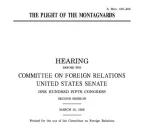
- Testimony to the Committee on Foreign Relations, United States Senate, March 10, 1998 — the State Department’s figures of 201 for 1985–86 and 398 for September 1992
- Michael D. Benge, “The Montagnard Political Movements and FULRO,” Sentinel (Special Forces Association Chapter 78), September 2018 — on the planning of the 1964 revolts, on Nay Guh’s faction, and on Y Bih Aleo and the White Elephant Battalion. A partisan source, written by a former American official and prisoner of war, and cited as such: his inference that Nay Guh was an agent is his own and has no second source
- Jim Morris, review of William Chickering’s account of the Mike Force, Special Forces Association Chapter 78, February 2025 — Kpa Doh at Plei Trap and his dismissal, Y Kdruin Mlo’s death, Y Bun Sur, Y Bhan Kpor, and the French embassy in April 1975
- Daniel Ford, Cowboy: The Interpreter Who Became a Soldier, a Warlord, and One More Casualty of Our War in Vietnam (Warbird Books, 2018) — the life dates 1936–1968, the Dam Y Division, and “murdered by his own side”
- Catherine Scheer, “Subaltern soldiers: Overshadowed Bunong highlanders in the Khmer Republic’s army, 1970–75,” Journal of Southeast Asian Studies 53:1–2 (2022), pp. 123–152 — the 5th Special Brigade, and the footnote citing a French life of Y Bun Sur that supplies his dates
- William B. Noseworthy, “Lowland Participation in the Irredentist ‘Highlands Liberation Movement’ in Vietnam, 1955–1975,” ASEAS 6:1 (2013) — the founding proclamation as printed in 1965, the offices it assigns, and Les Kosem’s coinage of Austrien
- Joe P. Dunn, “Kok Ksor and the Struggle for Cultural Survival, Human Rights, and Religious Freedom for the Montagnards of the Central Highlands,” Athens Journal of History — Pierre K’briuh, H’li Nie Hrah, and Ksor H’Ble
- Ben Kiernan, Việt Nam: A History from Earliest Time to the Present (Oxford, 2017), p. 460 — on American support for FULRO after 1975 under Y Tlur Eban
- Raleigh Bailey, The Montagnards: Their History and Culture (Center for Applied Linguistics, 2002) — the December 1992 figure of 402 with its breakdown, which does not add up and is printed here as found
Compiled September 2026. Where the sources conflict — on who was president in 1964, on which Adrong signed what, on whether Chau Dara and Um Savuth are one man, on how many walked out — the conflict is printed rather than resolved. Names that circulate without any source behind them are marked as such and not repeated as fact. No Vietnamese state source is used; where a Vietnamese official position appears it is reported at second hand and labeled. Dega personal names are written plainly except in quoted documents and lists, which stand exactly as printed.