

















For fifteen years, from 1957 into the 1970s, governments moved our villages. Saigon moved them to make room for Vietnamese settlers, then to empty the country the Viet Cong held. The American army lifted them out by helicopter so that it could fight where they had lived. A South Vietnamese general moved them again at harvest, on a few hours’ notice, and let soldiers take their gongs and kill their animals. At one camp in Pleiku between two and three hundred people died in the first two months. No one ever added up how many of our people were moved. This page gathers what the records say, place by place, with the names of the sites and the words of the few of us who were asked.

Settlers on our land, 1957–1963
The moving began with land. After 1954 the government of Ngô Đình Diệm settled Vietnamese refugees from the North, and then Vietnamese from the crowded coast, in “land development centers” across our plateau. The US Army’s official history of its Special Forces puts it in four sentences:
“Before 1954 very few Vietnamese lived in the highlands. In that year some 80,000 refugees from North Vietnam were resettled in the Montagnard area, and inevitably friction developed. Dissatisfaction among the Montagnards reached a point where in 1958 one of the principal tribes, the Rhade, organized a passive march in protest. Vietnamese officials countered by confiscating the tribesmen’s crossbows and spears, an act that further alienated the Montagnards.”
That march was the BAJARAKA movement’s. The land it protested about was being taken under law. Gerald Hickey, the American anthropologist who worked in the highlands from 1964 to 1973 under contract to RAND, paid for by the Defense Department’s research agency, wrote for his sponsors in 1967:
“Moreover, the government ignored the Highlanders’ claims in its Land Development Program, which sought to resettle lowland Vietnamese by giving them land in the highlands, and in the Highland Resettlement plan, under which Highlanders were forced off their ancestral land and into ‘reservations.’ Two decrees, in 1958 and 1959, deprived Highlanders of the right to own the land they farmed.”
He recorded the small humiliations that went with it. “A province chief in Darlac forbade the Rhade to enter Ban Me Thuot wearing their traditional loin cloths, and required them to be dressed in shirt and trousers. In Pleiku, a province chief ordered Jarai refugees to build their new houses on the ground, Vietnamese style, rather than on piling as was their custom.” And he recorded the one Vietnamese official who tried to pay for what was taken: General Lê Văn Kim, director of the Land Development Program, paid the people who farmed the site of the Buon Kroa project some 30,000 piasters, “a gesture which caused him to be removed from that position.”
Our people were moved too. The historian Stan Tan, working in the Republic’s own archives, found that by June 1959 the government’s program to “sedentarize” highlanders had put 80,159 of us into 108 centers, on an average of less than two hectares a household, below the government’s own standard. The full story of those years is on Pushed off, 1954–57 and Land law.
When our leaders were finally asked, they said the same thing every time. At a land registration seminar in Saigon in December 1964, Hickey writes, fourteen highland leaders brought complaints based on “the Highlanders’ indisputable ownership of certain lands,” and spoke of “privately-owned lands expropriated by local authorities to set up Land Development Centers.” Hickey did not name the fourteen. We would like to.
“To prevent their return,” 1962–1964
From 1961 the Viet Cong were strong in the mountains, and whole villages began to come down out of the fighting. On May 23, 1962, the American ambassador in Saigon, Frederick Nolting, reported to Washington:
“Recent months have seen greatly increased flow of Montagnards from mountain areas seeking GVN protection and support. Some 47,000 have been resettled in Kontum, Pleiku, Darlac, and Quang Duc Provinces. Flow continues, however, and possibly as many more are in great need of assistance. As flight of Montagnards probably deprives VC of important source of support in highlands, it is most encouraging sign. To prevent their return to highlands, it is essential they be given assistance in terms food, tools, etc., and establishment new villages.”
Read the last sentence again. The ambassador of the United States called our flight from our homes a most encouraging sign, and the aid he asked for was meant to stop us going back.
In August the policy was set in Saigon. On August 7, 1962, Nolting reported that Diệm’s secretary of state for the presidency, Nguyễn Đình Thuận, had told him and the CIA station chief that a meeting of ministers had decided to “encourage by all means possible exodus Montagnard population from areas controlled by VC to areas control by GVN,” and that in choosing new sites, “Where these principles conflicted, security comes first.” In the same conversation Thuận asked the ambassador for “a favorable answer re selective use chemicals for spraying crops,” because it was harvest time and the fields the villagers had left were full. The moving of our people and the poisoning of our fields were discussed in one meeting. The spraying is told on The trail and the poison.
.jpg)
Then came the strategic hamlets: villages regrouped behind fences of bamboo stakes and ditches, to cut the people off from the Viet Cong. Stan Tan reports figures given by a writer of the Republic, Lê Đình Chi, of 153,422 highlanders in 596 strategic hamlets, and another 214,533 who had fled the fighting in 483 resettlement centers. The French anthropologist Georges Condominas, returning in 1958 and 1962 to the Mnong village of Sar Luk where he had lived, found it gone and its people regrouped; from what he saw he took up the word ethnocide and gave it the meaning anthropologists still use. That is told on The Mnong.
In the far north it was the same. The Army’s handbook of 1966 records that in 1965 the government moved many Bru from their villages into a strip three miles wide on each side of Route 9, so that they could not be made to help the Viet Cong. Three years later the war came down Route 9, and the Bru were driven out again; see The battles fought on our land.
Beside the camps, and out of the fire
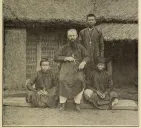
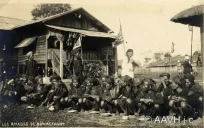
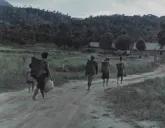
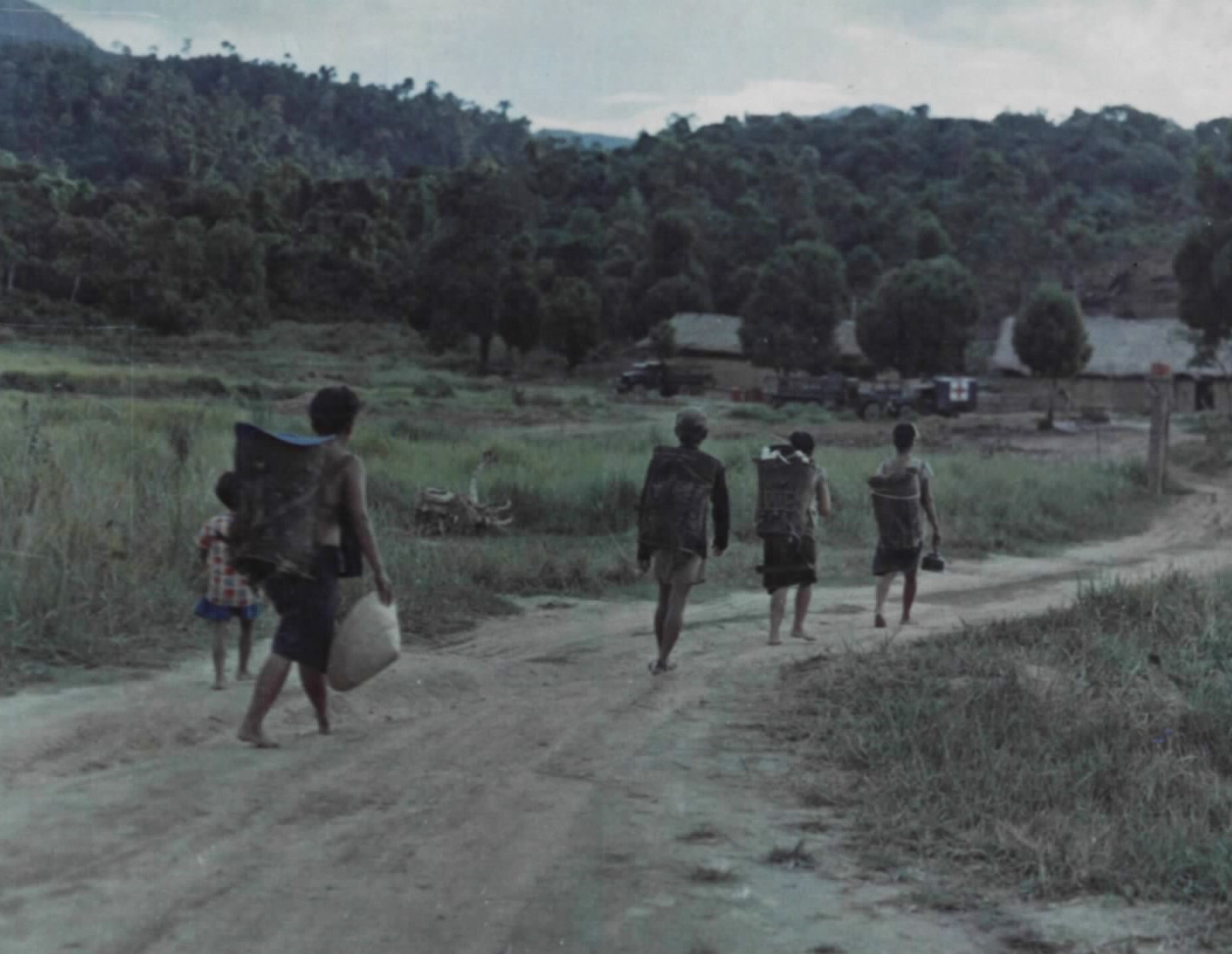
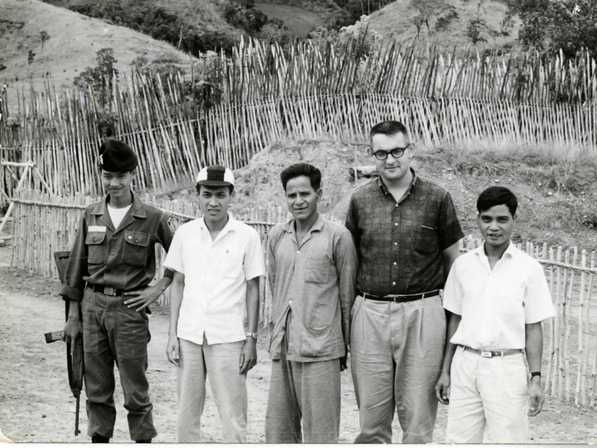
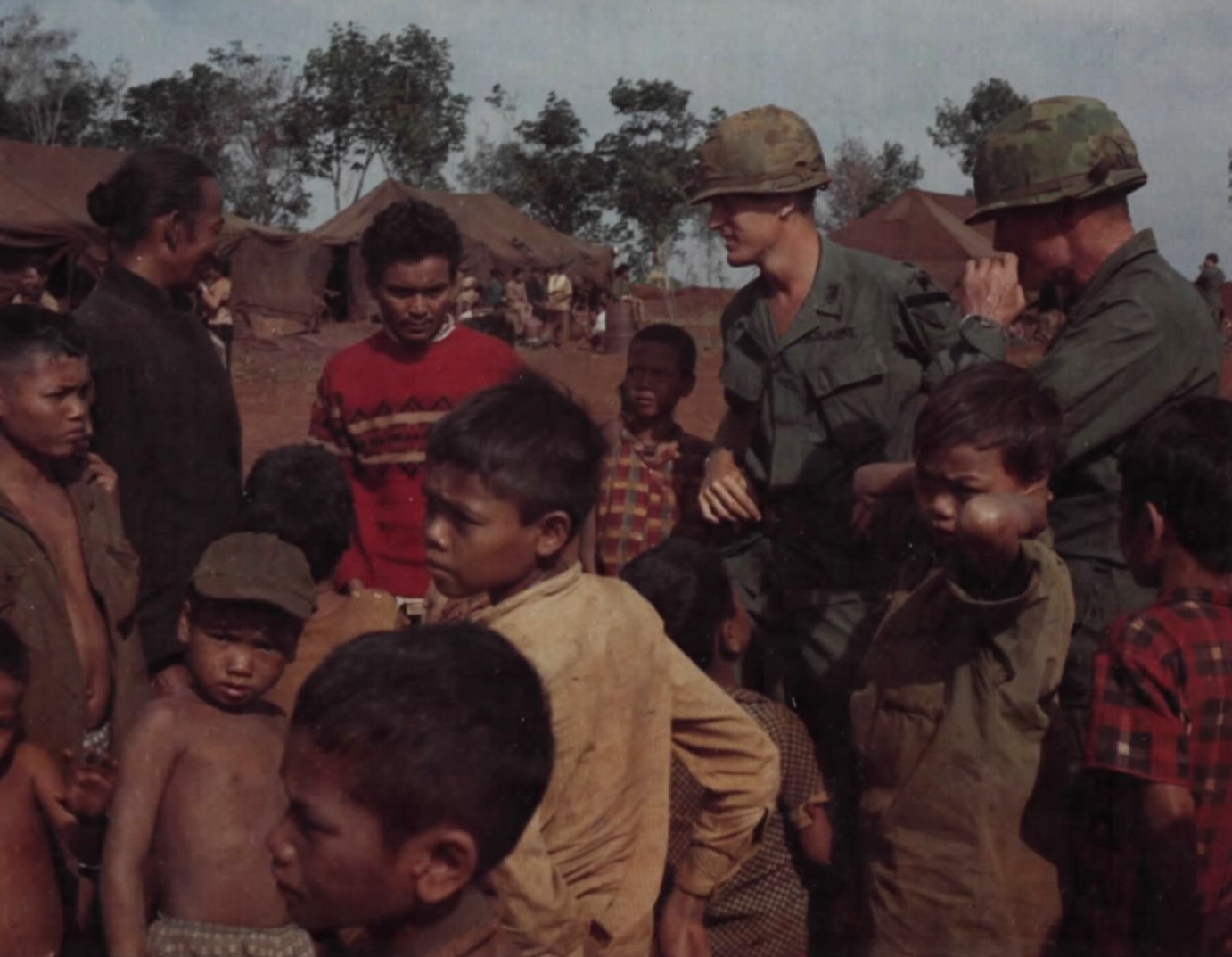
As the American war grew, villages were moved beside the Special Forces camps, like the one in the photograph at the top of this page, where an Army photographer found only the old and the children in July 1964. Other villages were moved out of the country the armies wanted to fight in, and then destroyed so that no one could go back. An American soldier, Wes Parker, told his great-niece fifty years later what that meant:
“While on that detail I helped relocate several villages that were in so-called ‘unsafe zones’ to more secure areas.”
Under a photograph of himself and a Montagnard soldier searching houses at dawn, he wrote: “Shortly afterwards we set fire to everything and burned the entire village to the ground.” He named the program he was working for: “That was all part of a relocation program known as Edap Enang.”
Edap Enang, 1967–1969
Êđăp ênang is a Rhade phrase for peace. It was the name given to a camp on Route 19 west of Pleiku, into which the Saigon government and the American 4th Infantry Division moved the Jarai villages of the border country after the battles of 1965 and 1966.
The division’s report for the spring of 1967 records how it began:
“On 2 April the GVN initiated the EDAP ENANG Resettlement Program employing one ranger battalion as a security force.”
The plan was to move about eight thousand people. In the first weeks the division’s 2nd Brigade moved “18 villages with a total population of 2,757 people and 90,000 pounds of food and rice from insecure areas” to the camp, with “more than 90 CH-47 sorties and 30 2½ ton truck loads,” and set up twenty-one Army tents for them to live in. By the autumn it was forty-seven villages. The division’s report on its operation that year:
“Forty-seven villages moved from isolated locations in insecure territory to the EDAP ENANG resettlement area.”
Its report for the summer gives the total: 47 hamlets, 7,046 people, “from areas south of THANH AN District Headquarters and west of Highway 14D.” The report names none of the forty-seven. It counts the acres the Army cleared for the camp: 583 for farming and 837 for houses. It calls the result an environment in which “pro-GVN attitudes could survive.”
What it was like inside. Ivars Bemberis, an American civil affairs officer who worked there, was asked about it in 2023. He had grown up in camps for displaced people himself, in Germany after the Second World War, and he did not soften it:
“this camp was basically an internment camp. People were forced to be there.”
South Vietnamese troops were, in his words, “acting as a guard force to stop people from leaving.” “The rations came sporadically.” In the cold months people fell sick with pneumonia. His team had two medics, he said, for five thousand people. Asked whether they had won any hearts and minds, he said: “No.”
The Army’s own civil affairs team there in 1968–69 brought in bigger pigs to improve the diet. Its lieutenant, David Schaffner, remembered what happened:
“I noticed that as we were putting that slop into the hog troughs, a little bit later the Montagnard kids would come along with gallon cans to scoop it out … for [their] dinner.”
The Army’s special operations historians add that “Local officials often pilfered construction materials furnished by the U.S. and South Vietnamese governments. Many coerced the refugees into buying back the same stolen materials.” The team’s captain, Darrell Buffaloe, concluded: “The problem I saw was that the U.S. and the Government of Vietnam did not understand the culture of the Jarai Montagnard people.”
The Viet Cong. The camp was also a target. A CIA report on Pleiku for December 1967 records Viet Cong “propaganda and threats of reprisal” directed at the people of the Edap Enang resettlement center, and lectures “accompanied by the usual rice collections.” In 1968 the 4th Division identified a new Viet Cong local force battalion north of the camp whose mission was to attack Edap Enang and a second resettlement village nearby. What a Viet Cong reprisal against a settlement of highlanders who had left their zone could mean had been shown at Dak Son in December 1967, the same month.
The walk-out. That winter the people left. The 4th Division’s report for the spring of 1968:
“The migration of people away from EDAP ENANG, commencing in December 1967, continued until March 1968, with an approximate 2,200 MONTAGNARDS remaining in EDAP ENANG at that time. The exodus, reducing the population from an estimated [six thousand] inhabitants to 2,200 in a one month period, was the cause for an immediate re-evaluation of the EDAP ENANG project and a concentrated effort to rectify the recognized mistakes. At the end of April 1968, 2,200 MONTAGNARDS had been re-located in EDAP ENANG.”
In plain words: in one month of the dry season, after the harvest, most of the people of Edap Enang walked out past the guards and went home, and in April the army brought in 2,200 more. Bemberis remembered it the same way: half of them “walked out back into the fields.” The report does not say what the recognized mistakes were. Whether the people were drawn out by the Viet Cong or driven out by the camp, the records do not settle, and the people inside were caught between both.
The dead. We have found no count of the deaths at Edap Enang. None of the Army’s reports records any. That is not the same as none having died.
“Gathering the People,” 1970–1971
The largest and cruelest moving came after the Americans had begun to leave. In the late summer of 1970 the South Vietnamese general commanding the highland military region, Ngô Dzu, ordered the province chiefs to gather the highland hamlets in to the roads and the towns. The US General Accounting Office, the auditing arm of the American Congress, investigated for Senator Edward Kennedy’s refugee subcommittee and reported in March 1972:
“These relocations were ordered by the GVN Commanding General of Military Region 2 who termed the campaign ‘Gathering the People.’”
The Republic’s own rules required that any unavoidable relocation be approved in advance by its central pacification council. These were not. The auditors found that
“many of the families had been moved—with only a few hours’ notice—and that adequate transportation had not been provided. Many of the Montagnards complained of being forced to leave behind their prized personal possessions, such as gongs, jars, and hardwood furniture.”
A gong is not furniture to us. It is the voice of a household and of its dead, passed from generation to generation; see Gongs and epics. Dispatch News Service, the small independent agency that had broken the story of My Lai, reported in March 1971 that “Cattle and ceremonial gongs were stolen by ARVN troops and later sold in a nearby Vietnamese market town.”
The Americans knew. The deputy director of the American pacification program for the region, Edward T. Long, wrote to General Dzu asking him to put the moves off until after the harvest. Dzu went ahead, and, Dispatch reported, “began to move during the autumn harvest season, leaving relocated hamlets without their rice supply for the remainder of the year.” The auditors’ finding on the Americans’ own part is one sentence:
“CORDS officials at the working level opposed these massive relocations; however, top officials in the CORDS organization—as far as we could determine—made no representations to GVN to oppose the moves.”
The sites
The auditors went to the sites in 1971 and wrote down what they saw. These are their words and their figures.
Buon Kli B, Darlac. “This resettlement site was established in February 1971 when 6,244 Montagnards were forcibly relocated because of the reported insecurity of the area in which they were living.” There were three wells and no latrines for more than six thousand people, and a five-classroom school for two thousand children. A spokesman for the people told the auditors that about twenty had died of sickness and lack of food. And:
“GVN promised them the land surrounding the resettlement site; however, the ethnic Vietnamese are now farming the land promised to the Montagnards. The refugee spokesman stated that additional land and food was necessary for their survival.”
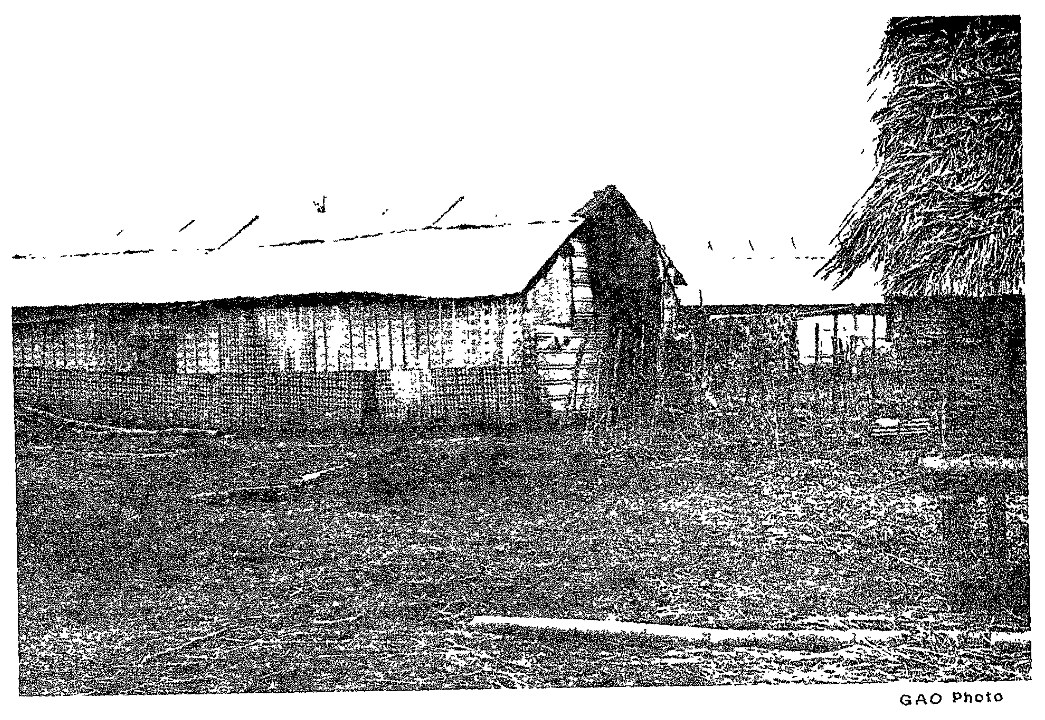
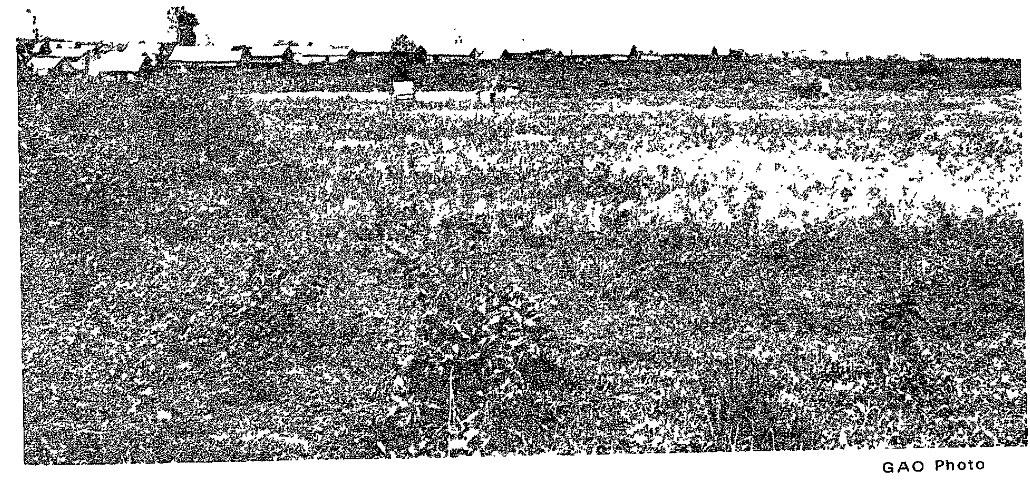
Buon M’Bre, Darlac. About 899 people, moved in January 1971, given a week’s notice. The farmland the government promised was not provided. At Buon Kli B and Buon M’Bre, the auditors found, each family had about 500 square meters of land, a twentieth of a hectare, where it needed about two and a half hectares to feed itself. “Without land self-sufficiency cannot be attained.”
Plei De Groi, Pleiku. The worst. The auditors wrote:
“About 2,500 Montagnards were forcibly relocated to this resettlement site in January 1971. In October 1971 only 750 persons lived at this site. The rest of the Montagnards had left the site reportedly because of the terrible living conditions. In March 1971 it was reported that between 200 and 300 Montagnards had died at this camp because of exposure, malnutrition, tuberculosis in older patients, or an influenza-type virus.”
Between two and three hundred people dead in about two months, in a camp built to keep them safe. The people themselves told the auditors why that was bitter:
“Lack of security was given as the reason for the relocation; however, the Montagnards told us that they had experienced only one attack in 10 years at their original village. Since relocation in January 1971, they have been attacked three times by the Viet Cong. The GVN military moved them very quickly and they had little chance for taking their livestock and personal possessions with them. These people desired to return to their home villages.”
Plei Ia Maih, Pleiku. “The 775 Montagnards living at this site were forcibly relocated without advance notice in January 1971. It was reported, prior to relocation, that they were collaborating with the Viet Cong. The GVN military killed all of their animals, and they were forced to leave their homes and many of their personal possessions.” There were no wells and no latrines. The American refugee adviser told the auditors that the people had lost the will to survive: “They had been moved many times.”
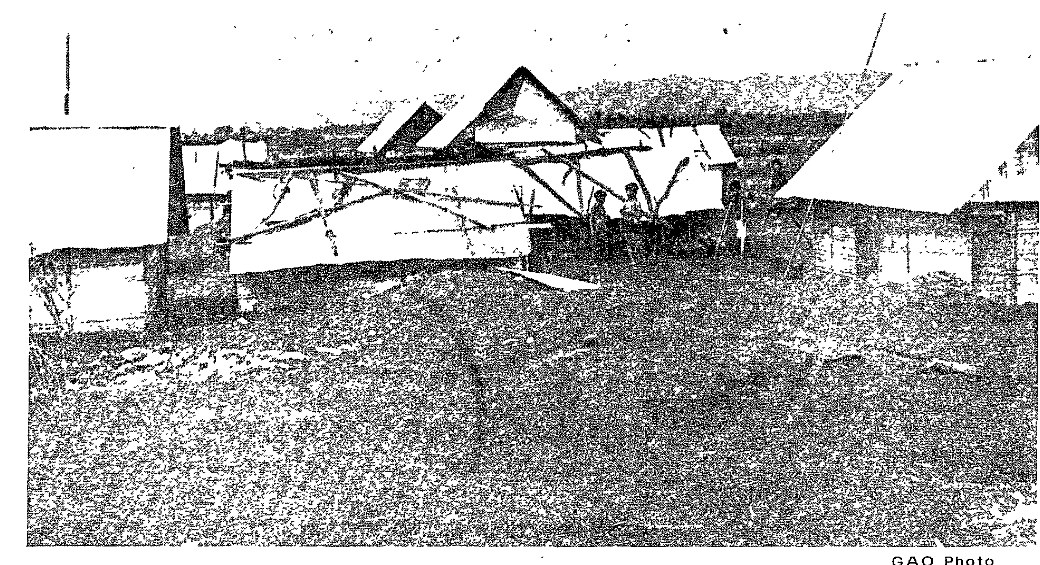
Others. Buon H’Dok in Darlac held 678 people, moved there in 1968; the whole camp stood on about half a hectare. Plei Doch in Pleiku, 1,479 people, is recorded as having moved of its own will in January 1971; the government had provided “no wells, no latrines, no schools, and no dispensary,” and the crops failed in the bad soil. Dispatch adds Buon Drai Si, 3,200 people, and Buon Nie Ea Sah, 2,800, where Vietnamese farmers moved onto the land promised to the people who had been moved there. In Kon Tum the auditors found 240 people made homeless by a Viet Cong attack in May 1971 who by October had not even been recognized as refugees.
What our people said. Dispatch News Service found an American official, identified only as Deputy Senior Advisor Bartley, who said the people in Darlac were reacting to the move as though it were permanent, and that the longer they stayed, the less they would want to go back. It put that to a Montagnard leader in Buon Ma Thuot, whom it did not name:
“All of them want to go back. There they had very good land. Here they can’t do anything.”
That is the only sentence spoken by one of us about Gathering the People that we have found in print. If you know who said it, please tell us.
How many. Dispatch’s headline in March 1971 was “45,000 Montagnards.” The auditors’ count is larger and runs later: “From May 1970 through August 20, 1971, about 62,546 Montagnards and other South Vietnamese were relocated in Military Region 2.” Most of them were ours.

What happened to the land
Every stage of the moving took land, and none gave it back.
- The law. The decree of 1958 and the official letter of 1959, in Hickey’s words, gave highlanders a right only to what they grew, not to the land itself.
- The centers were built on village land. The one official who paid for it, at Buon Kroa, was removed.
- The relocation sites were promised land that others then farmed. At Buon Kli B the auditors photographed it.
- The land left behind was sprayed in 1962, fought over from 1965, and in 1970 claimed by the powerful: Dispatch reported that the wife of Vice President Nguyễn Cao Kỳ said the land the people wanted back was “public domain.”
- After 1975 much of it became state farms, rubber, coffee and new settlements for people from the North. That story is on Land taken for coffee, Rubber and Land law.
How many, and who counted
| What | Figure | Who counted |
|---|---|---|
| Northern refugees settled in our country | about 80,000 | Kelly, the Army’s official history |
| Highlanders “sedentarized,” June 1959 | 80,159 in 108 centers | the Republic’s archives, through Stan Tan |
| Highlanders resettled by May 1962 | 47,000 in four provinces, “possibly as many more” in need | the American embassy |
| Highlanders in strategic hamlets | 153,422 in 596 hamlets | Lê Đình Chi, through Stan Tan; date unclear |
| Highlanders in refugee resettlement centers | 214,533 in 483 centers | the same |
| Edap Enang, 1967 | 47 hamlets, 7,046 people | US 4th Infantry Division |
| Edap Enang walk-out, winter 1967–68 | about 6,000 down to 2,200 in a month | the same |
| Gathering the People, 1970–71 | 45,000 (headline); 62,546 “Montagnards and other South Vietnamese” | Dispatch News Service; US General Accounting Office |
| Dead at Plei De Groi, early 1971 | 200 to 300 | US General Accounting Office, from a report of March 1971 |
| Dead at Buon Kli B, 1971 | about 20 | a spokesman for the people, to the auditors |
| Our people driven from their villages in the whole war | “more than 85 percent of the population” | Gerald Hickey, as Human Rights Watch reported him in 2002 |
| Our villages destroyed or abandoned | 85 percent | Rong Nay, before the US Senate, 1998; Michael Benge, 2010 |
Some people were counted more than once, because they were moved more than once; the refugee adviser at Plei Ia Maih said as much. Some of the counts include Vietnamese. No one has added them up honestly, and the only overall figure, the 85 percent, exists in two forms: a share of the people, and a share of the villages. Either way, it means that by 1975 most of us no longer lived where our grandparents had.
What we do not know
The names of the forty-seven villages moved into Edap Enang, where each came from, and how many died there.
Who reported the deaths at Plei De Groi, and where exactly Plei De Groi was.
The original villages of the people of Buon Kli B, Buon M’Bre, Buon Drai Si and Buon Nie Ea Sah, and whether any of them ever went home.
The fourteen leaders of December 1964, and the Montagnard leader in Buon Ma Thuot who said “All of them want to go back.”
What our own leaders did about Gathering the People. Nay Luett became Minister for the Development of Ethnic Minorities in 1971, in the middle of it. What his ministry did we have not yet been able to read; see Paul Nur and Nay Luett.
Your village. Most of all we want the thing no document has: the account of someone who was moved. If your village was moved during the war, please tell us its name, where it went, when, who moved it, what was taken, and what happened to the land. See How to record an elder.
See also: Highland refugees of the war years, The American years, The battles fought on our land, How we died.
Sources
- US General Accounting Office, Follow-Up Review on Assistance to War Victims in Vietnam, B-133001, report to Senator Edward M. Kennedy, March 27, 1972, full copy in our library — Gathering the People, the named sites, the deaths, the land and the photographs
- Dispatch News Service, “45,000 Montagnards: S. Viets order forced relocation of tribe,” The Michigan Daily, March 27, 1971
- Foreign Relations of the United States, 1961–1963, vol. II, documents 203 (May 23, 1962) and 260 (August 7, 1962) — the ambassador’s telegrams
- HQ 4th Infantry Division, Operational Report – Lessons Learned, quarter ending April 30, 1967; Combat Operations After Action Report, Operation Francis Marion (November 1967); report for May–July 1967; and report for February–April 1968 — the Army’s own record of Edap Enang
- Ivars Bemberis, oral history, Dartmouth Vietnam Project, May 6, 2023
- Troy J. Sacquety, “We’re not in Kansas anymore: The 41st Civil Affairs Company in Vietnam, Part II,” Veritas 10:1 (US Army Special Operations Command History Office, 2014)
- CIA, Summary of Viet Cong Activities in Pleiku Province During December 1967 (January 1968)
- Amanda Huffman, “The True Story of an American Hero in Vietnam” (2017) — Wes Parker
- Gerald C. Hickey, The Highland People of South Vietnam: Social and Economic Development, RAND RM-5281/1-ARPA (1967), at the Internet Archive — written under contract for the Defense Department’s research agency; and Free in the Forest (Yale, 1982)
- Col. Francis J. Kelly, U.S. Army Special Forces 1961–1971 (Department of the Army, 1973), at the Internet Archive
- Department of the Army, Minority Groups in the Republic of Vietnam, DA Pam 550-105 (1966), at the Internet Archive — the Bru along Route 9
- Stan B-H Tan, “Swiddens, Resettlements, Sedentarizations, and Villages,” Journal of Vietnamese Studies 1 (2006)
- Human Rights Watch, Repression of Montagnards (2002); Michael D. Benge, “The History of the Involvement of the Montagnards” (2010); and the testimony of Rong Nay before the US Senate Foreign Relations Committee, March 10, 1998 — the overall figures
Compiled September 2026. The quotations on this page were checked word for word against the documents they come from; the GAO report was read in the original scan, which we have placed in our library. The first figure in the Army’s report of the Edap Enang walk-out is illegible in the scan and is given in brackets.