

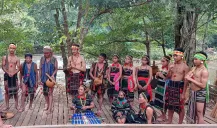







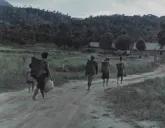
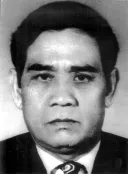
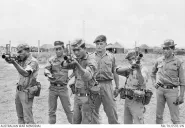

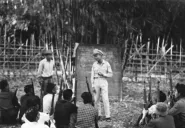
The Mnong hold the southern half of the plateau — Dak Nong, the Lak basin below Buon Ma Thuot, and Mondulkiri across the Cambodian line, where they call themselves Bunong and are the largest of Cambodia’s recognized indigenous peoples. They are the people of N’Trang Lơng, who kept the French out of his country for twenty-three years; of the elephant catchers; of the ot ndrong, an epic cycle so long that the man who wrote it down measured it in thousands of pages. They are also the subject of the most famous book ever written about anyone in the Central Highlands of Indochina — and of the sharpest illustration that exists of what can be done with a book about us once it is written. This page is about a border, a book and a kite.
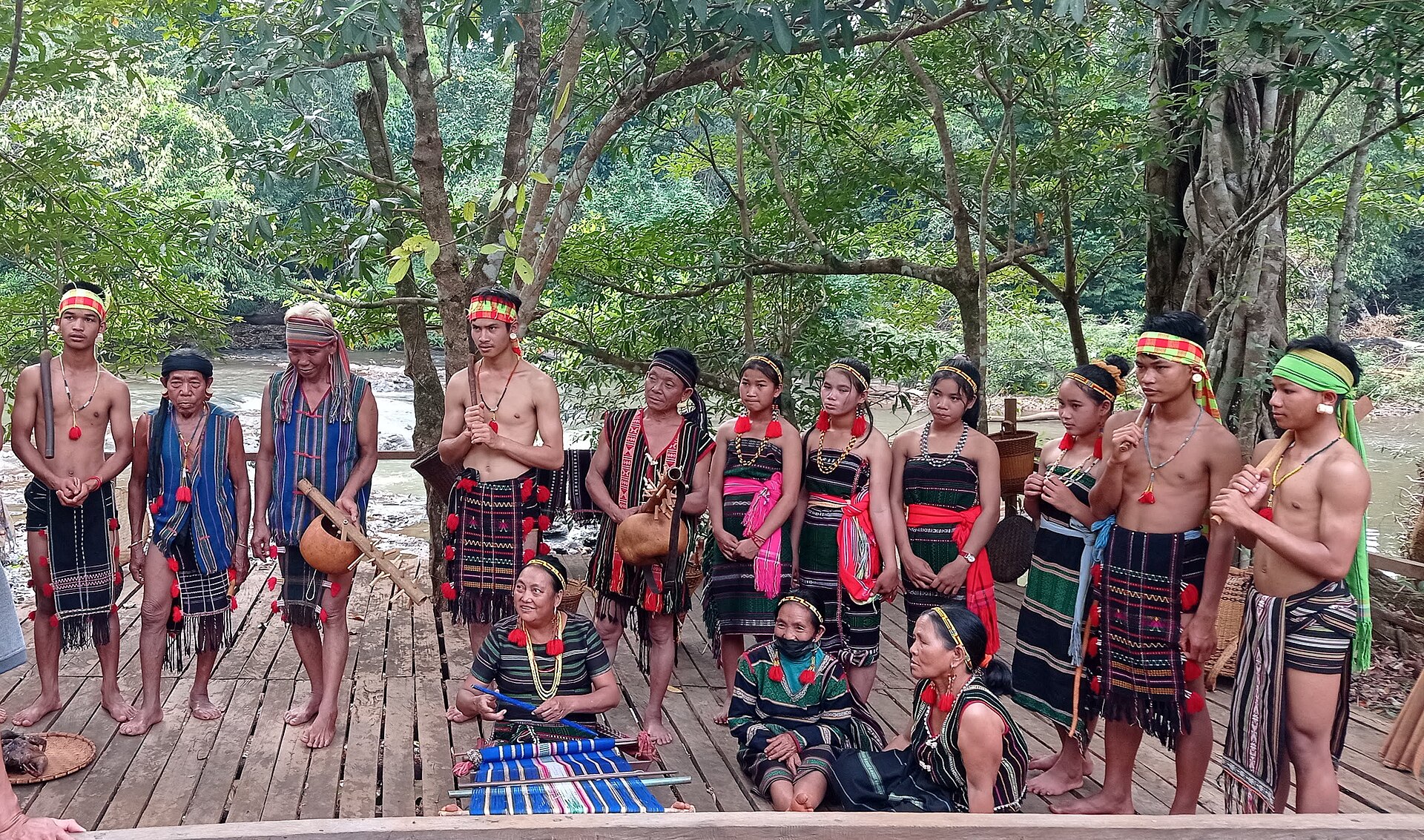

The country, and the line drawn through it
Start with the fact that governs everything else on this page: the Mnong live in two countries, and it is the same country.
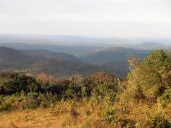
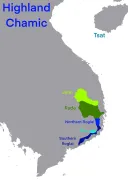
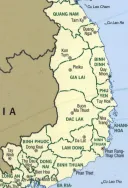
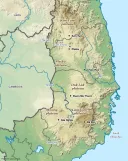
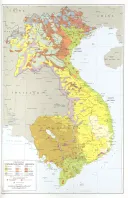
On the Vietnamese side, Dak Nong province — carved out of the southern half of Dak Lak in 2004 — and the districts around Lak Lake. The plateau is the M’nong Plateau in the French sources; the tri-border upland where the revolt of 1912 began was the Plateau des Herbes. The rivers are the Srepok and the Krong No.
On the Cambodian side, Mondulkiri: Khmer for “circular mountains,” the country’s largest province by area at 14,288 square kilometers and its emptiest. Four districts and one municipality; about 90,000 people all told at the 2019 count. The Srepok runs on into it, carrying Mnong water across the border, and eventually into the reservoir behind the Lower Sesan 2 dam. The largest waterfall is Bou Sra, forty-three kilometers from Senmonorom, and Bu Sra commune is both where the Bunong Indigenous People Association was formed and where the Socfin rubber concession sits. Those two facts in one commune are most of the story told further down this page.
Villages to hold on to: Bon Bu Nor, N’Trang Lơng’s village, where Henri Maitre was killed in 1914. Nam Nung, the base of the resistance, attacked from three directions in May 1935. Ndut Lieng Krak, where the stones were found. Sar Luk, on the Krong No. And across the line: Pu Teut, Pu Raing, Pu Char, Pu Luk in Bousra; Laoka in Sokdom, whose Bunong name is Ngavka, “pond full of fish”; Pau Trom, with three spirit forests around it; Dak Dam in Ou Reang, where the round houses still stand; and Koh Nhek, where the Khmer Rouge marched people to.
The name we answer to
There are four names in play and the people have taken a position on them.
Mnong is the Vietnamese and the French and the American form. Hickey uses it; Condominas uses it; the Vietnamese classification uses it.
Phnong is the Khmer exonym, and it is the Khmer word used generically for a hill savage.
Bunong is what the people in Cambodia call themselves, and increasingly what the people on both sides call themselves. Neal Keating, who worked with Bunong people in Cambodia, in Vietnam and in the United States, reports the position plainly: his Bunong participants reject both “Mnong” and “Phnong” as inaccurate and prefer “Bunong.” That is a people correcting two states at once, and it is the reason this page uses Bunong wherever the material is Cambodian, and Mnong wherever it is Vietnamese, and says so rather than picking one and flattening the other.
Phii Brêe is the fourth, and the oldest. It is what the Mnong Gar call themselves, and it means people of the forest. Hickey has it at page 53 of his 1964 RAND memorandum; the Encyclopedia of World Cultures lists it among the names. It is the one name on this list that nobody outside gave us.
And then the legal names, which is where this section is going. Cambodia’s Land Law calls the Bunong chun cheat daoem pheak tech — literally people, original, minority. Vietnam calls the Mnong dân tộc thiểu số — ethnic minority. One phrase has the word original in it and the other does not, and that one word is the difference between a community that can hold land collectively and a community that cannot. The same people, sixty kilometers apart.
Cambodia also folded the highland peoples into the phrase Khmer Loeu, upland Khmer, after 1953 — the Cambodian analogue of the Vietnamese framing. The Bunong have since moved out from under it and into the language of indigeneity, which is a thing a people can do with a name.
The language, and the two scripts
Mnong is South Bahnaric, closest to Koho and Stieng. The Cil are claimed by both the Mnong and the Koho literature, which tells you how graded the boundary is.
Three ISO codes cover the Vietnamese varieties — Central (cmo), Eastern (mng), Southern (mnn) — and Kraol (rka) in Cambodia is sometimes counted a fourth. Central Mnong is the code the Cambodian dictionary and the Cambodian Scripture use, so a single code spans both states.
The subgroup lists are worth putting side by side because no two of them match. Hickey’s list is twelve names long: Mnong Gar, Cil, Rlam, Prong, Kuen, Dlie Rue, Preh, Bunor, Kpreng, Budong, Biet, Nong. English-language reference works split them Western and Eastern. The Bunong dictionary made in Mondulkiri says something different again and more useful, because it is local: “There are five dialects of the Bunong language used in different areas of Mondulkiri province: Bunor, Biat, Preh, Ra’ong, and Stieng. Bunor is the main dialect.” The honest formulation is that these are names people in particular valleys use for themselves, that outsiders have tried four times to systematize them and produced four different systems, and that speakers of some of them do not understand the others.
Two scripts, one language
In Vietnam, Mnong is written in Latin letters on the Vietnamese model.
In Cambodia, it is written in Khmer script — and unusually for anything in this library, we can give the instrument and the date. The Bunong dictionary’s own front matter states it: “According to MOEYS Instruction #2696 dated 25 August 2003, the Ministry of Education, Youth and Sport (MOEYS) approves the use of the Khmer script for writing and recording the Bunong indigenous minority language.”
August 25, 2003. One people, one language, two alphabets, because of where a colonial border fell. A Bunong child in Mondulkiri and a Mnong child in Dak Nong can speak to each other and cannot read each other’s books. See Writing our languages.
What exists in print. A Bunong glossary in 2005, expanded in 2012 to a dictionary of 3,842 headwords and 1,665 minor entries, continued since 2019 by SIL with the Bunong community. A New Testament in Central Mnong, 2016, in two editions — one in Latin script and one in Khmer — plus an audio set titled Nau Brah Ndu Ngơi, the speech of God.
The only Bunong person named as a contributor on the dictionary’s own credits page is Tim Songvat, who proofread the Khmer side. We name him here because a dictionary of a people’s language with one of that people on the masthead is the pattern this whole batch of articles keeps finding, and the answer is not to stop using the dictionary. It is to say who made it.
The stones
In 1949 a set of shaped stone bars was found near the Mnong Gar village of Ndut Lieng Krak; Condominas recorded them being played in 1953, and the recording is in the CNRS sound archive under collection CNRSMH_I_1953_004. The world calls the instrument a lithophone.
The archive also gives its Mnong Gar name, which is gôec. Use that one.
A count of eleven slabs circulates. We could not source it and do not print it.
How the family works — and what we do not know
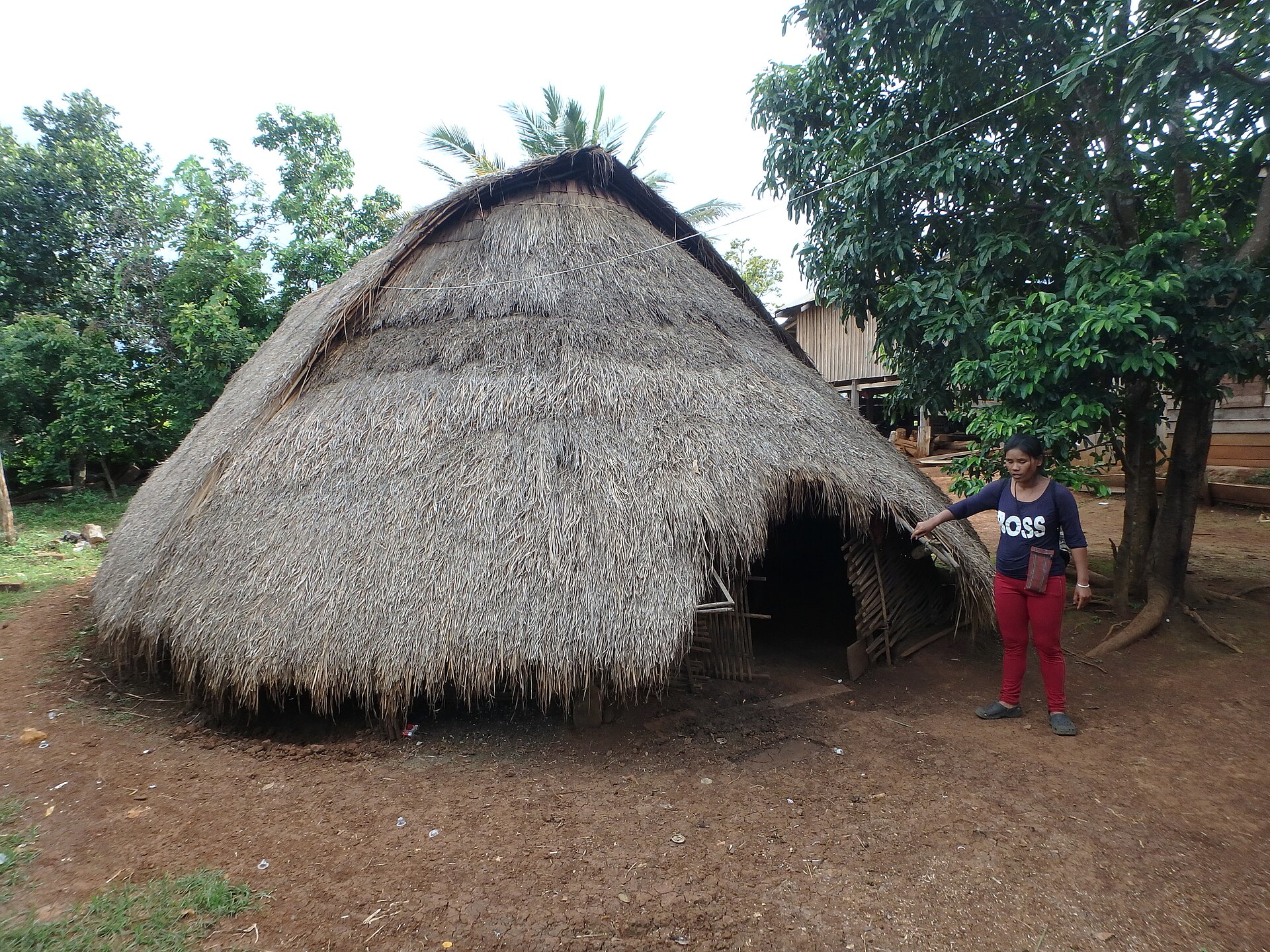

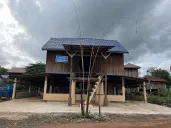
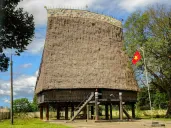
Three houses. The Mnong build three different ones, and the contrast is the clearest thing in this section. The Mnong Gar of the Krong No build long houses on the ground. The Mnong Rlam at Lak build longhouses on piles, in villages that, in Hickey’s words, resemble Rhade villages — a row of longhouses facing a central path. And the Bunong of Mondulkiri build a round house with a thatched roof that comes down almost to the ground, no windows, one door, one communal room around a central fire.
Inside the round house, the vocabulary: njoh baa, the rice spirit, who guards the rice cellar at the center; kuat njoh, the main altar; brah jaang, the local spirits it is for; lu-nak, the fireplace, also consecrated; sra peang, the wine drunk from the old jars. When a Bunong household becomes Christian, the spirit fittings come out and Catholic images and a priest’s blessing go in — and the house stays the same shape.
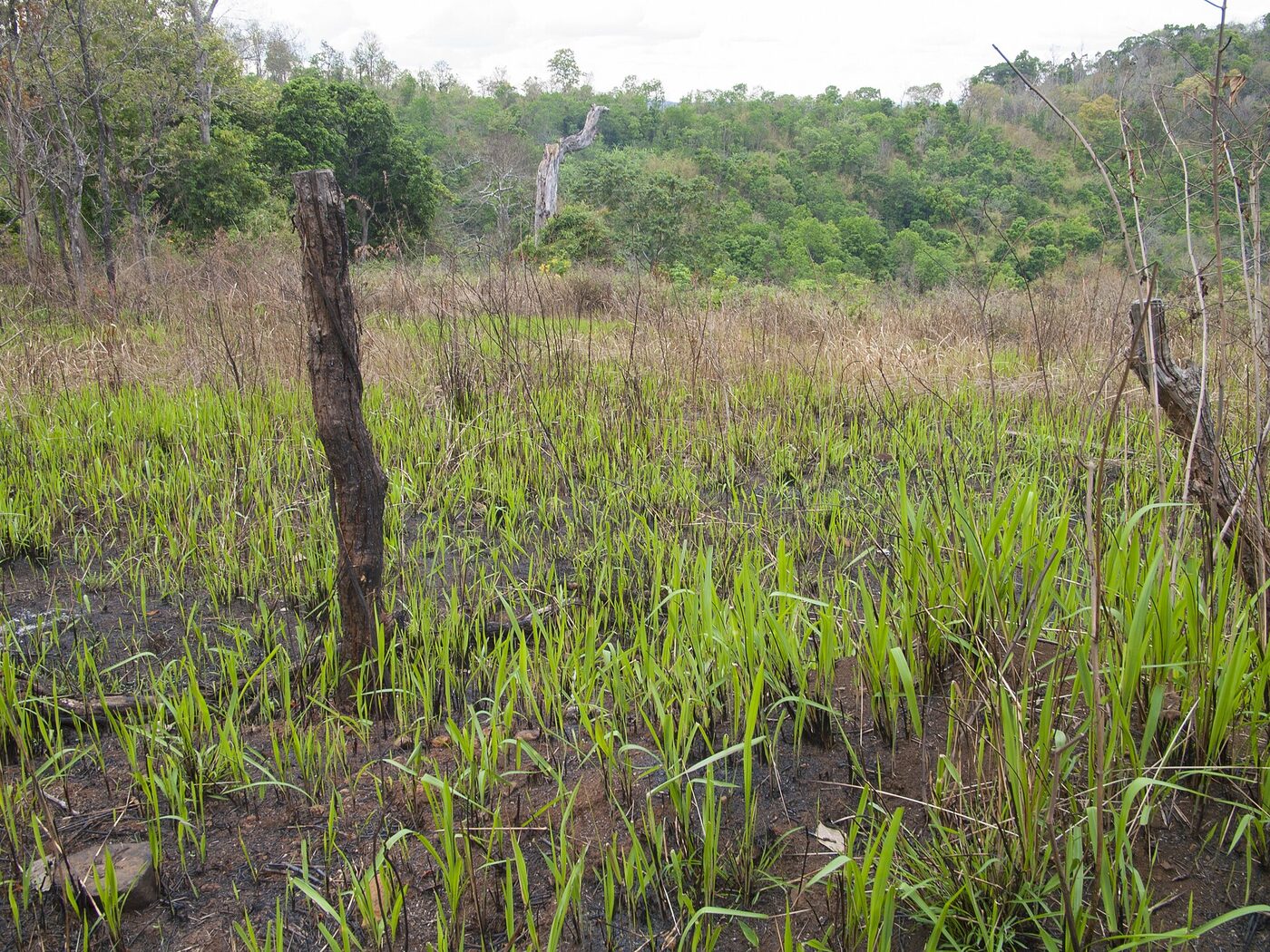
The field. On the Vietnamese side miir; on the Cambodian side meel, and we have that word in a Bunong man’s own mouth. Chok Marel, grandson of the elephant catcher Moe Chan, of Pau Trom:
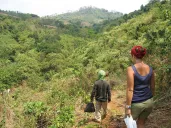
“We call our fields meel. Like my father and my grandfather before me, I grow sweet potatoes, mango, banana, pineapple, cassava, eggplant, chili, jackfruit and rattan.”
Ten crops. That is what a swidden actually is, and it is the reason the word “slash-and-burn” is useless.

Standing. Hickey, page 55: wealth distinctions are important and are based on the number of buffaloes a man sacrifices; the village is the most important political unit; a group of elders, described as the sacred men in the forest and the village, distributed the cultivable plots and supervised land ownership. The same page records, without softening, that slavery and intervillage warfare occurred among the Mnong, the latter usually over unpaid debts or accusations of witchcraft. That is our own record and we print it. See The slave raids.
The honest paragraph about descent
It is usually written down as: matrilineal, according to Hickey, with practice varying between subgroups. That sentence is doing more work than it can carry, so here instead is the whole of what the reachable record contains. Hickey groups the Mnong with the Rhade and the Jarai as matrilineal, and gives almost no detail compared with what he gives for those two. Every English summary of Mnong kinship written since traces back to one source: Georges Condominas, “The Mnong Gar of Central Vietnam,” a chapter in a 1960 volume edited by G. P. Murdock. It is nine pages long. We could not obtain it.
So: the Mnong Rlam at Lak live in Rhade-style longhouses next door to the Rhade and look matrilineal from the outside. Whether that holds for the Mnong Gar of the Krong No, or for the Bunong of Mondulkiri, rests on nine pages published in New York in 1960 that we have not read.
And we could not obtain a single list of Mnong or Bunong clan names from any source we are willing to cite. For the Rhade we can print fourteen, twenty and twenty-nine and argue about which count is right. For the Mnong we have none. The clans are still used in marriage arrangements in the North Carolina diaspora. An elder in Greensboro or Charlotte could fix this page in an afternoon. See How to record an elder.
The year you ate
The Mnong Gar name a year after the patch of forest they cleared and burned in it. Hii saa brii — we have eaten the forest of — and then the name of the place.
The year Condominas lived through at Sar Luk, from late November 1948 to early December 1949, was hii saa brii mau-yaang Gôo: we have eaten the forest of the Stone-Spirit Gôo. He put the Mnong Gar phrase on the title page of his book, in Mnong Gar, in Paris, in 1957.
Think about what that naming system is. A calendar in which every year is named after a place you fed on and cannot feed on again for a decade. Time measured in forest. It is not possible to hold that calendar and a land title deed in the same hand, and most of the twentieth century on this page is what happened when somebody tried.
For the cycle itself see The rice year and Jars and the buffalo feast.
Ot ndrong
The Mnong epic cycle is the ot ndrong, also written Ót N’drông. It is sung-told rather than recited: singing, narration, dialogue and gesture together. Before he starts, the artist summarizes what is coming and explains the hard passages; then he takes a drink of rice wine, clears his throat, and raises his voice.
The performers are not professionals. They are ordinary laborers who are expected to carry tens of thousands of verses in their heads and to perform across several nights.
And it is regulated, which is the part usually left out. A man singing at his own house must kill a chicken and prepare rice wine as an offering. Performance was forbidden for three years after a death in the singer’s family, and forbidden outright if anyone in the village had died. Beyond entertainment, ot ndrong was used for divination, for diagnosing illness, at funerals, and in offerings to the spirits. It is liturgy that happens to be literature.
Three fragments, which reach us through Vietnamese and should be read as translations of translations:
The hunting speech-taboo — Do not speak the name of wild cattle, only call it the red one; do not speak the name of wild buffalo, only call it the horned one.
The farming year — Month one we burn old fields, month two we clear new fields… month nine, October, we harvest rice home.
The birth taboo — Goats give birth, three nights ends taboo; pigs give birth, four nights ends taboo; humans give birth, four nights ends taboo.
The first is a hunting rule inside a poem: on the hunt you do not say the animal’s name. The second is a calendar in verse. The third is law.
Điểu Kâu
And here is the name that should be better known than any scholar’s on this page.
Điểu Kâu was a Mnong man who transcribed the ot ndrong. When a non-Vietnamese account of the epic salvage project found him he was seventy, and was described as the only living person able to transcribe the ot ndrong from recorded cassette tape into Mnong and Vietnamese script. His own measure of the job:
“A short Mnong epic can be transcribed in 1,000 pages, while longer ones may take tens of thousands of pages.”
A Mnong man writing his own people’s epic down in his own language, a thousand pages for a short one. Every foreign scholar on this page is a secondary source next to that.
The bards recorded by name are Điểu Mpiơih, Điểu Klưt, Điểu Klung and Điểu Kuk of Quảng Trực. Most are elderly and, in the account’s own words, barely have the strength to perform.
What we cannot tell you is how many ot ndrong there are, how many lines they run to, or how much has been published. Claims circulate that this is the longest epic tradition recorded anywhere. Every reachable statement of the totals is in Vietnamese state media, which this library does not cite, and the one scholarly version we have is a Vietnamese scholar’s assessment rather than an independent one. So we print no total.
We also could not find a single ot ndrong translated into any Western language. If that is right, then one of the longest oral epic traditions in the world has never left Vietnamese, and the only person who could put it into Mnong script was one man with a cassette player. See Gongs and epics.
The elephants

The trade is at The elephants of Ban Don. Two things belong here.
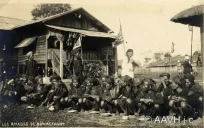
First, an honest complication. Y Thu Knul (1828–1938), the greatest of the catchers, is claimed as Mnong; a 1933 French photograph captions him as a chief of the Rhade; and he worked out of Buon Don, whose hunters were Mnong, Lao, Jarai and Rhade together. All three can be true at once. Buon Don was a multi-ethnic trading settlement on a river road, not one people’s village, and a page that claimed him flatly for the Mnong would be doing to him what the caption did.
Second, what is Mnong without qualification: the mahout families around Lak, who are Mnong Rlam, and the mahouts of Mondulkiri, who are Bunong.
The Bunong elders remember the catching. Moe Chan, about eighty, of Pau Trom: “I captured four wild elephants when I was a young man. As a farmer I have followed the Bunong way all my life.” And, on the road east: “When I was young, we used to ride all the way to Vietnam to buy musical instruments.” Read that second sentence again — it is a Bunong man describing the border as a shopping trip.
Pluk Mal, sixty-three, of Laoka: “The forest has already changed a great deal since I was a little boy… The last time I saw a wild elephant was in 1994.”
Before the Khmer Rouge most Bunong villages kept several elephants. During the genocide they were stolen, killed, sold or otherwise lost. Catching wild elephants became illegal in the 1990s. About a hundred domestic elephants were left in Mondulkiri when the elders above were interviewed. Eating elephant meat is taboo.
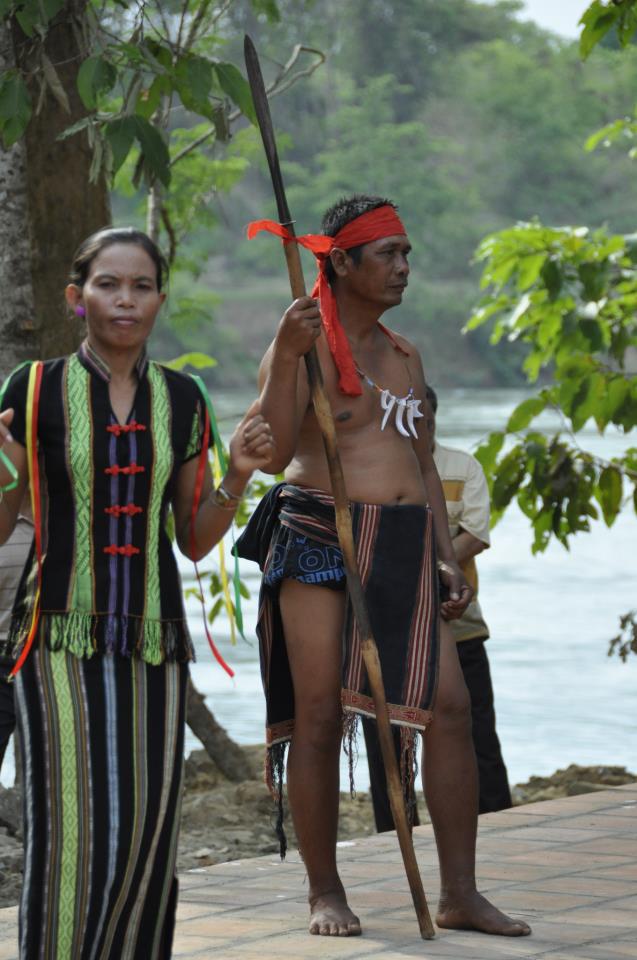
On the Vietnamese side the blessing survives: held in the first lunar month, the elephant washed in the river, dressed in Mnong cloth and bracelets, anointed with raw egg for long life, pork for abundance, pig’s blood for strength and well water for calm, rice scattered across its back, and then the family and the elephant share the jar wine and eat together. One elephant photographed at such a blessing in Dak Lak is named Y Kham Sel, and her owner is Y Vinh. The elephant’s name carries the Y- prefix that Dak Lak gives to men. That is not a nickname. That is a kinship term.
The spirits, and then the churches
The Mnong have spirits and rituals for everything in nature — animals, inanimate things, heroes, ancestors. Two specialists, both named in Mnong: the njau, the shaman, who functions as a medicine man; and the caak, the sorcerer, believed able to cause illness. Hickey records a vendetta among the Mnong Gar in 1949 arising from a sorcerer accused of bewitching families — the same year and the same people as Condominas’s book, so the two records touch at the edge.
In Mondulkiri the spirits are the brah jaang at the kuat njoh altar and njoh baa in the rice cellar. And the Bunong bury their dead rather than burning them, which has a consequence that Yun Lorang, a Bunong man and secretariat coordinator of the Cambodia Indigenous Peoples Alliance, put exactly:
“When family members of the Bunong pass away, we do not cremate them but instead bury them in the burial ground. This allows trees to grow, which are considered the homes of the deceased.”
A burial ground that becomes a forest, and the forest is where the dead live. Which is why a Bunong spirit forest is not a conservation area with a story attached, and why Chok Marel said this at the edge of one of the three around Pau Trom:
“This is where the Spirit Forest begins. There are no trails in. We never enter here and we never take anything.”
Now put that beside a rubber concession map. See Yang, the spirits.
The churches. In Mondulkiri most Bunong keep the old religion, with Protestant, Catholic and Buddhist minorities; a number converted during the war years of the early 1970s. On the Vietnamese side the Mnong are inside the general highland Protestant story — see The evangelical church and registration — and the best account of why people came is the Mnong man’s own, below.
Sar Luk, and what a book can do
This is the section this page exists for.
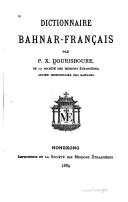
The book. Georges Condominas, Nous avons mangé la forêt de la Pierre-Génie Gôo (Hii saa brii mau-yaang Gôo): Chronique de Sar Luk, village mnong gar, Paris, Mercure de France, 1957. In English, translated by Adrienne Foulke: We Have Eaten the Forest, Hill and Wang, 1977.
The man. A Frenchman born in Haiphong, twenty-seven years old, working in a French colony during the First Indochina War, on a mission that had begun as a colonial study of culture contact. He became, over the decades that followed, one of colonialism’s sharper critics. Both halves are true and the first comes first. Lévi-Strauss called him the Proust of ethnology.
The method. Live in one village for at least a year so as to follow one farming cycle entire. He did, from late November 1948 to early December 1949, and wrote it as a diary. (The dates are worth getting right: 1948–49 is what the catalogs, the chronicle itself and his biographers all support, and the commonly printed 1948–1950 is not supported by anything.)
The people in it, under their own names. Baap Can, the spiritual leader and buffalo sacrificer. Truu, storyteller, canton chief and Baap Can’s rival. Aang-of-the-Drooping-Eyelid. Krông-the-Stutterer, a bachelor of exceptional skill in spite of his speech. And Srae, whose marriage the book describes.
Then, in order
1957. The book is published in Paris and becomes famous.
1958, and again 1962. Condominas returns to Vietnam and to his research site. He finds Mnong life destroyed and the villages replaced by American-designed strategic hamlets. Out of what he saw on those two visits he took up the word ethnocide and gave it the meaning anthropologists still use. See Strategic hamlets and relocation.
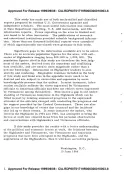
1962. The Joint Publications Research Service, a translation arm of the United States Department of Commerce, issues an English translation of the whole book. Condominas did not authorize it and was not told. Every page is stamped Government Use Only. It is distributed to the Special Forces.
Some time in the 1960s. Condominas sees evidence that Srae — whose wedding he had described by name — was tortured by a sergeant of the Special Forces in the camp of Phii Ko’.
Some years after that. He learns about the pirated translation.
1972. Invited to give the American Anthropological Association’s Distinguished Lecture, he notes the irony of being honored in a country where almost nothing of his has been translated — the one exception being the edition in the hands of the men he calls the technicians of death, of their death. And then:
“But you will understand my outrage when you know that I had learned the news of this ‘piracy’ some years after having seen the evidence that Srae, whose marriage I describe in Nous avons mangé la forêt, was tortured by a sergeant of the Special Forces in the camp of Phii Ko’.”
Note the order of his sentence, because it is the whole point. He learned about the theft of his book after he learned what had been done to Srae. The injury to the man came first; the injury to the author came second; and he says so in that order.
Why this is on a Dega site
A Frenchman came to a Mnong village, learned the language, ate what the people fed him, wrote their names down and published it as literature. Fifteen years later an American government printed it without asking, stamped it Government Use Only, and put it in the hands of the men who tortured one of the people in it.
That is what can happen to knowledge about us once it is written down. It is the reason this library names what every outsider who wrote about us was and what they wanted, and it is the reason we are careful about what we publish here. Condominas did nothing wrong and it happened anyway.
What became of Sar Luk. We could not establish a single event — no date, no bombing, no massacre — and we will not invent one. What the sources support: Sar Luk as Condominas knew it did not survive the war; its people were moved into strategic hamlets and military camps; and over the years the survivors regathered and made a new village. Mnong Gar families on the Krong No know which village that is. We do not. See Books about the Dega.
What has happened to us
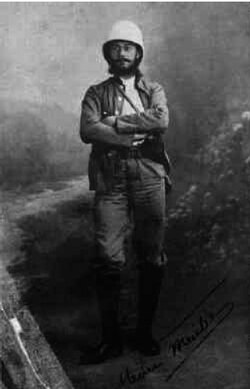
1911–1935. Henri Maitre presented Les Jungles Moï in Paris in 1911, took a prize for it, and published it in 1912; from 1910 he ran an outpost in the Kratié jungle. He was killed at Bon Bu Nor on July 30 or August 2, 1914, aged thirty-one. His grave was lost and found again in 2012.
N’Trang Lơng was born about 1870 at Bu Par, was wealthy from corn, rice and livestock and known for sharing with poorer villages, and unified some fifty villages across the tri-border country. He held the French off for twenty-three years. The French attacked Nam Nung from three directions in May 1935, killing his wife, wounding his brother and capturing three of his children; he was killed on the night of May 22, 1935, aged sixty-four or sixty-five. See N’Trang Lơng.
1970–1975, the Cambodian side. Here is a thing almost no history of the period says. Bunong men left Mondulkiri for Phnom Penh and enlisted in the Khmer Republic’s army — the weak pro-American one. The scholarship that recovered this describes them as “neither visceral rebels, nor unconditional allies… complex actors, whose engagements constitute a much-needed disturbance of dominant (historical) records.” The standard account mentions Cambodian highlanders mainly as Pol Pot’s bodyguards. Some of them were in the other army. See Highlanders on the other side.
The Khmer Rouge in Mondulkiri. About half the province’s people died in the relocations. One Bunong woman, interviewed under a pseudonym, was two or three years old: she was hiding with other children at the farms when a bomb fell and the soil it threw up buried her baby brother. Her family fled into Vietnam, moving at night and hiding behind trees by day. They came back after a year, found the Khmer Rouge still there, were made to join, were moved and then marched five days to Koh Ngek, where she worked in a daycare for seven or eight years. She was told the plan was to kill everyone in the camp except ten males and ten females of each race. When the Vietnamese came she walked home with what fitted in a basket and one buffalo, and was attacked on the road by Khmer Rouge who were people she knew.
Her father had been made to haul goods for the Khmer Rouge by elephant. Agitated buffalo panicked the elephant; it turned on him; he died of the injuries days later. The elephant and the father, in one story.
After 1975, the Vietnamese side. See 1975, Land taken for coffee — and note that Dak Nong is the bauxite province. Two Bunong men from Dak Nong are on the international list of Montagnard prisoners of conscience: Dieu Bre and Dieu By O, both arrested in 2013, both sentenced to four and a half years under the old Article 87, for conducting propaganda and holding meetings to pray for an independent Dega state. See Prisoners: Dak Nong.
The land in Mondulkiri, now
Cambodia’s 2001 Land Law lets an indigenous community register a collective title. Getting one is another matter, and the two cases below are why.
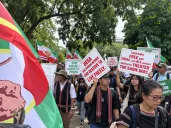
Bousra, and Socfin. In 2008 Socfin — registered in Luxembourg, with the French group Bolloré holding close to forty percent — was granted 12,000 hectares without the communities’ knowledge or consent. The grant covered farmland, sacred forests, cemeteries and grazing land. Negotiations from 2014; in 2015 eighty plaintiffs filed in the French courts; Bunong representatives attended a hearing at Nanterre in 2019; in 2021 the French court dismissed the suit and ordered the villagers to pay twenty thousand euros. A mediation concluded in September 2021. Four of the seven villages in the agreement are Pu Teut, Pu Raing, Pu Char and Pu Luk.
Three Bunong people on what that was:
Trang Seun: “Before Socfin came, we were living harmoniously in the highlands, where the forest and the land provided all that was needed. The company’s presence has destroyed our forest and our culture, making it impossible for us to practice farming and fishing anymore.”
Kreung Tola: “We’re not interested in acquiring distant plots. The company can use their power, but we will never be afraid. They displaced us from our rightful land and want us to work for their profits, causing us immense suffering. Our demand is simple: give us our land back.”
Klang Po: “Without a motorbike, it is hard to get to your farm, resulting in additional expenses.”
The third quotation is there on purpose. A compensation plot that is far away is not a plot.
Laoka. 728 hectares granted to a development company in 2011; the community registered a protected forest in 2014; court cases from 2015; in 2021 Ploek Phyrom and two others were sentenced to two years for allegedly dismantling the company’s fence; in 2022 the company filed a deforestation complaint against the villagers. More than a hundred families are affected.
The dam. Kbal Romeas, downstream in Stung Treng, was a Bunong village. It is under the Lower Sesan 2 reservoir; fifty-two families refused the resettlement package and stayed. See Lower Sesan 2.
Our own voices
A Mnong man from Dak Lak, interviewed in Mondulkiri in July 2001 — a man who had crossed the border to say it. This is the plateau’s whole century in one breath:
“Since God gave birth to the world, we ethnic minorities have always been in the same place. Since antiquity, our ancestors have always told us that this is our land. The Vietnamese never lived here. What we learned from our grandparents is that Vietnam started invading our land in 1930…
In 1965 when they let Y Bham out of jail the ethnic minorities started the FULRO movement. It was based here in Mondolkiri, right near the spot where we are sitting today. I was twelve years old and carried a gun that was as long as me. Everyone, young and old, joined the struggle…
Beginning in 1980 they started turning all the land over to the Vietnamese. Each day more and more Vietnamese arrived, by the truckload…
In 1988 the ethnic minorities started to become Christians. We’d been Christians for a long time before that but it was in 1988 when all the ethnic minorities believed; everywhere. Jesus changed our idea. If we didn’t have Christianity and the holy spirit within us, we would use violence to oppose the Vietnamese and we would all be dead.”
He was twelve in 1965 and the gun was as long as he was. See The men of FULRO.
The kite
Mpreo Bubong, a Bunong man, repeating in 2015 what his elders had predicted long before:
“Jun hao lă, jă hao lêng, klêng tăch rse” — the deer will invade everywhere, stepping in without permission, and the kite will break its string.
Klêng tăch rse, the kite with the broken string, is the Bunong figure for families broken up, brothers and sisters separated, people made refugees. And it is also, in the reading of the scholar who recorded it, a figure for hope — because a kite is what people on the ground send up into the sky.
An elder saw it coming and said it in one line, and the line is about being scattered and about hoping, at the same time, and in the same image.
The names of places
Ploek Phyrom, the Bunong coordinator at Laoka — whose own Bunong name is Mo Ar Rongom, and whose village’s Bunong name is Ngavka, pond full of fish:
“The worst thing is that our names are not used.”
“Now nobody calls it that, even the children, they don’t know it.”
“At first we didn’t know how to register a land title, but we just wanted to live as we had before… Now we see it’s the first step if we want to find our identity.”
“We keep pushing the government to take care of us, and that’s normal. Now, we think that they are playing around with us, but what they are playing around with is dangerous for us.”
“The worst thing is that our names are not used.” Not the hectares. The names.
Neat Lat, thirty, a community forest volunteer at Laoka: “We bring our own food to the court because we have no money to buy meals, and we have no money to stay in guesthouses. And the court always says we’re guilty.”
Ploek Navy, forty-one, Phyrom’s sister: “I feel unhappy that the officials say we’re using violence… actually we’re volunteer forest defenders.” And: “Our identity and livelihood are connected to the land. Our beliefs are anchored in the spirit of the forests.”
Ruem Krak, a senior villager at Pou Loung: “We must continue to fight; we must protect what remains. Even if I pass away, my children will carry on the fight.”
Mane Yun
In the mid-2000s a journalist met a twenty-five-year-old Bunong law student in Phnom Penh and asked her what Khmers said about her people. She answered:
“Some Khmers believe that Bunong have tails or kill themselves falling out of trees when they are old.”
Twenty years on, Mane Yun is executive director of the Cambodia Indigenous Peoples Organization, has worked with a UN agency in Cambodia, and supports communities in Mondulkiri and Stung Treng on sacred mountains and collective land titles. Her working sentence now:
“We depend on biodiversity, and biodiversity is connected to our society, our culture, and our economy.”
And, on what the job is: “we must tell Cambodians about who we are.”
A Bunong woman who was the subject of the joke and now runs the national indigenous organization.
BIPA
The Bunong Indigenous People Association was formed in 2009 by villagers of Bu Sra commune and registered with Cambodia’s Ministry of Interior in February 2016. It runs four programs: agriculture, education — including a student dormitory in Phnom Penh since 2011 — forest protection, and land conflict. In its own words:
“Bunong Indigenous People have been farmers, gatherers and hunters. We have a strong connection with our traditions and ancestral lands. We honor and respect our forests.”
Its executive director, Neth Prak, at an international land forum in 2016:
“We are against a development that is only serving companies, not serving the people. But it is not only a problem of the natives, it is a problem for the whole of humanity.”
A Bunong organization, run by Bunong people, publishing in its own name, about its own land. It is the first thing anyone reading this page should read next.
How many
| Figure | Year | Where | Who is counting |
|---|---|---|---|
| 16,496 | 1949 | South Vietnam | French investigators, cited by Hickey |
| 15,876 | 1960 | South Vietnam | Saigon, cited by Hickey |
| 40,000 | 1959 | — | a North Vietnamese source, cited by Hickey |
| 67,340 | 1985 | Vietnam | census, via the Encyclopedia of World Cultures |
| 89,000 | c. 2002 | Vietnam | Human Rights Watch |
| 102,741 | 2009 | Vietnam | 2009 census |
| 127,334 | 2019 | Vietnam | 2019 census, taken here from the UK Home Office country note of December 2024 |
| ~37,500 | 2008 | Cambodia | Cambodian census |
| 36,585 | 2019 | Cambodia | Ministry of Planning with the Cambodia Indigenous Peoples Alliance |
| ~75,000 | c. 2016 | worldwide | Keating |
| ~5,000 | c. 2016 | diaspora, mostly the US | Keating |
Two things those rows say out loud. First: the French and Saigon figures for around 1950 and 1960 are about sixteen thousand, and the Hanoi figure for 1959 is forty thousand. Two and a half times, for the same people, in the same decade. Nobody was counting us. Everybody was estimating us.
Second: the Bunong of Cambodia went down between 2008 and 2019, by about two and a half percent, while Vietnam’s count of the Mnong went up by a quarter. And the count that says so was produced with a Bunong-linked indigenous alliance, not by a state alone. The Bunong are the largest of Cambodia’s twenty-one recognized indigenous groups and there are fewer of them than there were.
One figure to reject: a French amateur site states that the Mnong fell from about 1.2 million early in the twentieth century to 120,000 by 1999. Nothing supports a figure anywhere near 1.2 million. Do not repeat it. National totals are argued at How many Dega there are.
What we do not have
Condominas’s prose. All three scans of We Have Eaten the Forest are lending-restricted. We have the book’s structure, its people’s names, its title phrase and its dates, and not one verbatim line of it. A library copy would fix that.
The nine pages on kinship — Condominas 1960 — which everything written since about Mnong descent rests on.
The clan names. Not one, from any source we would cite. The diaspora still uses them for marriages.
Mnong customary law as a text. The Rhade have a printed code. For the Mnong there is a French colonial administrator’s volume on social and customary life, which we could not reach, and a Vietnamese collection. We do not even have the Mnong word for the institution.
Any ot ndrong in a Western language, and any independent count of how many there are.
The elephant vocabulary — the terms for the master hunter, the ropes, the rites. The only pages carrying them are ones this library does not cite. The mahout families at Lak and in Mondulkiri have them.
One named Mnong person in North Carolina. About five thousand Bunong are in the United States. Their representation has run through organizations led by people of other Dega nations. We could not name a single Mnong person in the American diaspora, and that is a gap in our own house. If you are Mnong in Greensboro or Charlotte, please write. See How to record an elder.
Terms
- hii saa brii
- “We have eaten the forest of—”. How the Mnong Gar name a year: after the patch of forest cleared and burned in it.
- Phii Brêe
- People of the forest — what the Mnong Gar call themselves.
- meel / miir
- The swidden field: ten or more crops at once, not one.
- gôec
- The Mnong Gar name of the stone bars found at Ndut Lieng Krak, which the world calls a lithophone.
- njau / caak
- The shaman, who heals; the sorcerer, who is believed to cause illness.
- ot ndrong
- The epic cycle: sung-told across several nights, used for divination, diagnosis and funerals, and forbidden while a death is recent.
- klêng tăch rse
- The kite with the broken string — families scattered, and also the hope people on the ground send into the sky.
See also: N’Trang Lơng, The elephants of Ban Don, Kin across the border, Mondulkiri, 1992, The 2002 resettlement.
Sources
- bunong.org — the Bunong Indigenous People Association. Bunong-run, publishing in its own name. Read this first
- Oscar Salemink, “Introduction: Ethnography, Anthropology and Colonial Discourse,” in Beyond Complicity and Naiveté: Contextualizing the Ethnography of Vietnam’s Central Highlanders 1850–1990 — the JPRS episode, the “Government Use Only” stamp, the “technicians of death” phrase, and the Srae passage quoted from Condominas 1980, p. 103. Open access, and the single most important document behind this page
- Georges Condominas, Nous avons mangé la forêt de la Pierre-Génie Gôo, Mercure de France, 1957; English, tr. Adrienne Foulke, Hill and Wang, 1977. A Frenchman’s year in a Mnong Gar village during a colonial war, written as literature, with the people’s real names in it
- Neal B. Keating, “Kites in the highlands: articulating Bunong Indigeneity in Cambodia, Vietnam, and abroad,” Asian Ethnicity 17:4 (2016), 566–579 — the name question, the legal categories, Mpreo Bubong’s prophecy, and the diaspora figures
- Gerald C. Hickey, The Major Ethnic Groups of the South Vietnamese Highlands, RAND RM-4041 (1964), Mnong at pp. 53–56 — written for the United States Air Force about people it was about to fight a war among
- Human Rights Watch, Repression of Montagnards (April 2002) — the Mnong man’s testimony at pp. 16–17
- GRAIN, “The Bunong people’s land struggle with Socfin” (2023); FIDH, Cambodia: Land Cleared for Rubber, Rights Bulldozed; and CamboJA News, “For Indigenous Bunong, Land Rights Are Key to their Identity” (March 30, 2024) — Bousra and Laoka, in the villagers’ own words
- Catherine Scheer, “Subaltern soldiers: Overshadowed Bunong highlanders in the Khmer Republic’s army, 1970–75,” Journal of Southeast Asian Studies 53 (2022), 123–152; and her work on Bunong Protestantism
- CREM-CNRS sound archive, “Jeu du lithophone mnong gar,” Condominas, 1953 — where the word gôec is recorded; and Musique Mnong Gar du Vietnam, Ocora OCR 80, recorded June 1958
- Webonary, the Bunong dictionary (ICC, then SIL) — the five Mondulkiri dialects and the 2003 instruction on the Khmer script
- UK Home Office, Country Policy and Information Note: Vietnam: Ethnic and religious minority groups, v4.0, December 2024 — the route by which the 2019 Vietnamese figure reaches this page
Compiled September 2026. No Vietnamese government or state media source is used as a source, which costs this page the totals for the ot ndrong and the Mnong elephant vocabulary; we say so rather than filling the gaps. The account of the ot ndrong’s performance rules comes from a Vietnamese university journal article, attributed as such and used for literary description only. Three things printed here are unsettled and marked in the text: whether Mnong descent is matrilineal, which rests on nine pages we have not read; what happened to Sar Luk, and when; and how many ot ndrong exist. Two figures in common circulation are not printed here because we could not source them: a count of eleven stone slabs at Ndut Lieng Krak, and a date of 1950 for the end of Condominas’s year at Sar Luk. Cambodian material is spelled as the Bunong sources spell it and Vietnamese-side material as its sources do, so the same word appears twice on this page in two dresses. If you can correct a word, a village or a date here, we want it.