
















Both armies agreed that whoever held the Central Highlands would decide the war, so the largest battles of the American war, and the offensives that ended it, were fought where our villages stood. The histories of those battles count sorties, tons of bombs and enemy dead to the last digit. They name the hills by their height and the villages by their map reference. Of the people who lived there they say almost nothing. This page tells the battles from the ground: whose country each one was fought in, which of our men fought in it, and what the record does and does not say happened to our people.
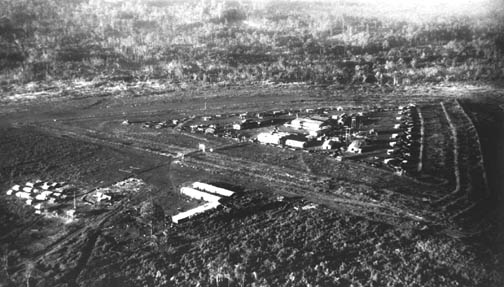

Whose hills these were
Every name on the maps of this war is one of ours. Ia is the Jarai word for water, and the Ia Drang is a Jarai river. Plei is the Jarai word for village, and Plei Me was a village before it was a camp. Dak is water again in the languages of the north, and Dak To, Dak Seang and Dak Pek are Sedang and Jeh names. Kon is the Bahnar village, as in Kon Tum. Buon is the Rhade village, as in Buon Ma Thuot.
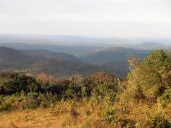
The official histories use those names as grid squares. The US Army’s history of 1965 describes the Chu Pong massif, where the first great battle between the American and North Vietnamese armies was fought, entirely in military terms: its peaks over seven hundred meters, its thirteen kilometers of base straddling the Cambodian border, the Ia Drang flowing along its northern edge. It does not say whether anyone lived on it. That silence runs through every history on this page, and we have tried to fill it where we can and to mark it plainly where we cannot.
The plateau mattered to both sides for the same reasons. It held the roads down to the coast and south to Saigon, and it lay across the trails that came in from Laos and Cambodia. For Hanoi it was the place to cut the South in half; for Saigon and Washington it was the place that had to be held. Neither calculation included the people who lived there.
Plei Me, October 1965
The US Air Force study written a few months afterward begins where the story should begin. Plei Me, it says,
“is a Jarai Montagnard village in the central highlands of Vietnam, about 25 miles southwest of Pleiku.”
Beside the village stood a Special Forces camp. How many of our men were in it depends on who is counting. The Air Force study says four CIDG companies and a twelve-man American team. The Army’s official history, John Carland’s Stemming the Tide, says “a CIDG unit of over four hundred Montagnard tribesmen.” The Associated Press, reporting from Pleiku while it happened, said three hundred. Most of them were Jarai, and their families lived in and around the camp.
The first people shot at Plei Me were ours. Carland:
“The 33d Regiment began its attack at approximately 1900, when some of its troops opened fire on a Montagnard patrol.”
That was the evening of October 19, 1965. By ten that night a North Vietnamese company had overrun the camp’s outpost to the southwest, and after midnight the assaults on the camp itself began. They went on for a week. The North Vietnamese command meant the siege as bait: to draw a relief column out of Pleiku and destroy it on the road, and then to draw the Americans in after it. The South Vietnamese relief column was ambushed on the way. The Americans came by air.
The Air Force counted what it dropped. Between October 20 and 28, in 696 strike sorties, aircraft “rained 866,300 pounds of GP bombs, 250,300 pounds of frag bombs, 485,880 pounds of napalm” around the camp. All of it fell within a few kilometers of a Jarai village and its fields. The Americans counted 326 North Vietnamese dead. The figure usually given for the camp’s own strikers is fourteen killed; we have not been able to trace it to a primary source, and nobody recorded the dead of the village.
Four years later, in August 1969, an American infantry sergeant, Mike Medley, was stationed near the camp. He wrote afterward that the Mike Force soldiers there “lived with their families” along the bunker line, and that
“The abandoned bunker line by our position was inhabited by orphans of those killed in the 1965 attack.”
He made friends with three of the boys. “I couldn’t understand their names,” he wrote, so he called them Gluck, Bludgen and Tom. Those three boys had Jarai names that nobody wrote down, and parents who died defending Plei Me. On the bracelet that the Americans at Plei Me wore, see The bracelet.
The Ia Drang, November 1965
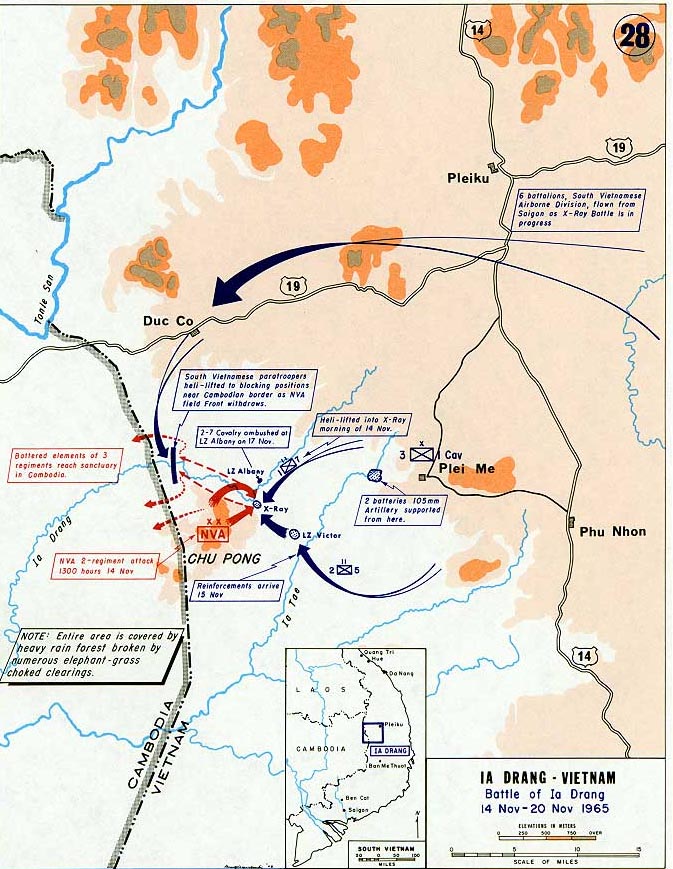

The American 1st Cavalry Division followed the North Vietnamese regiments west from Plei Me toward the Chu Pong and the Cambodian border, and in the middle of November 1965 it fought them in the valley of the Ia Drang. It was the first great battle between the two armies, and the Americans have written more about it than about almost any other battle of the war.
The division’s own report on the campaign, written in March 1966, gives one paragraph to the people who lived there. We quote it with the spellings of the original:
“Both Vietnamese and Montegnards lived in the area of operations. The majority of the Vietnamese had fled, however, leaving the area to the Montegnards and the VIET CONG. The Montegnards belonged primarily to the Djarai-Khoam Tribe. … Many C-I-D-G personnel in Special Forces camps had relatives living in hamlets throughout the area controlled by the V-C.”
Read it slowly. The Vietnamese left. The Jarai stayed, because it was their land. And the Army knew that the men it paid to fight in the camps had fathers, mothers and brothers in the hamlets it was fighting through. The same paragraph says the division attached great importance to minimizing injuries to non-combatants. It names no hamlet, and it gives no number of people hurt or killed.
Mr. Nik. On the morning of November 14, soon after the first American battalion landed in a clearing under the Chu Pong called Landing Zone X-Ray, its men caught a North Vietnamese deserter who had been living on bananas for five days. The Army’s history of the fight, Seven Firefights in Vietnam, tells what happened next:
“Notified of the catch, Colonel Moore rushed to the spot with his intelligence officer, Capt. Thomas C. Metsker, and his Montagnard interpreter, a Mr. Nik.”
The prisoner said that three North Vietnamese battalions were on the mountain, anxious to kill Americans. The first warning of the battle of the Ia Drang reached the American commander through one of our people, and the Army’s history calls him “a Mr. Nik.” We do not know his full name, which of our peoples he came from, or what became of him. If any of our veterans in North Carolina interpreted for the 1st Cavalry in 1965 and remembers him, we would like to know.
The bombs on the mountain. On November 15 American B-52 bombers struck the Chu Pong for the first time, the first use of the heavy bombers in direct support of a battle. Carland:
“By the time the B-52, or Arc Light, raids ended on the twenty-second, ninety-six sorties had dropped almost five thousand bombs on enemy positions and supply routes.”
Five thousand bombs fell on a Jarai mountain in a week. The histories count 305 Americans killed in the campaign and give an enemy count that the Army’s own historian calls open to doubt. Nobody counted the Jarai.
Afterward. The valley became a hunting ground, swept again in 1966 by American operations. In 1967 the Americans emptied it. The 4th Infantry Division’s report for that summer records:
“The 1st and 2d Brigades assisted in the resettlement program by moving 47 hamlets, with a population of 7,046 MONTAGNARDS, from areas south of THANH AN District Headquarters and west of Highway 14D.”
Thanh An is the district west of Pleiku, toward Plei Me, Duc Co and the Ia Drang. Two years after the battle, the Army moved forty-seven Jarai hamlets off the land it had fought over, to a place called Edap Enang. What happened to them there is told on Moved by force.
Lang Vei and the Bru, 1967–1968
In the far north, where the mountains come down toward the sea near the old frontier with the North, the Bru live on both sides of the border with Laos. Their villages lay along Highway 9 around Khe Sanh, and the Americans built a Special Forces camp at the Bru village of Lang Vei.
March 2, 1967. The US Marine Corps’ official history of that year records it in two sentences:
“Although the area remained quiet after this sharp encounter, an unfortunate incident occurred at Lang Vei on the evening of 2 March. Two USAF aircraft mistakenly bombed the village, killing 112 civilians, wounding 213, and destroying 140 buildings.”
Other accounts put the dead at 135, burned with napalm. Either way, American aircraft killed more than a hundred Bru in one evening, in their own village, and the history of the war calls it an unfortunate incident.
May 4, 1967. Two months later North Vietnamese troops broke into the camp at night, let in by two men who had joined its strike force as recruits. Kelly’s official history counts the camp’s losses: two Americans killed, and “seventeen civilian irregulars were killed, thirty-five wounded, and thirty-eight missing.”
February 7, 1968. During the siege of Khe Sanh, North Vietnamese tanks overran the new Lang Vei camp, the first time tanks were used against one of these camps. Its strike force included Bru companies, and a Mike Force company of Hre was posted nearby. The Army’s own special operations historian, Charles Briscoe, writing in 2019, says of the count of our dead: “CIDG records were cursory.” The figure usually repeated for the camp’s irregulars is more than three hundred killed and more than a hundred captured; nobody has named them.
The survivors, and thousands of Bru and Lao refugees, walked east to the American base at Khe Sanh. Briscoe records what happened at its gate in eight words:
“U.S. personnel were allowed to enter; all indigenous were not.”
The Marine Corps’ history of 1968 puts the crowd outside the gates at more than six thousand, and records that the base commander refused to let them in. The Bru who had fought for the Americans at Lang Vei were left outside the wire of the base they had been defending. The Bru are told on The smaller peoples.
Dak To, November 1967
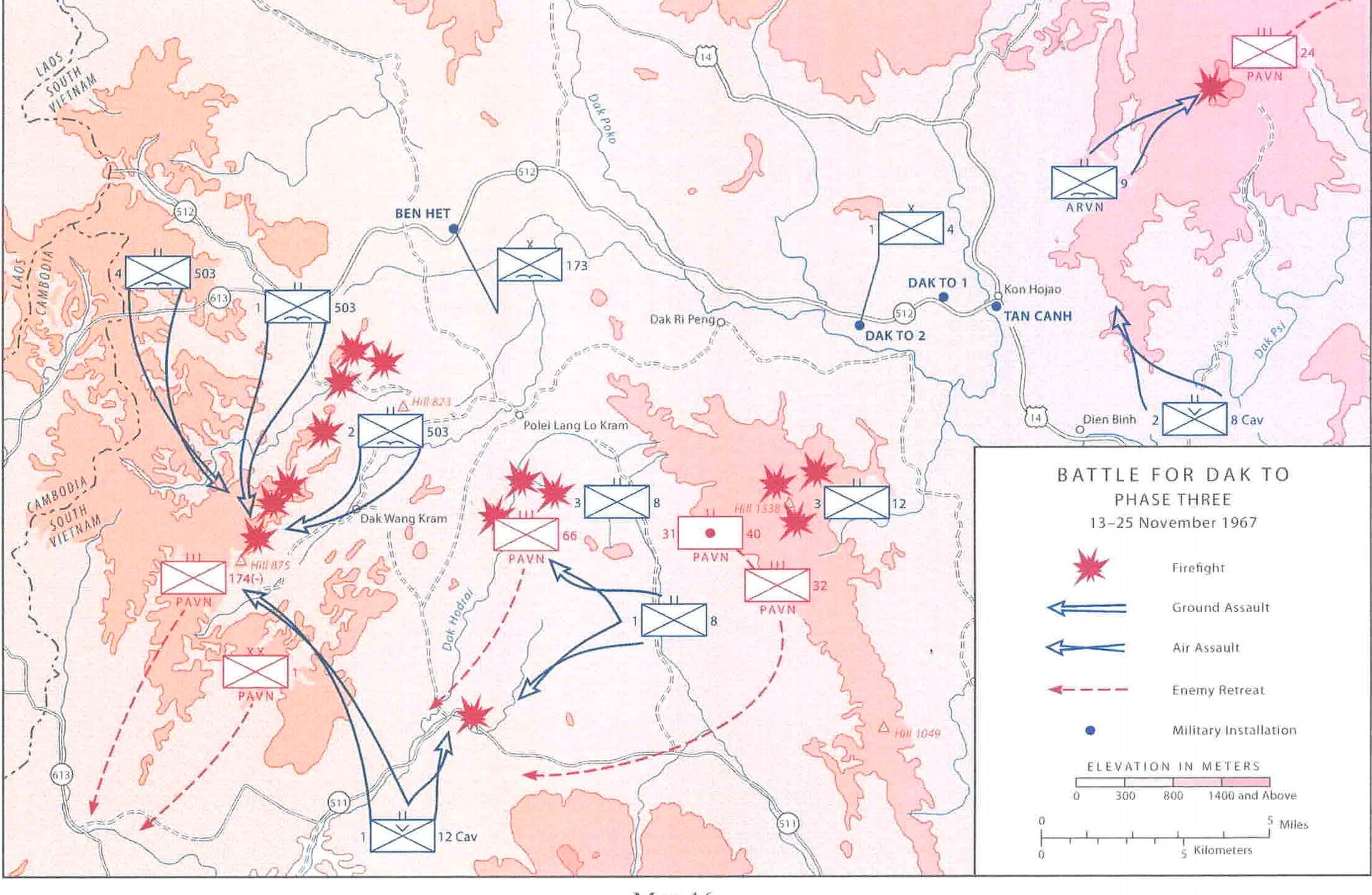

The hills around Dak To, in the north of Kon Tum province, are Sedang country, with the Halang and the Jeh to the west and north. In November 1967 the American 4th Infantry Division and 173rd Airborne Brigade fought North Vietnamese regiments there for three weeks, hill by hill, ending on Hill 875. The American dead are counted at 361, with 15 missing and 1,441 wounded. On Hill 875 alone one battalion lost 87 killed, 42 of them when an American bomb fell into their own position.
Our men were there. The Army’s Seven Firefights in Vietnam describes the American companies that climbed Hill 823 on November 6:
“Bronzed mountain men marched with the Americans: a platoon-size Civilian Irregular Defense Group force, based at the Dak To Special Forces Camp, was attached to each company.”
And then: “Master Sergeant Ky, Vietnamese Special Forces, led the thirty-man Montagnard platoon attached to Company D.” When the North Vietnamese attacked the rear of the perimeter that night, Sergeant Ky and his men drove them off. The Vietnamese sergeant has a name in the Army’s history. The thirty Montagnards do not, and their losses are not given.
The battle for Hill 875 itself began because our men found the enemy first. On November 19, in the words of the standard summary, the American brigade commander was told that “a Special Forces Mobile Strike Force company had run into heavy resistance while reconnoitering the area,” and ordered his battalion up the hill. What that company lost is not in anything we have read.
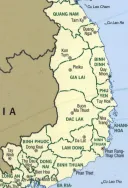
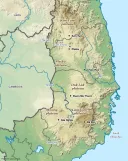
Only one village is named in the Army’s narrative of Dak To: Bak Ri, near Route 512, where a North Vietnamese sergeant walked in and surrendered on November 2. The Army’s own map, above, marks others. The histories do not say what happened to Dak Ri Peng, Polei Lang Lo Kram or Dak Wang Kram, or to the people who lived in them.
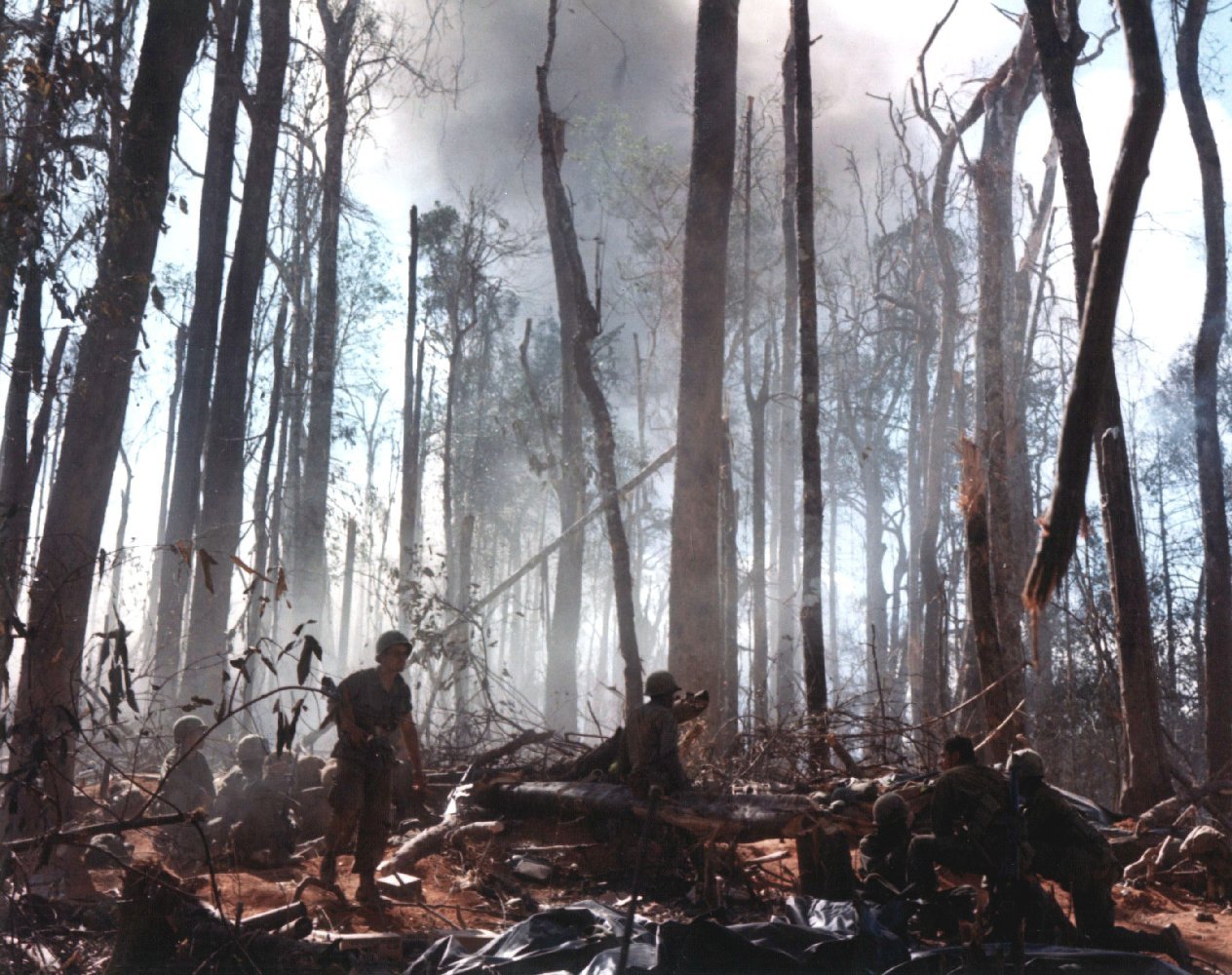

Dak Son, December 5, 1967
Two weeks after Dak To ended, a Viet Cong battalion burned the Stieng refugee settlement of Dak Son, far to the south, with flamethrowers, and killed more than two hundred and fifty people, most of them women and children. It was not a battle; nobody there could fight back. It is told, with the photographs taken the next morning, on Dak Son, December 5, 1967.
Tet 1968
At the end of January 1968 the Viet Cong and the North Vietnamese attacked the towns of the South at once, and in the highlands they came into Buon Ma Thuot, Pleiku, Kon Tum and Dalat. Our own history, written by Rong Nay, records what it cost us:
“The Vietnamese Communists used Montagnard villages as shields to cover their assault on the towns and thousands of Montagnard people were killed. In Hue City, Communist troops invaded and executed 82 Montagnard students who were living in a boarding school of the Ministry of Ethnic Minority Development.”
At the Minh Quy hospital in Kon Tum, an American wire report recalled four years later, more than thirty of the Dega staff and patients lay on top of the American doctor to hide her while the attackers ran through the wards, “tossing grenades, shooting women and children in the legs and demanding, ‘where are the Americans?’” See The missions and the doctors.
The strike forces held the towns. Kelly’s official history lists among the towns “successfully defended by the CIDG” Kon Tum, Pleiku, Buon Ma Thuot and Dalat, and says that their performance
“demonstrated conclusively that the CIDG soldier was the combat equal of any soldier in Vietnam.”
Michael Benge, the American aid officer who was captured at Buon Ma Thuot during Tet and spent five years a prisoner, wrote in 2010 that FULRO’s men were the reason the town did not fall: “FULRO fought fiercely, and largely because of them communist forces were unable to penetrate the defenses of the 23rd Division.” No other account we have read gives FULRO that credit, and we give it as his. The whole of Tet in the highlands is told on Tet 1968 in the highlands.
After Tet the attacks on our villages did not stop. Our history records that through 1968 the Communist forces “mounted intensive night assaults on Montagnard villages, killing men, women, children and the elderly huddled in bunkers.” Most of those villages have no page in any history. Their names are part of what the memorial register is for.
The camps under siege, 1968–1970
From 1968 the North Vietnamese turned on the border camps one by one. The camps were manned by our men, and their families lived inside the wire with them.
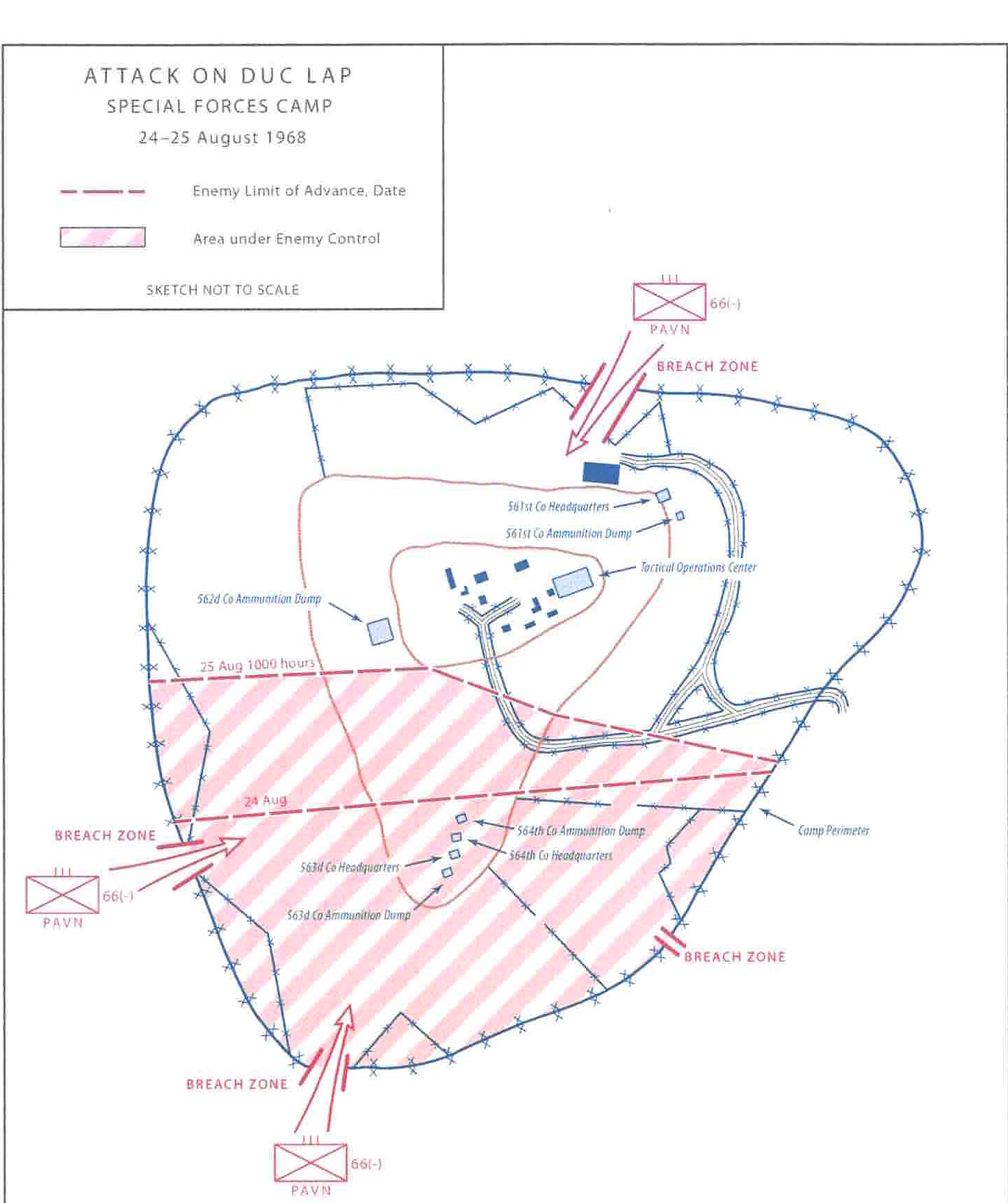
Duc Lap, August 1968. On the night of August 23–24 North Vietnamese regiments broke into the camp at Duc Lap, in Mnong country near the Cambodian border, and by the second morning they held nearly half of it. Mike Force companies were flown in and fought their way through. Neither the official histories nor the standard summaries say which of our peoples held the camp or who died there.

Ben Het, 1969. Ben Het, near the triborder in Sedang, Jeh and Halang country, was attacked by North Vietnamese tanks on March 3, 1969, in one of the few tank battles of the war, and was besieged again in May and June. On May 24 the Australian Keith Payne won the Victoria Cross bringing forty lost soldiers of his Dega Mike Force company back through the dark; that story is on Mike Force, SOG and the special operations war.
Bu Prang, late 1969. Kelly’s history gives the siege of Bu Prang, in Mnong country on the Cambodian border, one clause: it “had undergone a 45 day siege at the end of 1969” and was rebuilt entirely underground. When the Americans went into Cambodia in 1970, he adds, “handling refugees became the major task in II Corps camps. Refugee villages were established near Bu Prang and Duc Lap.” That is the Army’s whole account of the refugees. It gives no number and names no village.
Dak Seang, April 1970. Kelly: “Dak Seang was taken under siege at 0645 on 1 April.” The camp, in Sedang and Jeh country north of Dak To, was held by its strike force for more than a month. The 1st Battalion of the 2nd Mobile Strike Force, our men from Pleiku, fought for a week to reach it, and lost over a third of its four hundred men killed or wounded doing it.
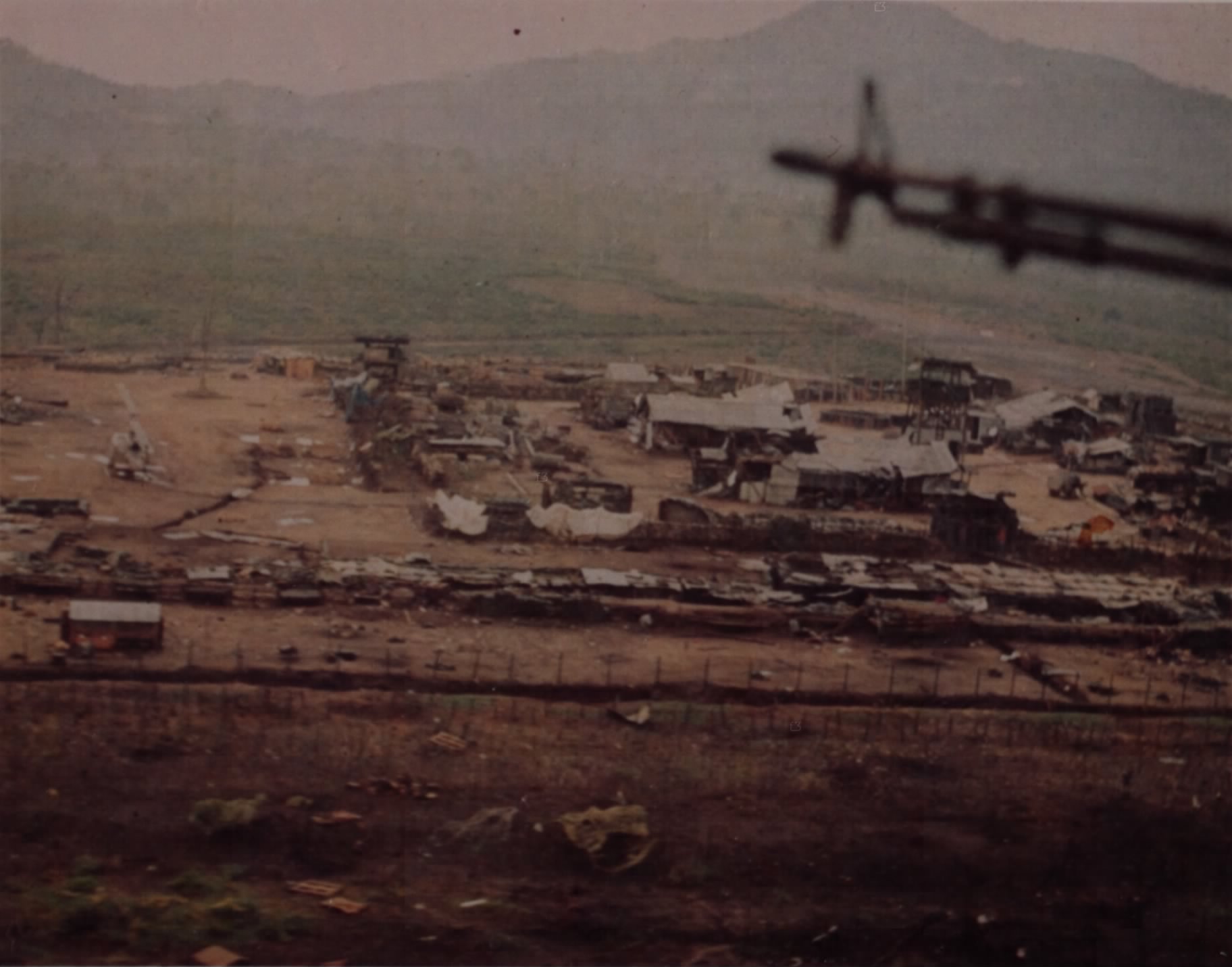

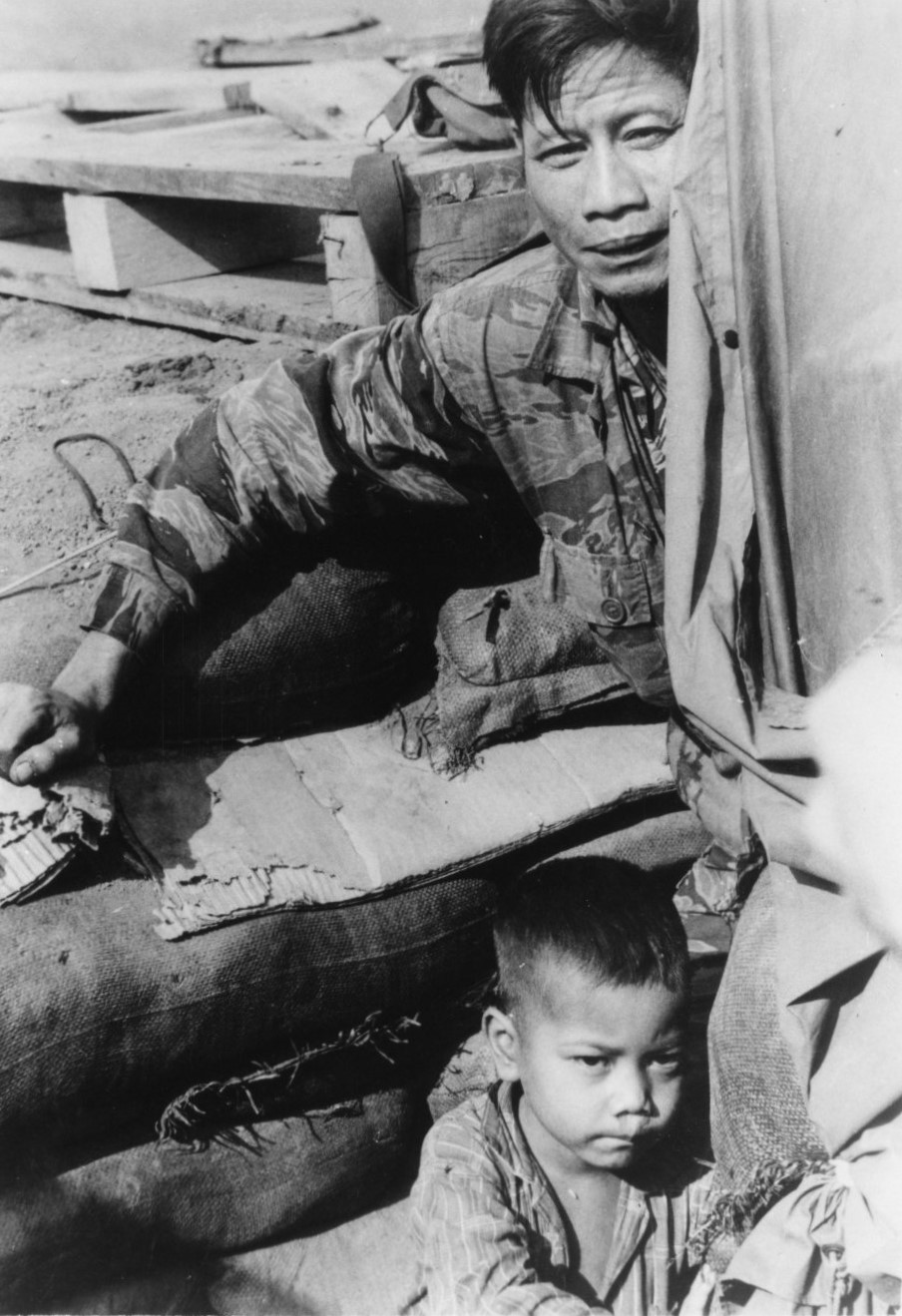

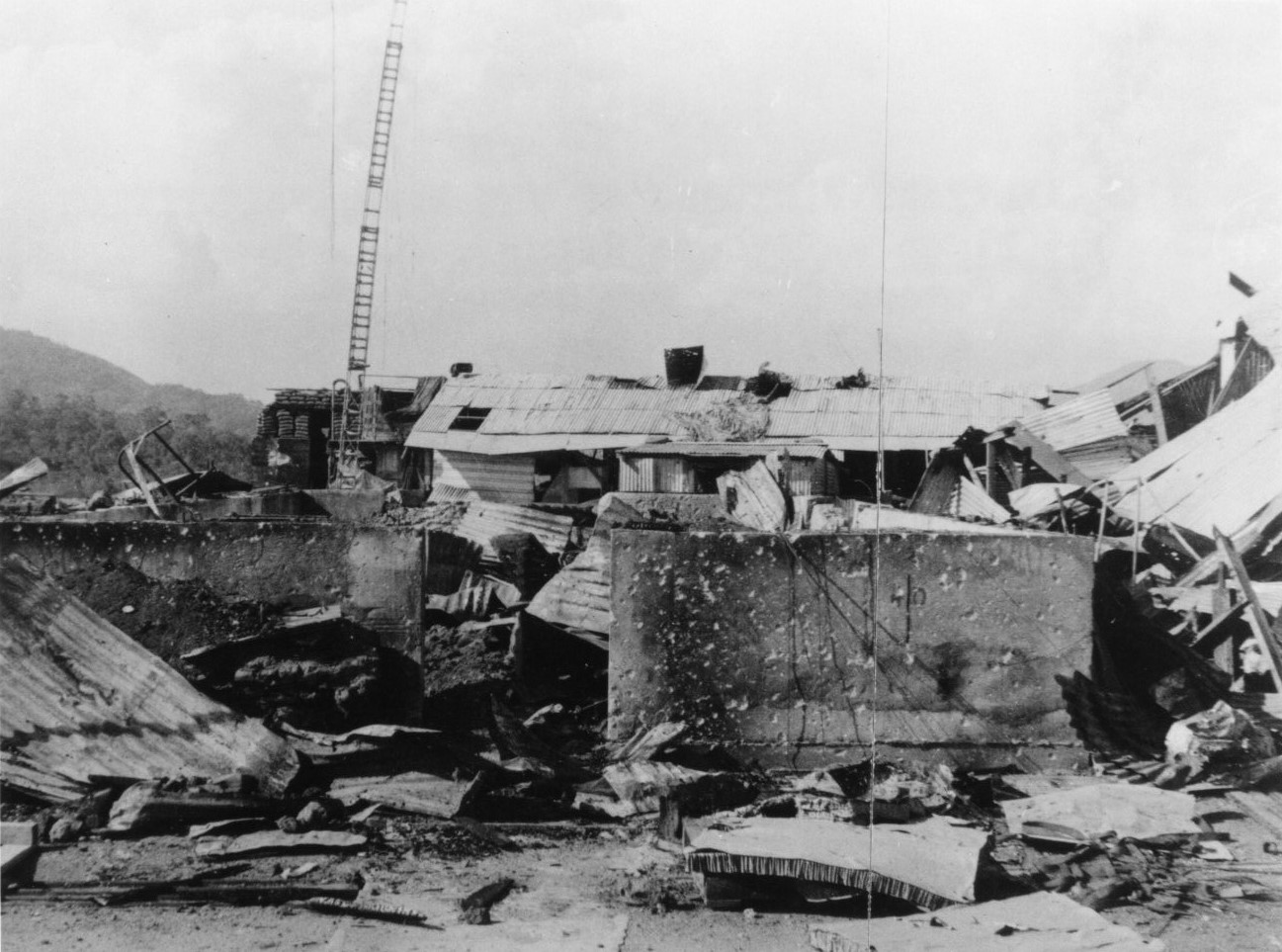

Dak Pek, April 1970. Twelve days after Dak Seang was attacked, Kelly writes, “the enemy turned his siege tactics on Camp Dak Pek,” in Jeh country to the north. “While the camp was almost completely destroyed, enemy losses were extremely high.” The camp’s own losses, and its families’, are not given.
Kon Tum, 1972
By 1972 the Americans had gone home and the camps had become South Vietnamese Ranger camps, still manned largely by our men. In April the North Vietnamese came across the border with tanks. Tan Canh fell on April 24 and Dak To the next day, and the divisions moved on Kon Tum.
The city was ours before it was anyone else’s, and the American press knew it. The US forces’ newspaper, Stars and Stripes, reported on April 30 that Kon Tum’s population of 30,000 “is mostly Montagnards.” The reporter then interviewed two Vietnamese men about whether to flee, and no one else.
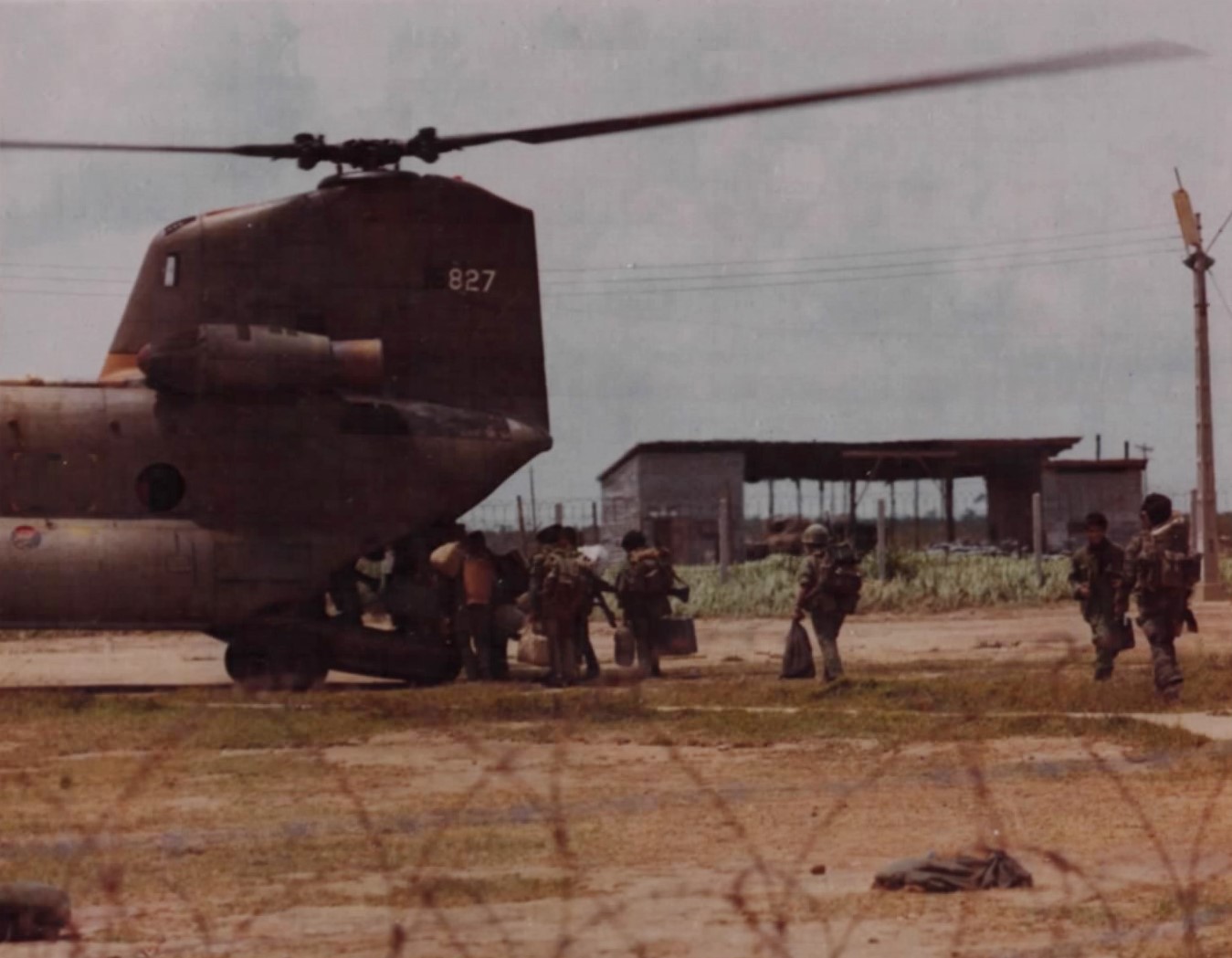

The Chinooks. The road south to Pleiku was cut. Four days later the same reporter wrote:
“Thirty per cent of the 30,000 Montagnards in this threatened provincial capital have been evacuated… Only women, children and very old men are being evacuated… Chinooks bearing up to 60 to 70 persons at a time have been making continuous dawn-to-dusk lifts.”
That is about nine thousand of our people flown out in a few days. The men stayed. The next day’s report told of an American adviser who drove a truck into a village to take out the family of one Montagnard soldier: “The whole village wanted to go. Many already had their meager possessions packed.” The adviser told his interpreters, “Tell them I’d like to take them all out.” He could not.
Minh Quy. When the American doctor who ran the Minh Quy hospital was evacuated at the beginning of May, she handed the hospital over to Sister Gabriel, “her most experienced Montagnard nurse.” At the end of the month the Associated Press reported that the hospital “was jammed with about 200 Montagnard civilians who had been wounded,” and that about 500 civilians were still there when the North Vietnamese took the area. It is the only count of wounded highland civilians in the battle for Kon Tum that we have found.
The 71st Rangers at Ben Het. Out at the border camps our men were fighting tanks. Stars and Stripes reported on May 13 that eleven tanks had been destroyed “in and around the beleaguered Montagnard Border Ranger camp” at Ben Het that week. On May 7, according to the history of the battle kept by the American veteran John Heslin, the Dega 71st Ranger Battalion at Ben Het rose against its own command:
“They shot one of their commanders and seized several Vietnamese officers as hostages. They threatened to shoot them all unless aircraft were made available the next day to transport them to Pleiku so that they could spend some time with their families.”
Their families were in Pleiku, or among the refugees. Two days later the camp at Polei Kleng was abandoned: “Approximately 350 defenders (including some of their dependents) moved out of the camp to the south, leaving an unknown number of wounded behind.” In the same weeks, the same history says, a group of Dega villagers fed and hid the crew of an American helicopter shot down near Dak To and gave them an old radio, with which they called for rescue. “Although these Montagnards had been essential to the survival of Lea and the others, it was impossible to airlift everyone involved out of the area at that time.” Heslin’s site does not give its sources for these passages, and we have not seen the originals.
Kon Hring. On May 12 the Associated Press reported from Pleiku that two French priests who had stayed with their congregations at “Kon Horing,” the Bahnar and Sedang Catholic village of Kon Hring northwest of Kon Tum, had been crucified. The report came from the American adviser John Paul Vann, who did not name his sources or the priests. We have not been able to confirm it, or to learn what happened to the people of Kon Hring. The archive of the Paris Foreign Missions and the diocese of Kon Tum may know.
Kon Tum held; it was declared secure on June 9, and Vann was killed in a helicopter crash that night. The South Vietnamese general who commanded in the North, Ngô Quang Trưởng, later wrote the official monograph of the campaign for the US Army. His whole account of our people in the battle for Kon Tum is one sentence: “Refugees stranded in Kontum City were evacuated by increments to Pleiku for safety and better care.” In the whole monograph the word Montagnard appears once, in a passage of geography about the Di Linh plateau, “Almost always a Montagnard area,” which, he says, “rarely attracted the interest of Vietnamese lowlanders.”
Buon Ma Thuot, March 1975
On March 10, 1975, the North Vietnamese attacked Buon Ma Thuot, and the final offensive of the war began. Two things from those days belong on this page.
Buon Pa Lam. Our history records:
“March 11, 1975, the South Vietnamese Government’s Air Force bombed Buon Pa Lam, killing 125 Montagnards and wounding 210. The entire village was burned to the ground and Montagnard villagers were forced to flee from their homes suffering terribly with no clothing, blankets, food or medical help.”
We have found this in no American or South Vietnamese account. It is our record, and we keep it.
What FULRO did. Two accounts of the same days disagree. Human Rights Watch, relying on a journalist’s account from 2001, writes that “a FULRO faction that supported the NLF agreed not to alert Saigon that North Vietnamese tanks were approaching.” Michael Benge writes that North Vietnamese propaganda men under Y Bih Aleo asked both FULRO factions to stand down, that “only the rogue unit led by Nay Guh agreed,” and that after the town fell “the execution of Montagnards in both FULRO elements began.” We cannot settle it. The retreat down Route 7B that followed, and everything after, is told on 1975, and what came after; Y Bih Aleo on Highlanders on the other side.
The battles at a glance
| When | Where, and whose country | Our men | What the record says of our people |
|---|---|---|---|
| Oct 1965 | Plei Me; Jarai | 300 to more than 400 strikers, mostly Jarai | A patrol fired on first; about 14 strikers killed (source not traced); the village’s dead not counted |
| Nov 1965 | Ia Drang and Chu Pong; Jarai | “a Mr. Nik,” interpreter | The Jarai stayed when the Vietnamese fled; no hamlet named; 47 hamlets moved in 1967 |
| Mar 1967 | Lang Vei village; Bru | — | 112 or 135 killed and 213 wounded by American bombs |
| May 1967 | Lang Vei camp; Bru | the camp’s strike force | 17 killed, 35 wounded, 38 missing |
| Nov 1967 | Dak To; Sedang | CIDG platoons with each American company; a Mike Force company at Hill 875 | One village named; no civilian counted |
| Dec 1967 | Dak Son; Stieng | — | 252 killed by the Viet Cong |
| Jan–Feb 1968 | Tet in the highland towns, and Huế | the strike forces held the towns | “thousands” killed; 82 students executed at Huế (our history) |
| Feb 1968 | Lang Vei camp; Bru | Bru companies; Hre Mike Force | “CIDG records were cursory”; the survivors kept outside the gate at Khe Sanh |
| Aug 1968 | Duc Lap; Mnong | the camp’s strikers; Mike Force | Not recorded |
| 1969 | Ben Het and Bu Prang | strikers and Mike Force | Refugee villages near Bu Prang; no number |
| Apr–May 1970 | Dak Seang and Dak Pek; Sedang and Jeh | the camps’ strikers; a Mike Force battalion | A third of the relieving battalion killed or wounded |
| Apr–Jun 1972 | Kon Tum, Ben Het, Polei Kleng | the Border Rangers | About 9,000 flown out; 200 wounded civilians in one hospital |
| Mar 1975 | Buon Ma Thuot and Buon Pa Lam; Rhade | FULRO, divided | 125 killed at Buon Pa Lam by the South’s air force (our history) |
What the counts leave out
Every history on this page counts sorties, tons and the enemy’s dead. None counts ours. The only overall figures come from people who knew the highlands, and they are far apart:
| Who | Our dead | Our people driven out |
|---|---|---|
| Gerald Hickey, the American anthropologist, as Human Rights Watch reported him in 2002 | at least 200,000 | more than 85 percent of the population forced from their villages |
| Michael Benge, former American aid officer and prisoner of the Viet Cong, 2010 | 200,000 to 220,000, including about half the adult men | about 85 percent of the villages in ruins or abandoned |
| Rong Nay, before the US Senate, March 10, 1998 | more than a million | 85 percent of the villages destroyed or abandoned |
Hickey did his highland research under contract to RAND, paid for by the American military, and he was also the American who told the people paying him most plainly what the war was doing to us. Rong Nay was a Dega witness speaking for his people before the Senate of the United States. Nobody counted village by village, and until somebody does, the distance between those figures is the measure of what the histories left out.
What we do not know
The Jarai villages of the Ia Drang and the Chu Pong in 1965: their names and what happened to them. The Jarai elders of the districts along the border, and our veterans who served at Plei Me and Duc Co, can tell us.
Mr. Nik: his full name, his people and his fate.
The strikers who died at Plei Me, Duc Lap, Dak Seang and Dak Pek, and which of our peoples held each camp.
The Sedang villages around Dak To in 1967 and 1972, and the Bru dead of Lang Vei.
The 71st Rangers at Ben Het: who they were, and what happened to them after May 1972.
Sister Gabriel: her own name and people.
Kon Hring in May 1972: what happened to its priests and its people.
Buon Pa Lam: the names of the 125.
If your village was bombed, burned, moved or fought over during any of these battles, please tell us what you remember. See How to record an elder.
See also: The American years, Mike Force, SOG and the special operations war, Tet 1968 in the highlands, Highland refugees of the war years, How we died.
Sources
- Capt. Melvin F. Porter, The Siege at Plei Me, Project CHECO report (US Air Force, Pacific Air Forces, 1966), at the Internet Archive — the Air Force’s study of its own part: the Jarai village, the garrison, the sorties and the bombs
- John M. Carland, Stemming the Tide, May 1965 to October 1966 (US Army Center of Military History, 2000), at the Internet Archive — the Army’s official history: Plei Me, the Chu Pong and the B-52 strikes
- HQ 1st Cavalry Division, Lessons Learned: The Pleiku Campaign (March 1966), at the Internet Archive — the paragraph on the people of the battlefield
- John A. Cash, John Albright and Allan W. Sandstrum, Seven Firefights in Vietnam (Office of the Chief of Military History, 1970), chapters 1 and 5 — Mr. Nik at the Ia Drang; the Montagnard platoons at Dak To
- HQ 4th Infantry Division, Operational Report – Lessons Learned, 1 May–31 July 1967 — the 47 hamlets moved to Edap Enang
- Gary L. Telfer, Lane Rogers and V. Keith Fleming Jr., U.S. Marines in Vietnam: Fighting the North Vietnamese, 1967 (US Marine Corps, 1984), at the Internet Archive — the bombing of Lang Vei village; and Jack Shulimson and others, U.S. Marines in Vietnam: The Defining Year, 1968 (1997), at the Internet Archive — the crowd at the gate of Khe Sanh
- Charles H. Briscoe, “The Battle of Lang Vei: An Operational Analysis”, Veritas (US Army Special Operations Command History Office, 2019)
- Col. Francis J. Kelly, U.S. Army Special Forces 1961–1971, Vietnam Studies (Department of the Army, 1973), at the Internet Archive — Lang Vei in 1967, the Tet verdict, Bu Prang, Dak Seang and Dak Pek
- “Battle of Dak To”, Wikipedia — the American casualty figures, Hill 875 and the Mike Force company
- Mike Medley, “The Road to Plei Me”, 9th Infantry Division veterans’ site — the orphans of 1965
- Rong Nay, “Summary of Montagnard History” — our own history: Tet 1968, the students at Huế, the night assaults of 1968 and Buon Pa Lam
- Pacific Stars and Stripes and the Associated Press, April–June 1972, as collected by John G. Heslin at The Battle of Kontum, with his narrative of the border camps — Kon Tum’s people, the Chinooks, Minh Quy and the 71st Rangers
- Ngô Quang Trưởng, The Easter Offensive of 1972, Indochina Monographs (US Army Center of Military History, 1980), at the Internet Archive
- Human Rights Watch, Repression of Montagnards (2002), chapter III — Hickey’s figures and the FULRO faction of 1975
- Michael D. Benge, “The History of the Involvement of the Montagnards” (2010) — an advocate and a witness: FULRO at Tet and in 1975, and his figures for the dead
- US Senate, Committee on Foreign Relations, The Plight of the Montagnards, March 10, 1998 — the testimony of Rong Nay
- Gerald C. Hickey, Free in the Forest (Yale, 1982) and Shattered World (University of Pennsylvania Press, 1993); Dale Andradé, America’s Last Vietnam Battle (Kansas, 2001); Harold G. Moore and Joseph L. Galloway, We Were Soldiers Once… and Young (1992) — the longer accounts, not read in full for this page
Compiled September 2026. The quotations on this page were checked word for word against the texts they come from, except where we say we have not seen the original. Where the tellers disagree we give each figure with its teller. We would like to replace the silences on this page with names.