























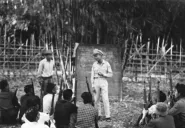
The American field force that held the highlands wrote its own verdict on Tet four pages after it counted the dead: “Heaviest attacks were launched initially” at “the highlands population centers of Kontum and Ban Me Thuot.” The first and hardest blows of the 1968 offensive in the whole of II Corps fell on two of our market towns. Then the same report counted the cost for all twelve provinces together — 814 civilians killed, 2,919 wounded, 97,101 made homeless — without naming a town or a people. The heaviest fighting was ours. The ledger had no column for us.

Four towns, twelve days
| Town | Dates | Who attacked | Enemy dead claimed |
|---|---|---|---|
| Kontum | from January 30; the city quiet by February 4 | three battalions of the 24th North Vietnamese Regiment, the 304th local-force battalion and the 406th Sapper Battalion | 1,039 |
| Ban Me Thuot | January 30 to February 6 | three battalions of the 33d North Vietnamese Regiment, the E301 battalion, and up to five provincial local-force companies | 919 |
| Pleiku | January 30 to February 4 | the B-15 local-force battalion, with units already inside the city | 632 |
| Dalat | February 1 to 11 | the 186th main-force battalion reinforced by part of the 145th | 208, in twelve days of fighting |
These are the figures the US command claimed at the time, and we give them only as the record states them. The number that matters more is the one it did not record: how many of our people were killed in those streets, and how many lost their houses. Nobody counted.
Kontum: the heaviest fighting of the offensive
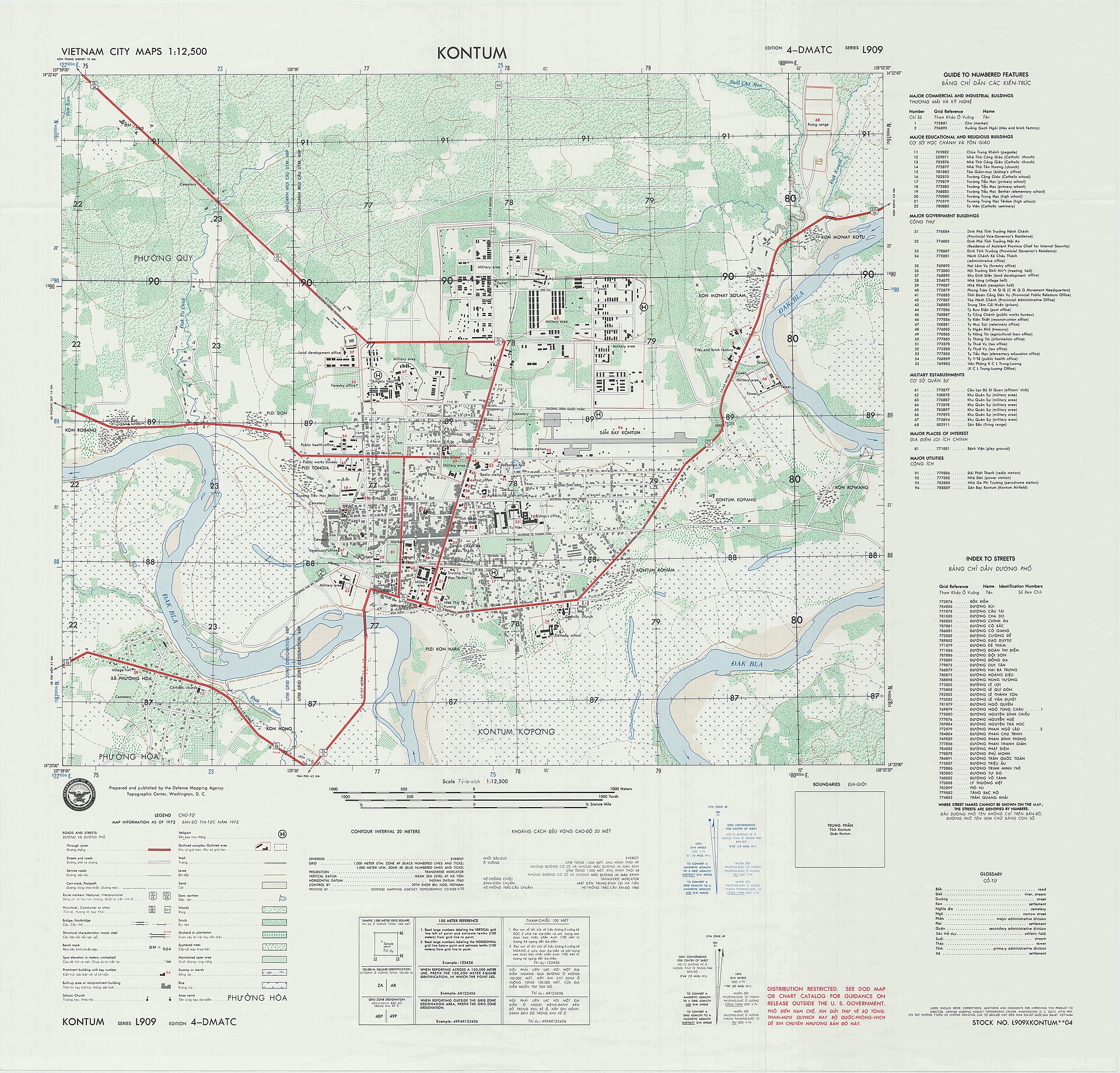
Kontum was struck early on January 30. The attackers went for the American compound, the post office, the finance office, the province chief’s headquarters, the airfield and the sector headquarters, and some of the heaviest fighting of the entire Tet offensive, by the field force’s own assessment, happened around the American compound. The prisoner interrogation center and a church were destroyed.
The first assault was met by two Montagnard Scout companies, two Civilian Irregular Defense Group companies, a South Vietnamese infantry battalion and the territorial forces. By noon it was clear that more was needed, and American armor and cavalry were formed into a task force and moved into the city; South Vietnamese reinforcements came in with two more scout companies. By February 3 and 4 the resistance had gone light and the fighting stopped.
Our men were in the streets first and the relief came later. Kontum also produced the highest body count of the four towns — higher than Ban Me Thuot, which is the battle everyone remembers.
The sapper battalion that hit the city had been living three kilometers south of the highland hamlet of Kon Gun. It was moved closer to Kontum in the days before Tet by a warning of a B-52 strike that was deliberately false — sent to shift the battalion into position. The headquarters that ordered the highland attacks, the B-3 Front, sat in the southwest of Kontum province, taking its orders from the south and passing them down. Both of them were inside our country, using it.
Ban Me Thuot
The attack began on January 30 and ended on February 6. The targets were the divisional headquarters, the American compound, both airfields, the province chief’s house, the South Vietnamese military compound, the training center and the province bank. Two churches, the missionary buildings and a leprosarium were destroyed. The first attacks were met by the territorial companies and platoons doing their ordinary night security; by noon the reconnaissance company, the armored cavalry and three battalions were in contact; the rangers came in on February 1, American paratroopers from Pleiku on February 2, and the search and clearance finished on the 6th. On February 4 a Popular Force company and Mike Force Company 27 joined the cordon and search.
On February 2, with the fighting still on, the CIA reported that all parts of the town had been badly damaged by mortars and rockets, that the enemy meant to renew the attack in force and hold the city, and that two North Vietnamese regiments had been identified. Two weeks later its economic assessment named Ban Me Thuot and Dalat as the two hardest-hit provincial capitals in II Corps, with more than 20,000 and 13,000 refugees. Of Ban Me Thuot it added that the situation was serious, “as the water supply is running low.”
By March most of the provincial government had stopped working.
Y Hin Nie, that night
He was Rhade, the adopted son of the missionary Carolyn Griswold, and he was sleeping at a friend’s house when the explosion came. He went back to the compound and found the house down. What he did next he has described himself:
“I come to the house, and I call ‘Mom, mom, mom, where are you? Where are you?’ I climb up a little bit and I see the foot of her father.”
He worked through the day with neighbors and South Vietnamese soldiers to get her out. Leon Griswold, her father, who was there on vacation, had died instantly; Carolyn Griswold was mortally hurt and died later. Of that night Y Hin Nie says, “God keep me. If not, I already die that night.” He went on to seventeen years in the forest and then to a church in North Carolina, and of the Americans afterward he says only that he is not angry, but very sad that they forgot us.
Six American missionaries died at Ban Me Thuot in those days, and two more were carried off. Their names are on a memorial and in the church press of 1968. The Rhade son who dug two of them out of the rubble is not on it. Four young Rhade were found dead in a missionary house at the same compound; two of them were sisters. We do not have their names either. See Missions and doctors and Highland women in the war.
Pleiku: the training center was on the list
Pleiku was attacked early on January 30 and held until February 4. The key targets, as the field force listed them, were the sector headquarters, the American compound, the evacuation hospital, the prisoner-of-war camp, the two airfields, the province chief’s quarters — and the Montagnard Training Center. The school where our men were trained was a military objective from the first night of the offensive.
Two Mike Force companies, a Regional Force company and a Popular Force company reinforced the defense of the city; American engineers were lifted in to the southwest and attacked back into it alongside two more Mike Force companies. The city was secured by February 3. Twenty-five members of the political apparatus were reported killed and 160 suspects detained.
On the night of February 7 to 8, after the city was declared secure, the Montagnard Training Center was hit again with mortars and small arms: four killed, one wounded. That is the only casualty figure from the whole of Tet in the highlands that we have found which certainly counts our people and nobody else’s. Four.
Dalat, and Tan Canh
Dalat was the last of the four to be struck and the longest to be cleared. The first attack was met by a single Regional Force platoon, an armored car platoon and the sector headquarters staff. On February 4 three CIDG companies reinforced the hard-pressed regional forces; on the 5th a ranger battalion moved in; on the 8th the divisional commander took control of all forces in the city, and with a second ranger battalion he secured Dalat on February 11. Twelve days.
At Tan Canh, in Sedang and Bahnar country in Kontum province, a man who was inside the attacking force described it afterward. His battalion had two hundred and fifty fighters and he did not think the offensive would succeed. The base camp was three hours’ walk from the town. The pagoda was taken easily, being held by four or five men. The bridge, which mattered, was not destroyed, because the men carrying the explosives disappeared. By three in the afternoon on the first day of Tet his unit had been driven out of the town. The men, he said, generally considered the offensive a defeat.
What was asked of the villages
The demand on our villages came before the attacks and did not stop when they ended. In early December 1967, Viet Cong cadres came to Buon Co hamlet in Buon Ho district, Darlac, gathered the people and told them to get ready to help. The men would have to carry food and ammunition for the Army of Liberation when the time came, and to act as guides. The village was to save its rice for the soldiers and eat vegetables instead. A man could leave only by himself; his family stayed behind, in bond so to speak. They had been promised victory in 1964, in 1965, in 1966 and in 1967, and now total victory was coming by March 1968. Meanwhile aircraft came over every day and destroyed the crops and the houses, because the village was in a controlled area. In the report’s flat summary of what that leaves: “They raised food but could not eat it.”
Some villages said no. On January 31, one chief and six other men from four villages northeast of Pleiku reported that the Viet Cong had come and told them to go into Pleiku and loot the city. The chiefs and the villagers refused, in spite of a threat to come back the next night and burn the village. Elsewhere the direction was the same: send people into Pleiku, to cause congestion and confusion while the attack went in. Villagers at Dak Hot Kram caught a North Vietnamese soldier who stopped for food; villagers at Plei Blo told the Americans where an anti-tank mine was; the combined village of Plei Chi Teh volunteered thirty-four men to form a platoon and defend itself, and eighteen other hamlets asked about doing the same when they heard.
At Edap Enang, the resettlement center outside Pleiku, the pressure worked the other way. The center was the target of the largest propaganda effort in the province, aimed at persuading our villagers to go back to their villages in the forest, where they could be used as labor. Food, water and fuel there were inadequate because the program had never been carried out properly, and that was what the propaganda had to work with. By January 14, twenty-three of the forty-eight villages had left Edap Enang. The attacks and the threats during Tet drove more of them out.
In Phu Bon, more than 150 people were taken in one district, and over 700 came in to the Special Forces camp at Buon Blech for safety. The people carried off, the assessment said, would probably be used as porters.
Of Pleiku province as a whole, seven weeks after Tet: “Most of this rugged province is populated by montagnards and the countryside has been, and remains, generally under enemy control.”
Our cadre
The Truong Son teams were the highland Revolutionary Development cadre — our men, working in our hamlets. On February 4 nobody knew where they were: their situation was unknown because of the heavy fighting in Kontum, Pleiku and Darlac. In Darlac no word had reached the American advisers for five days; by February 6 only two of the province’s seven teams had any security at all, and at least three of its twenty-six teams had been overrun in early February. When the accounting was made in March, it produced the one comparative statement about highland losses anywhere in the record: “Initial reports suggest that casualties among the Truong Son teams in Kontum have been the heaviest cadre losses in II Corps.”
Heaviest in the corps, and never given a number. Morale was low, from losses of men and equipment including the weapons of some two hundred cadre. The eleven Kontum teams were eventually accounted for, in hamlets or on security duty in the towns, and were reluctant to go back out. See Mike Force and SOG and The American years.
The ledger
For the whole of II Corps — twelve provinces, highland and coastal together — the quarterly report set down: 814 civilians killed, 2,919 wounded, 97,101 homeless, 10,202 homes destroyed, 4,028 damaged. On the political side, 63 of the apparatus killed and “439 captured (however some were only suspects).”
Not one of those figures separates highlanders from Vietnamese, and not one is broken down by town. Ban Me Thuot in 1968 was a Rhade town with a Vietnamese quarter of shops and offices; Dalat was overwhelmingly Vietnamese with Koho villages around it. The 20,000 and the 13,000 refugees cannot be divided on any evidence we have found. The CIA said as much in February 1968, about its own numbers: “it is doubtful that the extent of injuries to civilians will ever be known.”
These are the only figures we have found that certainly count our people:
- Four killed and one wounded at the Montagnard Training Center, Pleiku, the night of February 7 to 8.
- The heaviest cadre losses in II Corps among the Truong Son teams in Kontum — unquantified.
- Three of Darlac’s twenty-six teams overrun in early February.
- Twenty-three of the forty-eight villages gone from Edap Enang by January 14, and more after.
- More than 700 people sheltering at the Buon Blech camp, and more than 150 taken.
- About 3,000 highland refugees generated in Darlac between August and October 1968.
That is the whole of it. Everything else about what Tet did to our people is inside a number that also counts somebody else.
What our own chronology says about Huế
Our own chronology records that the Vietnamese communists used highland villages as shields for their assault on the towns and that thousands of our people were killed, and that at Huế the troops executed 82 highland students living in a boarding school of the ministry for ethnic minorities. The standard accounts of Huế do not mention highlanders, but those accounts were written by people counting a Vietnamese city’s dead, and a boarding school of highland students is exactly the kind of thing they would not have counted separately. The chronology dates the attacks to January 26, where the American records put them on January 30 and after. If anyone knows the school, or a family that lost a son or daughter there, we want to hear from them.
The year that followed
Tet did not end the demand. About 3,000 highland refugees were generated in Darlac in the autumn of 1968 by increased activity; an attempt to move about eighty of us from one district of Khánh Hòa to another failed outright, and within two weeks every one of them had walked back. The lesson the army drew from that was to consult the hamlet leaders first, “especially Montagnards,” before proposing to move anyone.
The rebuilding that is documented is military and administrative: a ministry boarding school and its buildings started in Lac Thien district, Darlac, to become a Montagnard Training Center by January 1, 1969; a new dining hall and more living quarters at the highland boarding school; a bridge at Quang Nhieu village built by a South Vietnamese battalion; emergency repairs to the road between Ban Me Thuot and Khanh Duong; revetments and an ammunition supply point at the Ban Me Thuot airfield. We have found no account of the rebuilding of the burned quarters of Buon Ma Thuot as such, and no map of which quarters burned.
The politics moved in the same months. In August 1968, a South Vietnamese delegation came to Buon Ma Thuot to negotiate with FULRO under a safe conduct from the prime minister; by December 11 an agreement had been reached to recognize minority rights, create a ministry for them, and let Y Bham Enuol remain permanently in the country. On December 30, Les Kosem took Camp le Rolland at the head of Cambodian troops and Y Bham Enuol was placed under effective house arrest. On February 1, 1969, a final treaty was signed by Paul Nur for Saigon and Y Dhon Adrong for FULRO. See FULRO, Y Bham Enuol in Phnom Penh and Paul Nur and Nay Luett.
Also in the same weeks
Eight weeks before Tet, on December 5, 1967, the village of Dak Son was burned with flamethrowers (see Dak Son, 1967).
What is missing
No source we have found counts the highland civilians killed, wounded or made homeless in the four towns as distinct from the Vietnamese. No highland CIDG camp is recorded as attacked or overrun during Tet itself; the camps appear in the record as places our soldiers were taken from and as places our people ran to. We have found no account of Tet at Kontum, Pleiku or Dalat by anyone of our people — every Dega voice we have is from Buon Ma Thuot. We have found no highland woman named in any account of these weeks. Gerald Hickey, who was in Buon Ma Thuot from January 27 and through the attack, wrote about it in a book we could not read.
If your family lived in or near one of these towns in 1968, we would like to hear what happened, in your words. See How to record an elder.
See also: Battles on our land, Highland refugees of the war, Four highland towns.
Sources
- I Field Force Vietnam, Operational Report – Lessons Learned, period ending April 30, 1968 — DTIC AD0392589. The city-by-city narrative at pp. 15–18, the zone summary at p. 50, and the accounting at p. 18. This is where the “highlands population centers” sentence, the four towns’ dates, units and claimed enemy dead, the Montagnard Scout and CIDG companies at Kontum, the Montagnard Training Center on the Pleiku target list, the leprosarium and churches at Ban Me Thuot, the twelve days at Dalat, and the II Corps civilian totals all come from. We read them against the scanned pages; the report’s optical character recognition is poor and we have transcribed the figures rather than the typing
- I Field Force Vietnam, Operational Report – Lessons Learned, period ending October 31, 1968 — DTIC AD0500666. The 3,000 highland refugees in Darlac, the failed resettlement in Khánh Hòa and the walk back, the instruction to consult hamlet leaders, and the 1968 building at the ministry boarding school
- US 4th Infantry Division, Operational Report – Lessons Learned, November 1, 1967 to January 31, 1968 — the report. The four villages that refused to loot Pleiku (p. 23), Edap Enang and the twenty-three villages of forty-eight (p. 4), and Plei Chi Teh’s thirty-four volunteers (p. 20)
- CIA, Pacification in the Wake of the Tet Offensive in South Vietnam, March 19, 1968 — the document. The heaviest cadre losses in II Corps, the three Darlac teams overrun, the 700 at Buon Blech and the 150 taken in Thuan Man district, the porters, and the judgment on Pleiku province
- CIA, Effect of the Viet Cong TET Offensive on the GVN Pacification Program, February 7, 1968 — the document. The four killed and one wounded at the Montagnard Training Center, and the Truong Son teams whose situation was unknown
- CIA, The Effects of the Tet Offensive on the Economy of South Vietnam as of 15 February 1968 — the document. Ban Me Thuot and Dalat as the two hardest-hit II Corps capitals, the 20,000 and 13,000 refugees, the water running low, and the admission that the extent of injuries to civilians will never be known
- CIA, II Corps situation report, 1545 hours, February 2, 1968 — the document. All parts of Ban Me Thuot badly damaged, the intention to hold the city, and the two regiments identified
- CIA field report, Montagnard Disenchantment with the Viet Cong in Darlac Province, March 13, 1968 — the document. Buon Co hamlet, what the village was told to do and to save, the family kept in bond, the aircraft overhead, and the sentence about raising food they could not eat
- CIA, Comment to the Tet Offensive and Indications of a Future Offensive, March 21, 1968 — the document. The attack on Tan Canh from inside the attacking battalion
- CIA, Prior Warning of Suspected B-52 Strike in Kontum Province, February 26, 1968 — the document — the 406th Sapper Battalion at Kon Gun and the false warning that moved it; and Location and Description of “B.3” Headquarters, May 3, 1968 — the document
- “A Space for Montagnards: A Cultural Refuge in Greensboro,” Redefining Home — the project pages at ibiblio. Y Hin Nie’s own words about the night of January 30, 1968, and about what came after
- Our own chronology, “History” — the 82 students at Huế, the 1968 negotiations, and the date of January 26
Compiled September 2026. Enemy casualty figures are those claimed by the US command at the time. Where the sources disagree about which units attacked Ban Me Thuot, or about the dates the missionaries died, we have kept the disagreement rather than choosing.